The chicks walk and feed themselves soon after hatching, but the adults tend them for almost 30 days
Lifespan
Record of 18 years and 10 months in the wild according to EURING (a bird ringed in Great Britain and Ireland); AnAge gives 13 years
Conservation status
LC
NT
VU
EN
CR
EW
EX
Global (IUCN)
Least Concern
Spain
Least Concern (LC) as a winter visitor and breeder in the Red List of Birds of Spain; on the List of Wild Species under Special Protection, but not in the Spanish Catalogue of Threatened Species
When to see it
Summer visitor
Months of the year when it is present
J
F
M
A
M
J
J
A
S
O
N
D
In Iberia
no
no
yes
yes
yes
yes
yes
yes
yes
yes
no
no
Breeding season
no
no
no
yes
yes
yes
yes
yes
yes
no
no
no
Song or voice of the Little Ringed Plover
In flight it calls with a fairly slow, rhythmic «críiiio-críiiio», and its alarm is a hard, rapid «priu-priu-priu» that it repeats non-stop. The song, which it gives by day and by night, is a quick «pri-pri-pri-pri». The recording is from Extremadura; we have joined two sections to remove the songs of other birds heard in between.
CallLittle Ringed Plover
0:00 / 0:13
10 kHz5
The sonogram draws the sound: time runs from left to right, and the higher a trace sits, the higher the note.Recording by Tanguy Loïs, xeno-canto XC1143443 (Sierra de Fuentes, Cáceres) (CC BY-SA 4.0).
Flight of the Little Ringed Plover
It is a wader of quick movements, and in flight it gives its slow, rhythmic call, «críiiio-críiiio».
Flight typeWith quick movements and a slow, rhythmic call in flight
It breeds mainly on riverbanks with pebbles and stones, and has adapted well to new habitats such as gravel pits.
In flight it lets out a rather slow, rhythmic «críiiio-críiiio».
With its short bill it picks insects and other small invertebrates from just below the wet surface of shores, islets and mudflats.
Photo gallery of the Little Ringed Plover
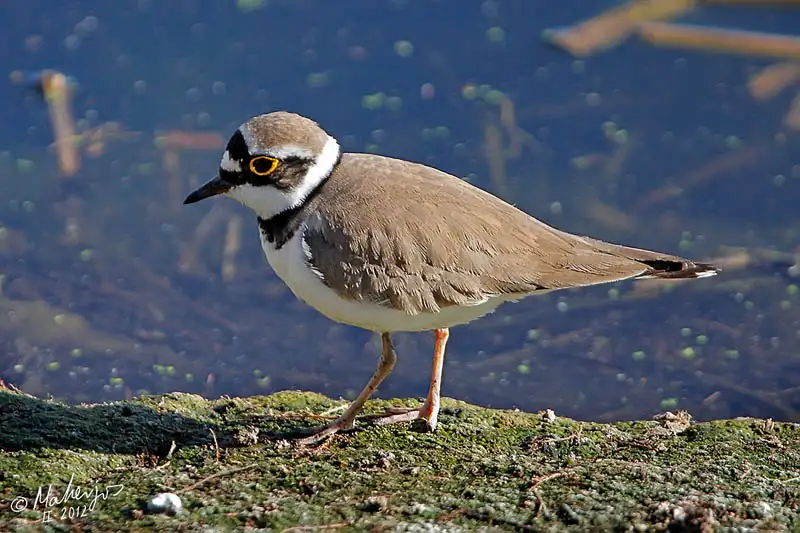
Little Ringed Plover in profile on a mossy shore, with the yellow ring around the eye, the black forehead bar and the black collarPhoto: Maherjos, CC BY-SA 4.0Photo 1 of 4
Little Ringed Plover at the edge of a pond, reflected in the water, with black collar and white bellyPhoto: José Prego from Moura, Portugal, CC BY 2.0Photo 2 of 4
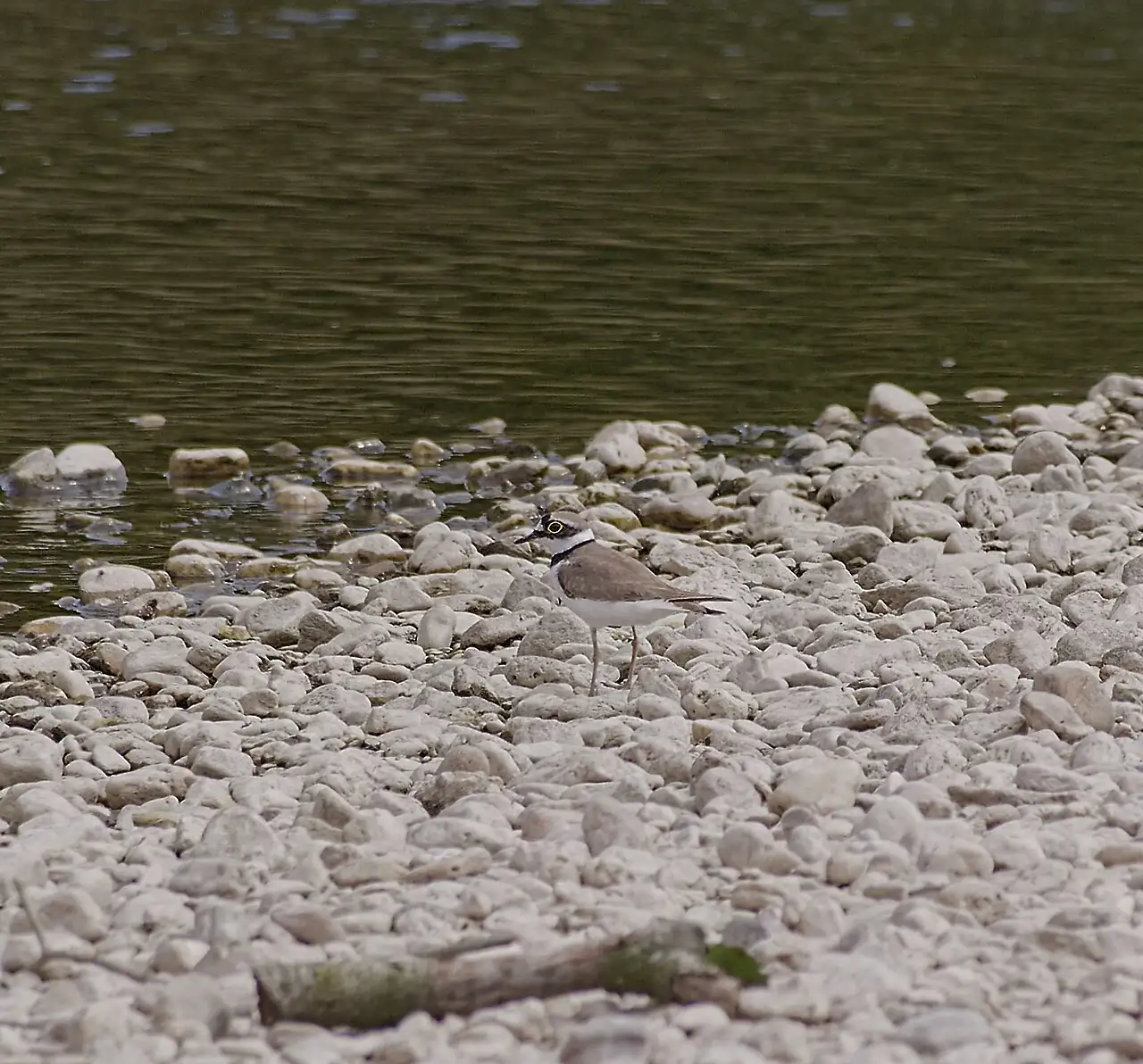
Little Ringed Plover almost camouflaged among the pebbles of a river shorePhoto: Andreas Eichler, CC BY-SA 4.0Photo 3 of 4
Little Ringed Plover on a mudflat with puddles and algae, looking for foodPhoto: Аимаина хикари, CC0Photo 4 of 4
1 / 4
Identification of the Little Ringed Plover
It is a small wader, with quick movements and a bulky head, with a very short bill and legs somewhat longer than the width of the body. The male in breeding plumage has a greyish-brown crown, separated from the also greyish back by a white and black double collar, completely closed in front. On the head it wears a characteristic pattern: white forehead and a black forehead bar separated from the crown by a thin white band. The eye-ring, like the legs, is yellow. The female resembles him, but with the black of the head duller.
Adult
White and black double collar, closed in front.
White forehead, black forehead bar and yellow eye-ring.
Outside the breeding season, almost all the black turns brown.
Young bird
Like the non-breeding adult, but with the upper feathers edged with pale buff.
The collar is dark and does not close completely.
Habitat and distribution of the Little Ringed Plover
It is a species of wide European and Asian distribution that breeds in temperate and Mediterranean zones and winters in West Africa. Several subspecies are known; in Spain «curonicus» breeds, which spreads across much of the Palaearctic.
It appears in all regions, with notable populations in Andalusia, Castilla-La Mancha, Castilla y León, Aragón and Catalonia, and also breeds in the Balearics, the Canaries and Melilla. Outside the breeding season it concentrates much more in the middle basins of the Tagus and Ebro, the Albufera of Valencia, the lower Guadalquivir and Doñana, Fuerteventura, Castilla-La Mancha and Extremadura.
It breeds mainly on river shores with pebbles and stones, and has adapted well to new habitats created by people, such as gravel pits. Outside the breeding season it is seen both on muddy inland shores and on the coast.
The Spanish population is mainly a summer visitor, and most winter in West Africa, although some birds stay at sites in the south. On passage many European birds are also seen, above all through the interior of the Peninsula.
Areas where it is regularly recorded since 2010Squares of about 25 km where it is recorded regularly (occasional passage records are left out). Data from GBIF.org (3,410 records, retrieved October 2026); outline from Natural Earth.
Etymology of the Little Ringed Plover
According to Wikipedia, Scopoli described it in 1786, and the epithet «dubius» is Latin and means «doubtful» or «uncertain», because the French naturalist Pierre Sonnerat thought it might be a mere variant of the Common Ringed Plover. In other languages it is called «corriol anellat petit» in Catalan, «píllara areeira» in Galician, «txirritxo txikia» in Basque and «little ringed plover» in English1.
Population of the Little Ringed Plover
In the 2021 European Red List of Birds the European breeding population is estimated at between 425,000 and 634,000 mature individuals, with a decreasing trend. In Spain 33,050 pairs are estimated, although with a wide confidence interval, with a minimum of 4,000. The trend is unknown, because the increase in the latest estimates may be due to more complete censuses rather than a real increase.
Its main threat is the alteration and destruction of its habitat: reservoirs, river channelling, works on banks and water pollution. It is also affected by human disturbance and predation by foxes, wild boar and rats. Some interventions, such as dredging and gravel extraction, may temporarily favour its breeding.
Nest of the Little Ringed Plover
To breed it chooses open shores with pebbles or gravel beaches, backwaters and sandbanks on rivers and lakes. The nest is a shallow hollow lined with plant debris and small stones.
Courtship and breeding of the Little Ringed Plover
It usually breeds between April and September, above all in June. The female normally lays four pear-shaped eggs, extraordinarily cryptic with their pattern of spots and lines. Incubation lasts 24 or 25 days. The chicks move and feed themselves soon after hatching, but the adults tend them for the almost 30 days they take to complete their development.
Diet of the Little Ringed Plover
It eats mainly insects, such as beetles, flies, ants and crickets, and larvae of mayflies, dragonflies, butterflies and moths, as well as spiders and other small invertebrates. With its very short bill, it catches prey just below the damp surface of shores, islets and mudflats, and also in shallow water.
Curious facts about the Little Ringed Plover
It is one of the most characteristic species of the rivers, lagoons and gravel pits of the interior1. EURING lists a Little Ringed Plover ringed in Great Britain and Ireland that lived 18 years and 10 months, quite a bit more than AnAge gives (13 years).
The Little Ringed Plover in Cabañeros
The habitat pages of this website do not mention it, and we have not found any other published source on it in the Park. GBIF.org records 31 observations of the Little Ringed Plover in Cabañeros and its surroundings.
Where to see the Little Ringed Plover in Cabañeros
In Cabañeros and its surroundings, from March to October, on gravel and sand shores of rivers, reservoirs and ponds.
When
From March to October: it is a summer visitor, and breeds from April to September, above all in June.
What time
By day, on the shores.
Where
On river shores with pebbles, gravel pits, sandbanks and muddy shores.
What to look for
Look for the yellow eye-ring and the double collar; listen for its «críiiio» when it flies.






 Same family
 Same family
 Same family
 Same order
 Same order
 Same order
 Same season in the park
 Same season in the park






