Solitary and territorial in the breeding season; in autumn and winter it forms large nomadic flocks
Lifespan
Record of 7 years and 1 month in the wild (a bird ringed in Spain)
Conservation status
LC
NT
VU
EN
CR
EW
EX
Global (IUCN)
Least Concern
Spain
Near Threatened (NT) in the Red Book of the Birds of Spain; included in the List of Wild Species under Special Protection and not in the Spanish Catalogue of Threatened Species
When to see it
Resident
Months of the year when it is present
J
F
M
A
M
J
J
A
S
O
N
D
In Iberia
yes
yes
yes
yes
yes
yes
yes
yes
yes
yes
yes
yes
Breeding season
no
no
no
yes
yes
yes
no
no
no
no
no
no
Song or voice of the Calandra Lark
It is very like the Eurasian Skylark’s, although stronger, more complex and with harsher notes, «chirrrr». It consists of a continuous flow of short sequences, trills, whistles, warbles and varied imitations. The recording is from Sierra de Fuentes (Cáceres).
SongCalandra Lark
0:00 / 0:30
10 kHz5
The sonogram draws the sound: time runs from left to right, and the higher a trace sits, the higher the note.Recording by Tanguy Loïs, Wikimedia Commons (CC BY-SA 4.0).
Flight of the Calandra Lark
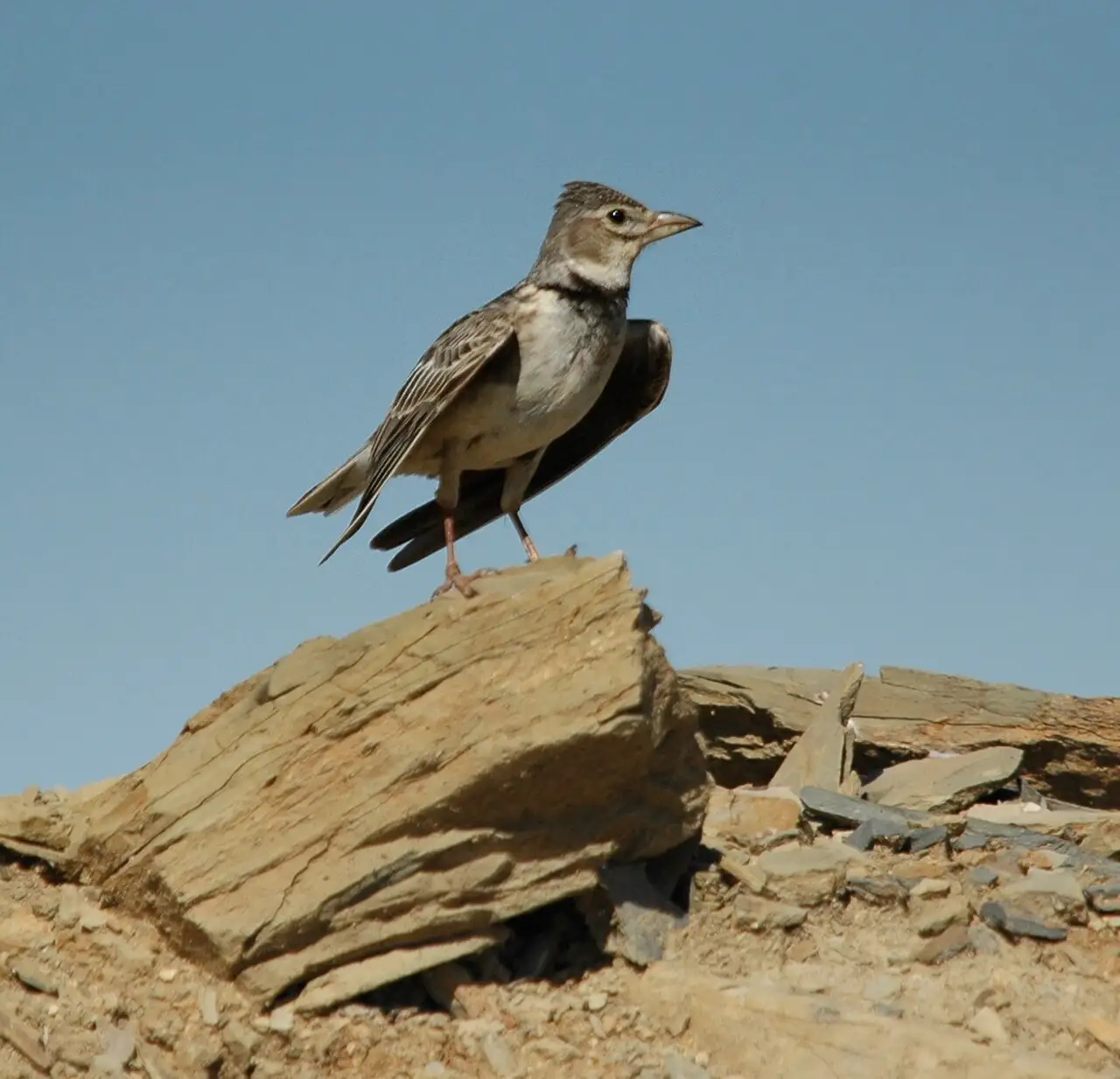
Its flight is powerful and with rapid wingbeats, and includes broad undulating paths and dizzying climbs. In flight the blackish underside of the wings is seen, with the white trailing edge.
Flight typePowerful, with big undulations and dizzying climbs
It takes off from among the grass and the cereal, with quick, powerful wingbeats.
Powerful flight, with quick beats of the wings, with wide, undulating paths and dizzying climbs. From below the blackish wings with the white trailing edge can be seen.
Drops down to the grass or stubble, where it walks and looks for invertebrates in the breeding season and for seeds, leaves and shoots in autumn and winter.
Photo gallery of the Calandra Lark
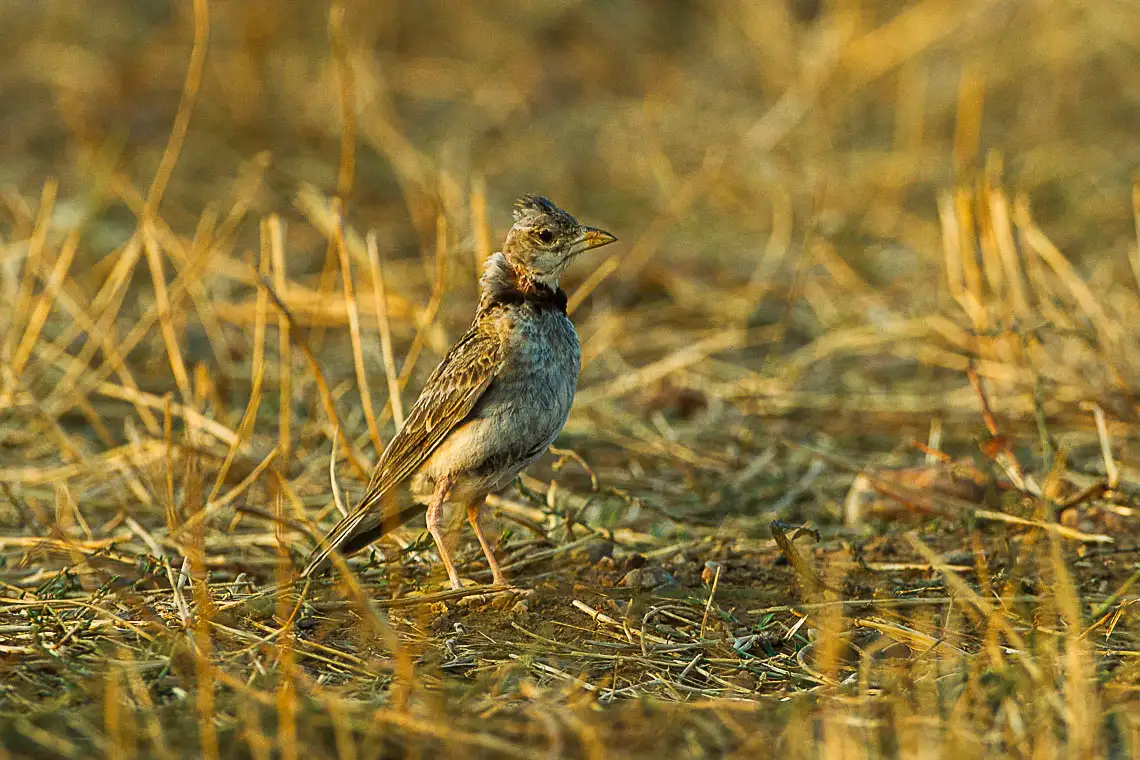
Calandra Lark among golden stubble, in profile, with the black patches on both sides of the neck and thick billPhoto: Francesco Veronesi from Italy, CC BY-SA 2.0Photo 1 of 4
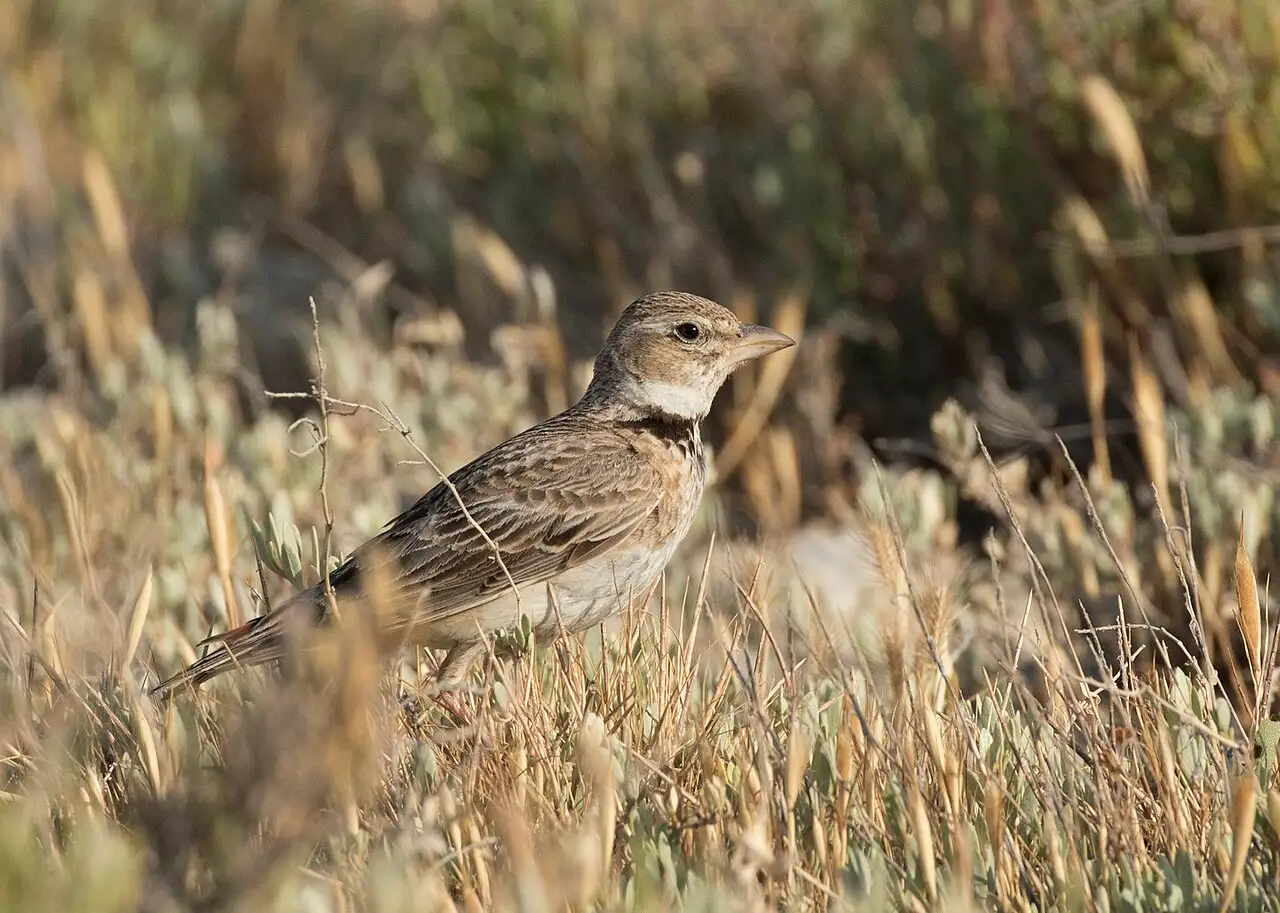
Calandra Lark in profile on dry grass, with the black neck patches and streaked backPhoto: Zeynel Cebeci, CC BY-SA 4.0Photo 3 of 4
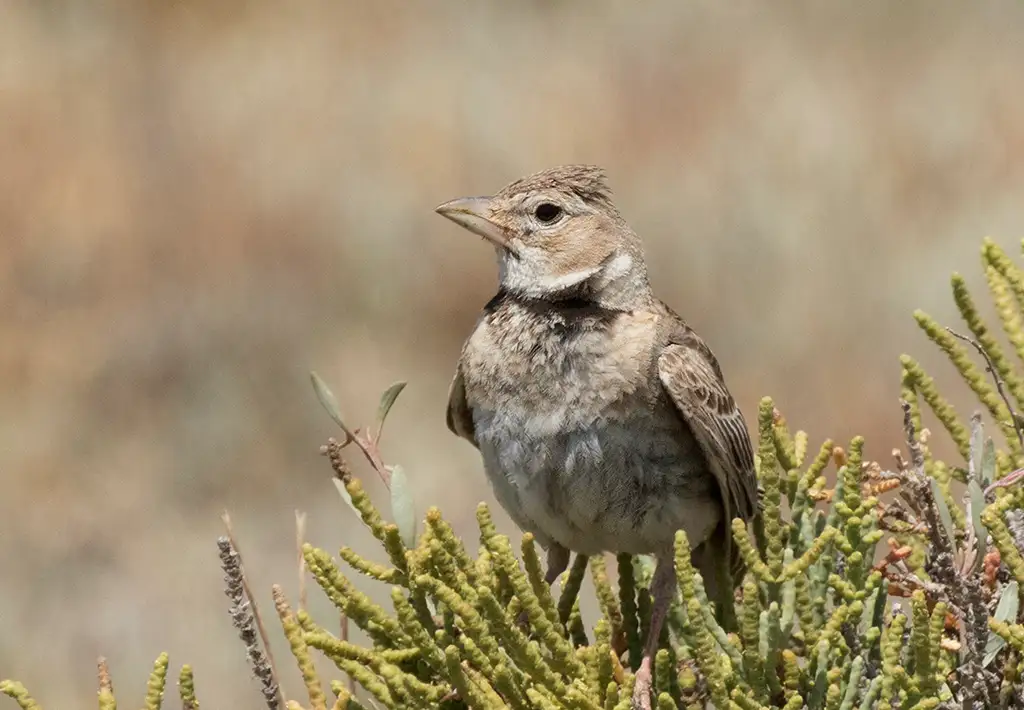
Calandra Lark perched on a bush, from the front, with big head, thick bill and the black neck patchPhoto: Zeynel Cebeci, CC BY-SA 4.0Photo 4 of 4
1 / 4
Identification of the Calandra Lark
It is a small bird but of sturdy appearance. As in other larks, brown tones dominate on the back and dark streaking. The big head, thick bill and black patches on both sides of the neck stand out. In flight the blackish underside of the wings is seen, with the white trailing edge.
Adult
Brown back streaked with dark.
Big head, thick bill and black patches on both sides of the neck.
Habitat and distribution of the Calandra Lark
It is distributed around the Mediterranean and the middle latitudes of eastern Europe and central Asia, as far as Turkestan. Its most important populations are on the Iberian Peninsula and in southern Russia. Three subspecies are recognised in Europe.
In Spain the subspecies «calandra» lives, spread across the interior of the Peninsula, above all the two plateaus, the Ebro valley, Extremadura and the Guadalquivir valley; it is rarer on the Mediterranean coastal strip and absent from the Cantabrian region, the main mountain systems, the Balearics and the Canaries. Tied to steppe environments, it prefers the great plains of extensive cereal cropping and, to a lesser extent, natural grassland, as long as they have plenty of herbaceous cover; it disappears where there is scrub or trees. In Spain it is resident, but in autumn and winter it forms large flocks of nomadic behaviour, and part of the population may go to winter in the south of the Peninsula and North Africa. The autumn passage is concentrated in September and October, and the pre-breeding one between February and March.
Areas where it is regularly recorded since 2010Squares of about 25 km where it is recorded regularly (occasional passage records are left out). Data from GBIF.org (33,530 records, retrieved October 2026); outline from Natural Earth.
Etymology of the Calandra Lark
«Melanocorypha» comes from the Greek «mélas», «black», and «kórydos», «lark»: «the black lark», from the neck patches. «Calandra» is the old name of these larks, from which the Spanish «calandria» comes.
Population of the Calandra Lark
In the 2021 European Red List of Birds the European breeding population is estimated at between 19.8 and 38.4 million mature individuals, with a decreasing trend. On the Peninsula it is very abundant, with a population of about 2,582,000 birds, but the trend is markedly downward: less than two decades ago it was estimated at between 6.79 and 10.35 million birds. The most important cores are in the cereal crops and grasslands of the northern Meseta, the Ebro valley, La Mancha and the Andalusian countryside. It is classed as Near Threatened in the Red Book of the Birds of Spain, and the main threats are the alteration of steppe environments by agricultural intensification (chemicals, short-cycle cereal, removal of fallows and wasteland, ploughing of stubble), the expansion of tree crops and the reforestation of marginal and farmland.
Nest of the Calandra Lark
It nests on the ground, among herbaceous vegetation. The nest is a hollow in the ground, lined with leaves and feathers.
Courtship and breeding of the Calandra Lark
The breeding season runs from April to June, and it may make two clutches a year. It is solitary and territorial when breeding. The clutch consists of three to six whitish eggs heavily speckled with reddish brown. Incubation lasts 16 days and is done by the female, although males sometimes help, and both parents care for the chicks for at least 10 days.
Diet of the Calandra Lark
In the breeding season it feeds on invertebrates, and in autumn and winter it depends on seeds, leaves and shoots of various herbaceous plants.
Curious facts about the Calandra Lark
It is abundant, but declining: the estimate of its population on the Peninsula has fallen to less than half in under twenty years. In winter it forms large nomadic flocks.
The Calandra Lark in Cabañeros
This website’s habitat pages list it, under the name «calandrina», in the grasslands of Cabañeros: in winter it is a seed- and plant-eater, like the Little Bustard, and forms very notable flocks.
Where to see the Calandra Lark in Cabañeros
On the rañas and grasslands of Cabañeros, above all in winter, when it forms flocks.
When
All year; in autumn and winter it moves in large flocks.
What time
Throughout the day.
Where
In the grasslands, rañas and cereal fields, with tall grass and no trees.
What to look for
A big, sturdy lark, with a thick bill and the black neck patches.
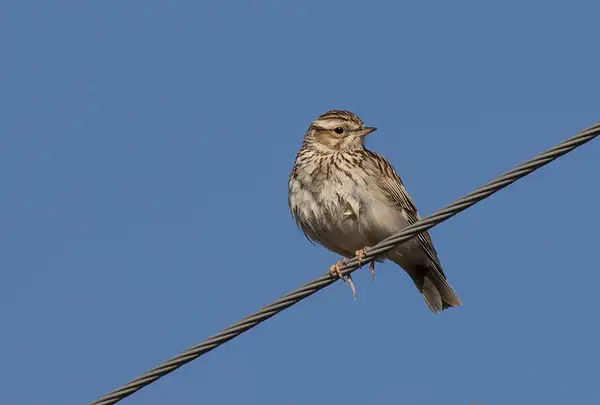
Smaller and more slender, with a short crest, a somewhat shorter bill and a heavily mottled breast, without the black patches on both sides of the neck. It prefers open scrub and dehesas.
Photo: Charles J. Sharp, CC BY-SA 4.0
Other birds
Birds related to the Calandra Lark or sharing its habitats in Cabañeros.



 Same family
 Same family
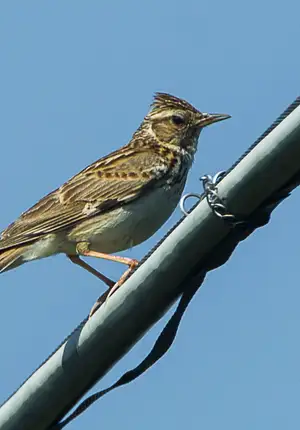 Same family
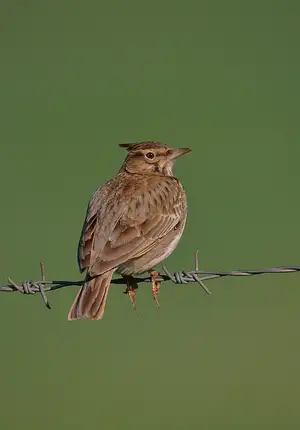 Same family
 Also in grasslands and rañas
 Also in grasslands and rañas
 Also in grasslands and rañas
 Also in grasslands and rañas





