It is usually monogamous in the breeding season (Wikipedia); in winter it forms flocks with other small insectivores of the grasslands (this website's habitat pages)
Lifespan
Record of 11 years and 5 months in the wild (a bird ringed in Germany and found dead)
Conservation status
LC
NT
VU
EN
CR
EW
EX
Global (IUCN)
Least Concern
Spain
Least Concern (LC) in the Red Book of the Birds of Spain; on the List of Wild Species under Special Protection, but not in the Spanish Catalogue of Threatened Species
When to see it
Resident
Months of the year when it is present
J
F
M
A
M
J
J
A
S
O
N
D
In Iberia
yes
yes
yes
yes
yes
yes
yes
yes
yes
yes
yes
yes
Breeding season
no
no
no
yes
yes
yes
yes
no
no
no
no
no
Song or voice of the Black Redstart
Characteristic and unmistakable, it is very loud and audible. It begins with some short whistles, some repeated notes, and continues with a peculiar, harsh, metallic rasp that ends with a hurried, rapid phrase.
SongBlack Redstart
0:00 / 0:25
10 kHz5
The sonogram draws the sound: time runs from left to right, and the higher a trace sits, the higher the note.Recording by Marie-Lan Taÿ Pamart, Wikimedia Commons (xeno-canto XC473244) (CC BY-SA 4.0).
Flight of the Black Redstart
Very ground-dwelling, it usually perches in an upright posture while flicking its red tail. It has a butterfly-like flight, with rapid wingbeats.
Flight typeButterfly-like, with rapid wingbeats
Very terrestrial, it leaves the stone, roof or wall where it perches upright, flicking its red tail.
It has a butterfly-like flight, with quick wingbeats. In the air the red rump and tail can be seen clearly.
It lands again on a rock face, a stone fence or a roof, dry, sunny environments.
Photo gallery of the Black Redstart
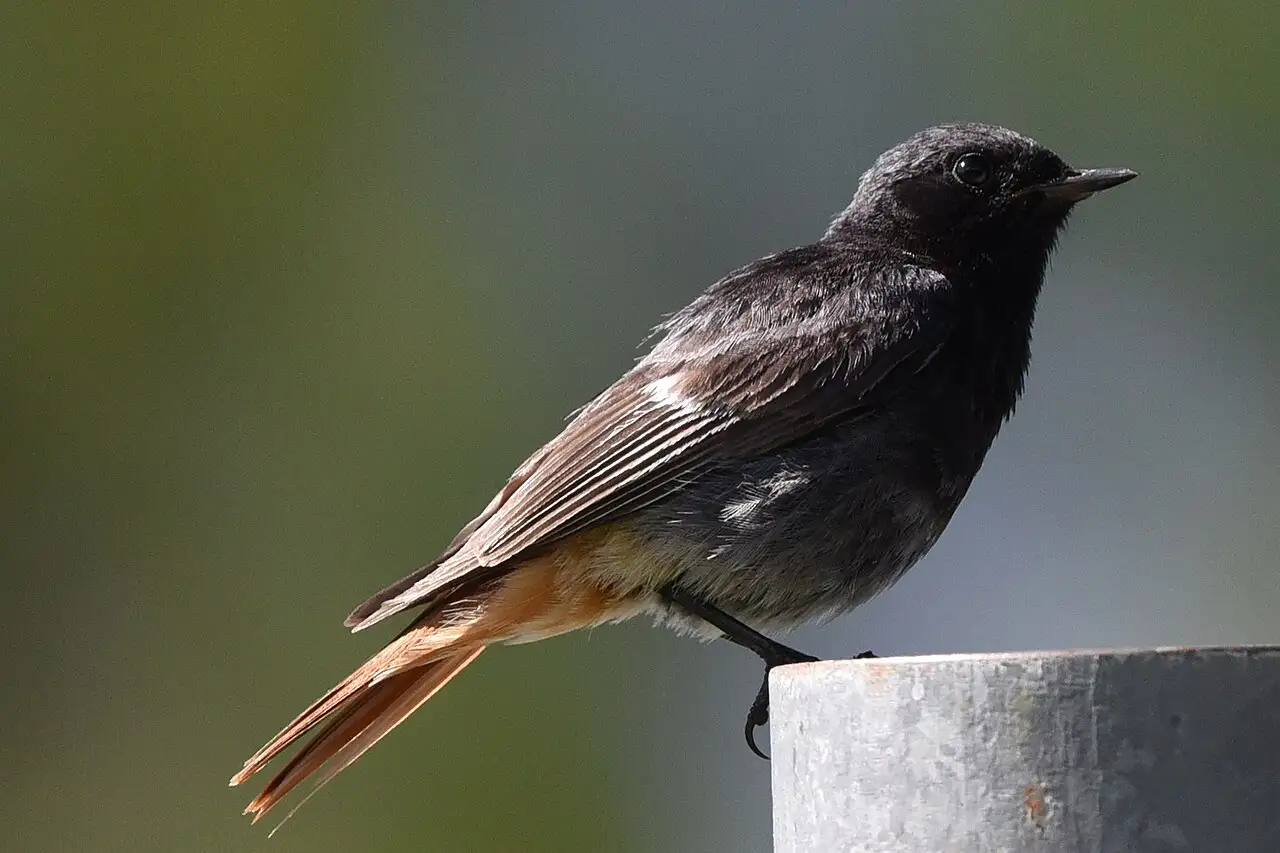
Male Black Redstart perched on a post, with almost black plumage, the white wing patch and orange-red tailPhoto: Pierre-Marie Epiney, CC BY-SA 2.0Photo 1 of 4
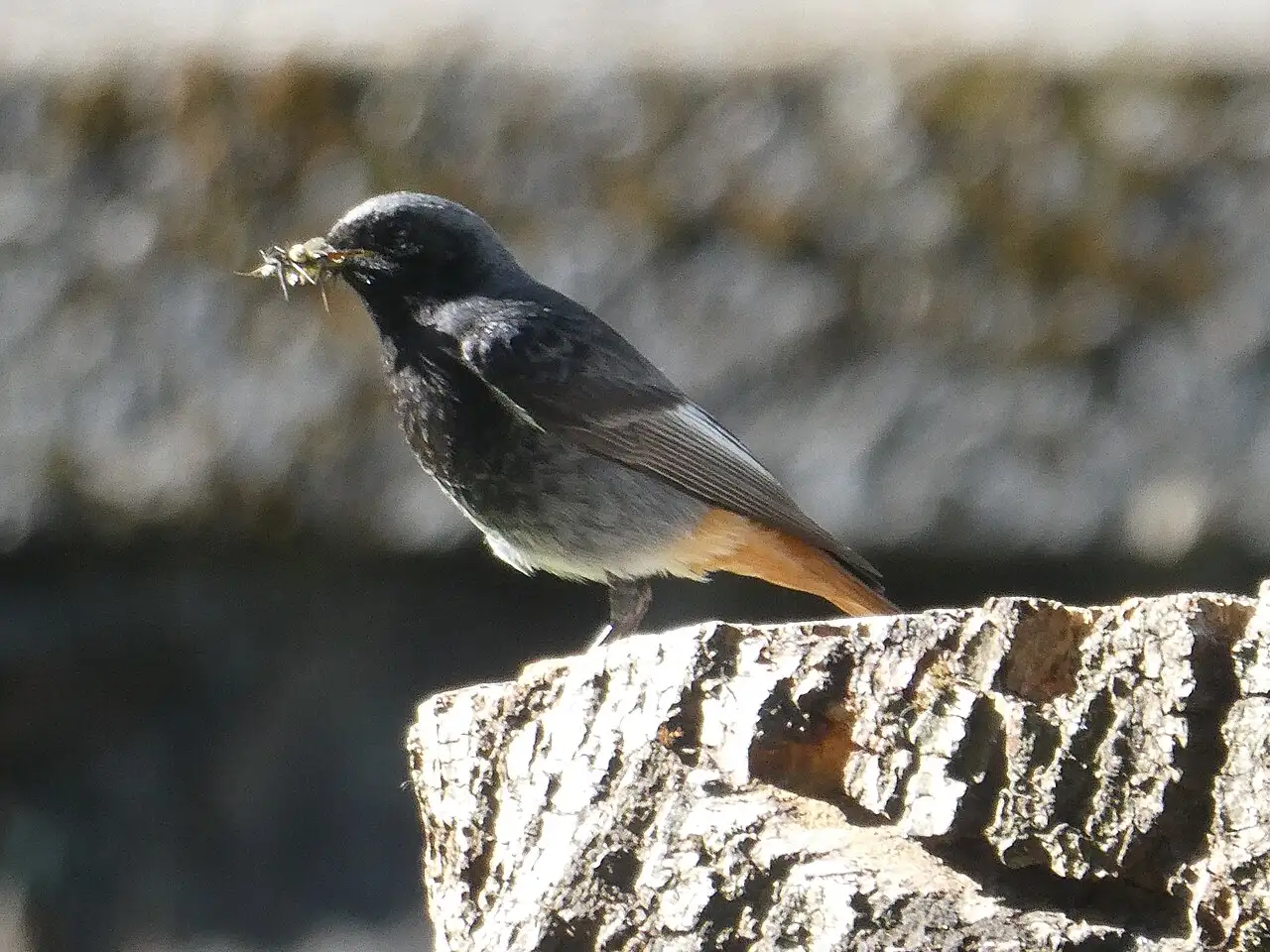
Black Redstart perched on a stone, with something in its bill and the reddish tail in viewPhoto: Jose Angel Urquia Goitia, CC BY-SA 4.0Photo 2 of 4
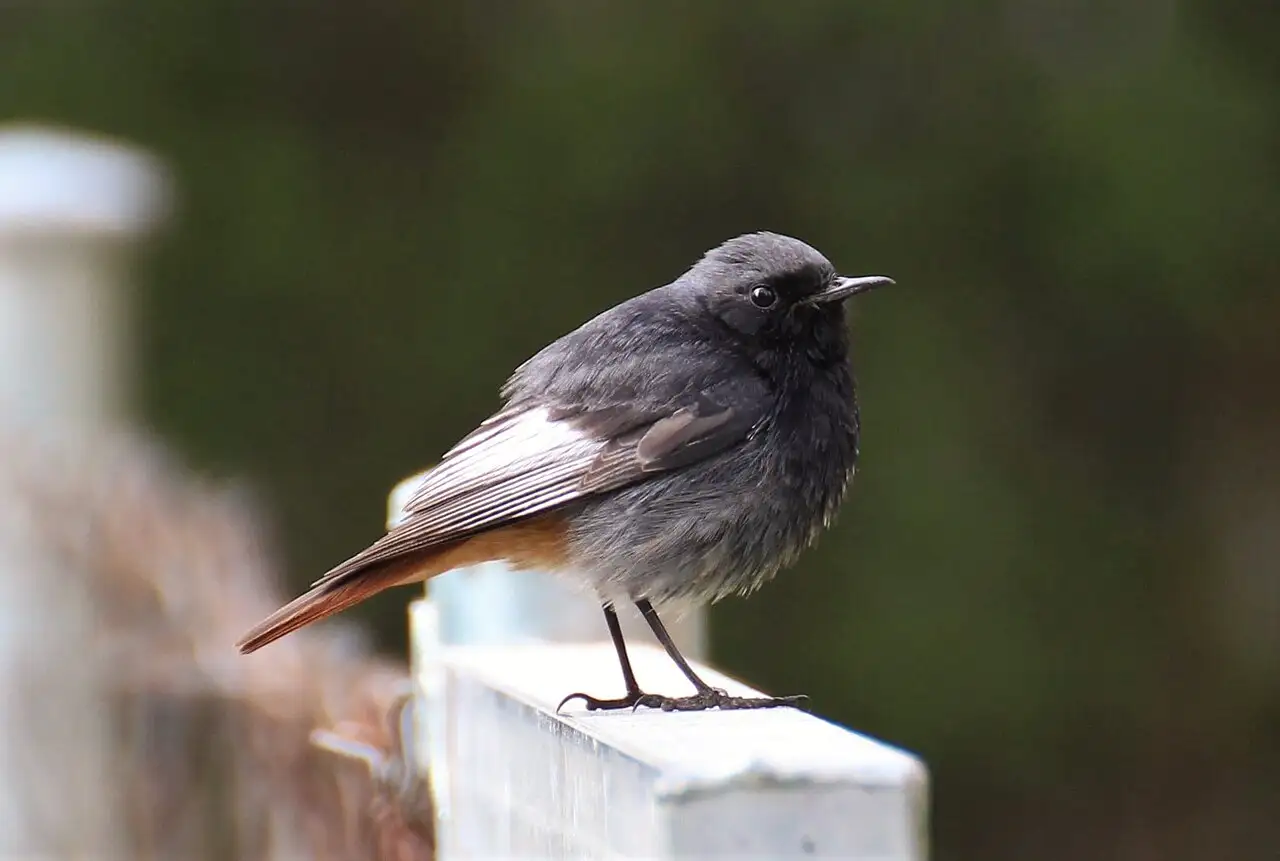
Male Black Redstart in profile on a white fence, with the white wing patch and reddish tailPhoto: Félix Hernández Pérez, CC BY-SA 4.0Photo 3 of 4
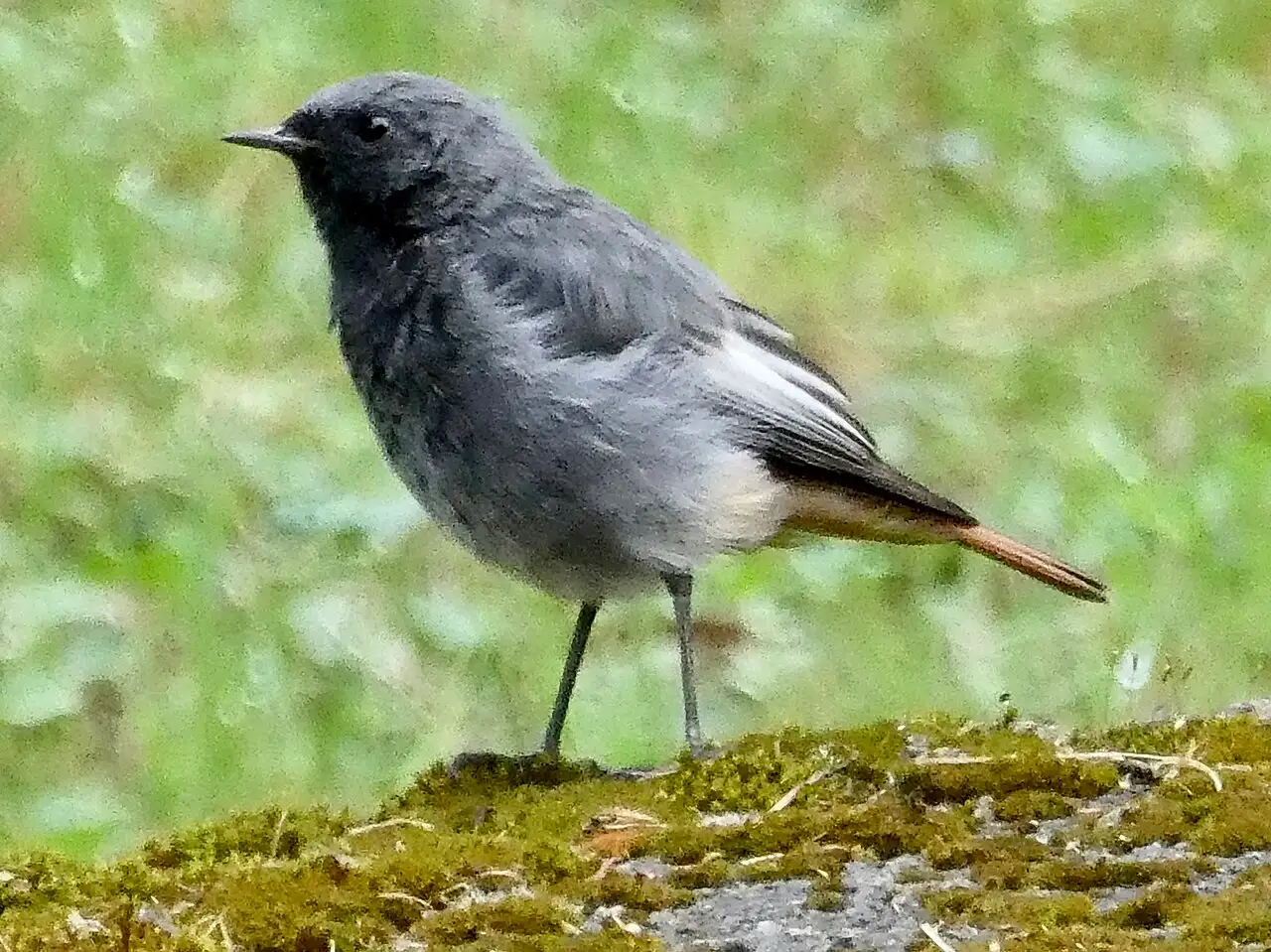
The Black Redstart is a small bird of peculiar pattern, with the rump and tail a characteristic red. The male has the breast and face jet black, and the rest of the body dark, with a white patch on the wings. Females and young birds are greyish brown. Very ground-dwelling, it usually perches in an upright posture while flicking its red tail.
Male
Breast and face jet black; rest of the body dark.
White patch on the wings.
Rump and tail red.
Female and young bird
Greyish brown, with red rump and tail.
Habitat and distribution of the Black Redstart
It has an extensive, continuous distribution across the middle latitudes of Europe, North Africa, the Near East and central Asia. Several subspecies are recognised, five of them recorded in Europe; in Spain there are «gibraltarensis», which occupies the northern third of the peninsula and has a grey back, and «aterrimus», restricted to the centre and south, with blacker tones.
It is continuously distributed across the whole northern half of Spain, where it is absent from the Ebro depression; in the southern half it is associated with mountain regions, and is absent from the Balearics and the Canaries. Its adaptation to breeding in humanised environments has favoured its expansion.
It is typically a rock-dweller and likes dry, sunny environments, with sparse vegetation and abundant crags. It is also common in urban areas and villages, where it frequents roofs, stone fences, quarries… It is present from sea level to the 3,300 metres of Sierra Nevada. The highest densities are recorded in deforested mountain areas, such as moors with broom thickets, junipers and gorse thickets, and in thinned pine woods with crags in the alpine zones of the Pyrenees.
Iberian populations are resident or partly migratory: in winter they move to localities in the south of the peninsula and descend in altitude. Those of central and northern Europe, markedly migratory, winter around the Mediterranean, including Iberia, and in North Africa. The pre-breeding passage is detected between February and April, and the post-breeding one in October and November.
Areas where it is regularly recorded since 2010Squares of about 25 km where it is recorded regularly (occasional passage records are left out). Data from GBIF.org (648,421 records, retrieved October 2026); outline from Natural Earth.
Etymology of the Black Redstart
According to Wikipedia, «Phoenicurus» comes from the ancient Greek «phoinix» («red») and «-ouros» («tail»), and «ochruros» from «okhros» («pale yellow») and «-ouros». The Spanish name «colirrojo» (red-tail) alludes to the colouring of its tail. In other languages it is called «cotxa fumada» in Catalan, «rabirrubio tizón» in Galician, «buztangorri iluna» in Basque and «black redstart» in English1.
Population of the Black Redstart
In the 2021 European Red List of Birds the European breeding population is estimated at between 13,100,000 and 21,300,000 mature individuals, with a stable trend. In Spain it is a common bird and 1,642,582 birds are estimated, with the most numerous populations in the north-west of the peninsula (León, Zamora, Lugo…). Its trends are positive, according to the SACRE programme over the last decade.
Its conservation status can be described today as good. Local threats have been described, such as the destruction of nesting sites in buildings and illegal trapping.
Nest of the Black Redstart
The nest consists of a small cup of twigs and leaves, lined with wisps of grass and moss, set in hollows or ledges of cliffs or walls.
Courtship and breeding of the Black Redstart
The breeding period runs from April to July and it can make two clutches a year. The clutch consists of two to eight small, whitish eggs, which the female incubates for 13–17 days. The chicks, fed by both parents, can fly at 12–19 days.
Diet of the Black Redstart
Its diet is based on small and medium-sized invertebrates and, to a lesser extent, seeds and berries.
Curious facts about the Black Redstart
It shows a certain degree of anthropophily: it occupies various kinds of human constructions in urban and rural settings. According to EURING, the ringed bird that lived longest, in Germany, reached 11 years and 5 months; AnAge gives 10.2 years.
The Black Redstart in Cabañeros
The habitat pages of this website list it in the grasslands: during winter it forms very notable flocks, like other small insectivorous species, among them the Meadow Pipit. GBIF.org records 164 observations of the Black Redstart in Cabañeros and its surroundings.
Where to see the Black Redstart in Cabañeros
In Cabañeros and its surroundings, above all in winter.
When
All year: it is resident or partly migratory, and in winter birds from other European countries arrive.
What time
In good light, in open, dry, stony terrain, and in grasslands in winter.
Where
On crags, rooftops, stone fences and quarries.
What to look for
Look for the red tail it flicks, the almost black male with his white wing patch and his harsh song.



 Same family
 Same family
 Same family
 Same family
 Also in grasslands and rañas
 Also in grasslands and rañas
 Also in grasslands and rañas
 Also in grasslands and rañas






