Solitary and territorial during breeding; both parents feed the chicks
Lifespan
Record of 11 years and 7 months in the wild (a bird ringed in Austria, found dead)
Conservation status
LC
NT
VU
EN
CR
EW
EX
Global (IUCN)
Least Concern
Spain
Least Concern (LC) in the Red Book of the Birds of Spain; included in the List of Wild Species under Special Protection and not in the Spanish Catalogue of Threatened Species
When to see it
Resident
Months of the year when it is present
J
F
M
A
M
J
J
A
S
O
N
D
In Iberia
yes
yes
yes
yes
yes
yes
yes
yes
yes
yes
yes
yes
Breeding season
no
no
yes
yes
yes
yes
yes
no
no
no
no
no
Song or voice of the Crested Lark
It is similar to the Thekla’s Lark’s: melodious, but more strident. It includes soft, long fluty sounds, short whistles and trills. The call, characteristic and easily recognised, is a «tuui-tii-tuu» that rises and falls in pitch.
SongCrested Lark
0:00 / 0:12
10 kHz5
The sonogram draws the sound: time runs from left to right, and the higher a trace sits, the higher the note.Recording by IBERIAN WILDLIFE, Wikimedia Commons (Vídeo de YouTube, con atribución).
Flight of the Crested Lark
In flight it shows broad wings and a short tail, the latter dark in the centre and buff at the edges.
Flight typeUndulating, with broad wings and a short tail
It is frequent in cereal crops, stubble fields, moors, fallows and even country tracks and suburban areas, where it takes off with its call, a «tuui-tii-tuu» that rises and falls in pitch.
In flight it shows broad wings and a short tail, dark in the centre and buff at the edges.
It nests on the ground, in a hollow lined with leaves and twigs, sometimes in the shelter of a shrub; in winter plant food dominates its diet.
Photo gallery of the Crested Lark
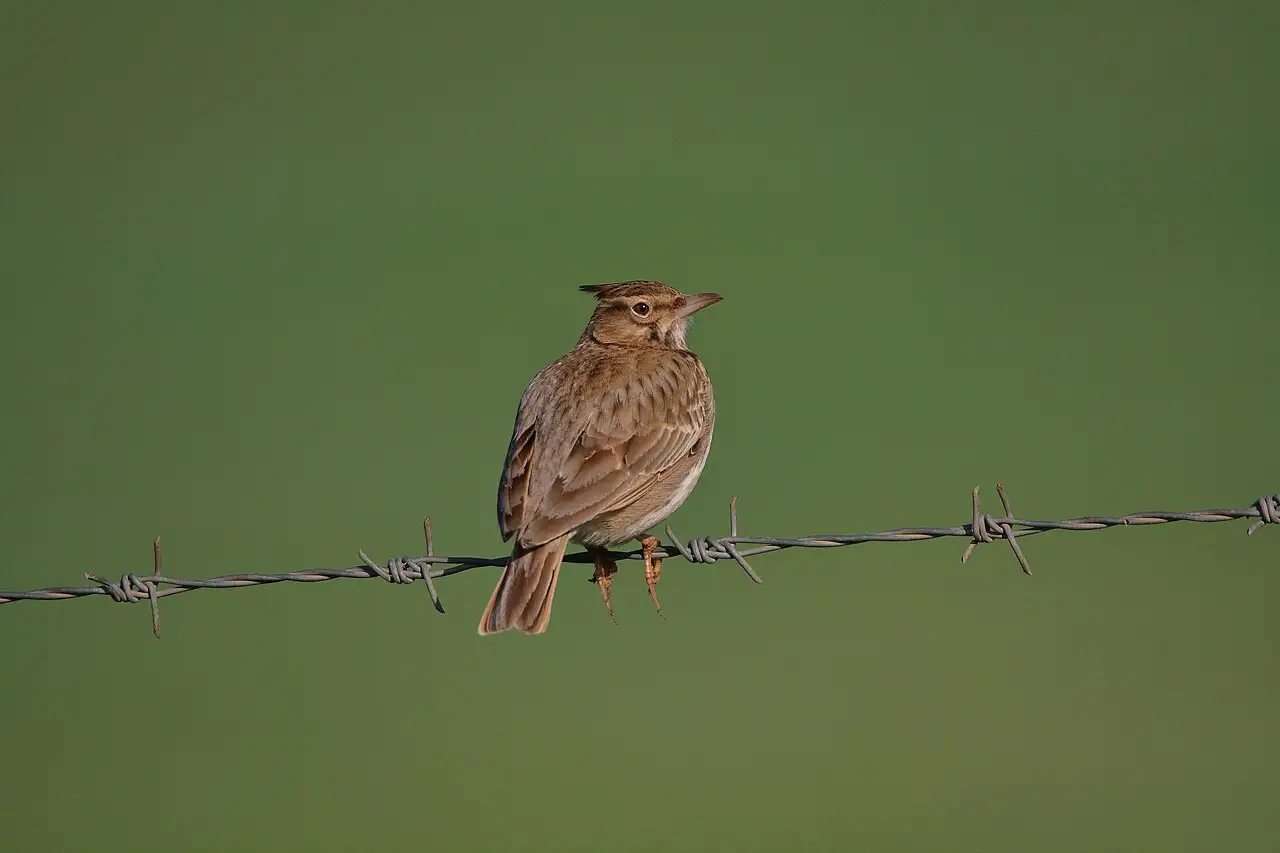
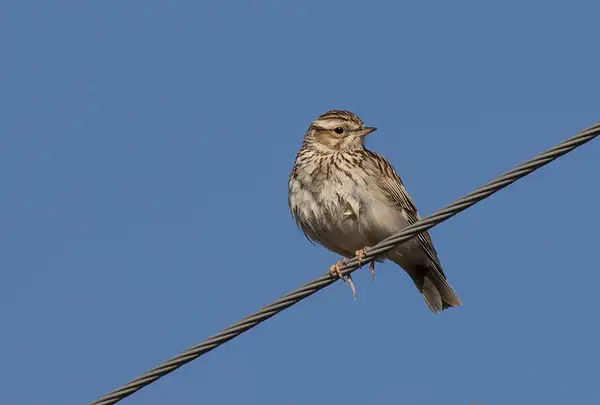
Crested Lark perched on a barbed-wire fence, from behind, with the crest raised and streaked brown backPhoto: José Prego from Moura, Portugal, CC BY 2.0Photo 1 of 4
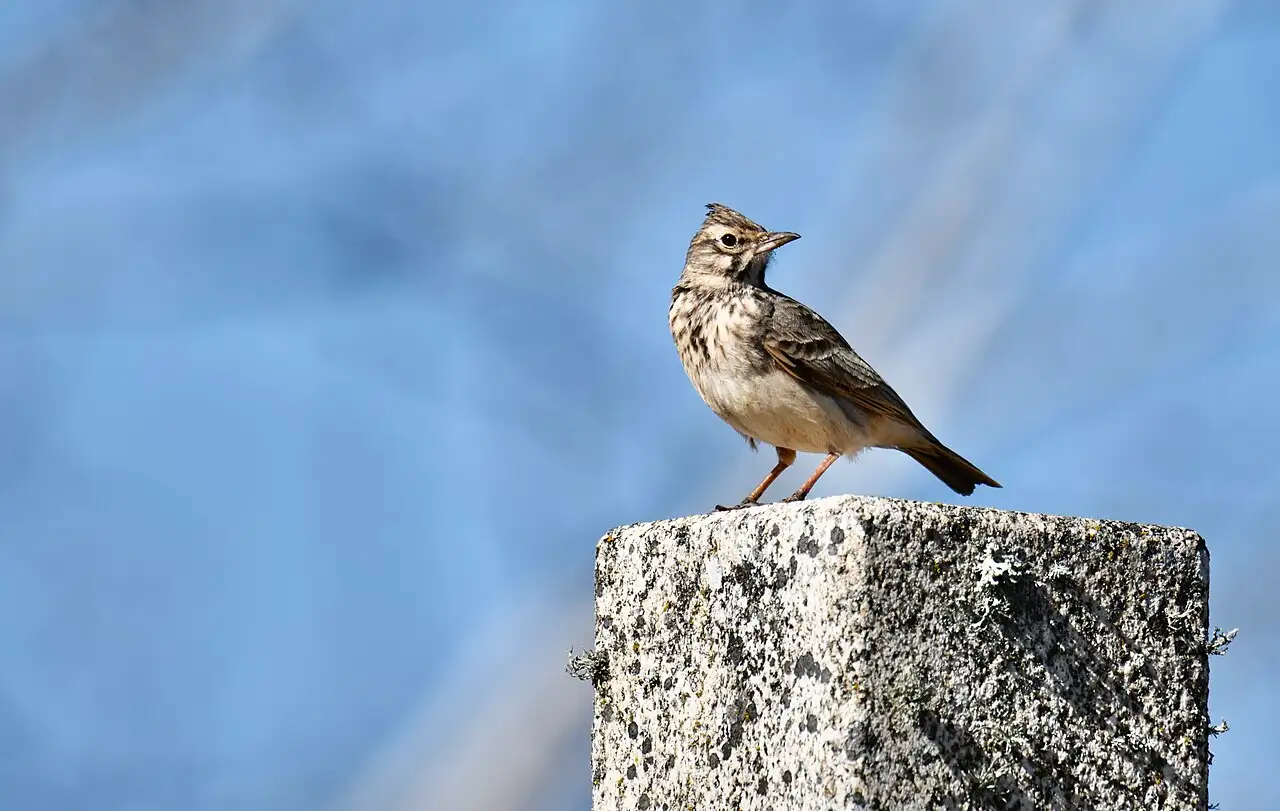
Crested Lark perched on a granite boundary stone, in profile, with raised crest and streaked breastPhoto: Luiz Lapa from Oeiras, Portugal, CC BY 2.0Photo 3 of 4
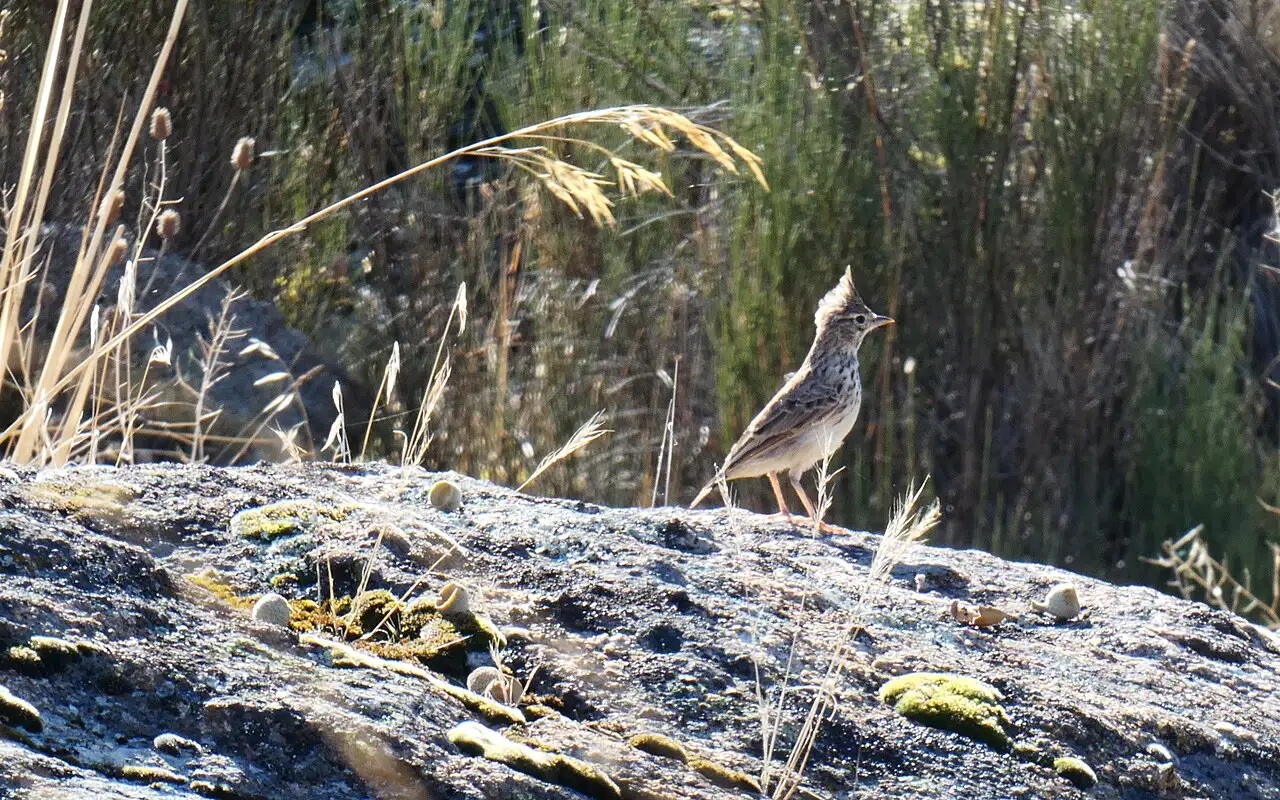
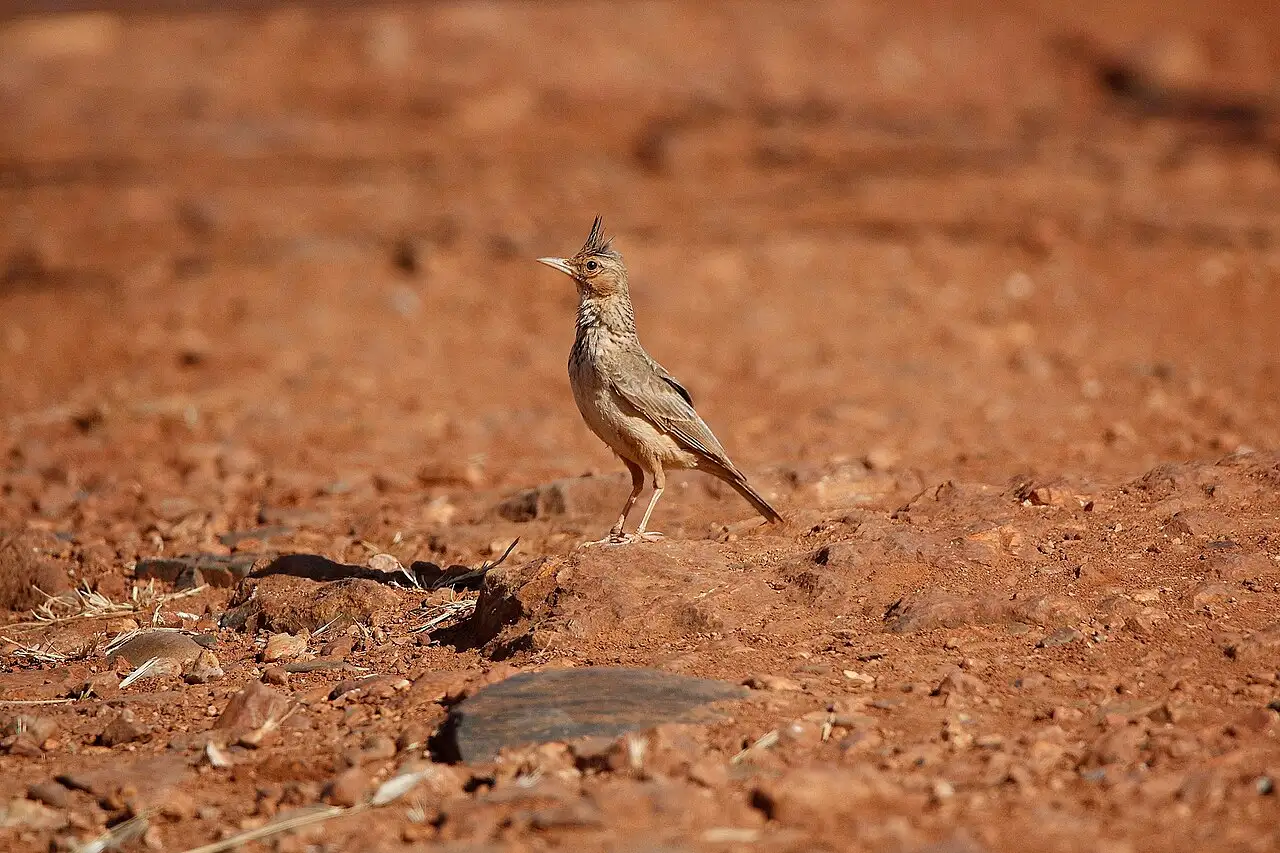
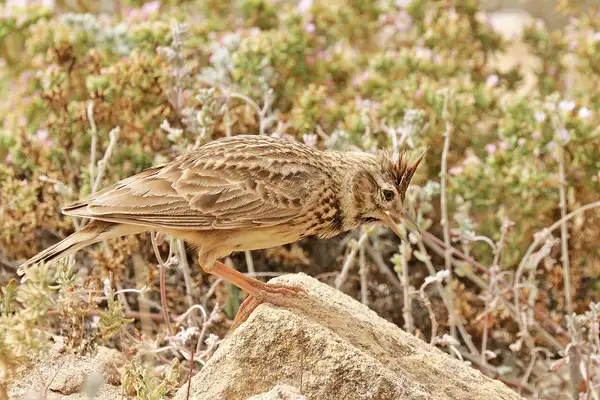
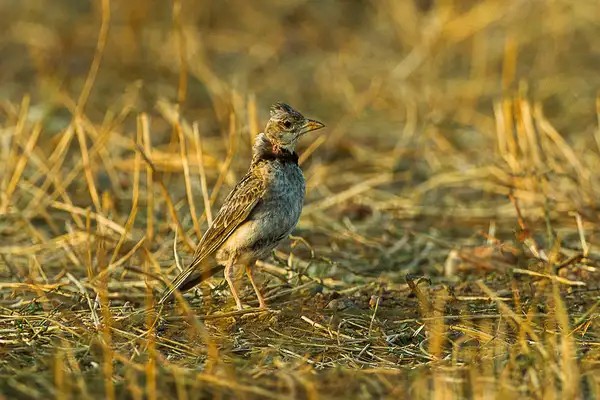
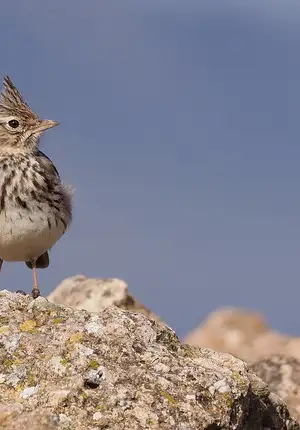
It is a medium-sized lark, in brown tones with dark streaking. On the head the crest stands out, as does the facial pattern, with very marked streaking. Plump in appearance, it has a big head, a long bill and a short, rounded tail. In flight it shows broad wings and a short tail, the latter dark in the centre and buff at the edges.
Adult
Brown, with dark streaking and a crest on the head.
Big head, long bill and short, rounded tail.
Habitat and distribution of the Crested Lark
It is widely distributed across the temperate and warm zones of Europe, the Near East, Asia and tropical Africa. It spreads across central and southern Europe, although it is absent from more northerly latitudes, such as the United Kingdom and the Scandinavian countries. It is a very common species, of which up to 24 subspecies have been recognised in the Palaearctic.
In Spain it is continuously distributed across the whole Mediterranean region, although absent from most of Galicia, the Cantabrian coast, the Basque mountains and the Pyrenees, as well as from the Balearics and the Canaries. There are three subspecies: «pallida», the most widespread on the Peninsula; «cristata», found in the north; and «schmidti», present in Ceuta and Melilla.
It prefers open environments in warm-climate areas and humanised surroundings, such as cereal crops. It is also common around villages, towns, roads and tracks. It is usually seen on the cereal steppes of the interior, where it occupies crops, grassland and wasteland, and can also be found in open wooded environments, such as olive groves, dehesas and wooded farmland.
Iberian populations seem resident, with short-range local movements. The more northerly European populations are migratory, with wintering territories on the Iberian Peninsula and in North Africa.
Areas where it is regularly recorded since 2010Squares of about 25 km where it is recorded regularly (occasional passage records are left out). Data from GBIF.org (480,223 records, retrieved October 2026); outline from Natural Earth.
Etymology of the Crested Lark
In other languages it is called «cogullada vulgar» in Catalan, «cotovía cristada» in Galician, «kutturlio arrunta» in Basque and «crested lark» in English1. In Spain there are three subspecies: «pallida», «cristata» and «schmidti».
Population of the Crested Lark
In the 2021 European Red List of Birds, the European breeding population is estimated at between 34,300,000 and 47,500,000 mature individuals, with a decreasing trend. The Spanish population shows a clearly downward trend, and is estimated at 8 million birds. The highest densities are found on the two plateaus, in Extremadura and, especially, the Guadalquivir valley and the south-east of the peninsula.
Although it is in clear decline, it is still abundant in Spain. The main threats seem to come from agricultural intensification and the use of agrochemicals.
Nest of the Crested Lark
Solitary and territorial during breeding, it nests on the ground, in a hollow lined with leaves and twigs, sometimes sheltered by a bush.
Courtship and breeding of the Crested Lark
The breeding period runs from March to July, and it can make two or three clutches a year. The clutch consists of three to seven white or yellowish eggs with abundant reddish-brown speckling. Incubation lasts 11–13 days and is done by the female, although sometimes the male also helps. Both parents take part in feeding the chicks, which leave the nest at 9 days and can fly at 15.
Diet of the Crested Lark
Its diet is varied and includes both invertebrates and seeds, leaves and shoots. In winter foods of plant origin dominate.
Curious facts about the Crested Lark
It is one of the most characteristic and frequent inhabitants of the open areas of Spain, where it is often found on cereal crops, stubble, moors, fallows and even country lanes and suburban areas. Although it is still abundant, the most recent data show a certain population decline that seems to stem from changes in farming regions. The ringed bird that lived longest, found dead in Austria, reached 11 years and 7 months.
The Crested Lark in Cabañeros
The habitat pages of this website mention the Thekla’s Lark, but not the Crested. GBIF.org records 307 observations of the Crested Lark in Cabañeros and its surroundings.
Where to see the Crested Lark in Cabañeros
In the open areas, crops and tracks around Cabañeros.
When
All year: it is resident, and breeds from March to July.
What time
In good light, scanning the open areas with binoculars.
Where
On cereal crops, stubble, fallows, country lanes and suburban areas; also in olive groves and dehesas.
What to look for
Look for the crest and listen for the call, a «tuui-tii-tuu» that rises and falls in pitch.



 Same family
 Same family
 Same family
 Same family
 Same order
 Same order
 Same order
 Same order






