Territorial and monogamous in the breeding season; in winter, very gregarious, at roosts of tens of thousands
Lifespan
Record of almost 14 years in the wild
Conservation status
LC
NT
VU
EN
CR
EW
EX
Global (IUCN)
Least Concern
Spain
Included in the List of Wild Species under Special Protection; not in the Spanish Catalogue of Threatened Species
When to see it
Resident
Months of the year when it is present
J
F
M
A
M
J
J
A
S
O
N
D
In Iberia
yes
yes
yes
yes
yes
yes
yes
yes
yes
yes
yes
yes
Breeding season
no
no
no
yes
yes
yes
yes
yes
no
no
no
no
Song or voice of the White Wagtail
The call, which it usually gives in flight, is two high, loud, dry notes, «tsi-sitt». The song is a succession of notes like that, with warbles that recall a swallow.
Flight callWhite Wagtail
0:00 / 0:23
10 kHz5
The sonogram draws the sound: time runs from left to right, and the higher a trace sits, the higher the note.Recording by Hannu Varkki, Wikimedia Commons (CC BY-SA 4.0).
Flight of the White Wagtail
It flies in broad waves: a few quick wingbeats lift it and, with the wings folded, it drops, and so it draws a wavy line with the long tail going up and down. On landing it starts to run, and never stops rocking its tail, which is what most characterises it.
Flight typeUndulating, in broad waves
It takes off running and with a high call, «chisik», and sets out with the long tail swaying.
It flaps and drops with its wings folded, tracing broad waves, with the long tail up and down. The contrast of grey, white and black can be seen.
It brakes with its wings open, lands and starts to run, bobbing its tail up and down non-stop.
Photo gallery of the White Wagtail
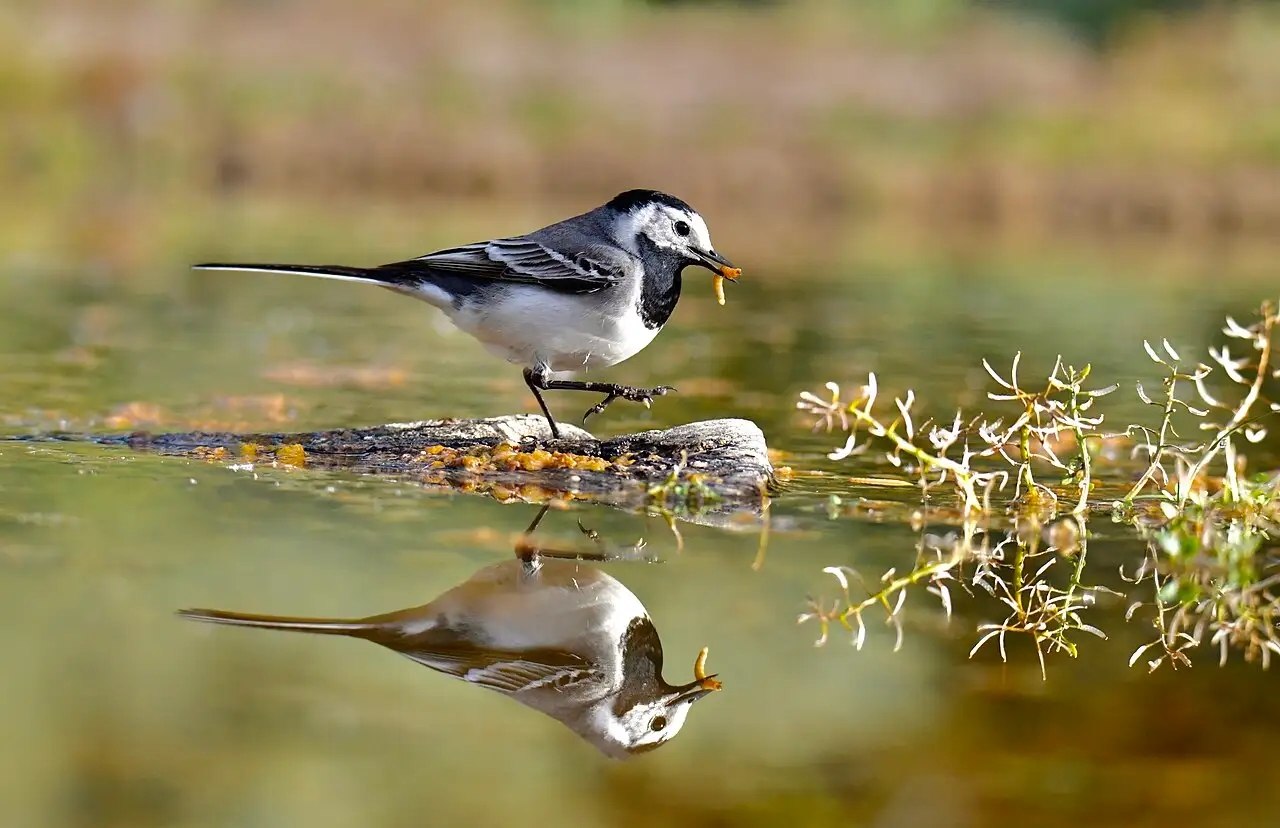
Male White Wagtail beside the water, with an insect in its bill: white face, black bib and long tailPhoto: Luiz Lapa from Oeiras, Portugal, CC BY 2.0Photo 1 of 4
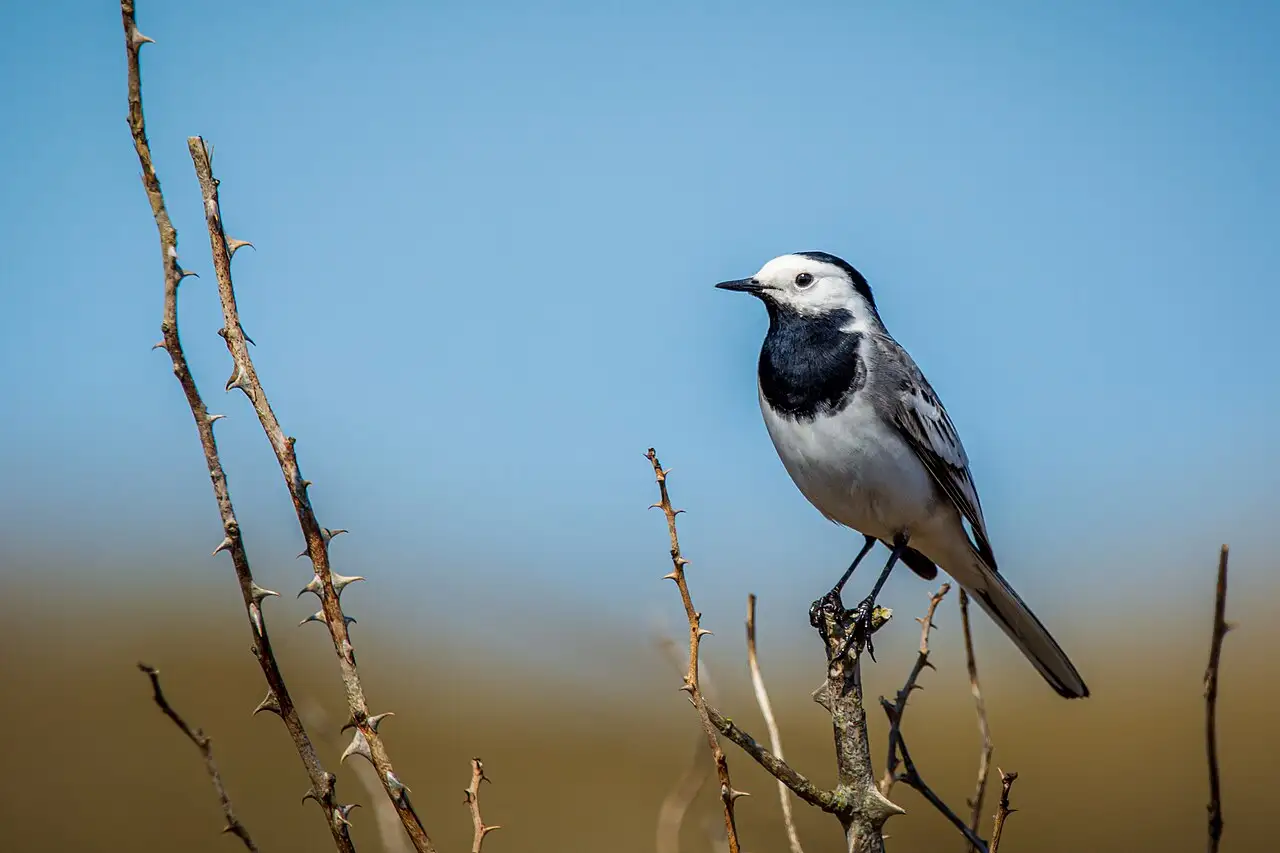
Male White Wagtail perched on top of a thorny branch, with black bib and grey backPhoto: Stephan Sprinz, CC BY-SA 4.0Photo 2 of 4
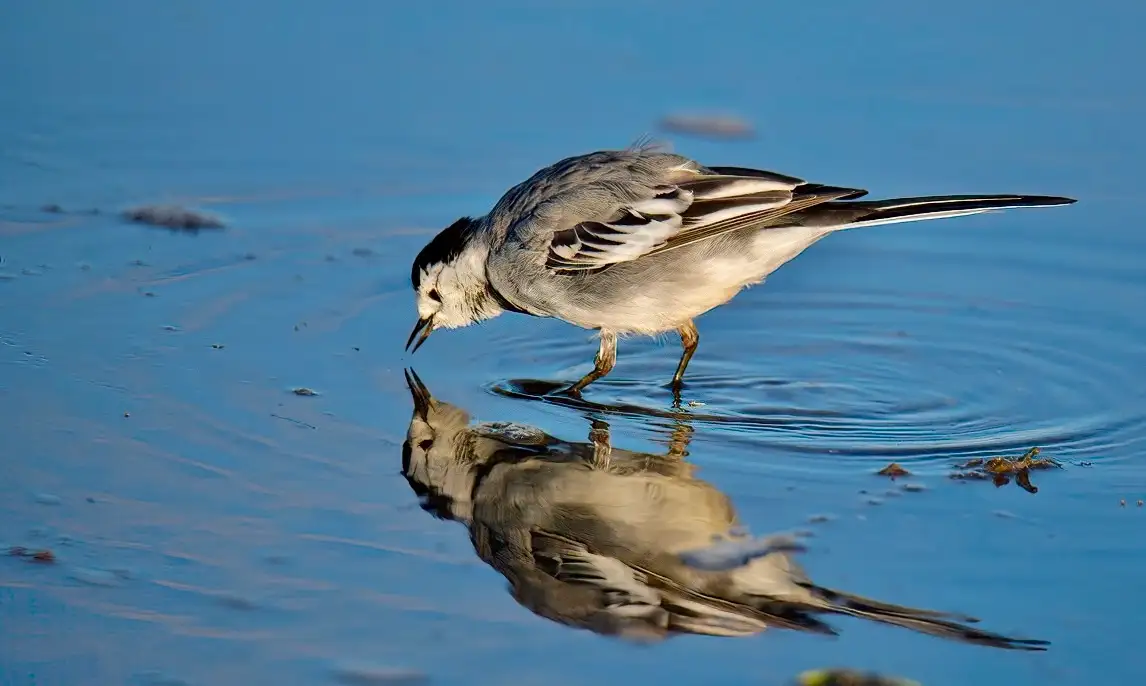
It is a slender bird of very distinctive appearance, with a long tail and white, black and grey tones. It has an ash-grey back, white belly and black wings with white bands when folded. The tail is long and black, with white outer feathers, and the legs and bill are black. The face is very contrasting, white and surrounded by black above and below. In winter the plumage is similar, but with less black on the head, the throat white and a black breast band. The Pied Wagtail, of British origin, has black tones on the back and flanks. Males and females are alike, although the female has a grey nape.
Adult
Back ash grey, belly white and wings black with white bands.
Long, black tail, with white outer feathers.
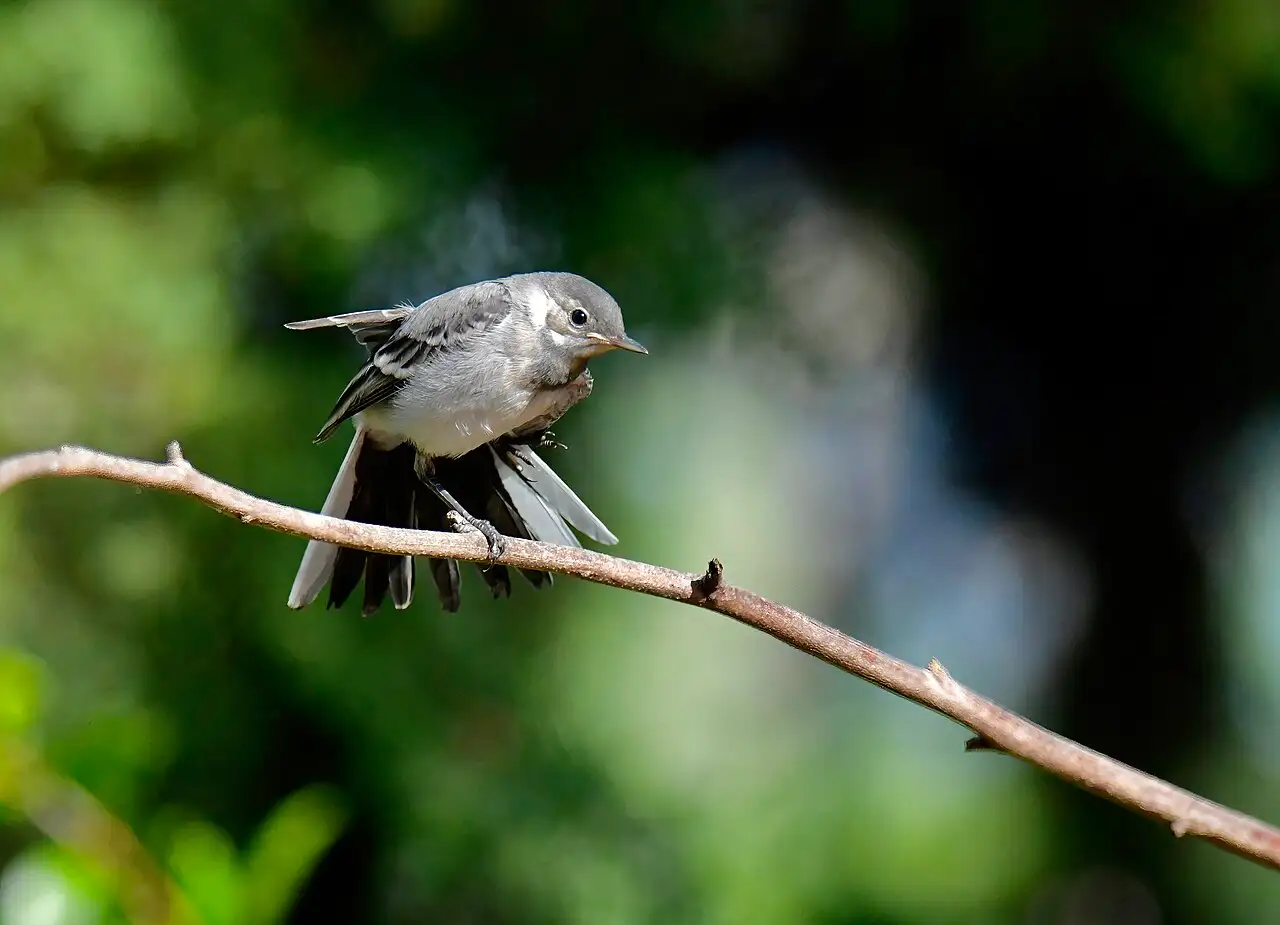
Young bird
More uniform, without black on the head and with a greyish breast band.
Habitat and distribution of the White Wagtail
As a breeder it occupies the temperate and cold latitudes of Eurasia and, marginally, Alaska and Greenland; in winter it extends across Africa and southern Asia. It has very great geographical variability, with eleven recognised subspecies.
In Spain it breeds only on the Peninsula, abundantly in the north and more scarcely and locally towards the south, and is absent from some sectors of La Mancha, Extremadura and Andalusia. In winter, the Peninsula receives an important contingent of birds from Europe, and the distribution extends towards the southern half, above all in the Guadalquivir valley, the Guadiana floodplains and the Levante. In the breeding season it occupies varied environments, often with human influence and near water: rivers, streams, ponds, grasslands, vegetable plots, irrigated land and parks. It nests from sea level to 1,600 metres, and generally avoids very dry areas and dense woodland. In winter it clearly prefers crops and grasslands, and forms roosts in trees, often in urban areas, and in marsh vegetation.
Areas where it is regularly recorded since 2010Squares of about 25 km where it is recorded regularly (occasional passage records are left out). Data from GBIF.org (864,675 records, retrieved October 2026); outline from Natural Earth.
Etymology of the White Wagtail
«Motacilla» is the Latin name for wagtails, and «alba» means «white». In Spanish, wagtails («lavanderas», literally «washerwomen») owe their name to the habit of frequenting the edges of pools.
Population of the White Wagtail
The Spanish breeding population, relatively small, is estimated at some 1.7 million individuals, with a trend of moderate decline, more marked in the populations of the Eurosiberian and Alpine region. The winter population has never been assessed, but surely amounts to millions of birds, because roosts with tens of thousands of wagtails are known. In Europe between 30.3 and 51.1 million mature individuals are estimated, stable. It is classified as Least Concern. The general threats are habitat loss, urbanisation, pesticide abuse and disturbance at roosts.
Nest of the White Wagtail
It is a cup of branches and dry grass, which both build, in a hole in river banks, rocks, bridges, buildings or walls.
Courtship and breeding of the White Wagtail
It breeds between April and August and may make up to three clutches. In that period it is monogamous and very territorial. It lays four to six whitish, finely speckled eggs, which both incubate for some 12 days. The chicks leave the nest at 10 or 15 days, with the care of both parents, and go on receiving food for at least another week.
Diet of the White Wagtail
It eats a great variety of terrestrial and aquatic insects, above all larvae and adults of flies and mosquitoes. It catches them by pecking on the ground and in shallow water, and sometimes chases them on foot and in flight. It feeds alone or in small groups.
Curious facts about the White Wagtail
In winter it becomes very gregarious and gathers at roosts in trees, often in the middle of a city, where tens of thousands of wagtails have been counted. And a darker subspecies of British origin, the Pied Wagtail, winters in Spain in very small numbers.
The White Wagtail in Cabañeros
The habitat pages of this website cite it in the grasslands and rañas as a shrewd bird, which takes advantage of the fauna that lives under stones and which rises after the tractors’ turning of the soil.
Where to see the White Wagtail in Cabañeros
On the rañas and grasslands, above all near ponds, streams and ploughed areas.
When
All year round; in winter it is much more abundant.
What time
Throughout the day; at dusk, when they gather at the roosts.
Where
Running on the ground beside the water, tracks and ploughed areas, flicking its tail non-stop.
What to look for
A slender grey, white and black bird, with a very long tail, which runs and gives a «tsi-sitt» as it flies.



 Same family
 Same family
 Same family
 Same family
 Also in grasslands and rañas
 Also in grasslands and rañas
 Also in grasslands and rañas
 Also in grasslands and rañas






