In pairs in the breeding season; in winter, in large mixed flocks
Lifespan
Record of 29 years, in captivity
Conservation status
LC
NT
VU
EN
CR
EW
EX
Global (IUCN)
Least Concern
Spain
Not listed on the Peninsula: only the Canarian populations are on the List of Wild Species under Special Protection
When to see it
Resident
Months of the year when it is present
J
F
M
A
M
J
J
A
S
O
N
D
In Iberia
yes
yes
yes
yes
yes
yes
yes
yes
yes
yes
yes
yes
Breeding season
no
no
yes
yes
yes
yes
no
no
no
no
no
no
Song or voice of the Common Chaffinch
The male sings from a high branch, with a phrase that starts with a series of «tuit-tuit-tuit» ever louder, goes on with another shorter, faster one, «chot-chot-chot», and ends with an abrupt final screech. Perched, its call is a loud, penetrating «chiip», and in flight, a soft, weak «suiit».
SongCommon Chaffinch
0:00 / 0:17
10 kHz5
The sonogram draws the sound: time runs from left to right, and the higher a trace sits, the higher the note.Recording by Alexander Kürthy, Wikimedia Commons (CC BY-SA 4.0).
Flight of the Common Chaffinch
It flies in a very undulating way, with quick wingbeats that lift it and a descent with the wings folded. In flight both the male and the female show the white bar that crosses the wing and the white outer tail feathers, which is what best gives it away when it leaves.
Flight typeUndulating, from tree to tree
It leaves the branch with quick wingbeats and sounds its alarm «chiip». In winter it is never alone: the whole flock follows it.
Very undulating flight: a few wingbeats lift it and, with the wings folded, it drops a stretch. On each rise the white wing bar can be seen.
It brakes with its tail spread, showing the white outer feathers, and grips a branch.
Photo gallery of the Common Chaffinch
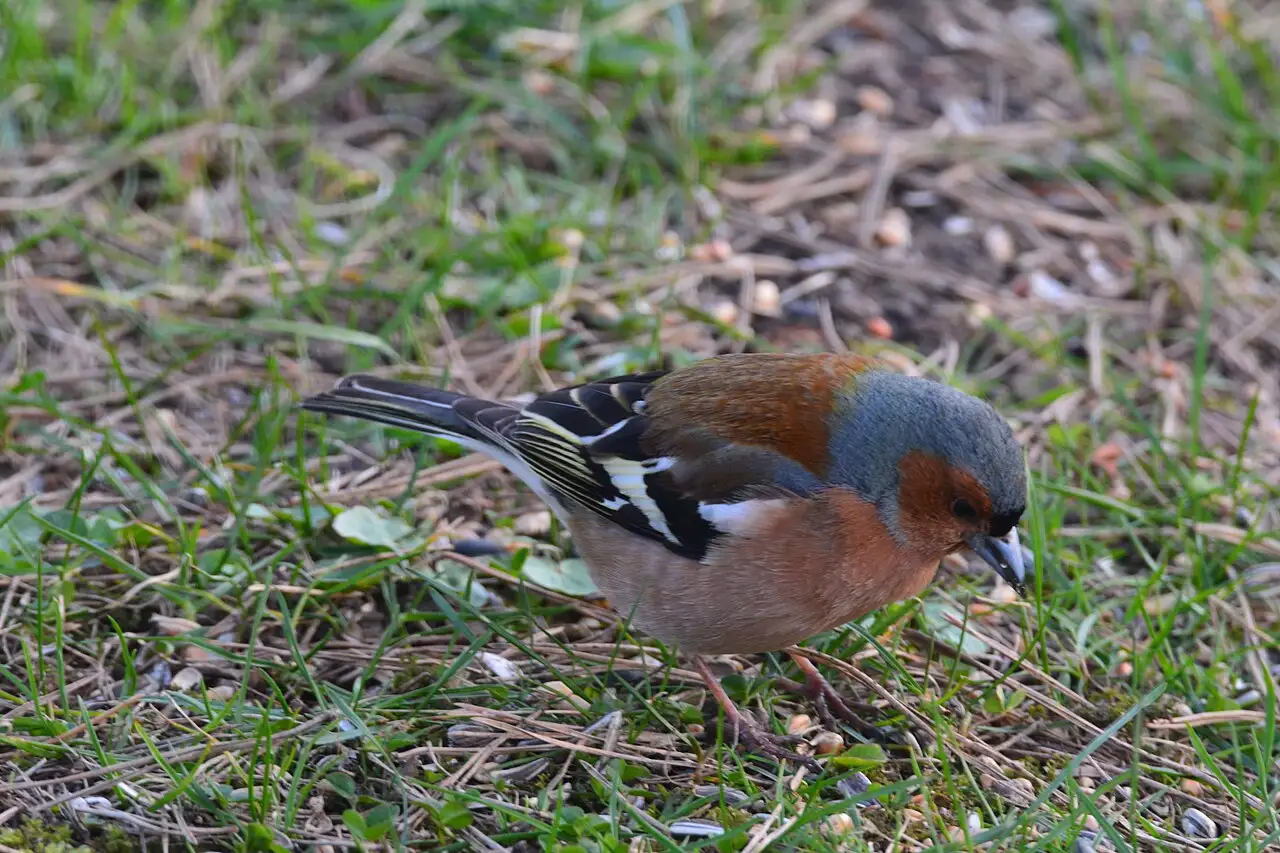
Male Common Chaffinch on the ground: blue-grey head, salmon breast and white wing barsPhoto: Pedalito, CC0Photo 1 of 4
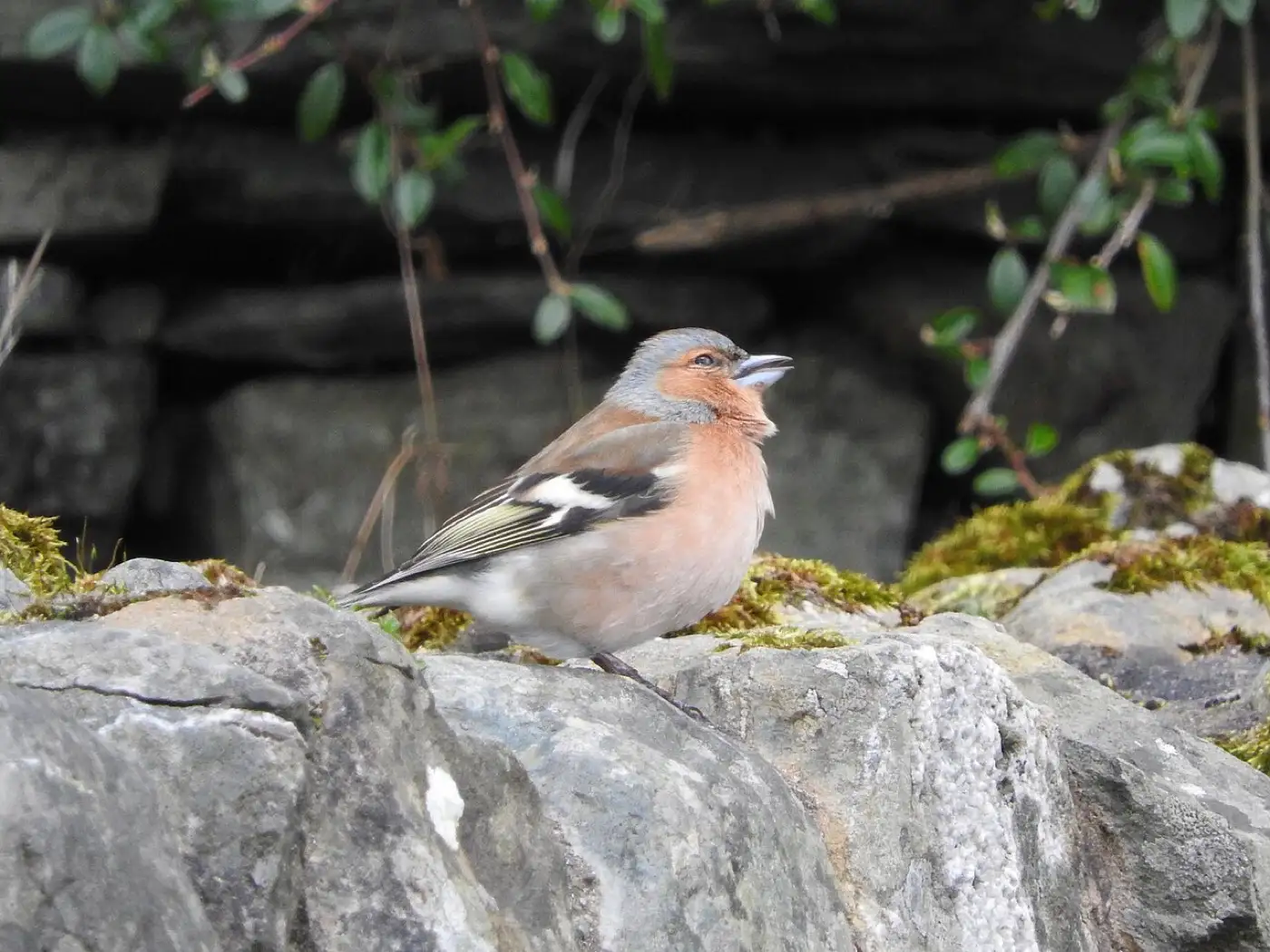
Male perched on a stone wall, with pink breast and the white shoulder patchPhoto: Rob Mitchell, CC0Photo 2 of 4
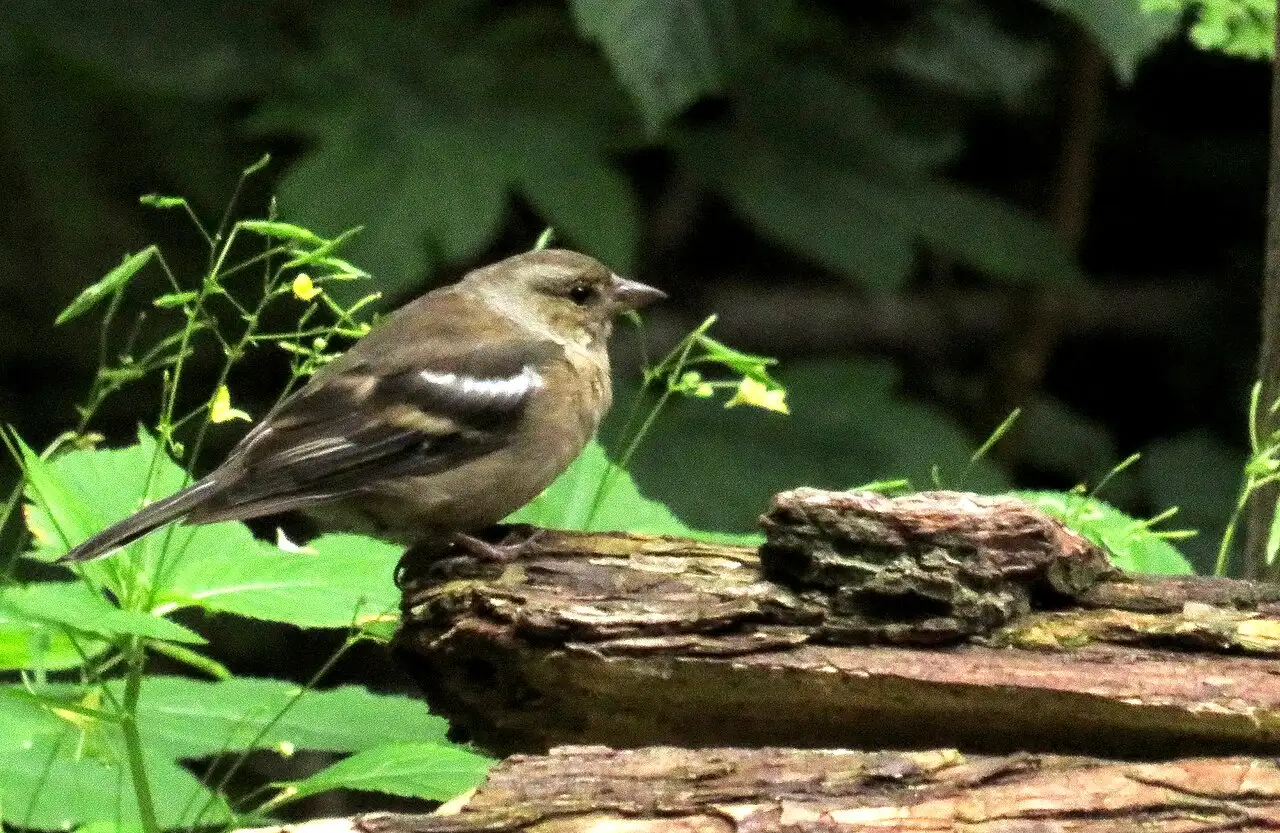
Female Common Chaffinch: dull olive-brown plumage, with the white wing barsPhoto: blondinrikard, CC BY 2.0Photo 3 of 4
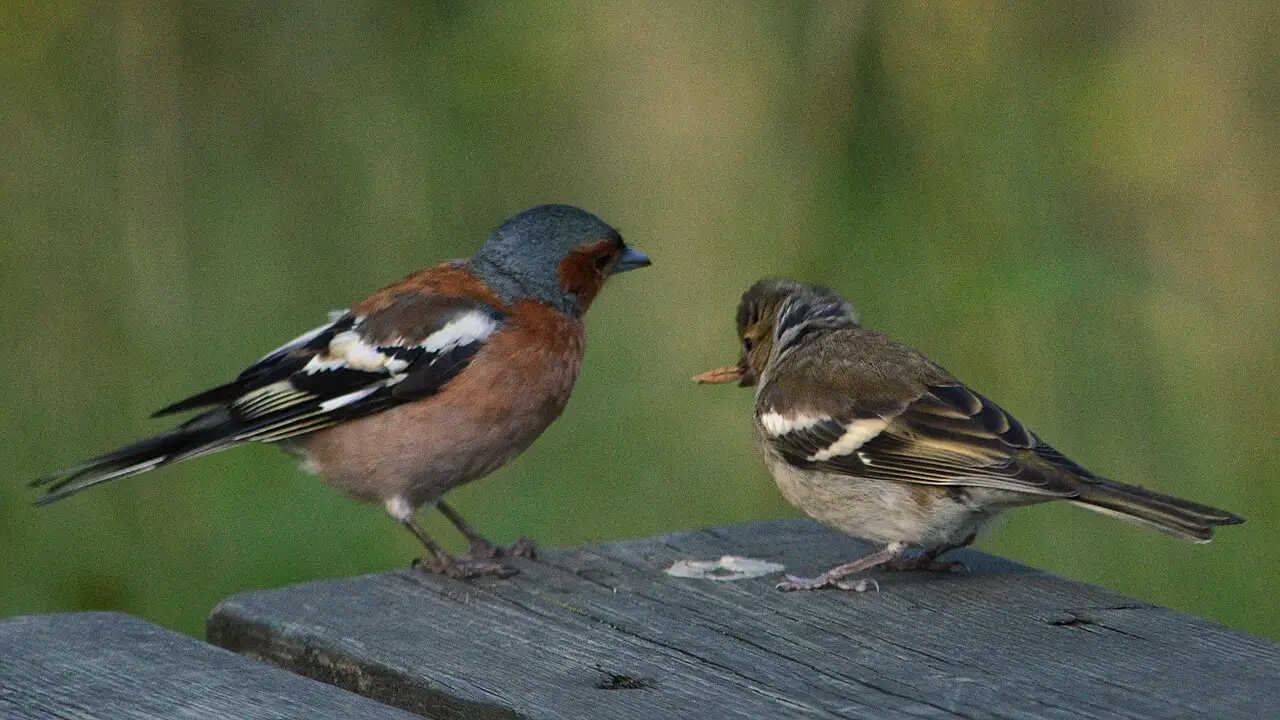
Male and female Common Chaffinch on a wooden table: the difference in colours can be seen clearlyPhoto: Ryan Hodnett, CC BY-SA 4.0Photo 4 of 4
1 / 4
Identification of the Common Chaffinch
It is the size of a sparrow, but is well told from it by the white wing marks, which both males and females have and which show a lot in flight. The dimorphism between the sexes is clear.
Male
Belly, breast and cheeks in salmon tones; crown and nape blue-grey.
In spring, a black band on the forehead, just above the bill, which is broad-based and not very long.
Greenish rump.
Female
Plumage in dull brown tones.
Shares with the male the greenish rump and the white wing bands.
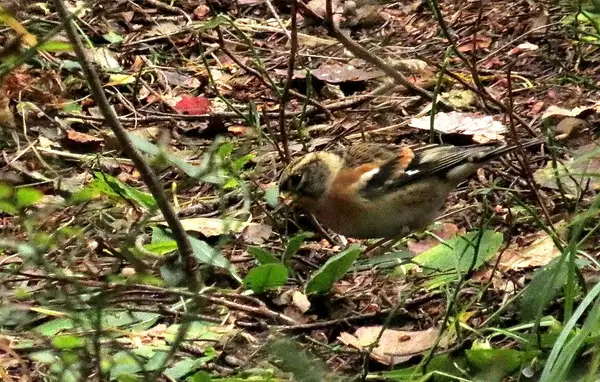
It can be confused with the Brambling, which is typically a winter visitor, lacks the white bands and wears a very visible white rump.
Habitat and distribution of the Common Chaffinch
It is found across the whole of Europe and extends through Asia to Siberia and western Mongolia. It also appears in the Canaries, Madeira and the Azores and in North Africa.
It is frequent over the whole Spanish territory, although in the breeding season it thins out in very treeless areas: the Ebro and Guadalquivir valleys, La Mancha, La Serena and the semi-arid south-east. It breeds both in closed woods and in open woodland, and, secondarily, in parks, gardens, vegetable plots, tall scrub and farmland with trees. In spring it is a woodland bird; in winter it gathers in large flocks, mixes with greenfinches, serins, linnets, goldfinches and Bramblings, and looks for seeds in fallows, thistle fields, dehesas, pine woods and mountain meadows. Iberian birds leave the high, cold areas and occupy open landscapes, olive groves, cereal plains with trees and dehesas.
Areas where it is regularly recorded since 2010Squares of about 25 km where it is recorded regularly (occasional passage records are left out). Data from GBIF.org (792,598 records, retrieved October 2026); outline from Natural Earth.
Etymology of the Common Chaffinch
«Fringilla» is the Latin name for the finch or for a similar small bird, and «coelebs», which means «bachelor» in Latin, was given by Linnaeus because in Sweden, in winter, he saw only males: the females migrate further south and the males stay alone. A bachelorhood that lasts only until spring.
Population of the Common Chaffinch
It is one of the most abundant birds in Spain: some 14 million birds are calculated, with the most important populations in Castilla y León, Castilla-La Mancha, Andalusia, Aragon, Extremadura and Catalonia, and a positive trend between 1998 and 20181. In Europe there are between 308 and 462 million mature individuals, with a stable trend. It is classified as Least Concern. Those that suffer are the Canarian chaffinches, which are endemic subspecies threatened by the loss of pine woods after fires.
Nest of the Common Chaffinch
The female builds alone a cup-shaped nest in the fork of a tree branch or among the twigs of a tall, dense shrub. She uses moss mixed with fine roots and grasses, lines the inside with feathers and covers the outside with lichens, so that it is almost camouflaged against the bark.
Courtship and breeding of the Common Chaffinch
The male marks his territory and attracts females with his powerful song. The pair usually makes one clutch a year of four or five eggs, white or bluish with reddish spots, between March and June; in some areas they make two and lay up to eight. Only the female incubates them, for 13 or 14 days, and the chicks leave the nest two weeks after hatching. During summer they group with other young birds and adults and form flocks that last until the beginning of the following spring.
Diet of the Common Chaffinch
It is omnivorous. It eats insects, buds, shoots, fleshy fruits such as elderberries and seeds of lavender, sunflower, verrucaria or beech. In winter it goes over the ground of clearings looking for seeds.
Curious facts about the Common Chaffinch
The chaffinch’s song is learned: young birds copy it from neighbouring males, so each area has its dialect, and one that grows up without hearing others ends up singing a poor version. Thanks to scientific ringing it is suspected that part of the Iberian chaffinches travel as far as Africa.
The Common Chaffinch in Cabañeros
Among the birds of the oak woods, tits stand out for their abundance, the Eurasian Blue Tit, the Common Chaffinch and the European Robin. We also find it in the sclerophyllous forest, together with the robin, the blackbird and the serin, and in the scrub, although there it is less abundant.
Where to see the Common Chaffinch in Cabañeros
In the Pyrenean oak woods and holm oak woods, at the edges of clearings and scrub areas, and in winter in the grasslands and dehesas.
When
All year round. In spring, to hear it sing; in winter, to see the mixed flocks on the ground.
What time
At dawn and during the morning, when it sings from the high branches.
Where
In the clearings of the woods, at mid-height, and on the ground of the grasslands and dehesas in winter.
What to look for
A sparrow-sized bird with a white patch on the shoulder and another white band on the wing, which repeats a loud «chiip» and a phrase that ends in a screech.



 Same family
 Same family
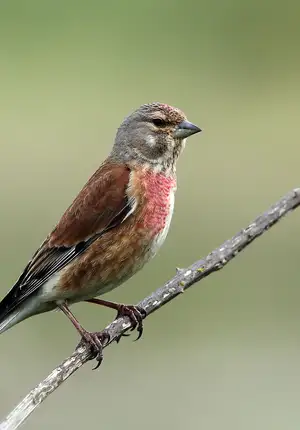 Same family
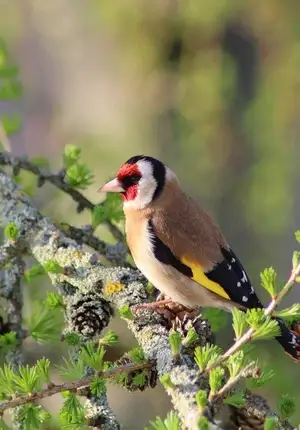 Same family
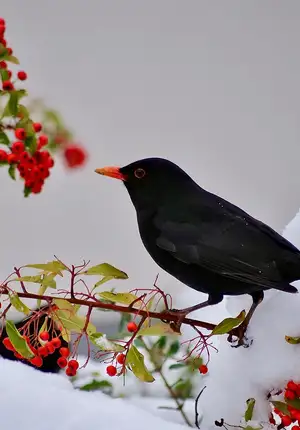 Also in sclerophyllous woodland
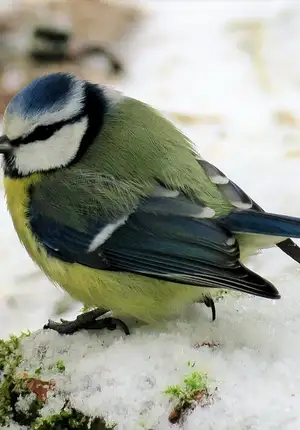 Also in sclerophyllous woodland
 Also in scrubland
 Also in sclerophyllous woodland






