Monogamous, solitary and territorial when breeding; the Peninsula also receives winter visitors from northern and western Europe
Lifespan
Record of 12 years and 3 months in the wild (a bird ringed in France)
Conservation status
LC
NT
VU
EN
CR
EW
EX
Global (IUCN)
Least Concern
Spain
Vulnerable (VU) in the 2021 Red Book of the Birds of Spain; not on the List of Wild Species under Special Protection or in the Spanish Catalogue of Threatened Species
When to see it
Resident
Months of the year when it is present
J
F
M
A
M
J
J
A
S
O
N
D
In Iberia
yes
yes
yes
yes
yes
yes
yes
yes
yes
yes
yes
yes
Breeding season
no
no
yes
yes
yes
yes
yes
no
no
no
no
no
Song or voice of the Eurasian Skylark
It gives a long, continuous, very fast song, made of a succession of chained, repetitive trills, with no pause between them. The recording, from the British Library, is from the island of Skokholm (Wales).
SongEurasian Skylark
0:00 / 0:28
10 kHz5
The sonogram draws the sound: time runs from left to right, and the higher a trace sits, the higher the note.Recording by British Library, Wikimedia Commons (CC BY-SA 4.0).
Flight of the Eurasian Skylark
Its flight is fast, with intense wingbeats. It has great manoeuvrability in the air, with the ability for prolonged hovering and dizzying climbs and descents.
Flight typeFast, with hovering and dizzying climbs and descents
It takes off from the ground of the grassland or crop, where it spends most of its time: it is a ground-living bird.
Its flight is fast, with an intense beating of the wings. It has great manoeuvrability in the air, with prolonged hovering and dizzying climbs and dives, and its song is long and continuous.
It drops into the field and lands; the white edge of the wings and the white outer tail feathers can be seen.
Photo gallery of the Eurasian Skylark
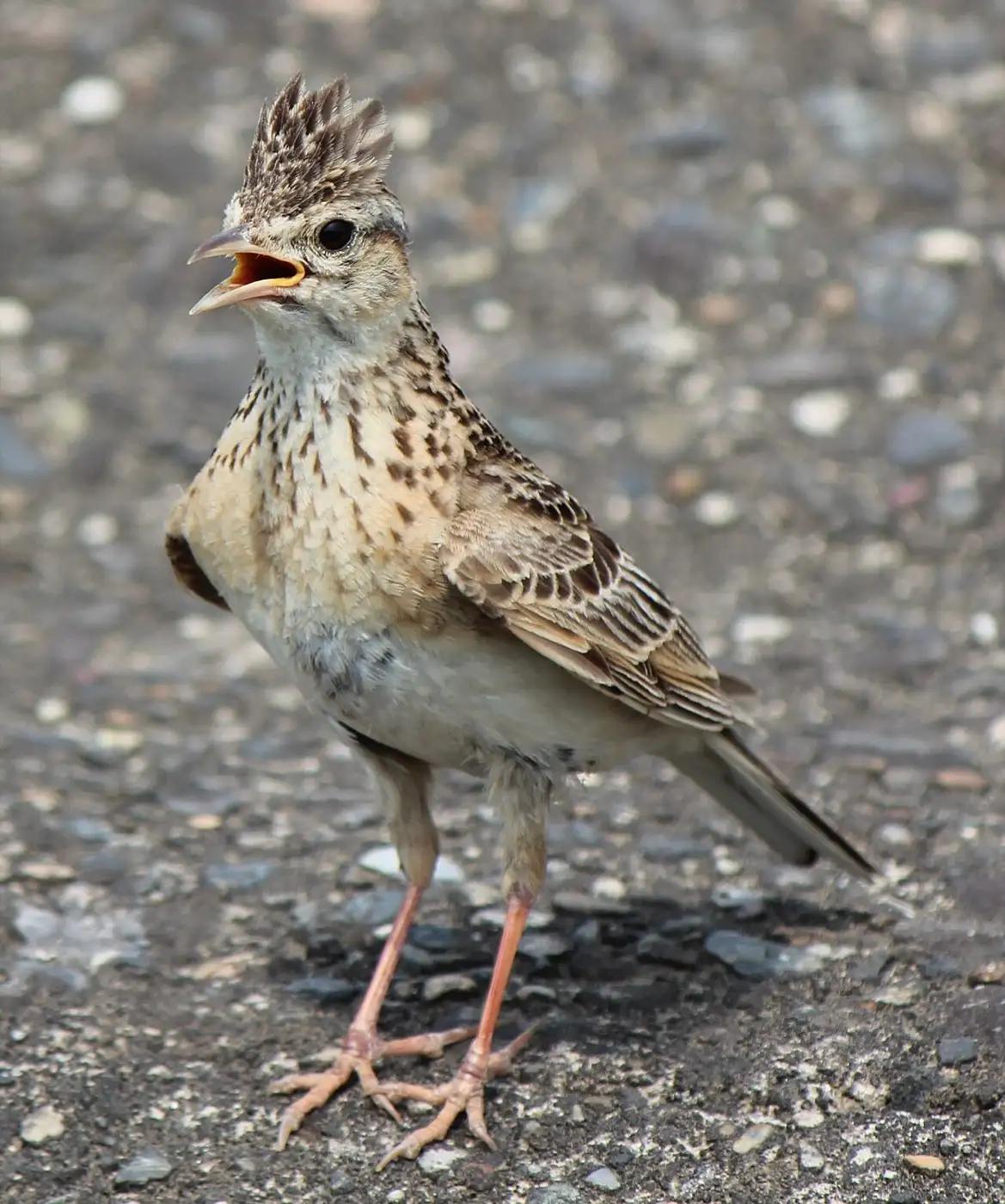
Eurasian Skylark on the ground with its bill open, singing, crest raised and streaked breastPhoto: Alpsdake, CC BY-SA 3.0Photo 1 of 4
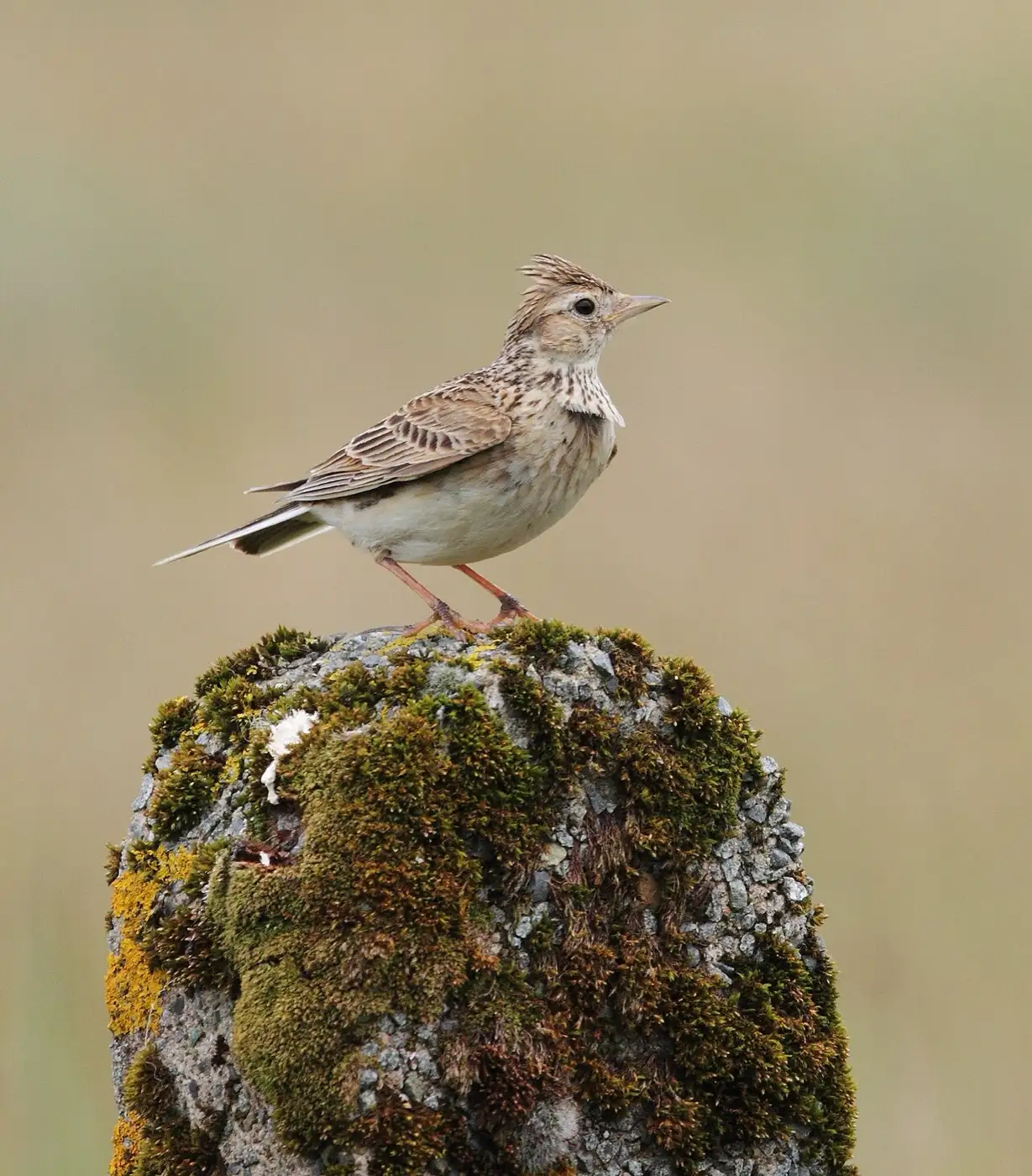
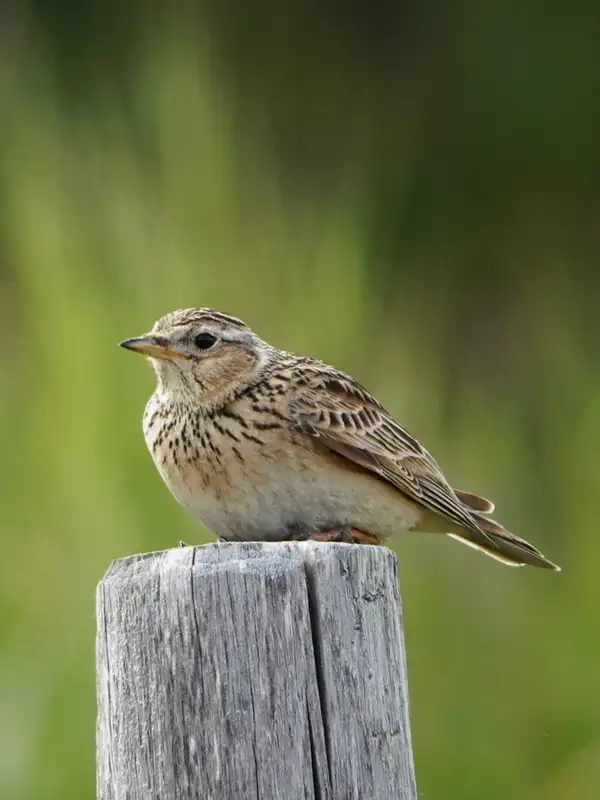
Eurasian Skylark on a post with moss and lichens, with a small crest and streaked breastPhoto: Alun Williams333, CC BY-SA 4.0Photo 2 of 4
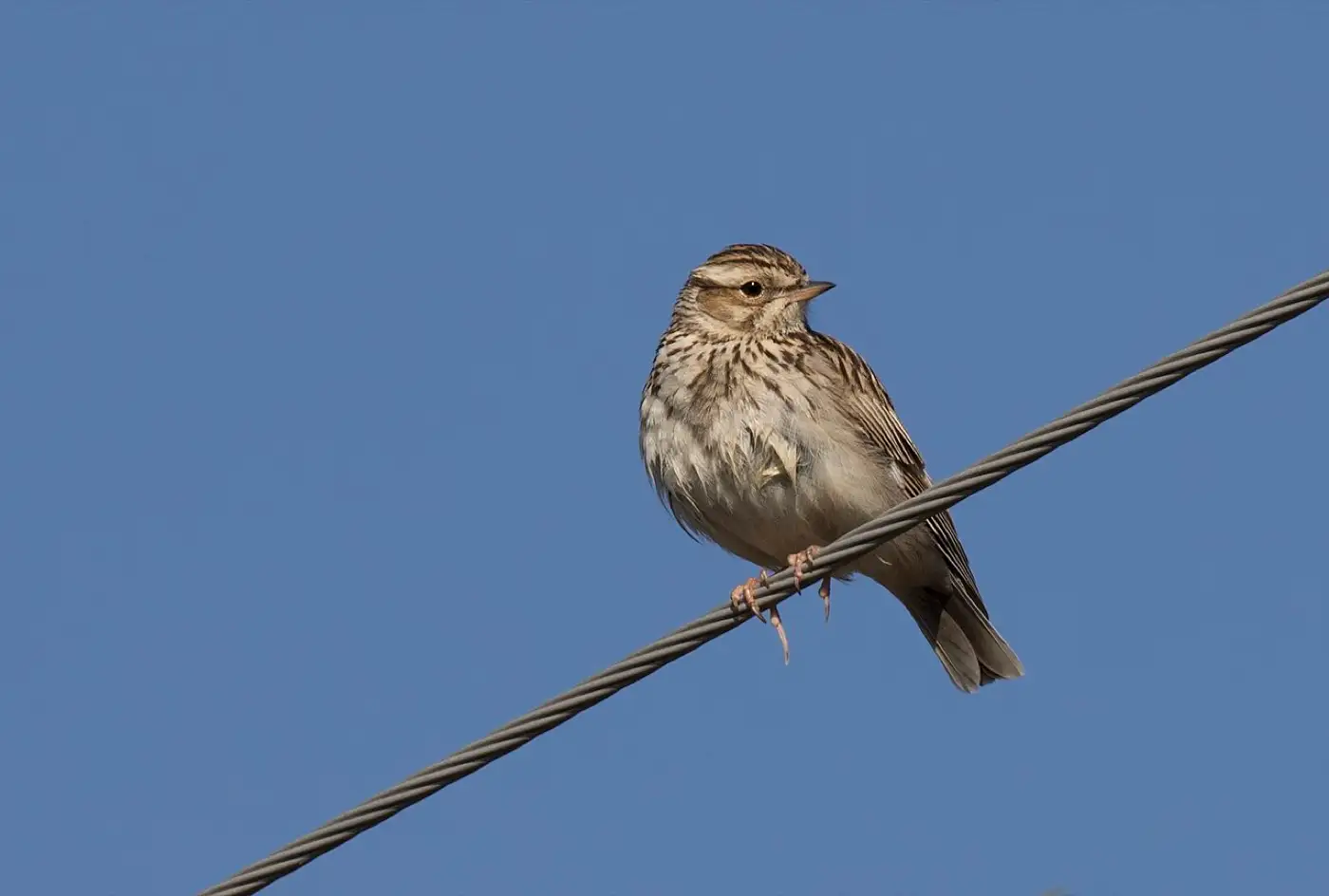
Eurasian Skylark perched on a wire against the blue sky, with streaked back and breastPhoto: Zeynel Cebeci, CC BY-SA 4.0Photo 3 of 4
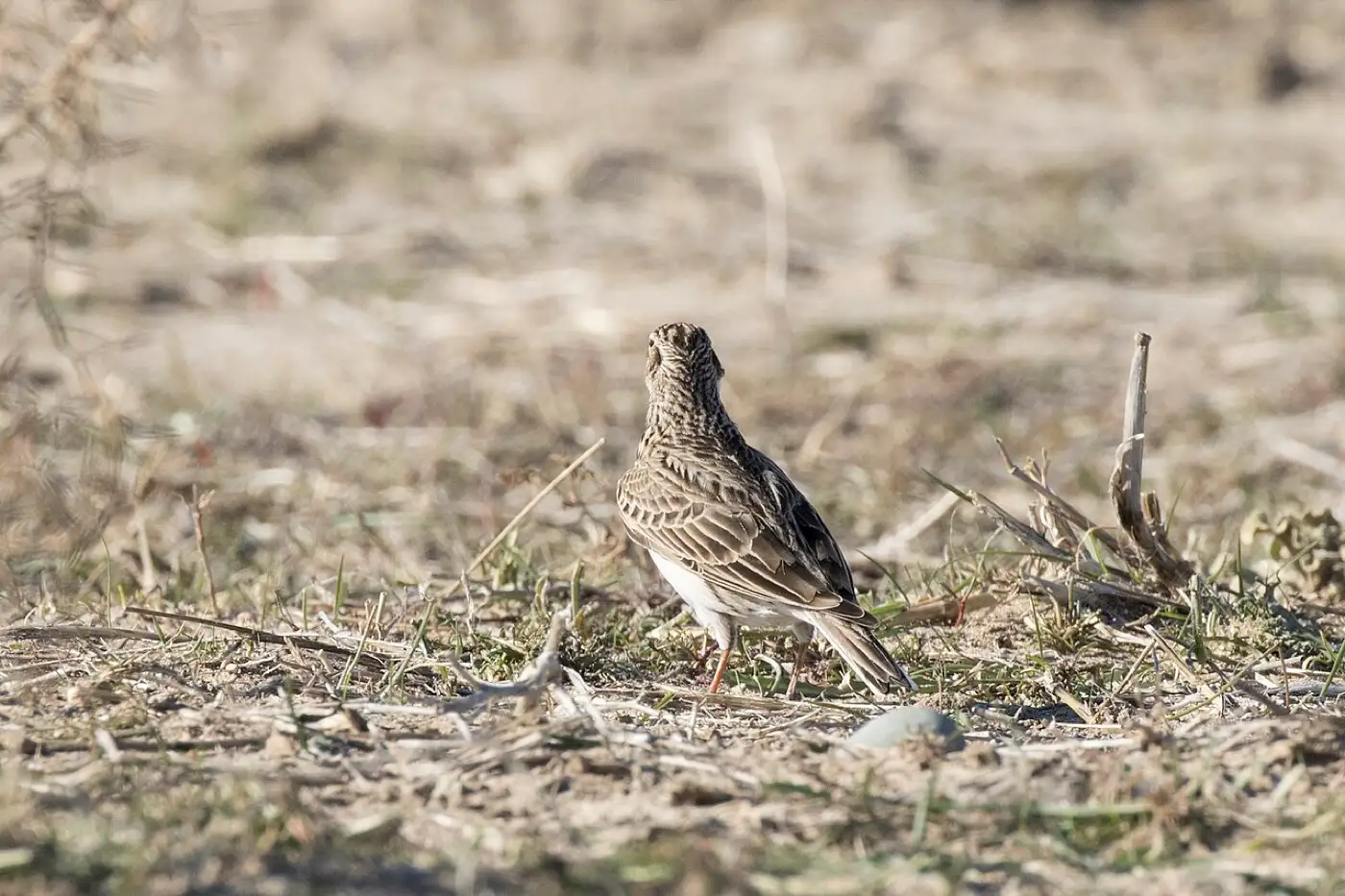
Eurasian Skylark seen from behind on the stubble, with streaked brown back and the white-edged tailPhoto: Zeynel Cebeci, CC BY-SA 4.0Photo 4 of 4
1 / 4
Identification of the Eurasian Skylark
The Eurasian Skylark is a typical lark, in brown tones with dark streaking, with a strong bill, an elongated, sturdy body, long legs, wings and tail and ground-dwelling habits. It combines a small crest, a pale facial mask, a streaked breast, the white terminal edge on the wings (as in the Calandra Lark) and white outer tail feathers.
Adult
Streaked brown, with a small crest and a pale facial mask.
Streaked breast; white terminal edge on the wings and white outer tail feathers.
Habitat and distribution of the Eurasian Skylark
It is widely distributed across the Palaearctic, through practically the whole of Europe and most of Asia; in Europe it is absent only from Iceland and the northernmost tip of Russia. Eight subspecies are recognised in the western Palaearctic, two of them in Spain.
In Spain it is continuously distributed across the northern half of the peninsula, and thins out in the warmest areas: it is scarcer in the southern half, the Mediterranean coast and the Ebro depression, and has its best populations in the farmland and grasslands of the northern Meseta and southern Aragón. It is absent from the Balearics, the Canaries, Ceuta and Melilla.
It abounds in open, treeless environments, where it selects cultivated areas, grasslands and sparse scrub (thyme heath, heathland, gorse thickets). The highest densities have been detected on the moors of the peninsular interior, and its presence thins out as summer drought increases. It occupies a wide altitude range, from sea level up to 3,000 metres (Sierra Nevada).
The local population seems resident or to make dispersive or nomadic movements of varying range, and the Peninsula receives winter visitors from various countries of northern and western Europe. The autumn passage is detected between September and December, with peaks in late October and early November, and the spring one from late February to mid-April, with peaks in March.
Areas where it is regularly recorded since 2010Squares of about 25 km where it is recorded regularly (occasional passage records are left out). Data from GBIF.org (154,481 records, retrieved October 2026); outline from Natural Earth.
Etymology of the Eurasian Skylark
«Alauda» is the Latin word for «lark», and from it come also the Spanish «alondra» and the French «alouette». «Arvensis» is the Latin adjective meaning «of cultivated fields».
Population of the Eurasian Skylark
The 2021 European Red List of Birds estimates that there are about 87.8–132 million Skylarks in Europe, with a decreasing trend. The Third Atlas of Breeding Birds in Spain estimates that about 2.32–2.54 million birds breed. The SACRE programme shows a negative trend of almost 35 % between 1998 and 2018 at national scale, and the decline is especially severe in the south of the peninsula, with decreases of 78.8 %, and in the Eurosiberian region, with reductions of 53.2 %. That is why the 2021 Red Book classes it as Vulnerable. The main problems are agricultural intensification, reforestation of marginal land, ploughing of wasteland or grassland and conversion to irrigation; in addition, it has a high tendency to die by colliding with wind turbines.
Nest of the Eurasian Skylark
It nests on the ground, among low vegetation or in crops. The nest is a small cup of leaves and twigs, lined with feathers.
Courtship and breeding of the Eurasian Skylark
The breeding period runs from March to July, and it can make up to four clutches a year, more frequent in March and April. It is a monogamous, solitary and territorial species. The clutch has three to seven eggs of variable colouring (white, yellowish, greenish, often tinged with green and speckled with brown). Incubation lasts 11 days and is done by the female. The chicks leave the nest at 8–10 days and can fly at 18–25.
Diet of the Eurasian Skylark
It is omnivorous, and its diet includes animal and plant matter: in summer insects are especially important; in autumn cereal and weed seeds dominate; in winter it eats weed leaves and seeds; and in spring cereal grains gain importance.
Curious facts about the Eurasian Skylark
Its song is long and continuous, with no pause between the trills, and in the air it masters prolonged hovering and dizzying climbs and descents. Its decline in southern Spain has been 78.8 % between 1998 and 2018, according to the SACRE programme.
The Eurasian Skylark in Cabañeros
This website’s page on grasslands lists it among the birds that use the ploughed areas of the raña of Cabañeros, together with the Spanish Sparrow and the Common Chaffinch.
Where to see the Eurasian Skylark in Cabañeros
In the ploughed areas of the raña of Cabañeros.
When
All year; in winter birds from other European countries also arrive, with the peak passage in late October and early November.
What time
Throughout the day; the song starts in the air.
Where
In open environments: crops, grassland and sparse scrub.
What to look for
A streaked brown lark, with a small crest, that climbs singing non-stop.
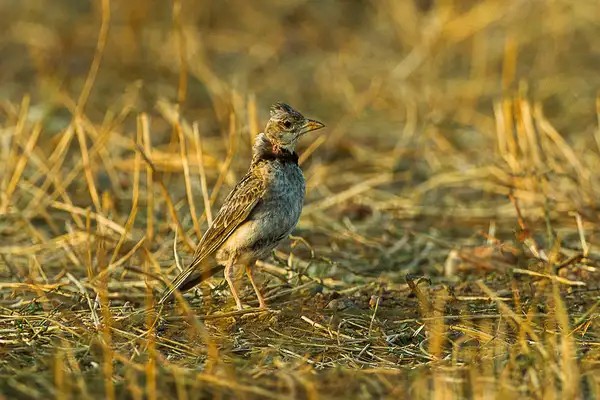
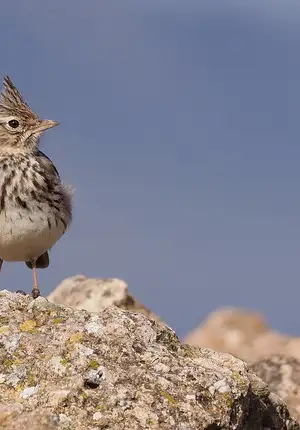
They are similar in song1. The Calandra Lark is a bigger, sturdier lark, with a thick bill and black patches on both sides of the neck; its song is louder and harsher.
Photo: Francesco Veronesi from Italy, CC BY-SA 2.0



 Same family
 Same family
 Same family
 Same family
 Same order
 Same order
 Same order
 Same order






