After the breeding period it moves in small groups, often with other tits, goldcrests and leaf warblers
Lifespan
Record of 9 years and 5 months in the wild according to EURING (a bird ringed in Great Britain); AnAge gives 9.5 years
Conservation status
LC
NT
VU
EN
CR
EW
EX
Global (IUCN)
Least Concern
Spain
Least Concern (LC) as a breeder in the Red List of Birds of Spain; on the List of Wild Species under Special Protection, but not in the Spanish Catalogue of Threatened Species
When to see it
Resident
Months of the year when it is present
J
F
M
A
M
J
J
A
S
O
N
D
In Iberia
yes
yes
yes
yes
yes
yes
yes
yes
yes
yes
yes
yes
Song or voice of the Coal Tit
The song is simple and repetitive: «tit-tuii, tit-tuii, tit-tuii…». The calls are varied, as in the other tits: it gives different short notes, which it sometimes threads into long, rapid phrases. The recording is of a male from Slovakia; we have trimmed and normalised it.
SongCoal Tit
0:00 / 0:25
10 kHz5
The sonogram draws the sound: time runs from left to right, and the higher a trace sits, the higher the note.Recording by Alexander Kurthy, xeno-canto XC108345 (Volovec, Eslovaquia) (CC BY-SA 4.0).
Flight of the Coal Tit
It is very active and explores branches, twigs, leaves and pine cones minutely; in its search for food it performs real acrobatics, often hanging or with short hovers.
Flight typeVery active on the branches, with acrobatics and short hovers
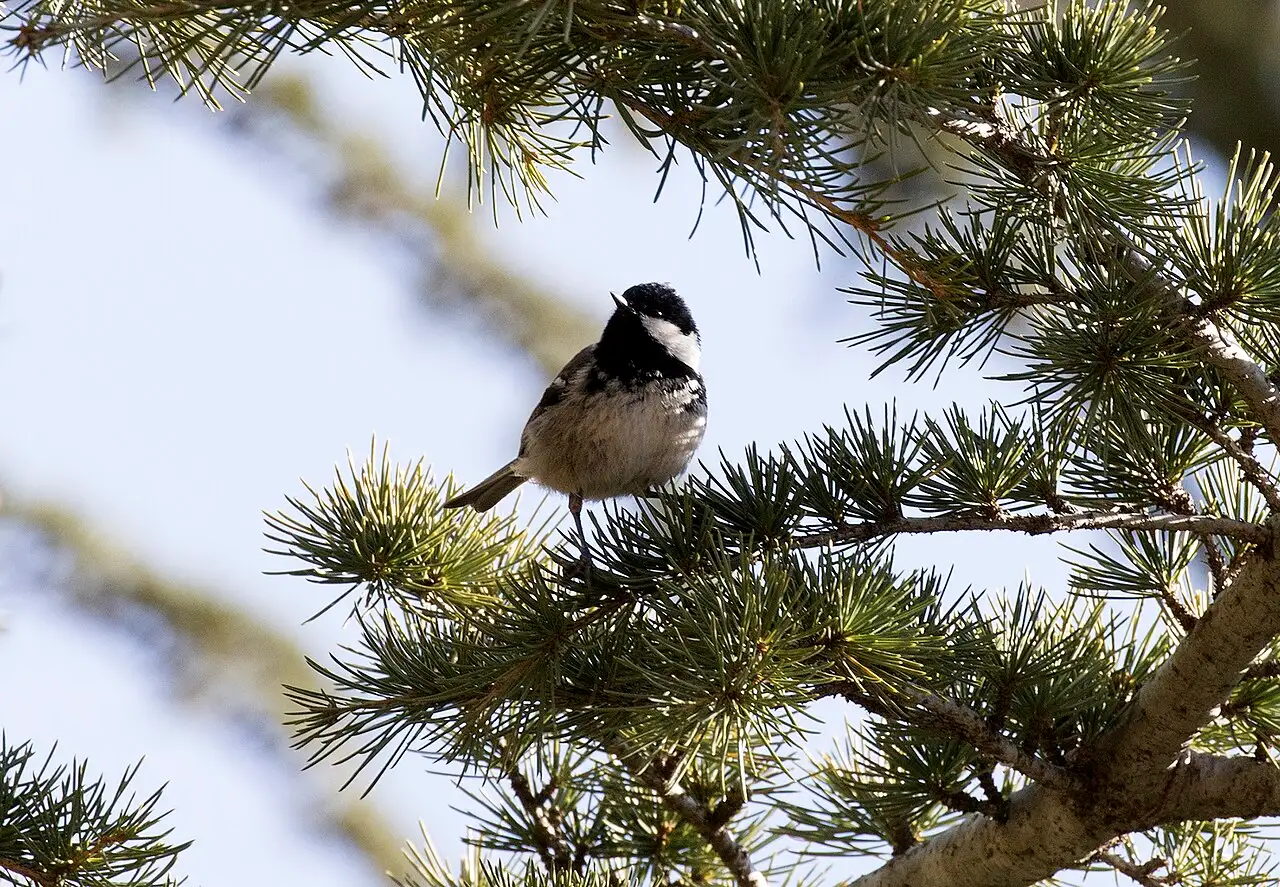
It lives preferably in pine woods, but also in broadleaf formations and in landscaped areas; its incessant call lets you locate it in the high branches.
Very active, it searches branches, twigs, leaves and cones thoroughly, and in its hunt for food it performs real acrobatics, often hanging or with short hovers.
After the breeding season it moves in small groups that often include other tits, goldcrests and leaf warblers.
Photo gallery of the Coal Tit
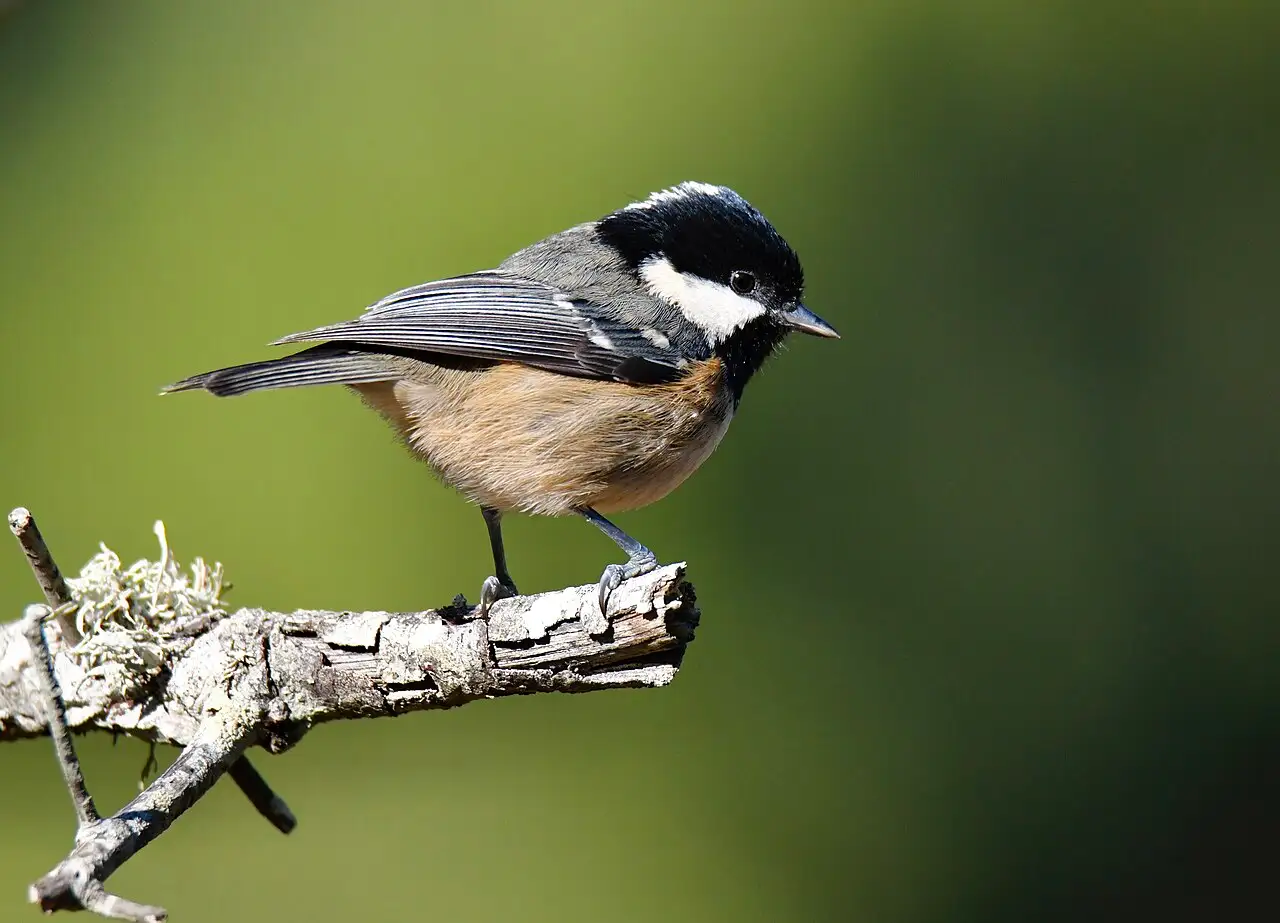
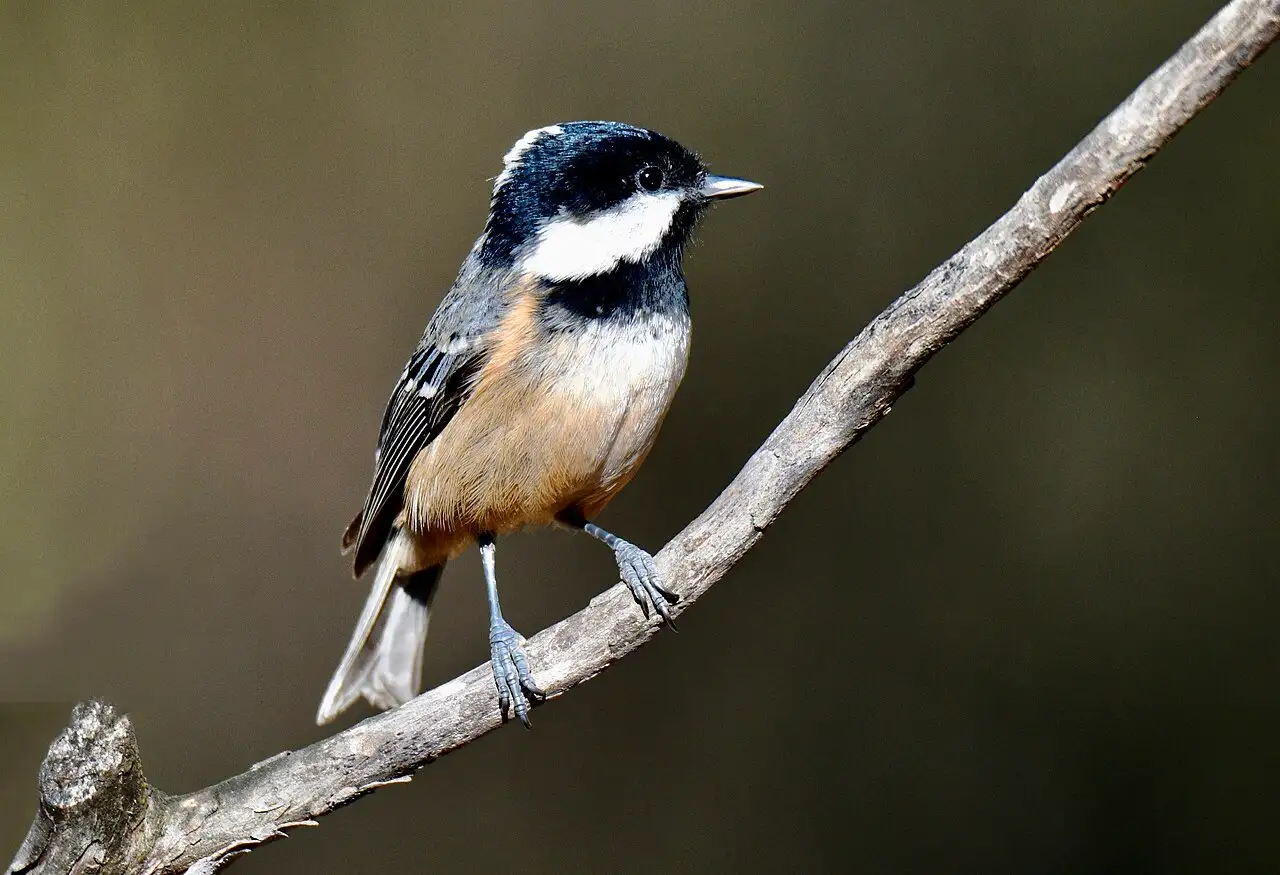
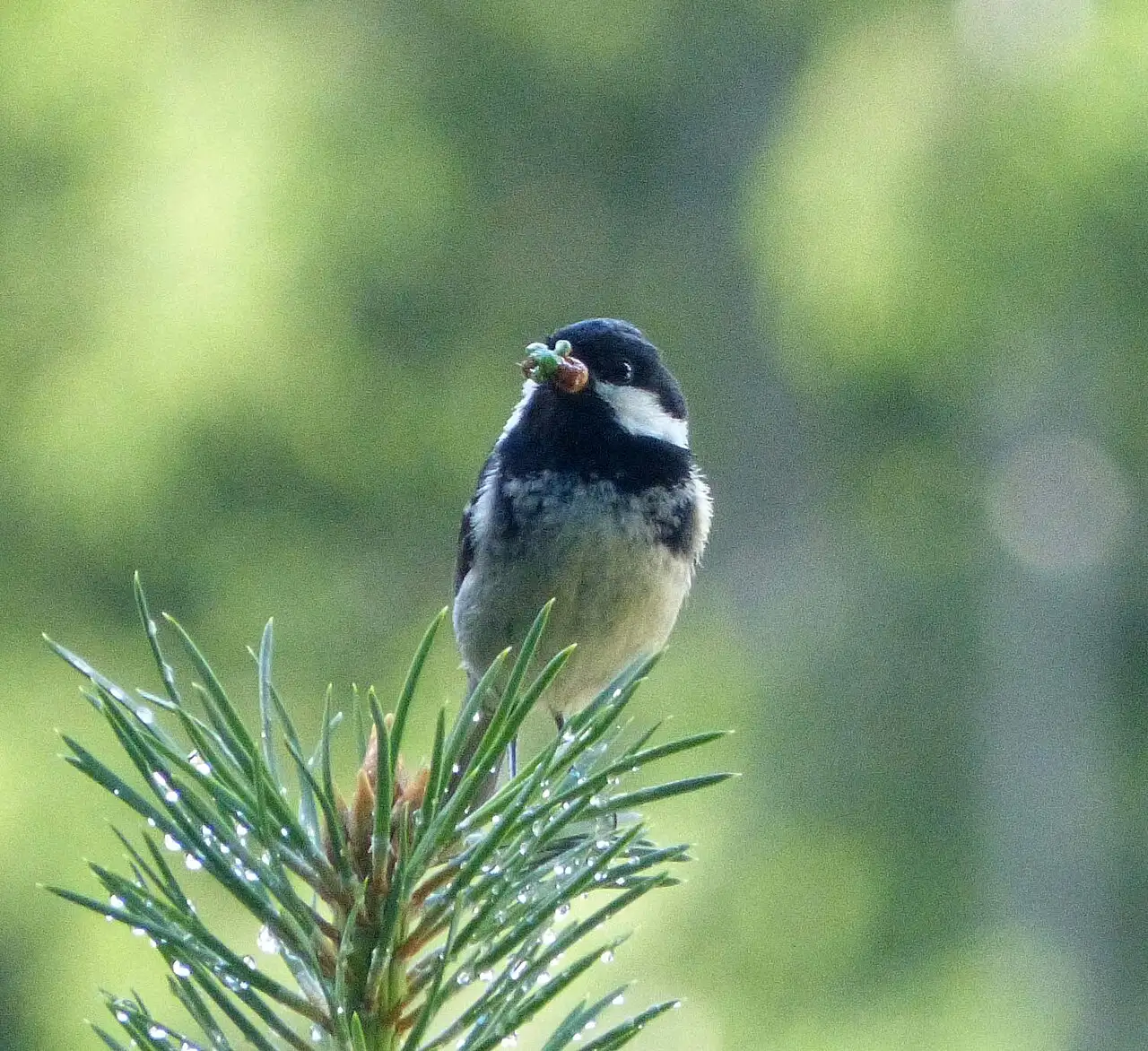
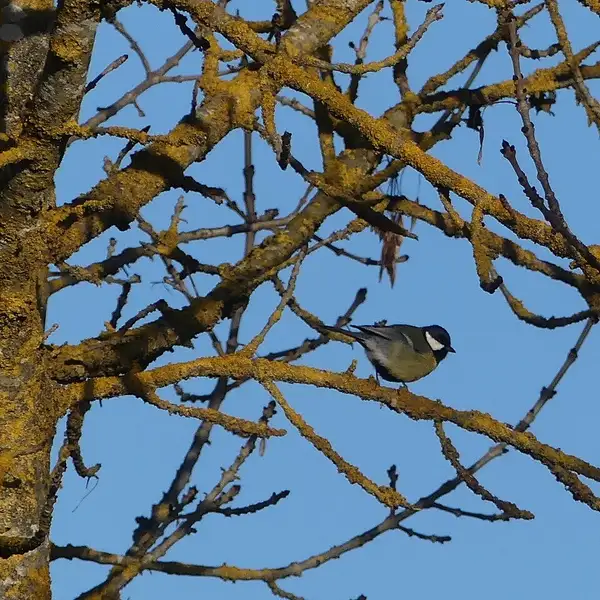
Coal Tit perched on a lichen-covered branch, with black cap, white cheek, bluish-grey back and buff bellyPhoto: Luiz Lapa from Oeiras, Portugal, CC BY 2.0Photo 1 of 4
The Coal Tit is a small bird, with dull-coloured plumage. The back and wings are bluish grey, while the breast and belly have a buff tone. Its most distinctive feature is the white patch on the nape, and when alert it shows a small crest. It is very active and explores branches, twigs, leaves and pine cones minutely.
Adult
Back and wings bluish grey; breast and belly buff.
White patch on the nape.
Small crest when alert.
Habitat and distribution of the Coal Tit
It is a tit that spreads across much of Europe and Asia, where it has several subspecies. On the Peninsula two are recognised: «ater», common in Europe and localised in the Pyrenees, and «vieirae», present in the rest of the territory.
It is found in most of our mountains and lives above all in pine woods, natural or plantation. Its abundance correlates positively with rainfall and the presence of conifers, with the highest concentrations in Gredos and the Pyrenees. Towards the north it becomes more abundant and less dependent on conifer woods, and also thrives in broadleaf ones. It does not appear in the Balearic Islands, the Canaries, Ceuta or Melilla.
It lives mainly in pine woods in cool environments: it is a montane woodland species in the centre and southern half of the peninsula, with less need of conifers and altitude as one moves through the Eurosiberian zone. Secondarily it occupies Pyrenean oak, beech, birch and holm oak woods, and even eucalyptus plantations, and sometimes urban parks of some size with conifers, native or exotic.
Hardly any data are known on its migratory movements, and it is not known whether the irruptions of central and northern European populations reach Spain. In our country it is eminently resident, recording only dispersive movements from September.
Areas where it is regularly recorded since 2010Squares of about 25 km where it is recorded regularly (occasional passage records are left out). Data from GBIF.org (243,940 records, retrieved October 2026); outline from Natural Earth.
Etymology of the Coal Tit
According to Wikipedia, Linnaeus described it in 1758 as «Parus ater», a name meaning «blackish tit» that he took from older ornithological texts. The epithet «ater» is Latin and means «matt black», and the genus «Periparus» comes from the Greek «peri» and the genus «Parus», of which it was formerly considered a subgenus. In other languages it is called «mallerenga petita» in Catalan, «ferreiriño dos piñeiros» in Galician, «pinu-kaskabeltza» in Basque and «coal tit» in English1.
Population of the Coal Tit
In the 2021 European Red List of Birds the European breeding population is estimated at between 31,500,000 and 55,700,000 mature individuals, with an increasing trend. In Spain about 2,800,000 birds are estimated to exist, with the highest densities in the Scots pine woods of the Central System and the Pyrenees. The SACRE programme data record a moderate increase in its populations between 1998 and 2018.
Unlike other woodland species, it has been markedly favoured by the artificial spread of pine, and is able to thrive without problems in the extensive, monotonous plantations without undergrowth that flood our landscape.
Nest of the Coal Tit
It usually sets it in natural or artificial cavities, whether in trunks or under roots on a bank or in the holes of a wall. The female, with the male’s help, builds a cup with a thick layer of moss mixed with spiders’ webs, which she lines with animal hair, hairy parts of plants and feathers.
Courtship and breeding of the Coal Tit
It pairs up already in the winter months, above all from January and February, starts breeding weeks later and can breed twice a year. The female lays and incubates between 5 and 10 eggs, sometimes 12, pale with reddish speckling. The male feeds her during incubation, which lasts 14–18 days. The chicks leave the nest at 16–19 days and become independent two weeks later.
Diet of the Coal Tit
It feeds on spiders and also on adult insects and their larvae, and in winter completes its diet with pine nuts. It accumulates body reserves as fat and also prepares small temporary larders in hidden places, so that it can face sudden temperature changes and periods of food scarcity, such as snowfalls, without long movements.
Curious facts about the Coal Tit
It is a little bird typical of conifer woods, very easy to detect by its incessant call, which lets you locate it on the high branches of the pine woods of our sierras1. EURING lists a Coal Tit ringed in Spain that lived 9 years and 4 months.
The Coal Tit in Cabañeros
The habitat pages of this website do not mention it, and we have not found any other published source on it in the Park. GBIF.org records 17 observations of the Coal Tit in Cabañeros and its surroundings.
Where to see the Coal Tit in Cabañeros
In Cabañeros and its surroundings, all year, in pine woods and broadleaf woods.
When
All year; it is eminently resident.
What time
By day; it is located by its incessant call.
Where
In pine woods, above all in cool environments, and secondarily in Pyrenean oak, beech, birch and holm oak woods.
What to look for
Look for the white patch on the nape; listen for its «tit-tuii» and scan the high branches of the pines.




 Same family
 Same family
 Same family
 Same order
 Same order
 Same order
 Same order
 Same order






