Record of 21 years and 5 months in the wild (a bird ringed in Switzerland and shot)
Conservation status
LC
NT
VU
EN
CR
EW
EX
Global (IUCN)
Least Concern
Spain
Least Concern (LC) in the Red Book of the Birds of Spain; not on the List of Wild Species under Special Protection or in the Spanish Catalogue of Threatened Species
When to see it
Resident
Months of the year when it is present
J
F
M
A
M
J
J
A
S
O
N
D
In Iberia
yes
yes
yes
yes
yes
yes
yes
yes
yes
yes
yes
yes
Song or voice of the Mistle Thrush
The song is very melodious, similar to that of the Common Blackbird, though somewhat faster, more repetitive and more melancholy. It usually gives a dry, fairly strident, mechanical-sounding rattle: «zer-r-r-r-r». The alarm call has the same features, but its sequence is faster and more nervous: «tr-r-r-r-r».
SongMistle Thrush
0:00 / 0:25
10 kHz5
The sonogram draws the sound: time runs from left to right, and the higher a trace sits, the higher the note.Recording by Benoît Van Hecke, xeno-canto XC534146 (Bélgica) (CC BY-SA 4.0).
Flight of the Mistle Thrush
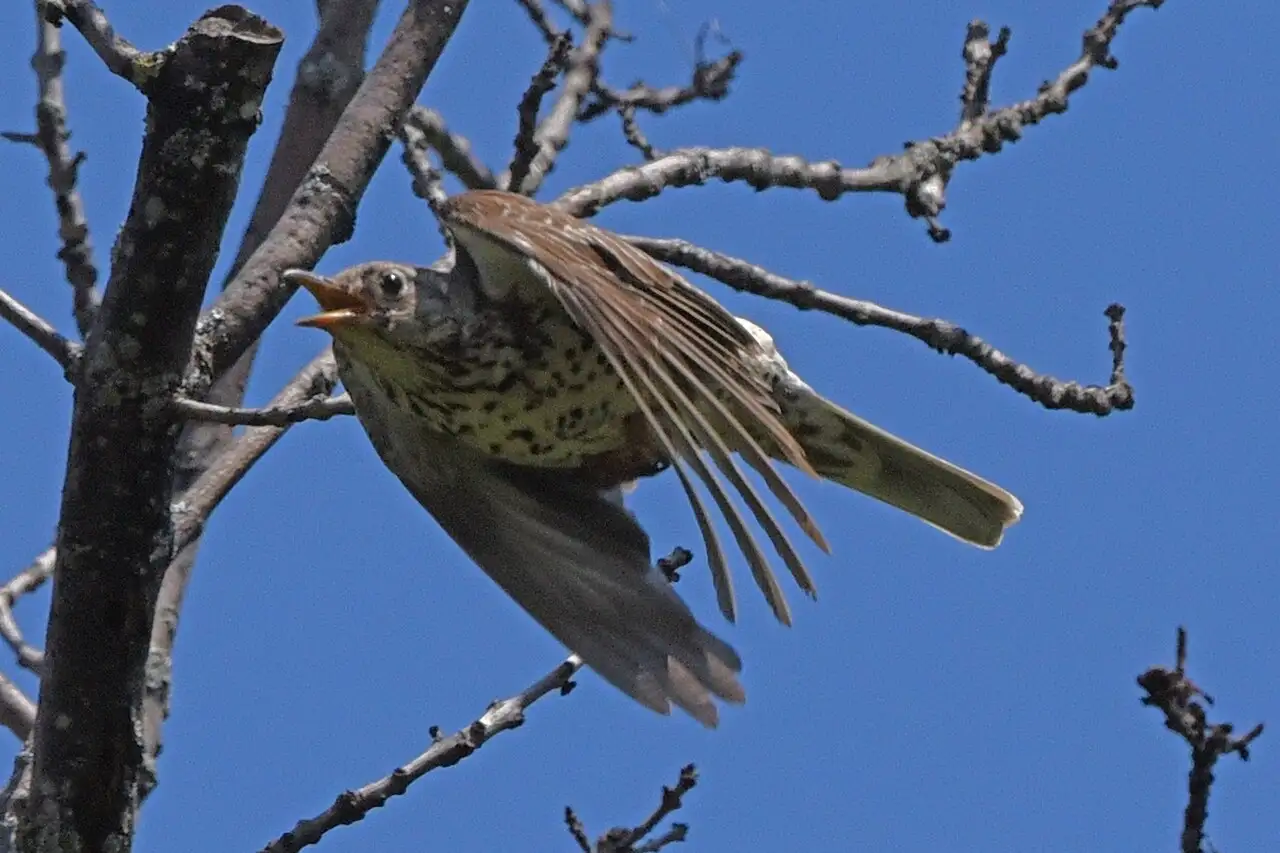
Its flight is fast and direct. In the air its long tail and white axillary region are especially visible, and set it easily apart from other thrushes.
Flight typeFast and direct
It leaves the branch or the ground, where it looks for earthworms and snails, with a dry rattle, «zer-r-r-r-r».
It crosses with a fast, direct flight. In the air the long tail and white armpits are easily seen, and set it apart from other thrushes.
It perches in a tree, upright and elongated, from where in the breeding season it sings its repetitive, melancholy tune.
Photo gallery of the Mistle Thrush
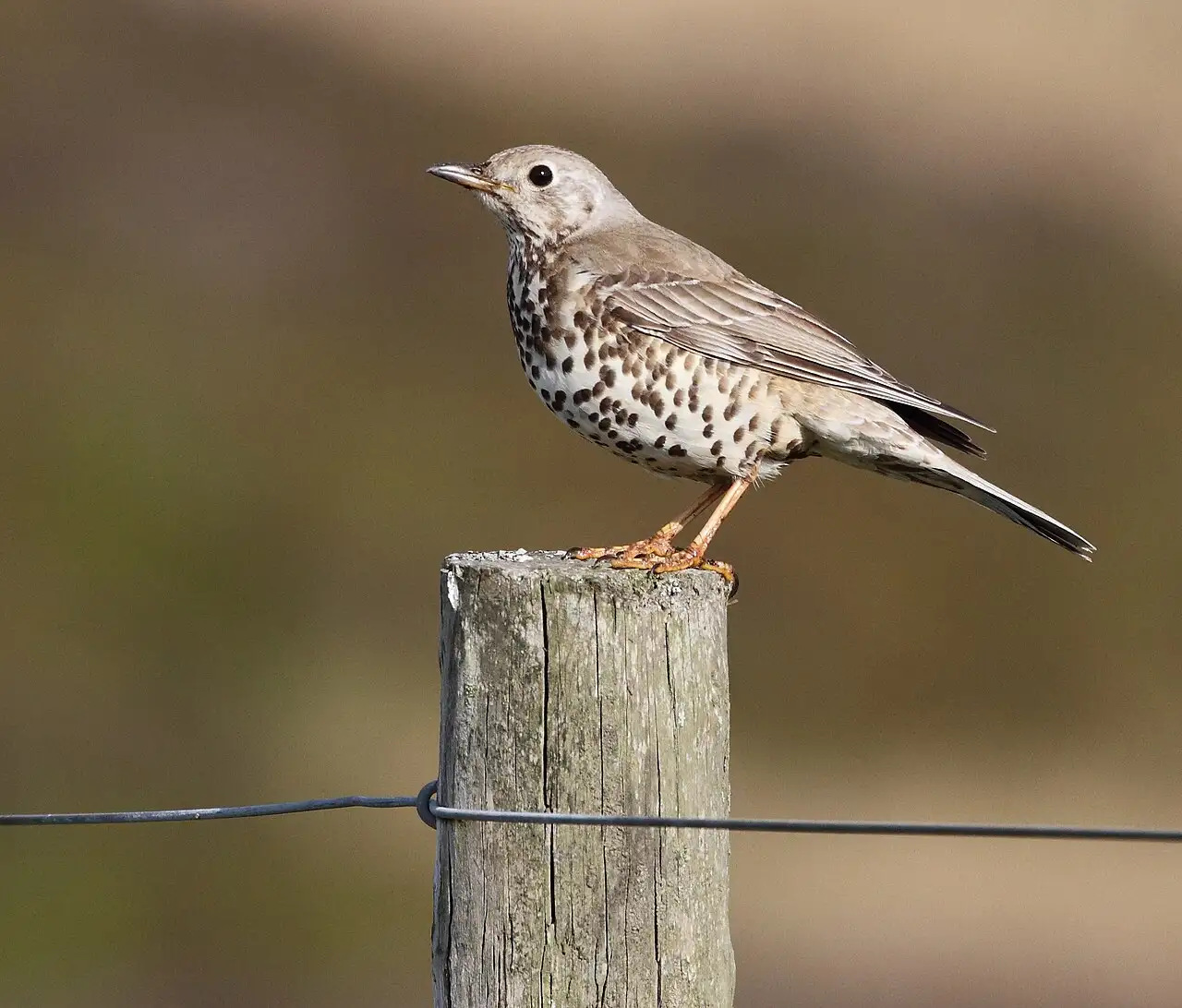
Mistle Thrush perched in profile on a wooden post, with whitish breast covered in thick dark spotsPhoto: Alun Williams333, CC BY-SA 4.0Photo 1 of 4
Mistle Thrush taking off from a branch with open wings and half-open billPhoto: Pierre-Marie Epiney, CC BY-SA 2.0Photo 2 of 4
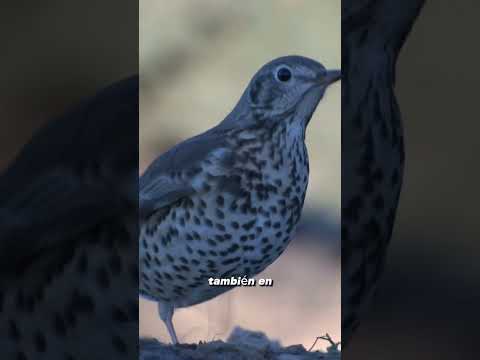
It is a large thrush, considerably stockier than the Song Thrush and more elongated and upright when perched. The upperparts are greyish brown and the underparts whitish, with a dark grey patch on the sides of the breast and heavily spotted, from the throat to the belly, with thick dark spots arranged randomly. On the face it shows an irregular pattern of grey, white and black spots.
In flight, which is fast and direct, its long tail and white axillary region are especially visible, and set it easily apart from other thrushes. Juveniles are heavily spotted with brown, ochre and white all over the plumage.
Adult
Greyish brown above and whitish below, spotted from throat to belly.
Dark grey patch on the sides of the breast.
Face with grey, white and black spots.
Young bird
Spotted with brown, ochre and white all over the plumage.
Habitat and distribution of the Mistle Thrush
It is found across all of Europe, the western half of Asia (as far as the west of the Himalaya) and the African Mediterranean strip. It has three subspecies, of which «viscivorus» is present in almost all of Europe, except Corsica and Sardinia.
It is the only thrush species with a wide distribution in Spain: it spreads across almost all the wooded or partly wooded areas of the Peninsula, and is scarce only in the driest, treeless regions of the Ebro valley, the two Castillas, large parts of southern Extremadura, the Levante and the Guadalquivir valley. It does not breed in the Balearics, the Canaries, Ceuta or Melilla, although in these places (except the Canaries) it appears as a winter visitor.
It occupies a great variety of woodland environments, both closed and open. It prefers oak and conifer woods, although it may also appear in holm oak, cork oak and Portuguese oak woods, as well as in dehesas. The presence of diverse, abundant undergrowth, or the nearness of riverside groves and banks, favours its presence, since they provide abundant invertebrates. The best densities are found in Pyrenean oak woods and montane pine woods, and it can live from sea level to very high regions (2,000 metres in the Sierra Nevada), although it preferably breeds above 1,000 metres.
The populations of northern and eastern Europe are partly migratory and move to the Mediterranean region in varying numbers, depending on how adverse the weather conditions are. Central European birds become progressively more resident the further south, so at our latitudes the whole population behaves as sedentary; only pairs breeding at high altitude come down with the arrival of winter. Scientific ringing reveals that in Spain, between October and April, wintering birds from several European countries gather, mainly Germany and the Netherlands, and a weak migratory passage is recorded through Gibraltar in autumn and early spring.
Areas where it is regularly recorded since 2010Squares of about 25 km where it is recorded regularly (occasional passage records are left out). Data from GBIF.org (134,354 records, retrieved October 2026); outline from Natural Earth.
Etymology of the Mistle Thrush
Its scientific name, «viscivorus», means «mistletoe-eater», and comes from its fondness for the sticky fruits of this plant1. In other languages it is «griva» in Catalan, «tordo charlo» in Galician, «garraztarroa» in Basque and «mistle thrush» in English1.
Population of the Mistle Thrush
In the 2021 European Red List of Birds the European breeding population is estimated at between 7,300,000 and 13,600,000 mature individuals, with a stable trend. The current Spanish population is estimated at 1,660,000 birds, with the most important concentrations in Castilla y León, Castilla-La Mancha, Aragón, Andalusia, Catalonia and Extremadura. The trend, although fluctuating, was moderately increasing between 1998 and 2018, according to the results of the SACRE programme.
It adapts to a multitude of environments, but, like almost all birds, is affected by habitat loss and modification: urban expansion and agricultural intensification reduce both its food sources and its breeding sites. It is not a bird under significant hunting pressure, although in some regions of the Basque Country excessive hunting can be a serious problem for breeding populations.
Nest of the Mistle Thrush
Nests can be seen under construction as early as February, and are usually placed high up, in the fork of a tree. They are made of various plant materials and other items, such as paper or feathers, reinforced with mud and lined inside with finer materials. The female, who does the building, often decorates the edges with green leaves, plastic or petals.
Courtship and breeding of the Mistle Thrush
The breeding season starts early. Laying takes place around April and consists of three to five eggs of a soft bluish or greenish colour, which the female incubates for 12–15 days. Some relief by the male in incubation has been cited, but it is not considered usual behaviour. Both parents feed the chicks for 12–15 days and, once they leave the nest, depend on them for at least two weeks more, until they become independent. It usually lays a second clutch, and even a third, in the same season.
Diet of the Mistle Thrush
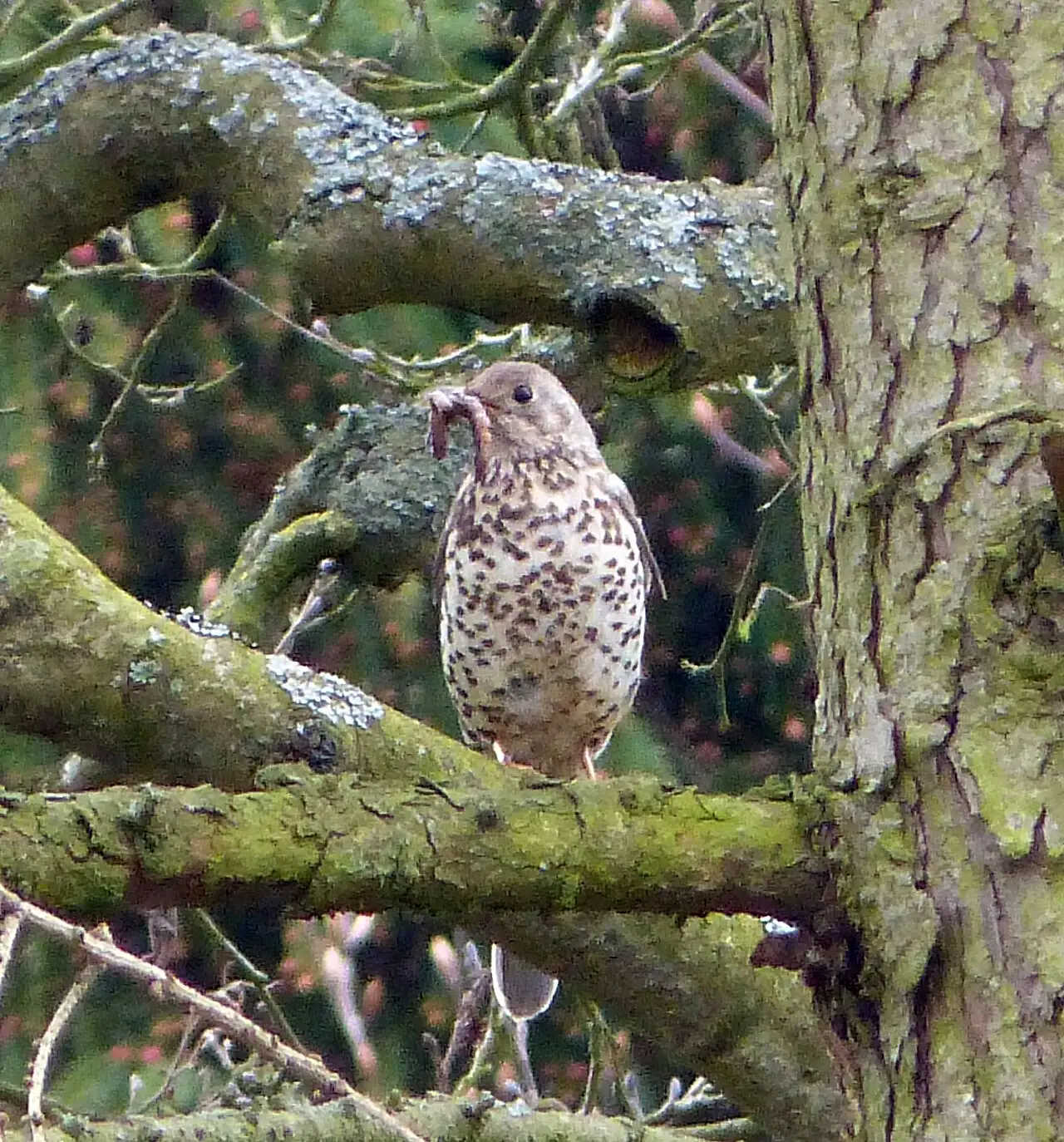
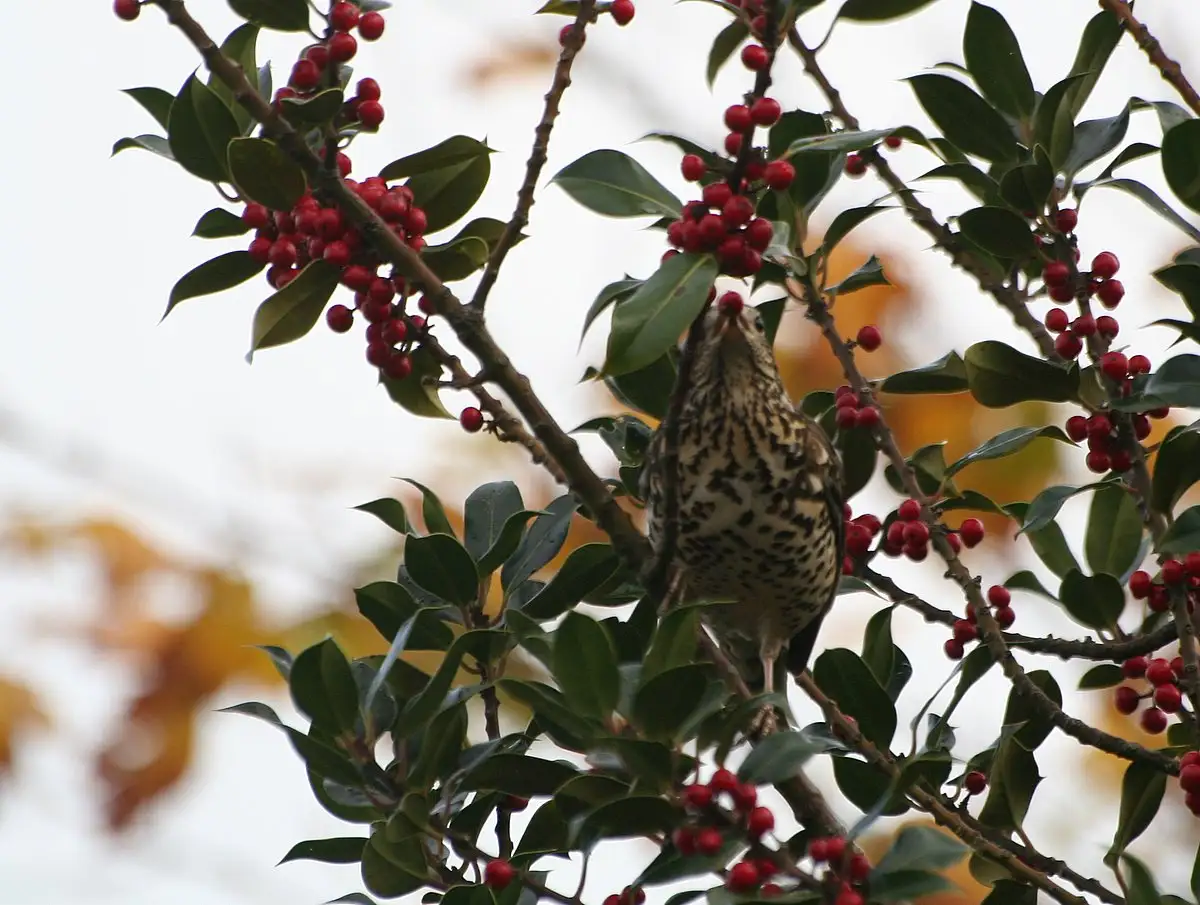
The diet is made up of a wide repertoire of invertebrates (insects, snails, earthworms, spiders…) and plant foods, such as fruits and seeds, with animal food predominating in spring and summer. In conifer woods it is especially fond of the sticky fruits of mistletoe, a habit from which its scientific name derives.
Curious facts about the Mistle Thrush
It is the largest of the thrushes of western Europe. Its song recalls that of the Common Blackbird. According to EURING, the ringed bird that lived longest, shot in Switzerland, reached 21 years and 5 months; another was checked in Belgium at 14 years and 2 months.
The Mistle Thrush in Cabañeros
The habitat pages of this website do not mention it. GBIF.org records 178 observations of the Mistle Thrush in Cabañeros and its surroundings.
Where to see the Mistle Thrush in Cabañeros
In Cabañeros and its surroundings, all year.
When
All year: in Spain it is sedentary, and in winter birds from other European countries join it, from October to April.
What time
In good light, in woods and dehesas with tall trees and, if possible, with undergrowth or a riverbank nearby.
Where
On top of a tree, from where it sings, or on the ground, looking for earthworms and snails.
What to look for
Look for the whitish breast with thick spots, its size and, in flight, the long tail and white armpits.



 Same family
 Same family
 Same family
 Same order
 Same order
 Same order
 Same order
 Same order






