In pairs in the breeding season; in winter, in mixed flocks with other tits
Lifespan
Record of almost 15 years in the wild
Conservation status
LC
NT
VU
EN
CR
EW
EX
Global (IUCN)
Least Concern
Spain
Included in the List of Wild Species under Special Protection; not in the Spanish Catalogue of Threatened Species
When to see it
Resident
Months of the year when it is present
J
F
M
A
M
J
J
A
S
O
N
D
In Iberia
yes
yes
yes
yes
yes
yes
yes
yes
yes
yes
yes
yes
Breeding season
no
no
no
yes
yes
yes
yes
no
no
no
no
no
Song or voice of the Eurasian Blue Tit
A high, thin call, a «tiit-tiit-tutu» that slides down into a trill, and that it often finishes with a sort of giggle. It is much less powerful than the Great Tit’s, with which it shares woodland, and we almost always hear it before we see it.
SongEurasian Blue Tit
0:00 / 0:09
10 kHz5
The sonogram draws the sound: time runs from left to right, and the higher a trace sits, the higher the note.Recording by Vladimir Yu. Arkhipov, Wikimedia Commons (CC BY-SA 3.0).
Flight of the Eurasian Blue Tit
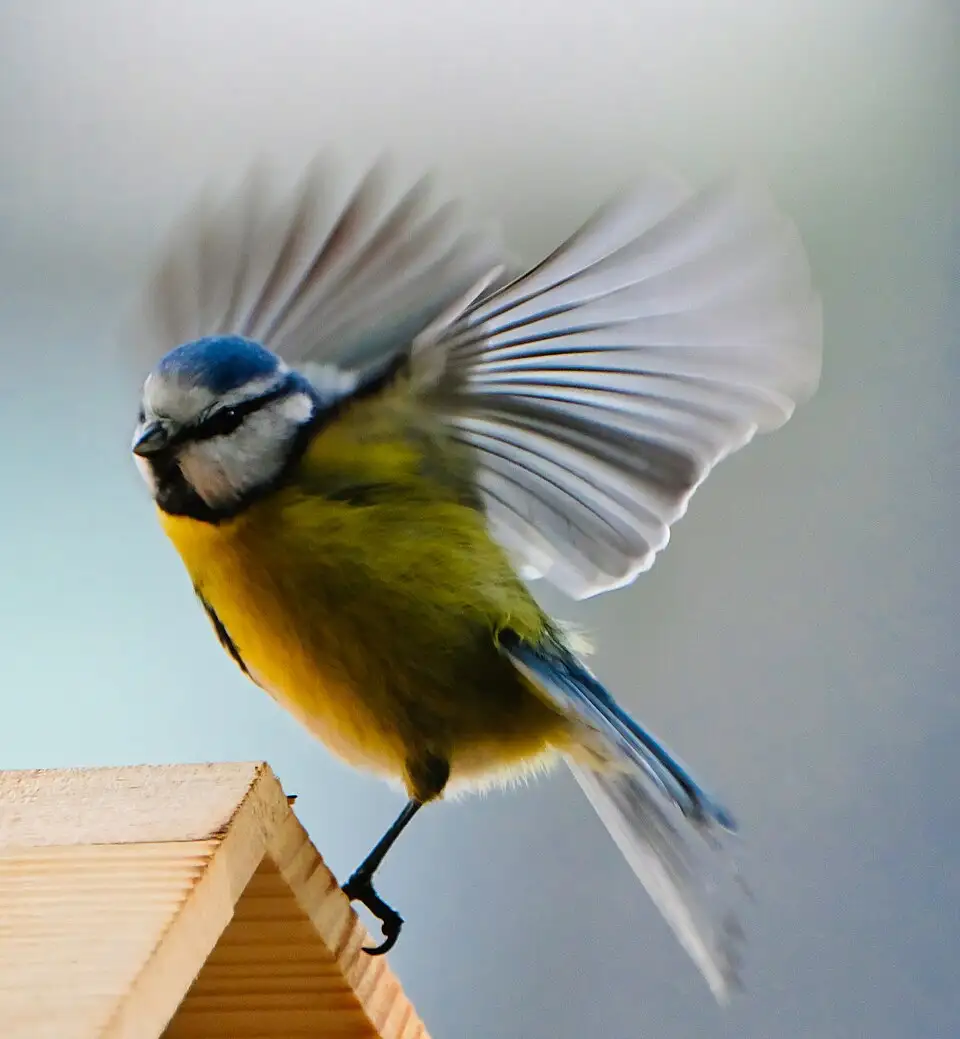
It is a short, nervous flight, from branch to branch: a few quick wingbeats lift it and it drops with its wings folded, over stretches of a few metres. It rarely crosses a large clearing and spends most of the day hopping, climbing and hanging from the thinnest branches.
Flight typeShort, undulating and nervous
It leaves the branch with a buzzing flutter, almost without warning. It is never still: it hops, hangs upside down and hops again.
Short, undulating flight: a few quick wingbeats lift it and it drops with its wings folded, over stretches of a few metres.
It brakes with its tail spread and wings extended and hangs from a fine branch, where it goes on looking for bugs.
Photo gallery of the Eurasian Blue Tit
Eurasian Blue Tit in full flutter beside a nest box: wings open and blue tailPhoto: David Lienhard, CC BY-SA 3.0Photo 1 of 4
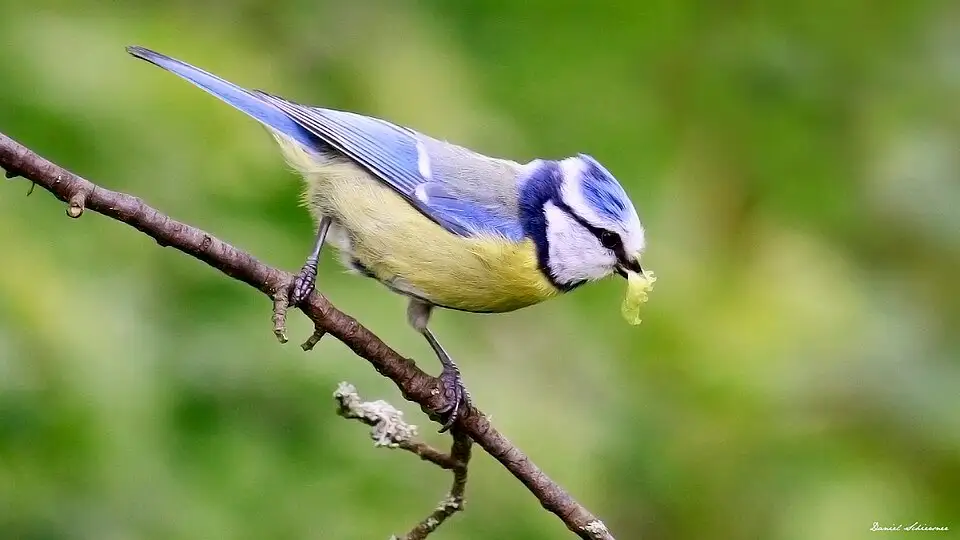
Eurasian Blue Tit on a thin branch with a caterpillar in its bill, in profilePhoto: Daniel Schiersner, CC BY 2.0Photo 2 of 4
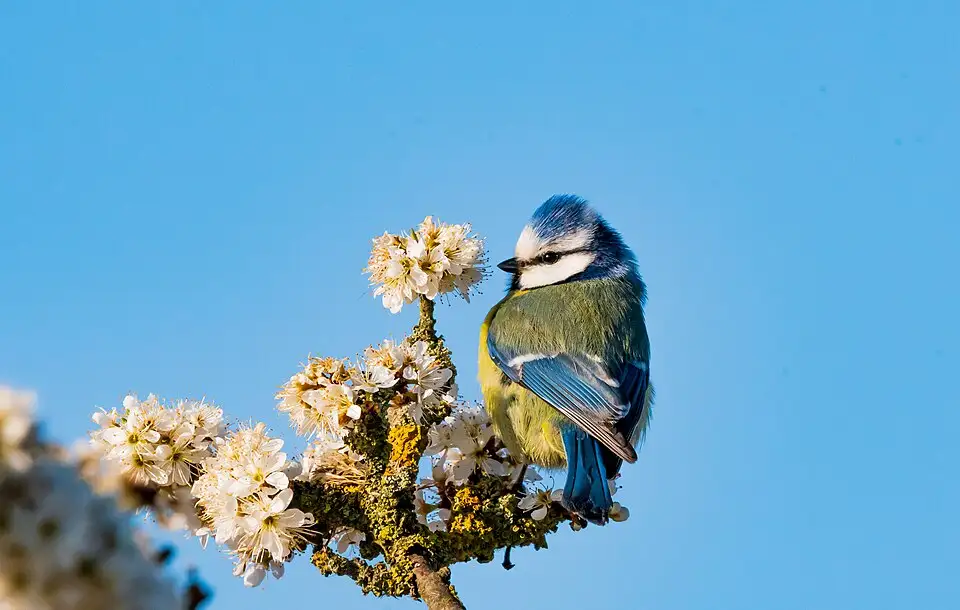
Eurasian Blue Tit perched among blackthorn blossom, seen from behind: blue wings and tailPhoto: Canaturephoto, CC BY-SA 4.0Photo 3 of 4
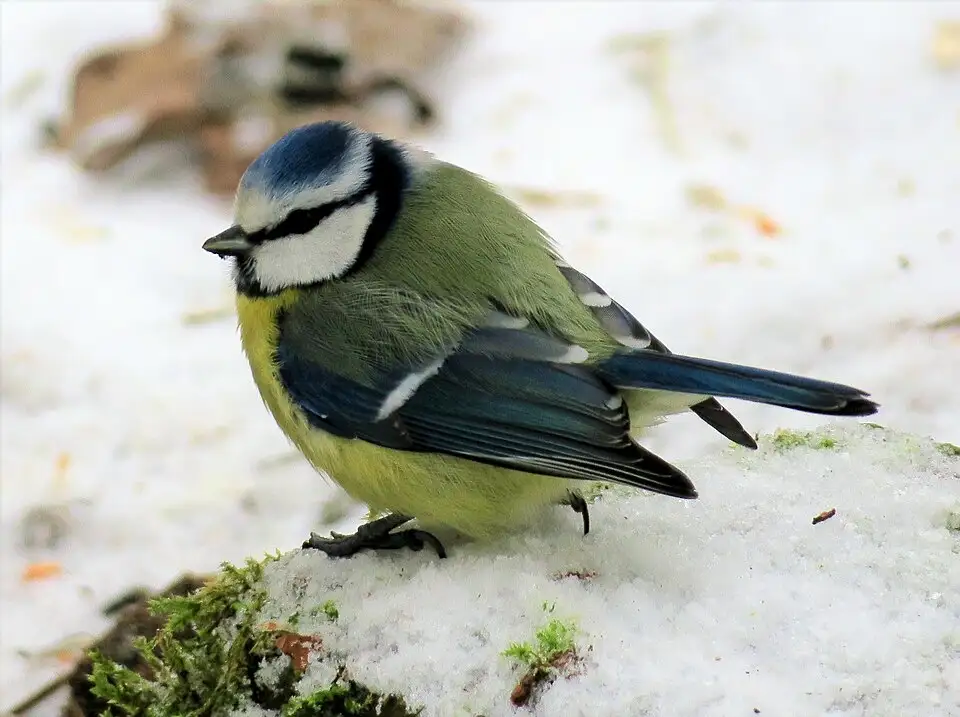
It is hard to confuse, but there are two details worth bearing in mind. The sexes are very alike: the male has a somewhat brighter cap and a broader dark band on the neck, but at a glance they cannot be told apart. And young birds, the fledglings, have pale yellow cheeks instead of white, which sometimes makes us doubt in early summer.
Adult
Cap, wings and tail a vivid blue.
White cheeks, with a black line through the eye and a dark blue collar.
Greenish back and yellow underparts.
Young bird
Duller colours, with a greenish cap.
Pale yellow cheeks.
Habitat and distribution of the Eurasian Blue Tit
It ranges over much of Europe, from the British Isles to the Urals. The populations of North Africa and the Canaries, which were considered the same species, have recently been split off as the African Blue Tit (Cyanistes teneriffae).
In Spain it appears in every peninsular province and in the Balearics, but avoids areas without trees: it is rare in the middle of the Ebro valley, in the south-east or in some areas of the Guadalquivir valley. It prefers deciduous woods, although it is also very frequent in evergreen broadleaf woods, such as holm oak and cork oak woods, and occupies dehesas, parks and vegetable plots. It can climb up to 2,000 metres in the southern ranges, and in winter it comes down and explores all kinds of habitats, even reedbeds.
Areas where it is regularly recorded since 2010Squares of about 25 km where it is recorded regularly (occasional passage records are left out). Data from GBIF.org (640,545 records, retrieved October 2026); outline from Natural Earth.
Etymology of the Eurasian Blue Tit
«Cyanistes» comes from the Greek «κυάνεος» (kyáneos), the dark blue from which we also get «cyan»; and «caeruleus» is the Latin «cerulean», blue. Two ways of saying the same thing for a bird that leaves no room for doubt. In Spanish «herrerillo» is a diminutive of «herrero» («blacksmith»), as «carbonero» is of «carbón» («charcoal»); both names come from trades, although it is not clear why.
Population of the Eurasian Blue Tit
It is the most abundant tit on the Peninsula. 8,545,223 birds are calculated, with a positive trend between 1998 and 2018, and in spring it reaches up to 20 birds per 10 hectares in montane broadleaf woods1. In Europe, the 2021 Red List estimates between 59.7 and 95.1 million mature individuals, and growing. It is classified as Least Concern. What does affect it is the loss of woodland, insecticides against forest pests and the lack of holes to breed in.
Nest of the Eurasian Blue Tit
The female builds the nest in a hole: that of an old trunk, a stone wall or a nest box. She lines it with moss, wool, grasses, dry leaves, hair and cobwebs, and finishes it with hair, down and feathers. It is so fond of nest boxes that they are a good help to the species, as long as they are placed and maintained well: badly managed, they make it easier for eggs, chicks or even adults to be eaten.
Courtship and breeding of the Eurasian Blue Tit
It usually raises a single brood a year, although in some populations they make two clutches. It lays 6 to 12 white eggs with reddish spots, which only the female incubates for 12 to 16 days. The chicks are fed by both parents and leave the nest at three weeks. Such a large family needs a huge amount of food, and that is why breeding is timed to when caterpillars are abundant.
Diet of the Eurasian Blue Tit
Although we call it insect-eating, it is not strictly so. It eats spiders, beetles, flies, butterfly larvae, bugs and other invertebrates that it looks for on the thinnest branches, often hanging upside down. But it also pecks at buds, seeds, including pine nuts, and the pulp of fleshy fruits such as blackberries, figs, elderberries or olives.
Curious facts about the Eurasian Blue Tit
Blue Tits see ultraviolet, and under that light the blue cap shines much more than we perceive it: for them it is a lure in courtship. In hard winters they join Great Tits, Long-tailed Tits and nuthatches in mixed flocks that move through the woods together, and that makes them easier for us to find: when we hear one, there are usually more nearby.
The Eurasian Blue Tit in Cabañeros
The pages on the birds of Cabañeros place it among the most abundant species of the oak woods: in deciduous woodland, tits stand out in number and, among them, the Blue Tit, together with the Common Chaffinch and the European Robin. We also see it in the dehesas, where it looks for insects among the branches of the trees, and in the sclerophyllous forest, among the birds that feed both in trees and shrubs and on the ground. In scrub it is less abundant.
Where to see the Eurasian Blue Tit in Cabañeros
Wherever there are old trees: the oak woods of the damper areas, the holm oak dehesas and holm oak woods, above all at the edges and in clearings.
When
All year round. In winter it is easier to see, because it moves in mixed flocks and comes close to woodland clearings.
What time
From first thing in the morning to mid-afternoon. It is active all day, with no dead hours.
Where
On the thin branches of Pyrenean oaks, holm oaks and Lusitanian oaks, and beside springs and the tree-lined edges of tracks.
What to look for
A blue and yellow little bird that never keeps still: it hops, hangs upside down and rummages at the tips of branches, with thin, high calls.



 Same family
 Same family
 Same family
 Also in sclerophyllous woodland
 Also in sclerophyllous woodland
 Also in sclerophyllous woodland
 Also in sclerophyllous woodland
 Also in sclerophyllous woodland






