Not especially gregarious, but in autumn and winter it can form small groups of 2 to 10 individuals, often within mixed flocks with other tits, treecreepers and goldcrests
Lifespan
Record of 11 years and 11 months in the wild (a bird ringed in Finland and checked by the ringer)
Conservation status
LC
NT
VU
EN
CR
EW
EX
Global (IUCN)
Least Concern
Spain
Least Concern (LC) in the Red Book of the Birds of Spain; on the List of Wild Species under Special Protection, but not in the Spanish Catalogue of Threatened Species
When to see it
Resident
Months of the year when it is present
J
F
M
A
M
J
J
A
S
O
N
D
In Iberia
yes
yes
yes
yes
yes
yes
yes
yes
yes
yes
yes
yes
Song or voice of the European Crested Tit
Its daily activity is accompanied by high calls, «rir-rir-rirrir…», which recall a goldcrest’s, but which it finishes with a note as characteristic as it is hard to transcribe: «chrr-rr-rr-rar».
SongEuropean Crested Tit
0:00 / 0:22
10 kHz5
The sonogram draws the sound: time runs from left to right, and the higher a trace sits, the higher the note.Recording by Joost van Bruggen, xeno-canto XC433387 (Países Bajos) (CC BY-SA 4.0).
Flight of the European Crested Tit
It is a small, restless bird, which explores both the ground and, above all, the bark, branches and leaves of trees.
Flight typeShort and undulating among the branches
Small and restless, it leaves the branch with high calls, «rir-rir-rirrir», which it finishes with a note hard to transcribe, «chrr-rr-rr-rar».
It explores the bark, branches and leaves of trees, often in mixed flocks with other tits, treecreepers and goldcrests.
It lands on another branch or on a stump, where it looks for insects and spiders; it also stores seeds.
Photo gallery of the European Crested Tit
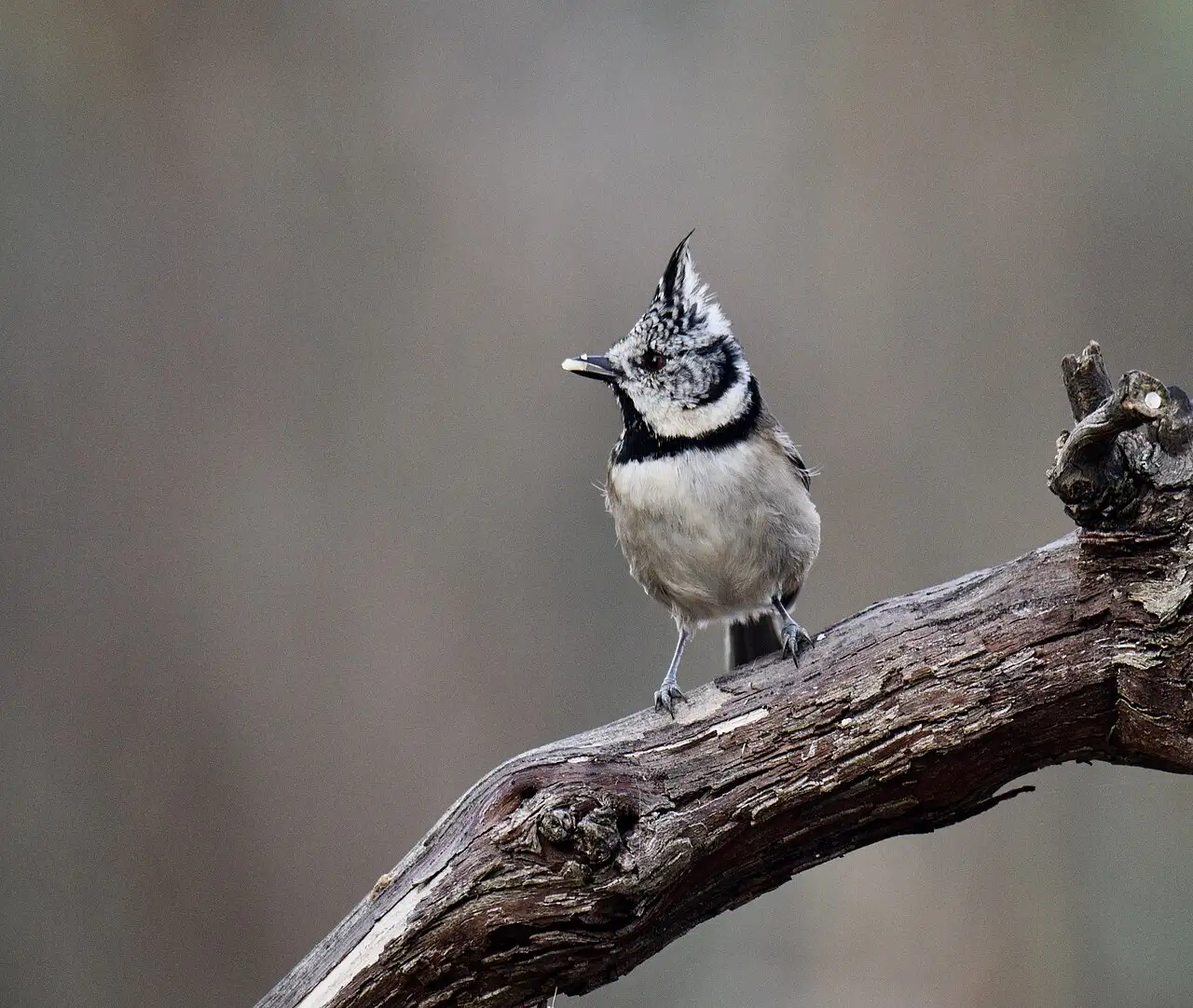
European Crested Tit perched from the front on a twisted branch, with the triangular crest erect and the face with black and white bandsPhoto: Luiz Lapa from Oeiras, Portugal, CC BY 2.0Photo 1 of 4
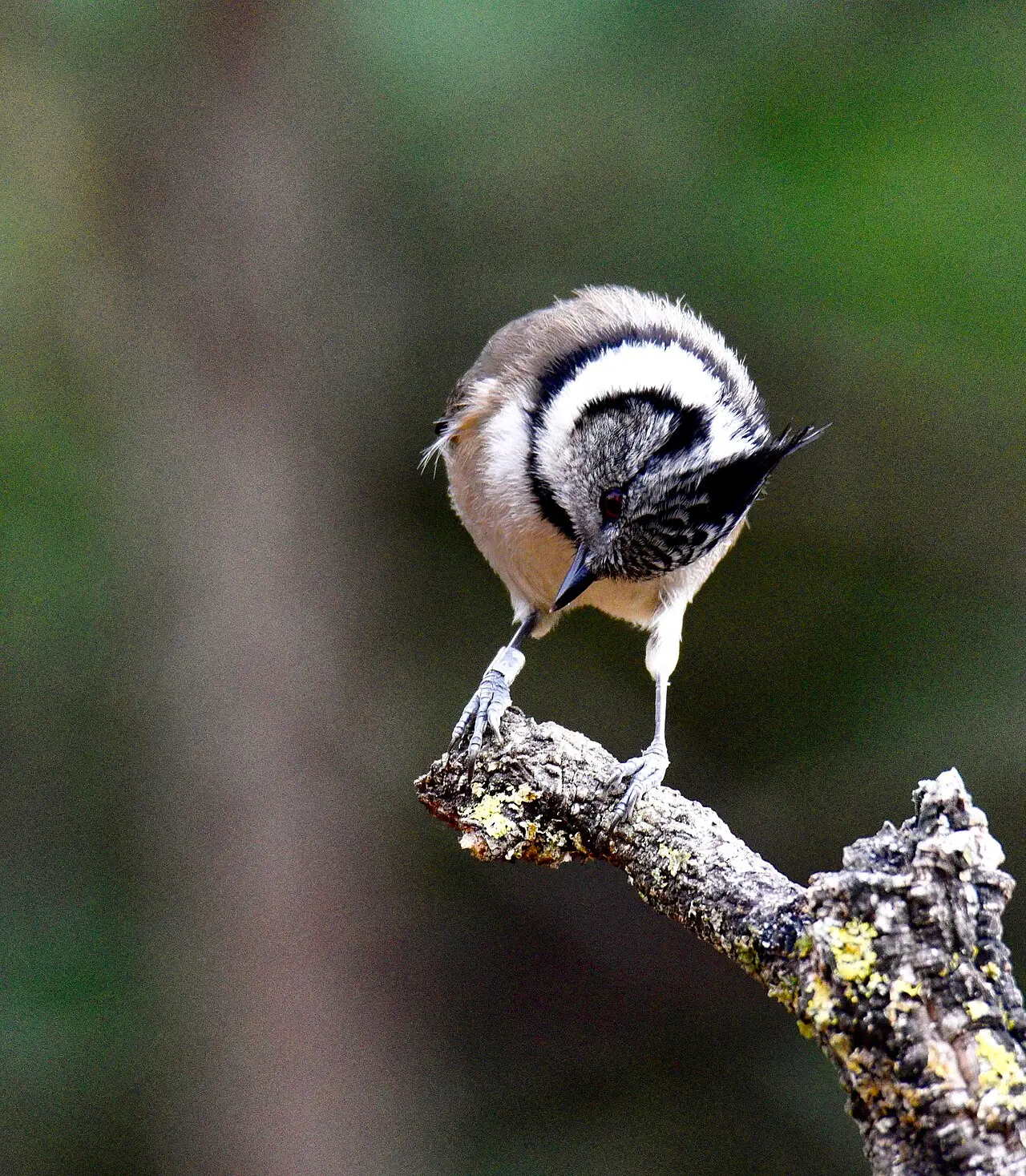
European Crested Tit seen from above, looking down from a lichen-covered branch, with the black necktie in the form of a collarPhoto: Luiz Lapa from Oeiras, Portugal, CC BY 2.0Photo 2 of 4
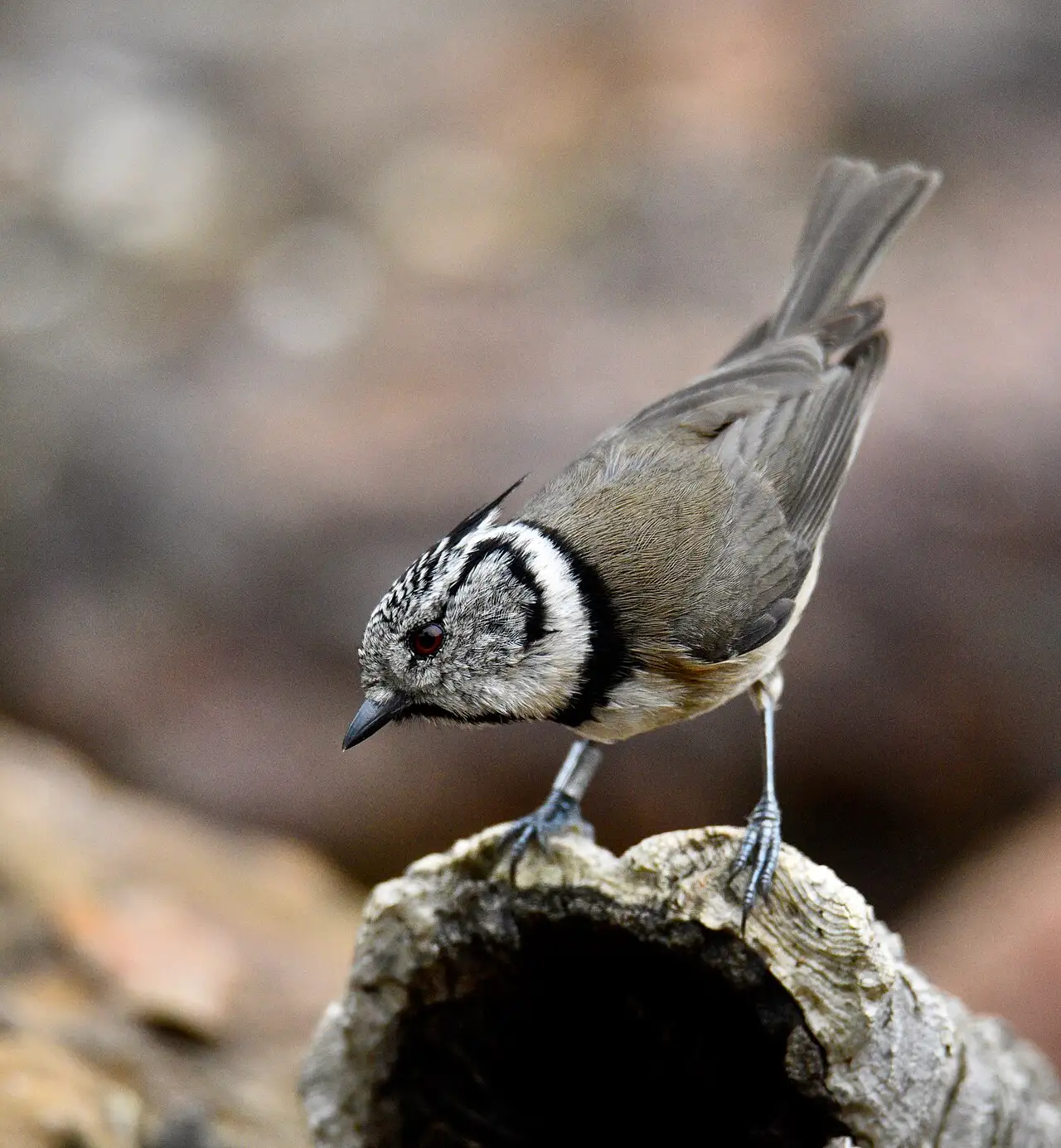
The European Crested Tit is a small, restless little bird of unmistakable appearance, thanks above all to its characteristic triangular, pointed crest of white and black feathers, which it habitually raises. Its face is also a play of black and white bands. It has a conspicuous black necktie that extends like a collar. It also has a black eye line and another that runs across the cheek, always on a pale or white background. By contrast, the back, wings and tail are dark brown, which contrasts with the flanks, breast and belly, of a very dull buff-grey tone.
Adult
Triangular, pointed crest of white and black feathers.
Face with black and white bands and black necktie in the form of a collar.
Back, wings and tail dark brown; underparts buff grey.
Habitat and distribution of the European Crested Tit
It is found over much of Europe, from the Urals and the southern half of Scandinavia to the Iberian Peninsula. It has several subspecies: in the centre and north of the Peninsula «mitratus» lives, the typical Central European one, and in the south-western quadrant, from Gredos to the ranges of Cádiz, «weigoldi» is recognised, smaller and darker.
It has been recorded with very variable abundance across the whole territory, although it is very scarce in the treeless areas of the great depressions (Tagus, Duero, Ebro and Guadalquivir) and in the semi-arid south-east (Murcia and Almería), and its presence is also scarcer in the plateau areas, above all on the southern plateau. It does not appear in the Balearics, the Canaries, Ceuta or Melilla.
It is a woodland bird and lives in various kinds of forest. It seems to prefer pine woods, natural or planted, of maritime pine, Scots pine and Monterey pine, but it is also abundant in stands of cork oak, Pyrenean oak, holm oak or Spanish juniper. Like the Coal Tit and other tits, it lives in conifer woods, but is also found in broadleaves (deciduous and evergreen) and is seen in landscaped areas.
It is basically sedentary, and even stays in high-altitude woods if winter storms are not prolonged.
Areas where it is regularly recorded since 2010Squares of about 25 km where it is recorded regularly (occasional passage records are left out). Data from GBIF.org (151,261 records, retrieved October 2026); outline from Natural Earth.
Etymology of the European Crested Tit
According to Wikipedia, «Lophophanes» comes from ancient Greek «lophos» («crest») and «phaino» («to show»), and «cristatus» is «crested» in Latin. In other languages it is called «mallerenga emplomallada» in Catalan, «ferreiriño cristado» in Galician, «amilotx mottoduna» in Basque and «European crested tit» in English1.
Population of the European Crested Tit
In the 2021 European Red List of Birds the European breeding population is estimated at between 9,230,000 and 16,500,000 mature individuals, with a decreasing trend. The Spanish population could amount to 2,193,026 individuals, according to the III Atlas of Breeding Birds, with the highest records in Castilla y León and Catalonia. The general trend is stable, with increases in the Mediterranean and Eurosiberian regions, offset by declines in the Alpine population.
It seems favoured by the expansion of pine woods through reforestation, but, as it needs cavities, which are only common in old and dead trees, the real influence of conifer plantations is not necessarily positive. It benefits from variability in the stage of development of the trees in woodland. The spraying of pine woods to control the pine processionary caterpillar and the decline of the insects it feeds on are also threat factors.
Nest of the European Crested Tit
Building the nest falls to the female, and the male helps. It is located in natural holes in trunks and stumps, and sometimes the female excavates or touches up the cavity. It also dares to set it among the branches of a raptor’s nest, regardless of whether it is occupied. For the cup it uses mainly moss with cobwebs, and lines the inner walls with hair, wool and feathers.
Courtship and breeding of the European Crested Tit
It begins breeding in April and May, although females incubating already in March have been recorded, above all in the southern half of Spain. Here it usually makes two clutches, but the populations of central and northern Europe breed only once a year. Females lay between three and nine eggs, white with purple or reddish-brown spots, and incubate them for up to 18 days. Both sexes feed the chicks, and the male helps especially when the female begins to build a second nest. The chicks fly after three weeks.
Diet of the European Crested Tit
It feeds all year round on seeds (pine nuts and juniper berries), spiders and insects, and the latter are the most important part of its diet. It stores seeds and, to a lesser extent, insects.
Curious facts about the European Crested Tit
It is present only on the Iberian Peninsula and does not appear in the Balearics or the Canaries. According to EURING, the longest-lived ringed bird, in Finland, reached 11 years and 11 months; AnAge gives 11.6 years.
The European Crested Tit in Cabañeros
The habitat pages of this website do not mention it. GBIF.org records 108 observations of the European Crested Tit in Cabañeros and its surroundings.
Where to see the European Crested Tit in Cabañeros
In Cabañeros and its surroundings, all year.
When
All year: it is resident.
What time
In good light, in pine woods and also in cork oak woods, Pyrenean oak woods and holm oak woods.
Where
On the branches and bark of trees, above all in autumn and winter, in mixed flocks with other tits, treecreepers and goldcrests.
What to look for
Look for the triangular crest, the striped face and the black necktie, and listen for its «rir-rir-rirrir».






 Same family
 Same family
 Same family
 Same order
 Same order
 Same order
 Same order
 Same order






