Gregarious: found both in isolated pairs and in colonies (oiseaux.net and Wikipedia)
Lifespan
Record of 9 years in the wild (a bird ringed in Spain and checked by the ringer)
Conservation status
LC
NT
VU
EN
CR
EW
EX
Global (IUCN)
Least Concern
Spain
Least Concern (LC) in the Red Book of the Birds of Spain; on the List of Wild Species under Special Protection, but not in the Spanish Catalogue of Threatened Species
When to see it
Resident
Months of the year when it is present
J
F
M
A
M
J
J
A
S
O
N
D
In Iberia
yes
yes
yes
yes
yes
yes
yes
yes
yes
yes
yes
yes
Breeding season
no
no
no
yes
yes
yes
yes
yes
no
no
no
no
Song or voice of the Rock Sparrow
Its calls are fairly high and nervous. The most typical call is a short, quick «tvit», or a «tviyuiit» that speeds up at the end. The song is a «tvii-turr-tvirii».
SongRock Sparrow
0:00 / 0:21
10 kHz5
The sonogram draws the sound: time runs from left to right, and the higher a trace sits, the higher the note.Recording by Carlo Fracasso, Wikimedia Commons (CC0).
Flight of the Rock Sparrow
On the tail it has white spots towards the ends, which are clearly visible in flight.
Flight typeUndulating, over open terrain
It leaves the cliff, the country building or the bank where it nests, with a short, quick call, «tvit».
It flies over open areas, of rock faces and fields. In flight the white spots towards the ends of the tail can be seen clearly.
It lands at the top of a rock face or comes down to the ground, where it looks mainly for seeds.
Photo gallery of the Rock Sparrow
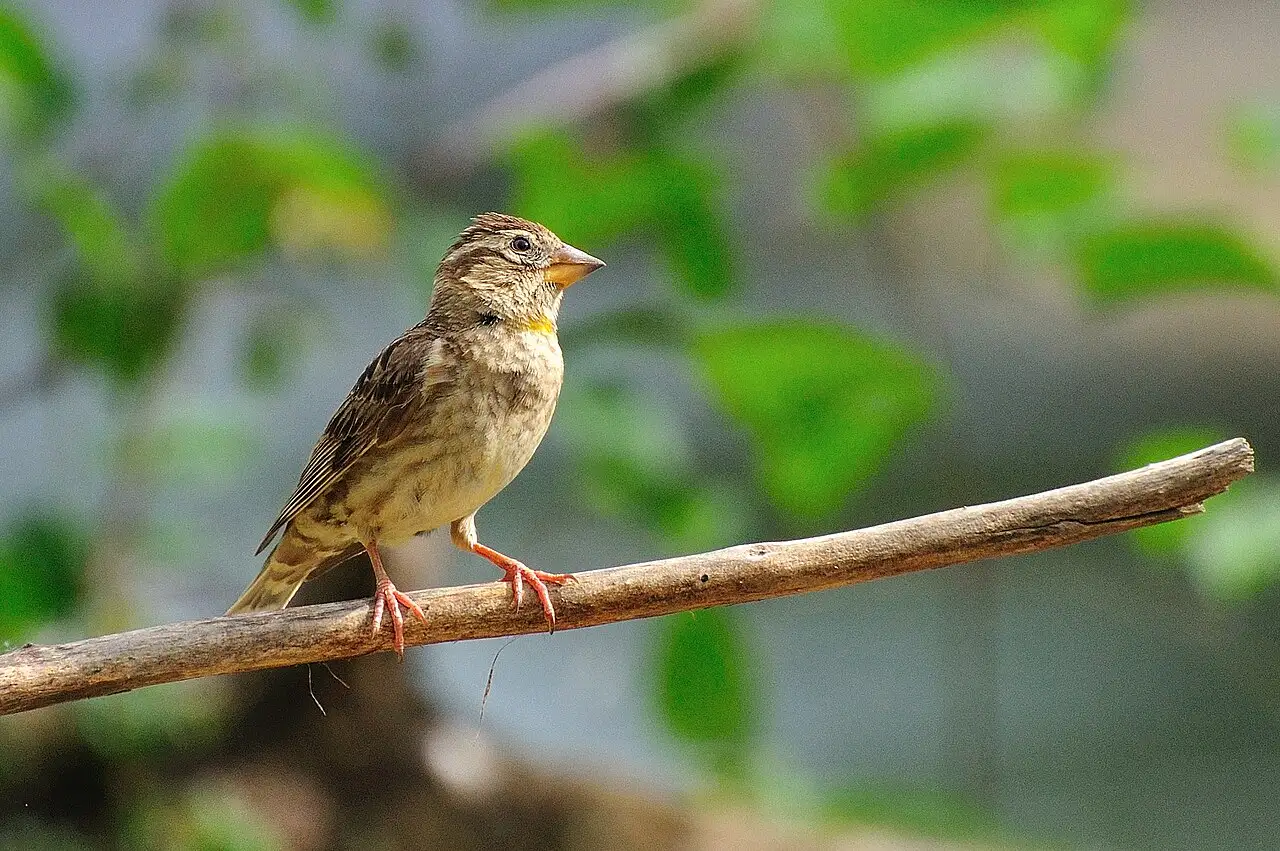
Rock Sparrow perched on a dry branch, with streaked greyish-brown plumage, strong bill and pink legsPhoto: Sandra from France, CC BY 2.0Photo 1 of 4
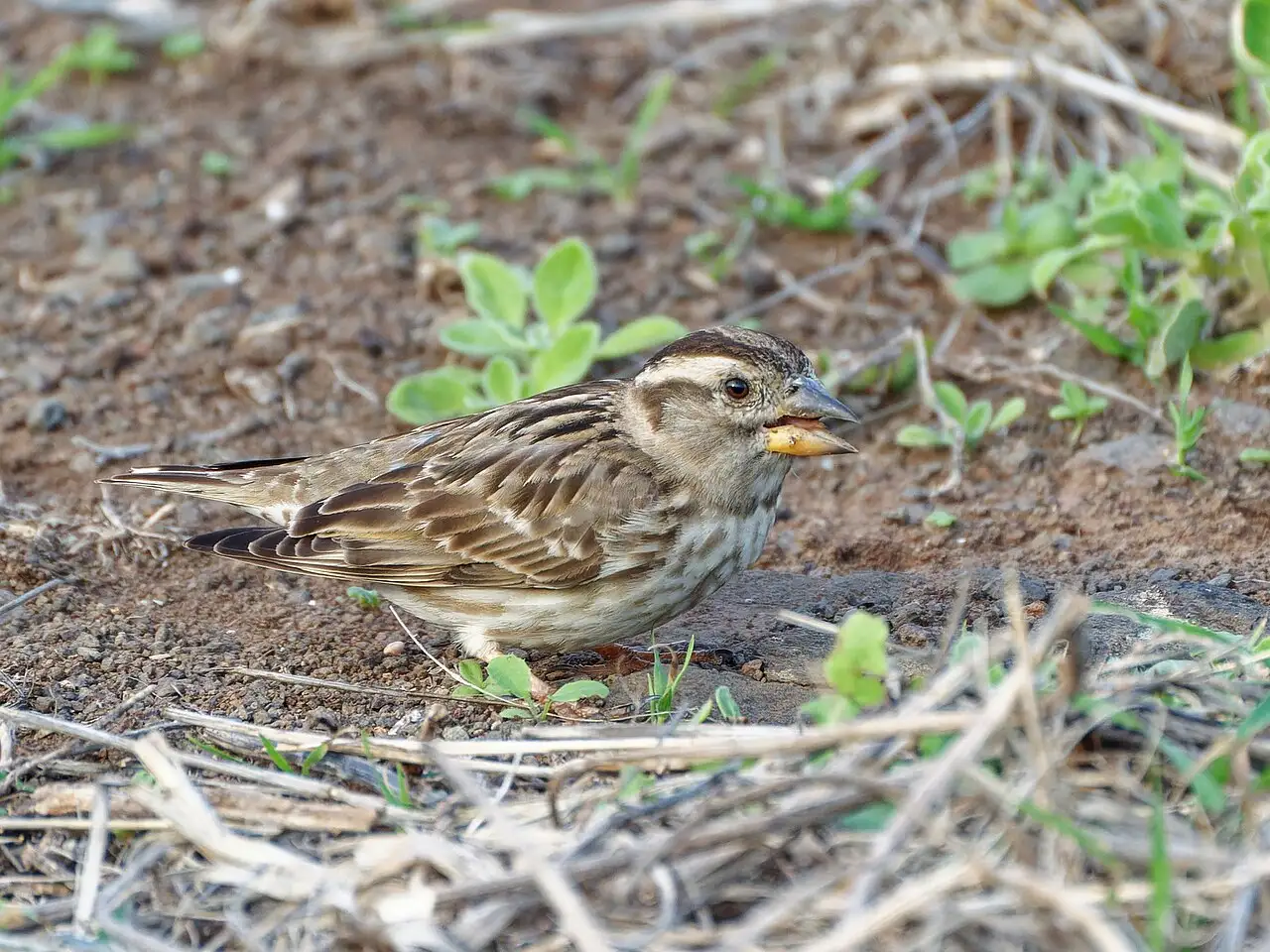
Rock Sparrow on the ground, with the broad stripes on the head clearly visible and a little yellow on the billPhoto: Donald Davesne from Paris, France, CC BY 2.0Photo 2 of 4
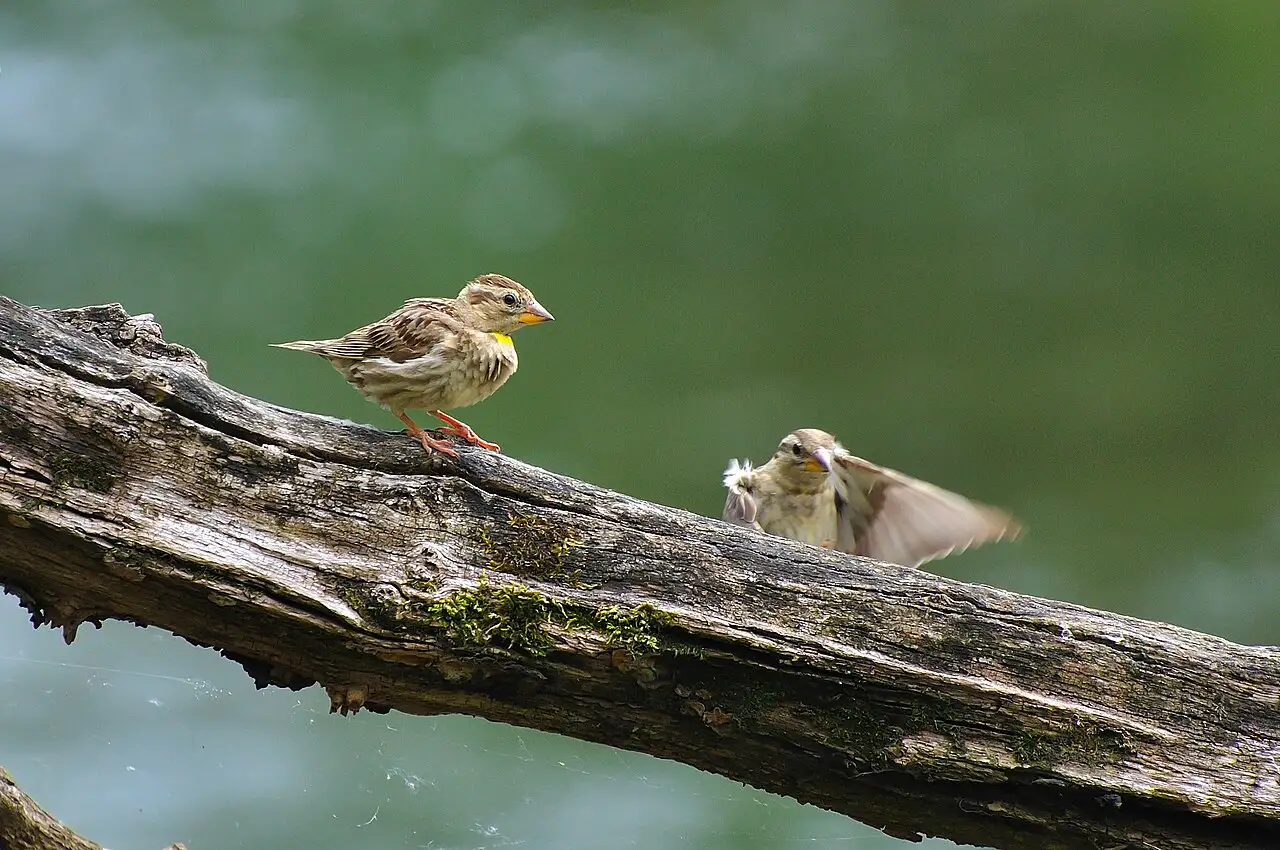
Rock Sparrow perched on a dry trunk beside another bird flapping its wingsPhoto: Sandra from France, CC BY 2.0Photo 3 of 4
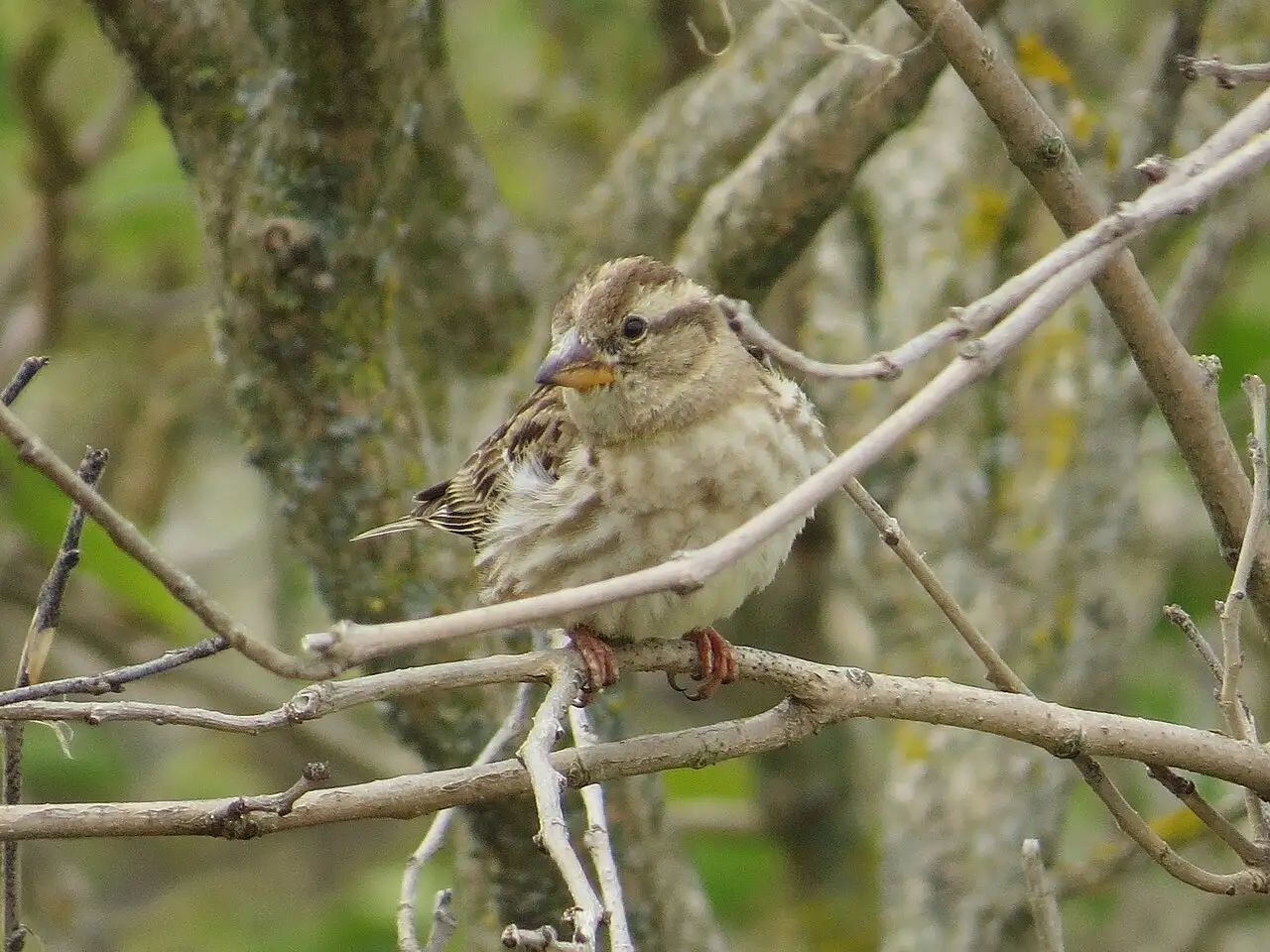
Rock Sparrow in profile on a branch, with robust head and very strong billPhoto: MPF, CC BY-SA 4.0Photo 4 of 4
1 / 4
Identification of the Rock Sparrow
It is a large, stocky sparrow, with a robust head and a very strong bill. Greyish-brown tones dominate its plumage, with profuse dark streaking on the back. The underparts, by contrast, are pale and adorned with broad stripes of brownish grey. On the head three broad stripes stand out: a pale one; another greyish brown behind the eye, below it, and, above, a dark brown one. Another pale brown stripe runs along the crown. Under the throat it has a yellow spot that often stays hidden or barely visible. On the tail there are white spots towards the ends, clearly visible in flight.
There are no differences in colouring between males and females. Young birds are hard to tell from adults, even just out of the nest; they differ in lacking the yellow throat spot, having the face pattern poorly defined and a softer overall colouring.
Adult
Greyish brown, with profuse dark streaking on the back.
Three broad stripes on the head and another, pale, on the crown.
Yellow spot under the throat, often barely visible.
Young bird
Without the yellow throat spot.
Face pattern poorly defined and softer colours.
Habitat and distribution of the Rock Sparrow
It is distributed patchily across the temperate and warm regions of Europe and Asia, and is also present in North Africa. In Europe it ranges over the Iberian Peninsula, France, Greece and Turkey. The European and North African populations, except those east of Bulgaria, belong to the subspecies «petronia».
In Spain it is well spread across the whole Peninsula, except the northern strip and Galicia, where it appears quite locally. Its presence also thins on the Mediterranean coastal zones, in the Guadalquivir depression and the Guadiana valley. It occupies the Balearics and the Canaries, but is absent from Ceuta and Melilla.
It occupies mainly open areas with rock faces and farmland, as well as steppe environments. It is also found in thinned woods, such as dehesas, near which there are rocky cliffs, abandoned quarries or uninhabited country buildings, which it uses for nesting. It reaches its highest densities in uncultivated farmland and the lowest in dense woodland.
Most European populations are resident, although a few birds make short movements, generally under 200 kilometres, in search of milder temperatures in winter. During winter there is greater occupation of the lowlands of the Guadiana and Guadalquivir floodplains.
Areas where it is regularly recorded since 2010Squares of about 25 km where it is recorded regularly (occasional passage records are left out). Data from GBIF.org (41,716 records, retrieved October 2026); outline from Natural Earth.
Etymology of the Rock Sparrow
According to Wikipedia, «Petronia» is a local name for the Rock Sparrow in the Bologna area of Italy. In other languages it is called «pardal roquer» in Catalan, «pardal das rochas» in Galician, «harkaitz-txolarrea» in Basque and «rock sparrow» in English1.
Population of the Rock Sparrow
In the 2021 European Red List of Birds the European breeding population is estimated at between 4,320,000 and 9,340,000 mature individuals, with an increasing trend. The Spanish one is calculated at 2,745,663 individuals, with the greatest presence on both plateaus and important cores in Andalusia and Extremadura. According to the SACRE programme for 1998–2018, the trend is one of moderate growth, though with year-to-year fluctuations.
The populations of the Peninsula and the Balearics do not seem to have any special conservation problems, apart from those caused by agricultural intensification, and keep a notable stability. In the Canaries the situation is more worrying: the species has been displaced from some cores by the settlement of numerous colonies of Spanish Sparrows. Competition with other colonial sparrows has reduced its populations in some regions.
Nest of the Rock Sparrow
The nest is placed in a hole in a cliff, a country building, a sandy bank or an old tree. Given its cave-dwelling habits, it often occupies abandoned nests of other birds, such as bee-eaters, Sand Martins or woodpeckers. It is a somewhat untidy, partly closed structure made of various plant materials and feathers, whose construction seems to fall only to the female.
Courtship and breeding of the Rock Sparrow
The breeding period begins in April and ends in August. The clutch is four to seven white or greenish, slightly speckled eggs, which only the female incubates for 11–14 days. Both parents feed the chicks until, after staying a little over two weeks in the nest, they reach full development; even so, they will go on depending on the adults for the next 8 or 10 days. Second clutches are not uncommon.
Diet of the Rock Sparrow
It feeds mainly on seeds, which it supplements with fruit and berries in autumn and with invertebrates in spring. Young birds are fed mostly on insects.
Curious facts about the Rock Sparrow
It is a «rock» sparrow: a typical inhabitant of steppe environments and open areas where rocky ground or country buildings abound1. According to EURING, the longest-lived ringed bird, in Spain, reached 9 years; AnAge gives 7 years and oiseaux.net, 8 years and 4 months.
The Rock Sparrow in Cabañeros
The habitat pages of this website do not mention it. GBIF.org records 217 observations of the Rock Sparrow in Cabañeros and its surroundings.
Where to see the Rock Sparrow in Cabañeros
In Cabañeros and its surroundings, all year.
When
All year round: in Spain it is resident.
What time
In good light, on open terrain with rock faces, crops and steppes, and in dehesas with cliffs nearby.
Where
On cliffs, abandoned quarries, uninhabited country buildings and old trees.
What to look for
Look for the three broad stripes on the head, the strong bill, the yellow throat spot and the white spots on the tail in flight.
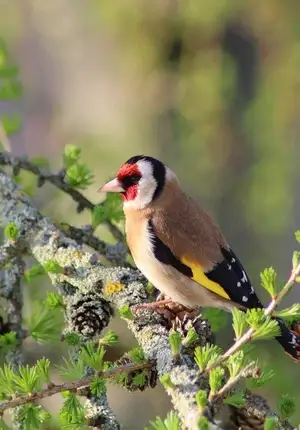
It is similar in physical appearance1. The Rock Sparrow is a large, stocky sparrow, with three broad stripes on the head, a yellow spot under the throat and white spots on the tail, and there is no difference in colouring between male and female.
Photo: Giles Laurent, CC BY-SA 4.0
Other birds
Birds related to the Rock Sparrow or sharing its habitats in Cabañeros.



 Same family
 Same family
 Same family
 Same order
 Same order
 Same order
 Same order
 Same order






