In the breeding season the male is very territorial and firmly defends his territory against other males (Wikipedia)
Lifespan
Record of 10 years and 11 months in the wild (a bird ringed in Great Britain and Ireland and checked by the ringer)
Conservation status
LC
NT
VU
EN
CR
EW
EX
Global (IUCN)
Least Concern
Spain
Near Threatened (NT) in the Red Book of the Birds of Spain; on the List of Wild Species under Special Protection, but not in the Spanish Catalogue of Threatened Species
When to see it
Winter visitor
Months of the year when it is present
J
F
M
A
M
J
J
A
S
O
N
D
In Iberia
yes
yes
yes
yes
yes
yes
yes
yes
yes
yes
yes
yes
Breeding season
no
no
yes
yes
yes
yes
yes
no
no
no
no
no
Song or voice of the Common Chiffchaff
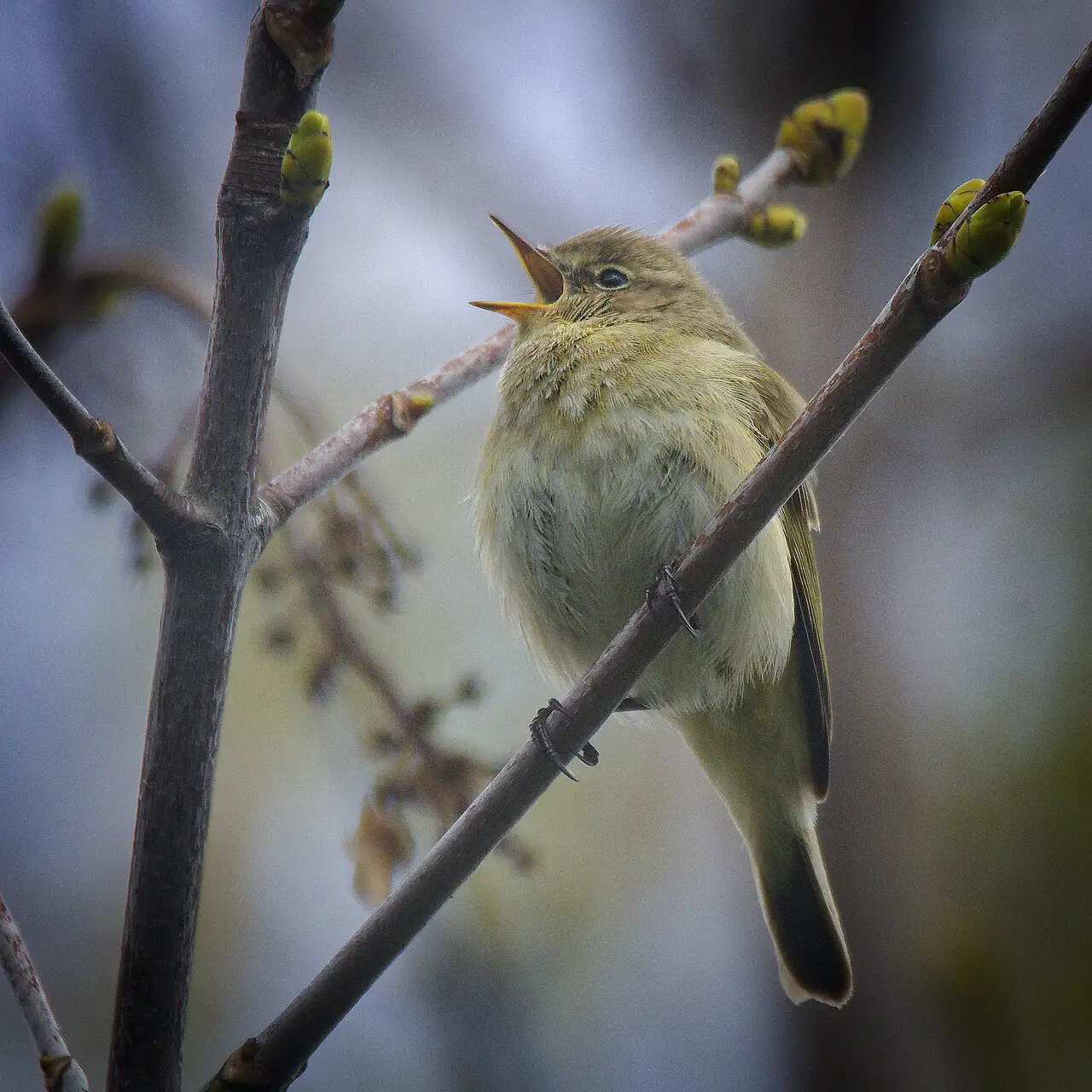
Very characteristic, it consists of the regular alternation of two sounds: «chiff-chaff, chiff-chaff». The call is a faint «huit».
SongCommon Chiffchaff
0:00 / 0:11
10 kHz5
The sonogram draws the sound: time runs from left to right, and the higher a trace sits, the higher the note.Recording by T. Voekler, Wikimedia Commons (CC BY-SA 3.0).
Flight of the Common Chiffchaff
It is a small, always restless little bird, which moves among the branches of trees, scrub and reedbeds.
Flight typeShort and undulating, always restless
Always restless, it leaves the branch and gives its faint call, «huit».
Short flight among trees, scrub and reedbeds, in search of small invertebrates.
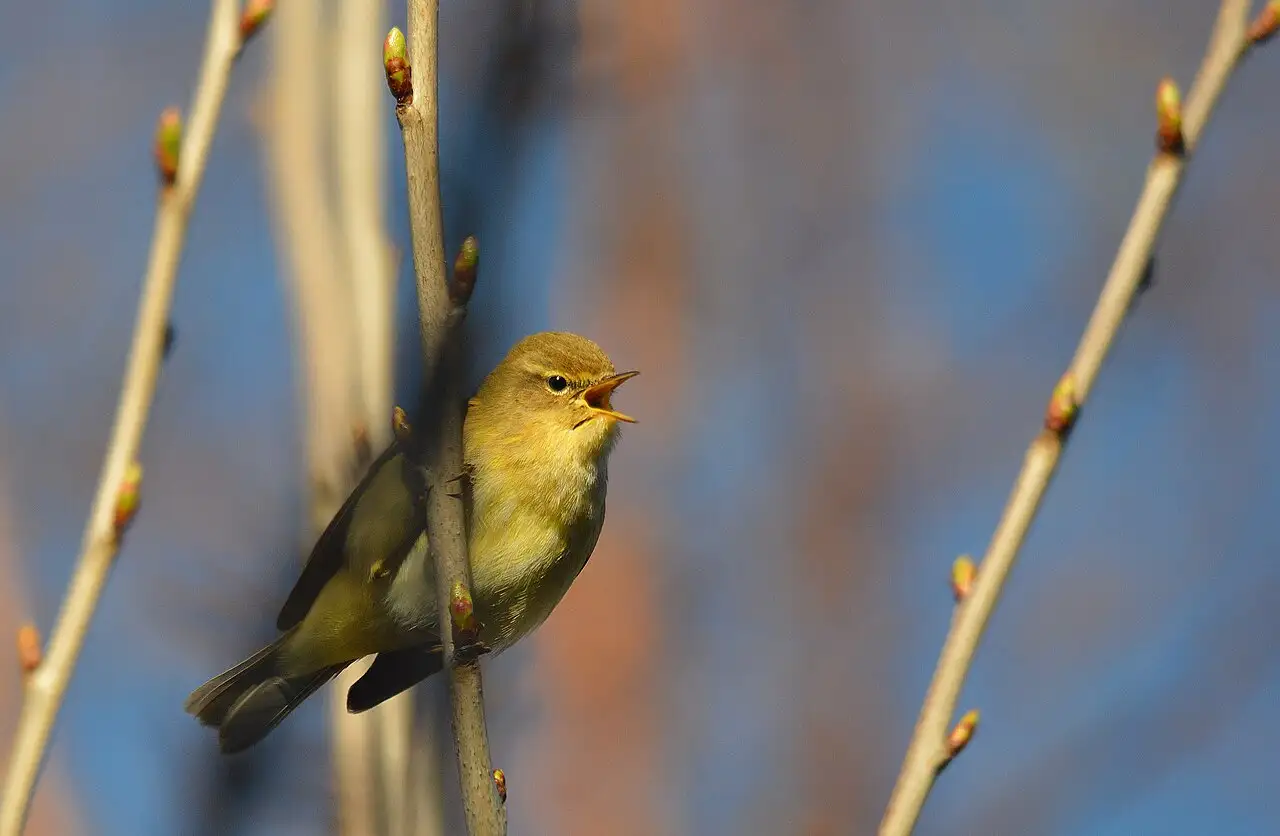
It lands on another branch, where the male may sing, alternating regularly «chiff» and «chaff».
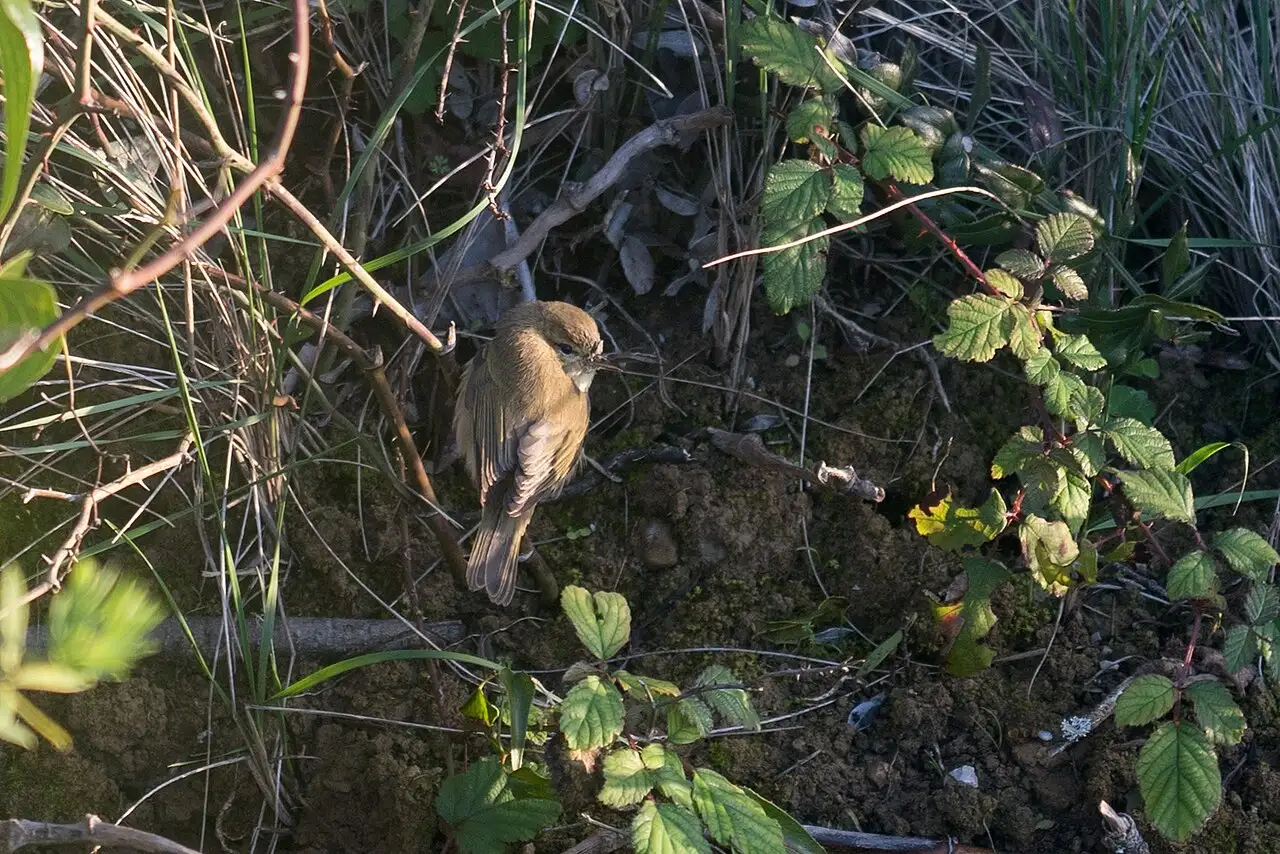
Common Chiffchaff on the ground of a bank with brambles and grasses, in winter, near the Serra de El Rei (Portugal)Photo: Alexkom000, CC BY 4.0Photo 2 of 4
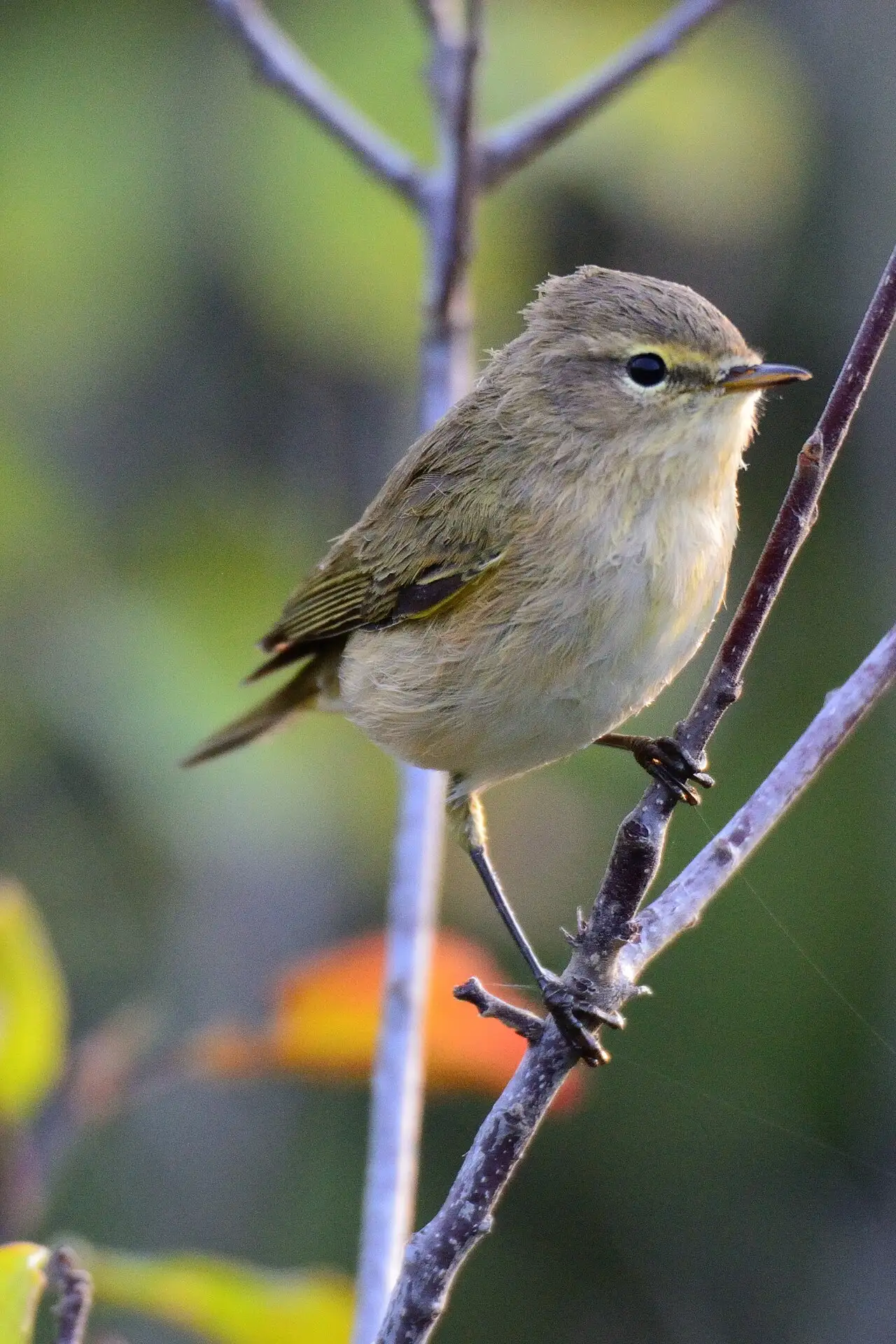
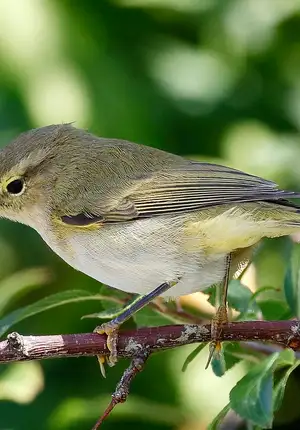
Common Chiffchaff in profile on a thin branch, with thin bill, greenish back and whitish underpartsPhoto: Ott Rebane, CC BY 2.0Photo 3 of 4
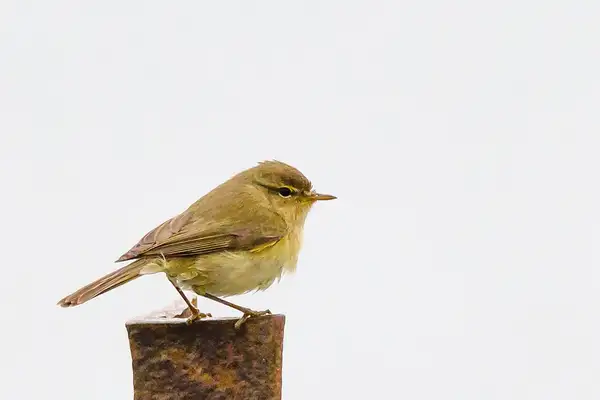
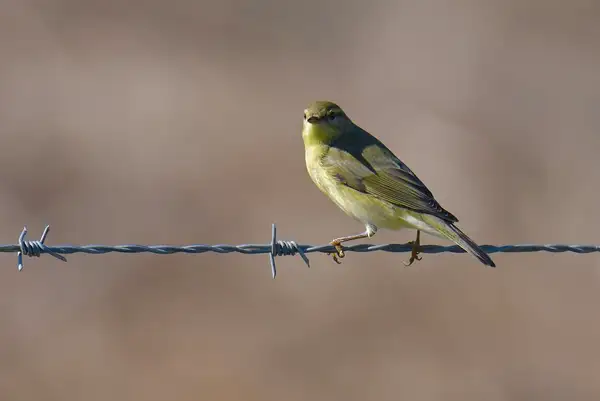
It is a small little bird with a thin bill and dark legs. It shows greenish or greyish-brown tones on the back and whitish on the underparts. Both sexes are alike, although males are slightly larger than females.
In the field it is practically identical to the Iberian Chiffchaff, from which it is told by its song and because it is present in our territory all year or in winter, depending on the region, while the Iberian Chiffchaff is only a summer visitor. It is also very like the Willow Warbler, but the latter has pale legs and bill, as well as a more defined supercilium and other fine ear-covert markings; moreover, the Willow Warbler is only present on passage.
Adult
Thin bill and dark legs.
Back greenish or greyish brown; underparts whitish.
Males somewhat larger than females.
Habitat and distribution of the Common Chiffchaff
As a breeder it is distributed widely and continuously across the temperate and boreal latitudes of Europe and Asia as far as Lake Baikal, and more locally in south-east Europe and the Near East. Its taxonomic situation is complex: a colour gradient across Europe lets two large groupings be recognised, the «collybita» group, which is distributed across the whole of Europe and shows predominantly greenish tones, and the «tristis» group, in the far east of Europe and Asia, with browner and greyer tones.
In Spain it nests mainly in the Pyrenees, Catalonia, the riverside groves of the northern plateau and the Central System, the Valencian Community and, much more scattered, the Cantabrian coast and Galicia. It does not breed in the Balearics, the Canaries or Melilla, but does in Ceuta. As a winter visitor it occupies the whole Peninsula and the Balearics, and is especially abundant in the milder areas of the Mediterranean region and in the Andalusian Atlantic arc; the population is also greatly increased by birds arrived from central and western Europe. The subspecies «collybita» is present, as a breeder and winter visitor, and the subspecies «abietinus», much rarer and only on migration.
It is an eminently woodland species. To breed it selects a great variety of wooded environments, with a clear preference for riverside woods or cool, damp deciduous woods (beech woods, oak woods…). During winter it is less demanding and may also occupy more open areas, such as Mediterranean scrub, gardens or reedbeds.
Iberian populations seem sedentary and make only movements of small scale. Those of central and northern Europe are partial migrants and have their main winter quarters around the Mediterranean. The pre-breeding passage occurs between February and March (with a peak in early March) and the post-breeding one between September and December, with the highest numbers in late October and early November.
Areas where it is regularly recorded since 2010Squares of about 25 km where it is recorded regularly (occasional passage records are left out). Data from GBIF.org (677,625 records, retrieved October 2026); outline from Natural Earth.
Etymology of the Common Chiffchaff
According to Wikipedia, «Phylloscopus» comes from Greek «phúllon» («leaf») and «skopéō» («to look»), and «collybita» is a corruption of the Greek «kollubistḗs» («money-changer»), because its song was compared with the jingling of coins. The English name, «chiffchaff», is onomatopoeic. In other languages it is called «mosquiter comú» in Catalan, «picafollas europeo» in Galician, «txio arrunta» in Basque and «common chiffchaff» in English1.
Population of the Common Chiffchaff
In the 2021 European Red List of Birds the European breeding population is estimated at between 72,100,000 and 114,000,000 mature individuals, with a stable trend. In Spain a population of 419,000 individuals is calculated, of which approximately 50 % is on the northern plateau and in the mountains of Catalonia and Aragon. The demographic trend is alarmingly negative, with an overall decrease of more than 50 % in the last 15 years according to the SACRE programme.
In Spain it is already considered a near-threatened species, given the significant population decline of recent decades. The destruction of riverside woods, one of its most favourable habitats, through felling of poplar groves, channelling and other works is without doubt one of the reasons for the fall. The use of pesticides and the decrease in the number of insects, the basis of its diet, are also threats.
Nest of the Common Chiffchaff
The nest is built basically by the female in a few days and consists of a small closed structure, made of little leaves and mosses, entered by a side opening. It is placed low down in the thicket of the vegetation, usually in a dense bush or shrub.
Courtship and breeding of the Common Chiffchaff
The breeding period runs from March to July. The clutch is three to nine white eggs, plain or speckled, which the female incubates for 13–15 days. The chicks are tended and fed mainly by the mother. They make their first flights at 14–16 days of life, although they stay another 10–20 days under their parents’ guardianship, who share their care until they become independent. It can make two clutches a year.
Diet of the Common Chiffchaff
Its diet is based on small invertebrates, which it may supplement with small berries in autumn and winter, and even with nectar and pollen in spring.
Curious facts about the Common Chiffchaff
In Spain it is not very usual as a breeder, but is very abundant as a winter visitor and on migration passage. According to Wikipedia, it is one of the first passerines to return to its breeding areas in spring and one of the last to leave in autumn. According to EURING, the longest-lived ringed bird, in Great Britain, reached 10 years and 11 months; AnAge gives 8 years.
The Common Chiffchaff in Cabañeros
The habitat pages of this website do not mention it. GBIF.org records 192 observations of the Common Chiffchaff in Cabañeros and its surroundings.
Where to see the Common Chiffchaff in Cabañeros
In Cabañeros and its surroundings, mostly from autumn to spring.
When
Mainly from autumn to spring: it is very abundant as a winter visitor; the pre-breeding passage runs from February to March and the post-breeding one from September to December.
What time
In good light, in reedbeds, Mediterranean scrub, riverbanks, gardens and parks.
Where
On low branches and in the thicket of shrubs, always on the move.
What to look for
Look for the thin bill, the dark legs and the «huit» call; in spring, listen for the «chiff-chaff».
It is almost identical in the field: it is told by its song and because it is only a summer visitor, while the Common Chiffchaff is present all year or in winter, depending on the region1.



 Same family
 Same family
 Same family
 Same order
 Same order
 Same order
 Same order
 Same order






