Ground-dwelling and gregarious: it is seen almost always on the ground and in a group
Lifespan
Record of 11 years and 4 months in the wild (a bird ringed in the United Kingdom)
Conservation status
LC
NT
VU
EN
CR
EW
EX
Global (IUCN)
Least Concern
Spain
Least Concern (LC) in the Red Book of the Birds of Spain; included in the List of Wild Species under Special Protection and not in the Spanish Catalogue of Threatened Species
When to see it
Winter visitor
Months of the year when it is present
J
F
M
A
M
J
J
A
S
O
N
D
In Iberia
yes
yes
yes
yes
no
no
no
no
no
yes
yes
yes
Song or voice of the Meadow Pipit
The call is distinctive and very useful for identification: a «sip» or «bis», which it repeats a few times, like «bis-bis-bit», hence its name. The song is heard little in Spain and is also a succession of «tsip»-type notes. The recording (call, also in flight) is by Sean Ronayne and was made in Los Monegros (between Ontiñena and Candasnos), Huesca, Aragón (xeno-canto XC511712, quality A). It lasts 9 seconds and is a trimmed section of the original, without repeating or lengthening, from which we have removed the bass below 300 Hz, reduced the background noise and adjusted the volume; neither pitch nor speed has been changed.
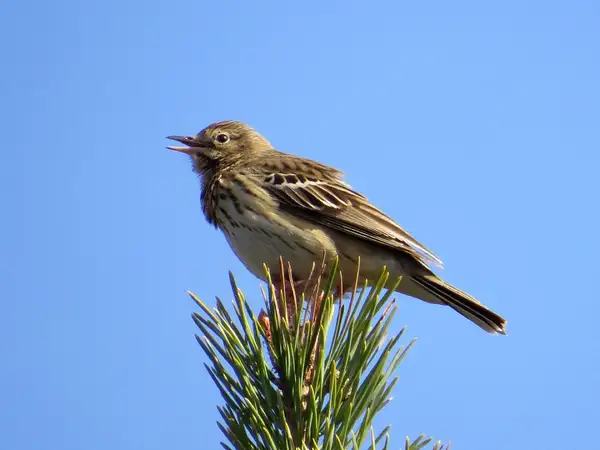
It is seen almost always on the ground and in a group. It has rounded wings, a long tail with white outer feathers, a thin bill and thin legs, with a long, straight hind claw.
Flight typeUndulating and low, in loose groups
It is nearly always seen on the ground and in a group. When it takes off it gives its call, a «sip» or «bis» that it repeats a few times: «bis-bis-bit».
With rounded wings and a long tail with white outer feathers, it moves in loose groups over meadows and crops.
It lands on the ground, where it looks for and pecks at small invertebrates and, in winter, also seeds.
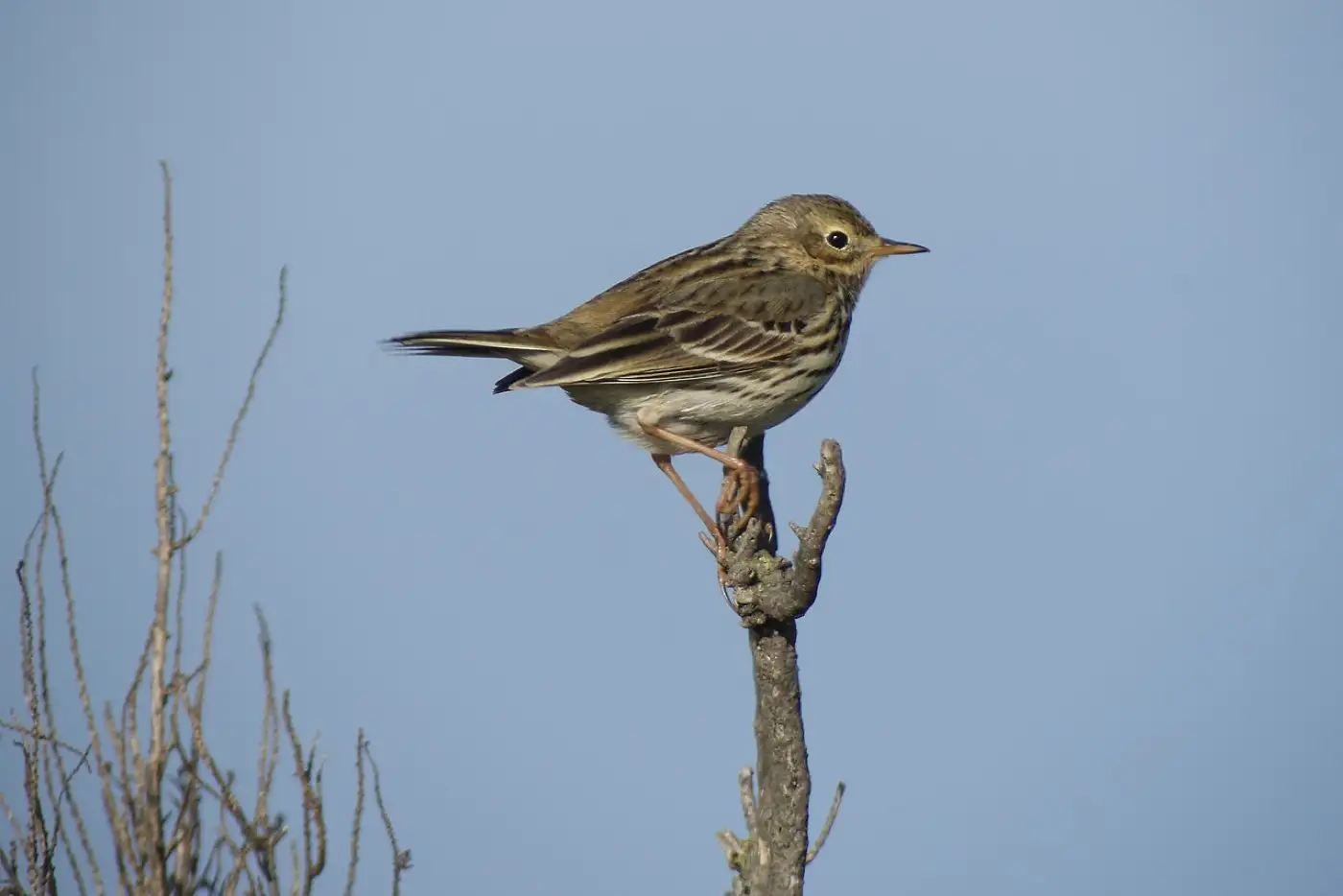
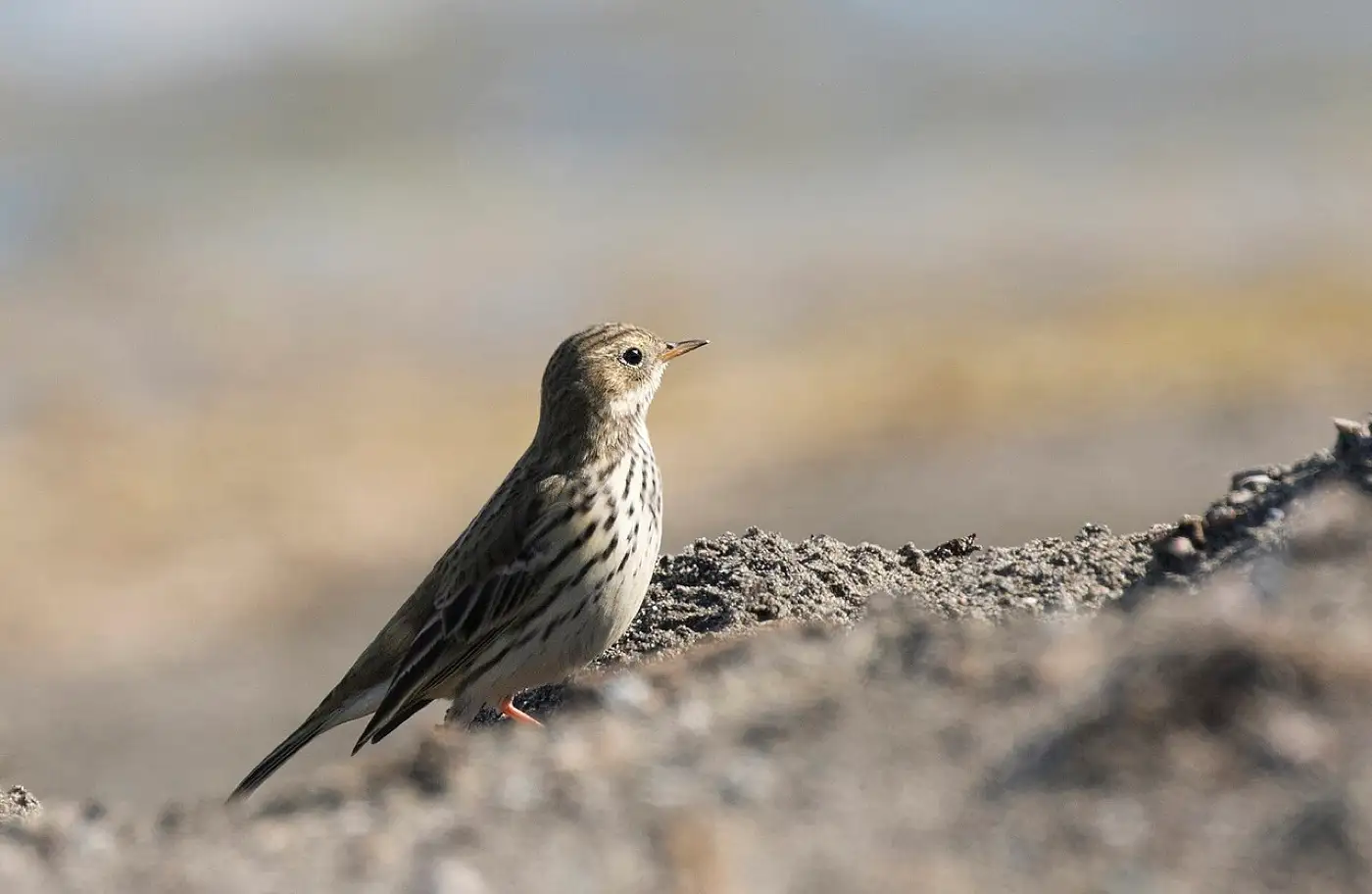
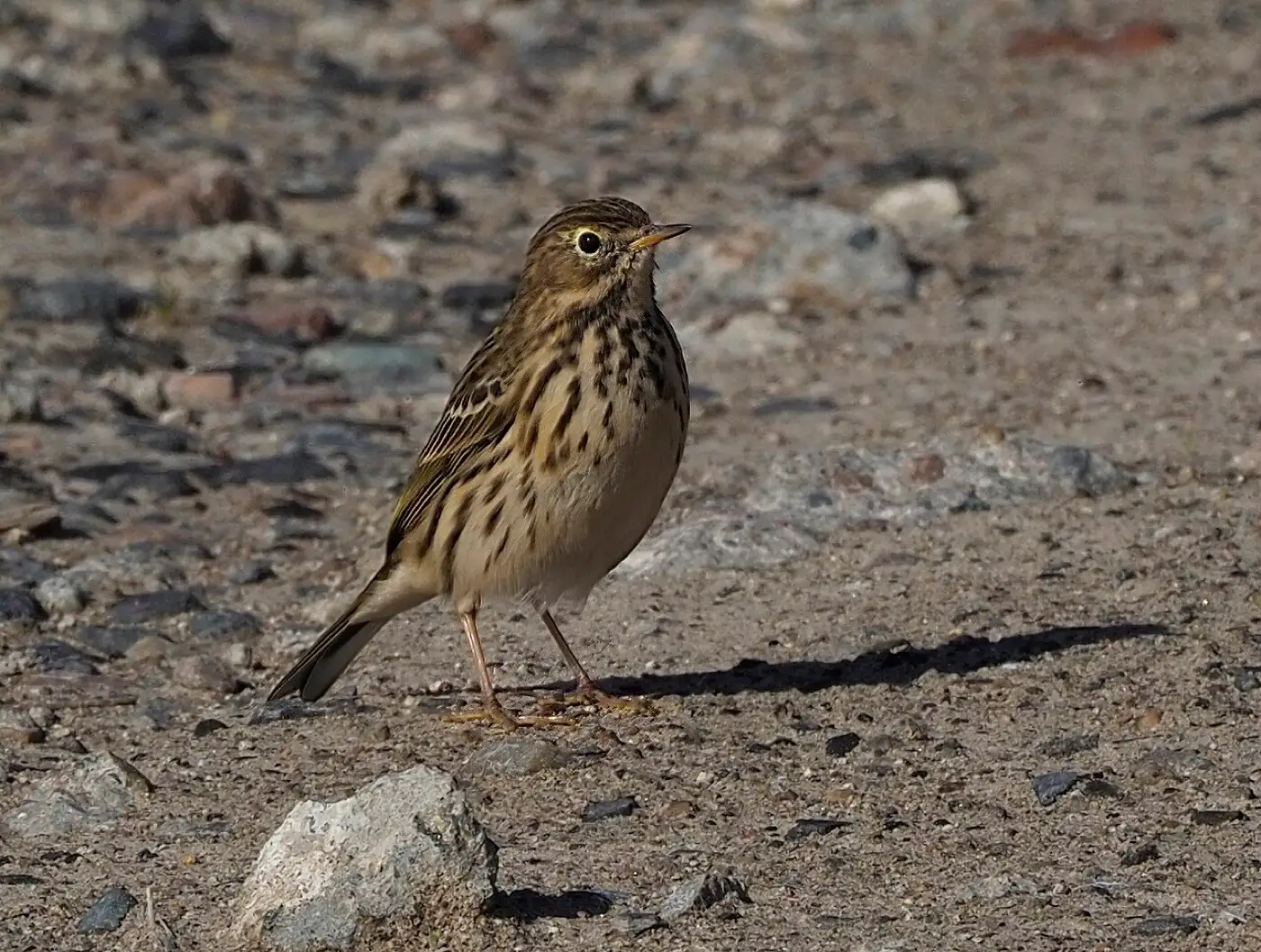
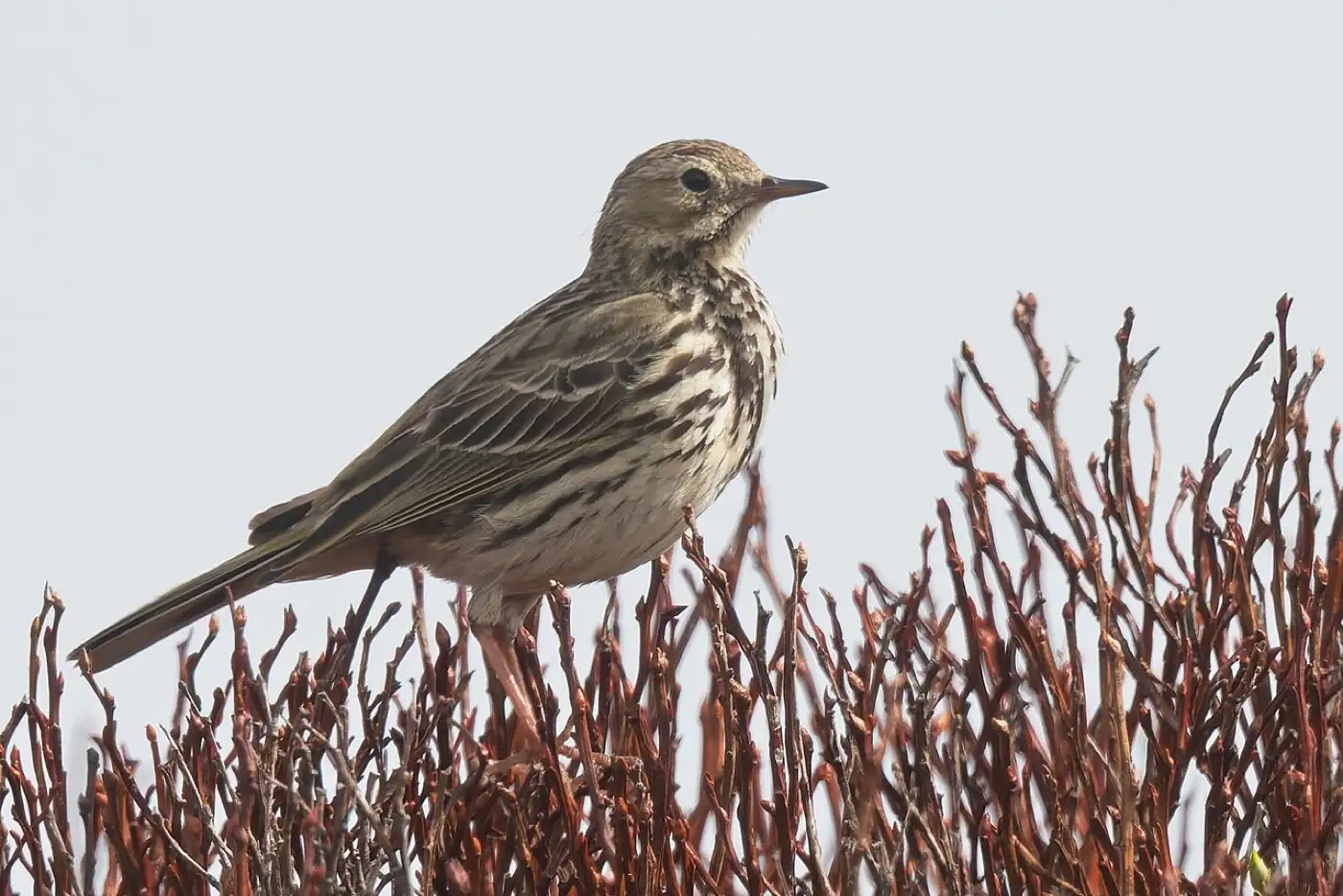
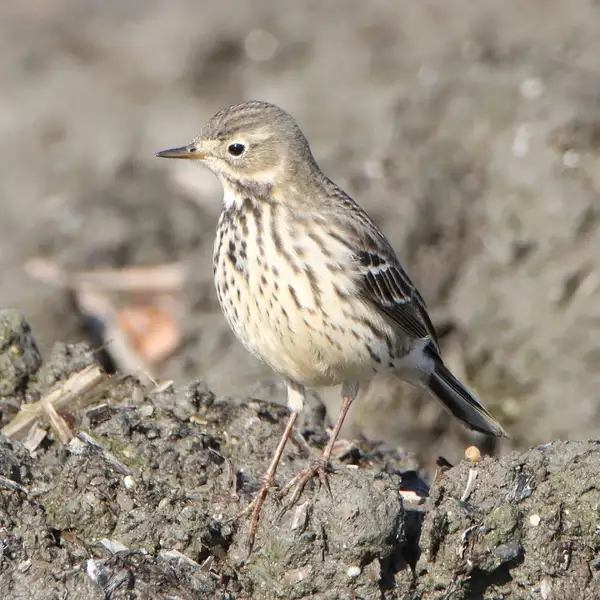
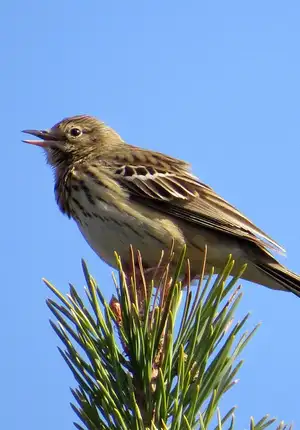
It is a bird of unremarkable appearance and without very distinctive features, similar to the other pipits. It has a brown back, somewhat greenish in early autumn, with many dark streaks. The belly is dirty white, heavily streaked, and the flanks, orange in autumn, become paler as winter advances. It has rounded wings, a long tail with white outer feathers, a thin bill and thin legs, with a long, straight hind claw. The throat is white, with a thin black moustache. Both sexes are alike, and young birds, when they reach Spain, cannot be told from adults.
The pipit group, with its earthy plumages that blend with the ground, is one of the hardest to identify. To tell the Meadow Pipit from other pipits one has to pay attention to dates, its voice, its small size and plumage details, such as the flanks with coarser streaks and the less contrasting back.
Adult
Brown back, slightly greenish in early autumn, heavily streaked.
Dirty-white belly heavily streaked and orange flanks in autumn; white throat with thin black moustache.
Habitat and distribution of the Meadow Pipit
As a breeder it is almost restricted to central and northern Europe. In the centre-west of this continent it is resident, and it also winters in countries of the Mediterranean basin. Two subspecies are recognised.
In Spain no recent evidence of breeding has been found, although in 2003 a case was recorded of an adult carrying food, without chicks being detected, and it is considered a very scarce and scattered local breeder in Asturias, so a minimal population on the Cantabrian coast cannot be ruled out. It nests in grassland with low scrub in the Cantabrian range. In winter it is very widespread across the Peninsula and the Balearics, present in the Guadalquivir valley, Extremadura, the Cantabrian–Atlantic coast, the western sector of Castilla y León, the Ebro valley and the central Mediterranean coast. The subspecies that breeds in Spain, and also the majority one in winter, is «pratensis»; for the winter, birds of the subspecies «whistleri», from Scotland and Ireland, also arrive.
In winter it can occupy any type of open environment, but prefers damp farmland in the north, while in the southern half and the Mediterranean arc it chooses irrigated land, sown fields and grassland. It does not disdain areas with low, scattered scrub, nor dehesas and other open wooded formations. The main wintering takes place between October and March: the first arrivals in the north usually occur at the end of September, with very early cases in August, and the bulk appears suddenly in October. The spring return, slower, runs between February and early April in the south, or until May in the north, peaking in March.
Areas where it is regularly recorded since 2010Squares of about 25 km where it is recorded regularly (occasional passage records are left out). Data from GBIF.org (336,321 records, retrieved October 2026); outline from Natural Earth.
Etymology of the Meadow Pipit
«Bisbita» comes from its call, «bis-bis-bit»1. «Pratensis» is the Latin adjective meaning «of the meadows». Until recently it was called «bisbita común».
Population of the Meadow Pipit
In the 2021 European Red List of Birds the European breeding population is estimated at between 109,000,000 and 168,000,000 mature individuals, with a decreasing trend. In Spain there are no wintering data, but the presence of several million birds is assumed. The breeding population in Spain, almost unknown, is vulnerable because of its tiny size, although, being marginal to a much larger one, it could depend on immigration from it. In winter it is not considered threatened, but the European population as a whole is. It may be affected by generic threats, such as the abuse of pesticides, changes in land use, winter drought and agricultural policy measures.
Nest of the Meadow Pipit
In the rest of Europe, where it breeds, its nests are on the ground. There is no information on breeding in Spain1.
Courtship and breeding of the Meadow Pipit
There is no information on breeding in Spain, but in the rest of Europe it makes two clutches, between April and August, of four to six eggs speckled on a ground colour that varies (brown, grey or reddish), which the female incubates for about 11 days in nests set on the ground.
Diet of the Meadow Pipit
In the breeding season, the diet consists basically of invertebrates under 5 millimetres, above all flies, mosquitoes and beetles. In winter it also eats many insects, but the intake of seeds gains some importance. Its most used technique is searching and pecking on the ground, usually in small loose groups.
Curious facts about the Meadow Pipit
It used to be called the «bisbita común», and in the cold months it is abundant on the Peninsula, where it is characteristic of open environments. Its breeding in Spain was first cited in 1972, and it is really scarce. The bulk of wintering pipits appears suddenly in October.
The Meadow Pipit in Cabañeros
This website’s pages on grasslands and dehesas list it, under the name «bisbita común» or Meadow Pipit, among the small insectivores that form very notable flocks in winter in the grasslands of Cabañeros, and among the species that eat small insects in the dehesas in that season.
Where to see the Meadow Pipit in Cabañeros
In the grasslands and dehesas of Cabañeros, in winter.
When
From October to March; the bulk arrives in October and leaves in March.
What time
Throughout the day, on the ground, in small flocks.
Where
In open environments: grassland, sown fields, irrigated land, grasslands and dehesas.
What to look for
An earthy, streaked little bird that rises from the ground with a «bis-bis-bit».
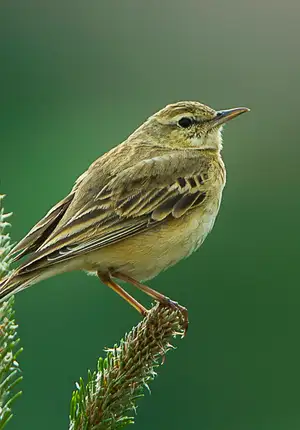
They are similar in song and appearance1. It has a heavily streaked brown back and a pale, heavily streaked belly, with an orange wash on the breast and flanks; it is subtly distinguished by being a little sturdier and more olive in tone.
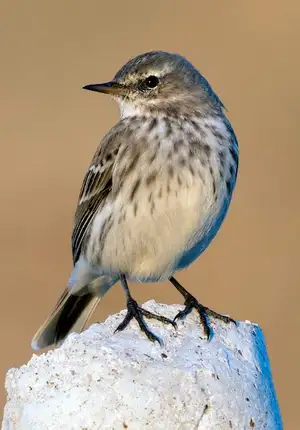
It is similar in song and appearance1. In winter, the whitish breast with dark streaks and the pale eyebrow recall the Meadow Pipit, although it is a pipit of sierras and river banks.
Photo: Alpsdake, CC BY-SA 4.0
Other birds
Birds related to the Meadow Pipit or sharing its habitats in Cabañeros.



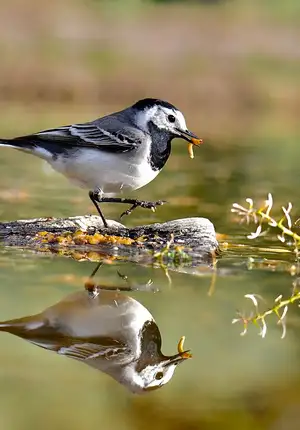 Same family
 Same family
 Same family
 Same family
 Also in dehesas (wood pasture)
 Also in dehesas (wood pasture)
 Also in dehesas (wood pasture)
 Also in dehesas (wood pasture)






