Pair relationships may be monogamous or polygamous (one male with two or three females)
Lifespan
Record of 18 years and 8 months according to EURING (a bird ringed in the Netherlands and killed by a cat); a very high figure against AnAge's 11.8 years
Conservation status
LC
NT
VU
EN
CR
EW
EX
Global (IUCN)
Least Concern
Spain
Data Deficient (DD) in the Red Book of the Birds of Spain; on the List of Wild Species under Special Protection, but not in the Spanish Catalogue of Threatened Species
When to see it
Passage migrant
Months of the year when it is present
J
F
M
A
M
J
J
A
S
O
N
D
In Iberia
no
no
yes
yes
yes
yes
yes
yes
yes
yes
yes
no
Song or voice of the Willow Warbler
It consists of a soft, descending phrase, which the bird performs repeatedly. The call is a soft, two-syllable, rising whistle, like a «huiit».
SongWillow Warbler
0:00 / 0:28
10 kHz5
The sonogram draws the sound: time runs from left to right, and the higher a trace sits, the higher the note.Recording by Tommy Andriollo, xeno-canto XC552124 (Suiza) (CC BY-SA 4.0).
Flight of the Willow Warbler
It moves among trees, shrubs and scrub, as long as they give it some plant cover, above all during migration passage.
Flight typeShort and undulating among the vegetation
During migration passage, an important contingent crosses Spain and stops in any habitat that offers some plant cover.
It moves among trees and shrubs in search of small insects and spiders; in autumn, also of small berries.
Its winter quarters extend across almost all of sub-Saharan Africa; in Spain its breeding has not been confirmed.
Photo gallery of the Willow Warbler
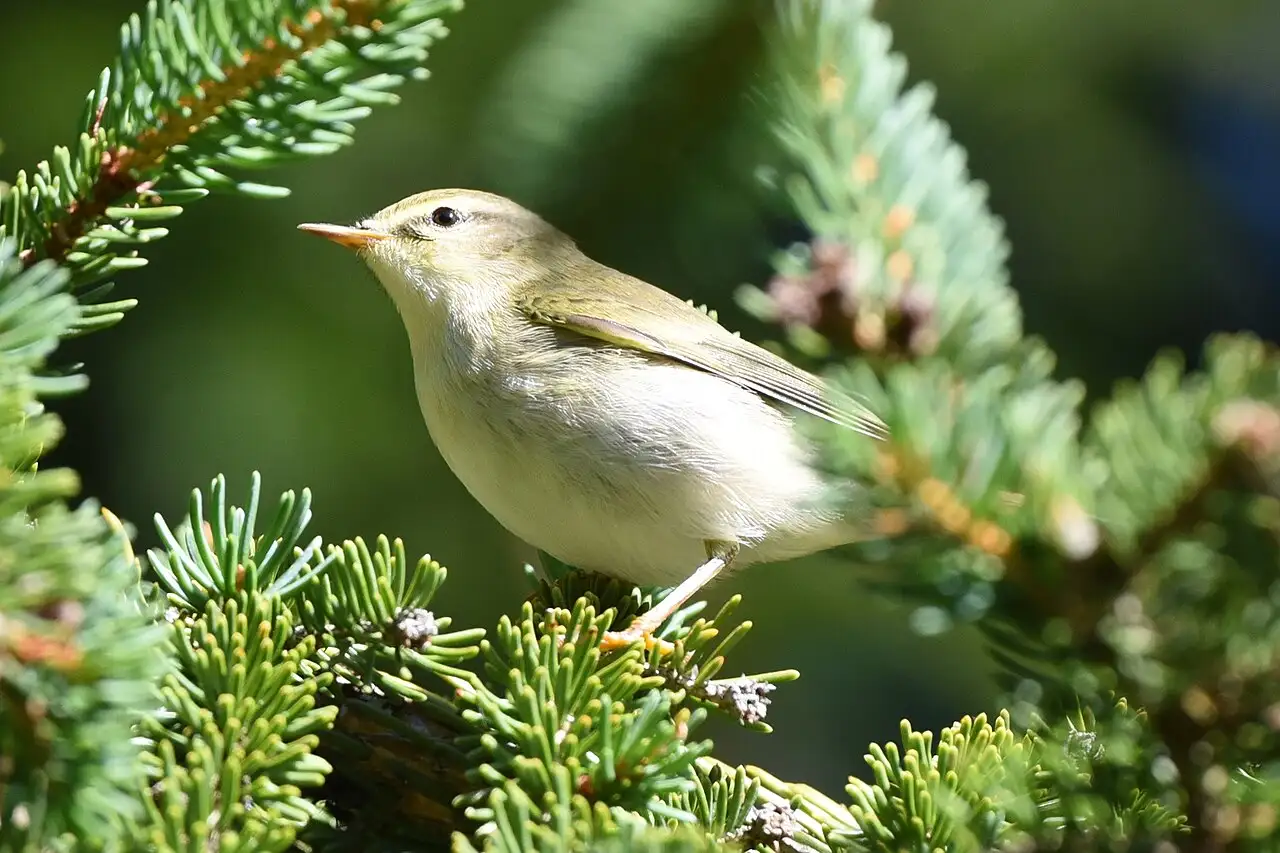
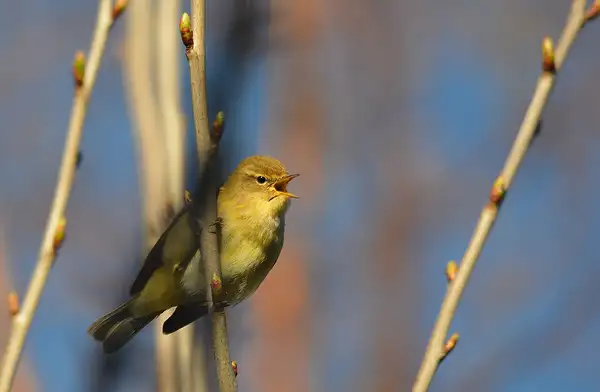
Willow Warbler perched on a fir branch, in profile, with pale bill and legs, pale eyebrow and yellowish underpartsPhoto: Pierre-Marie Epiney, CC BY-SA 2.0Photo 1 of 4
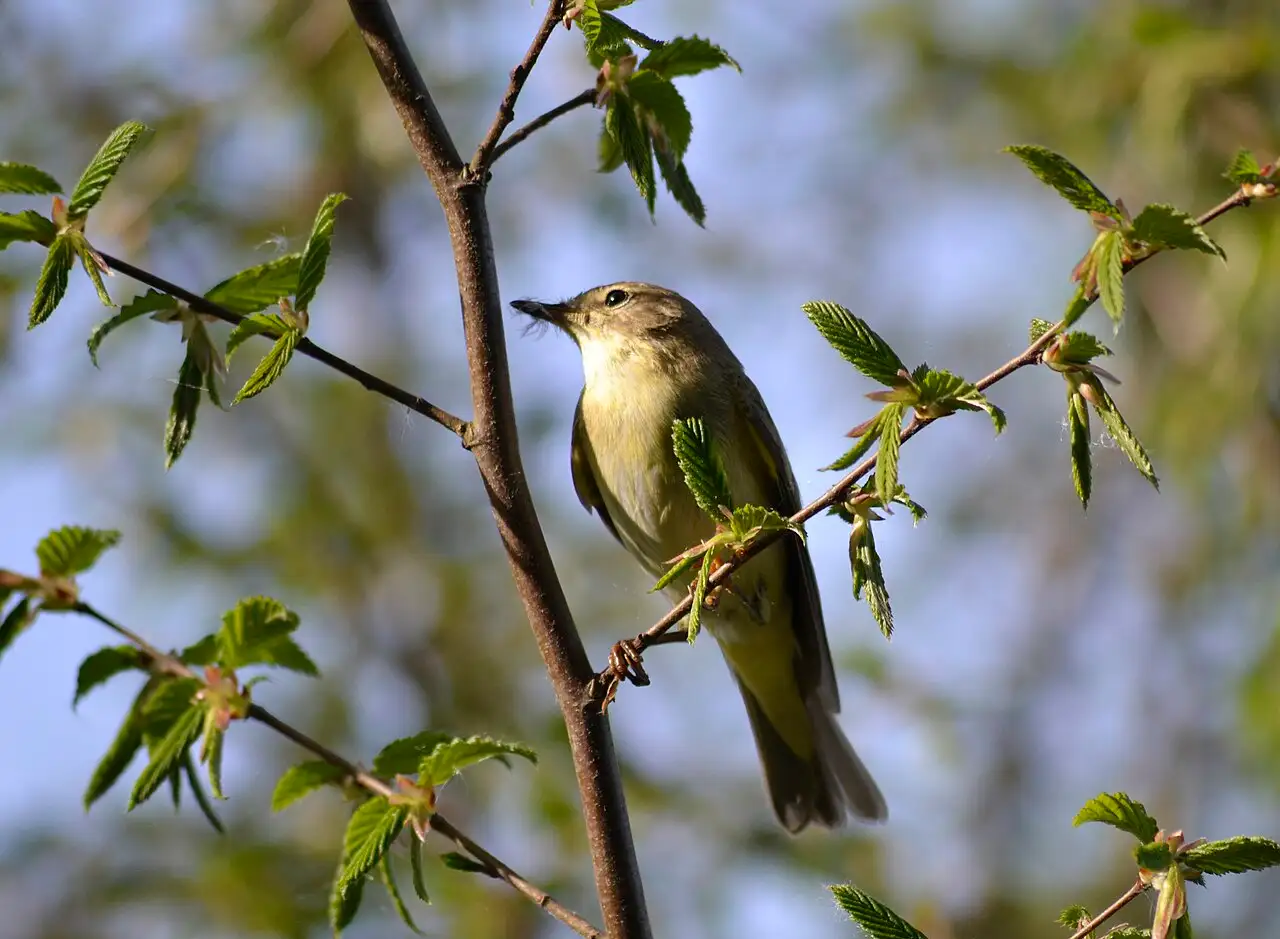
Willow Warbler in a tree with young leaves, with an insect in its billPhoto: Franziska Neubauer, CC BY-SA 4.0Photo 4 of 4
1 / 4
Identification of the Willow Warbler
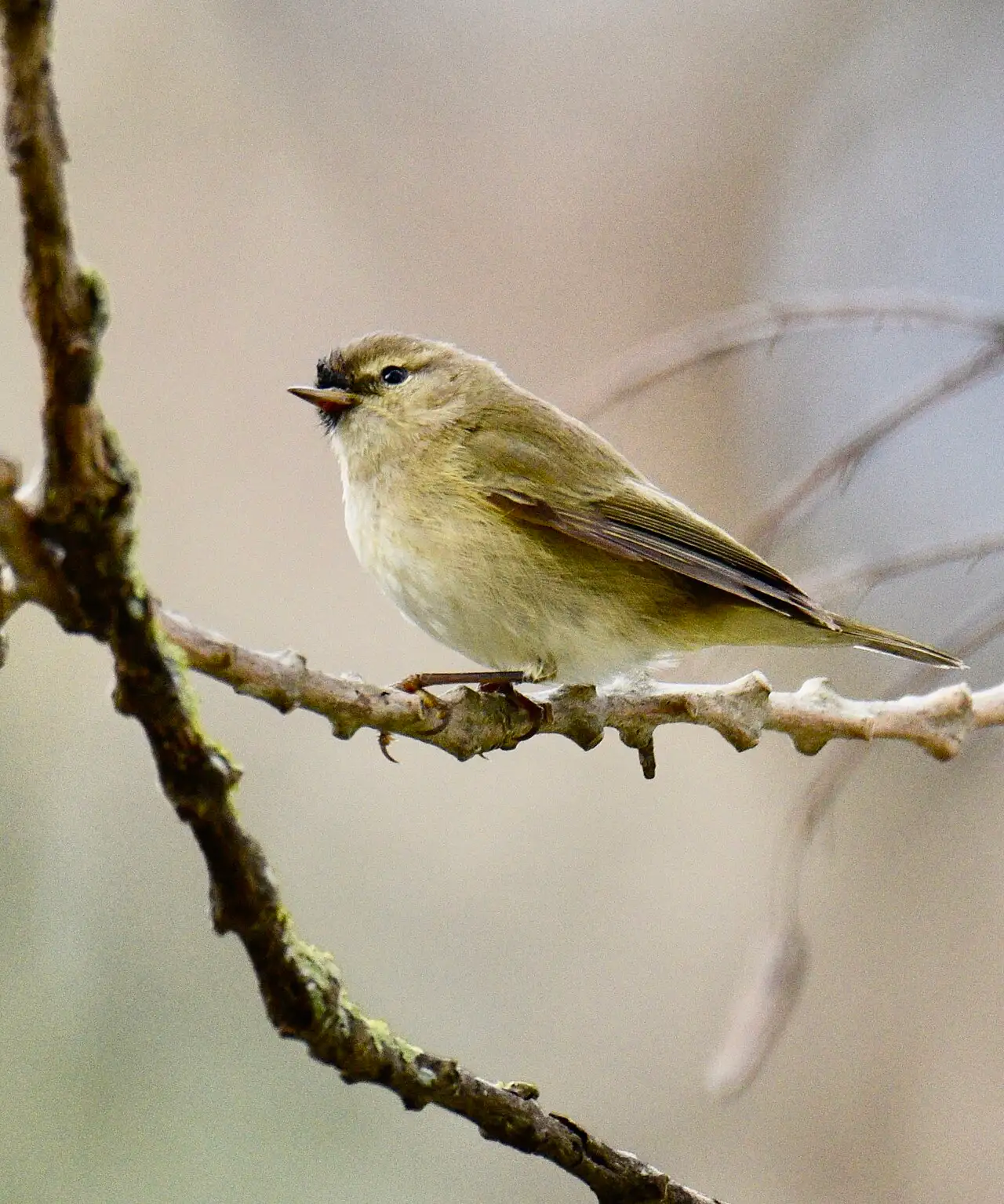
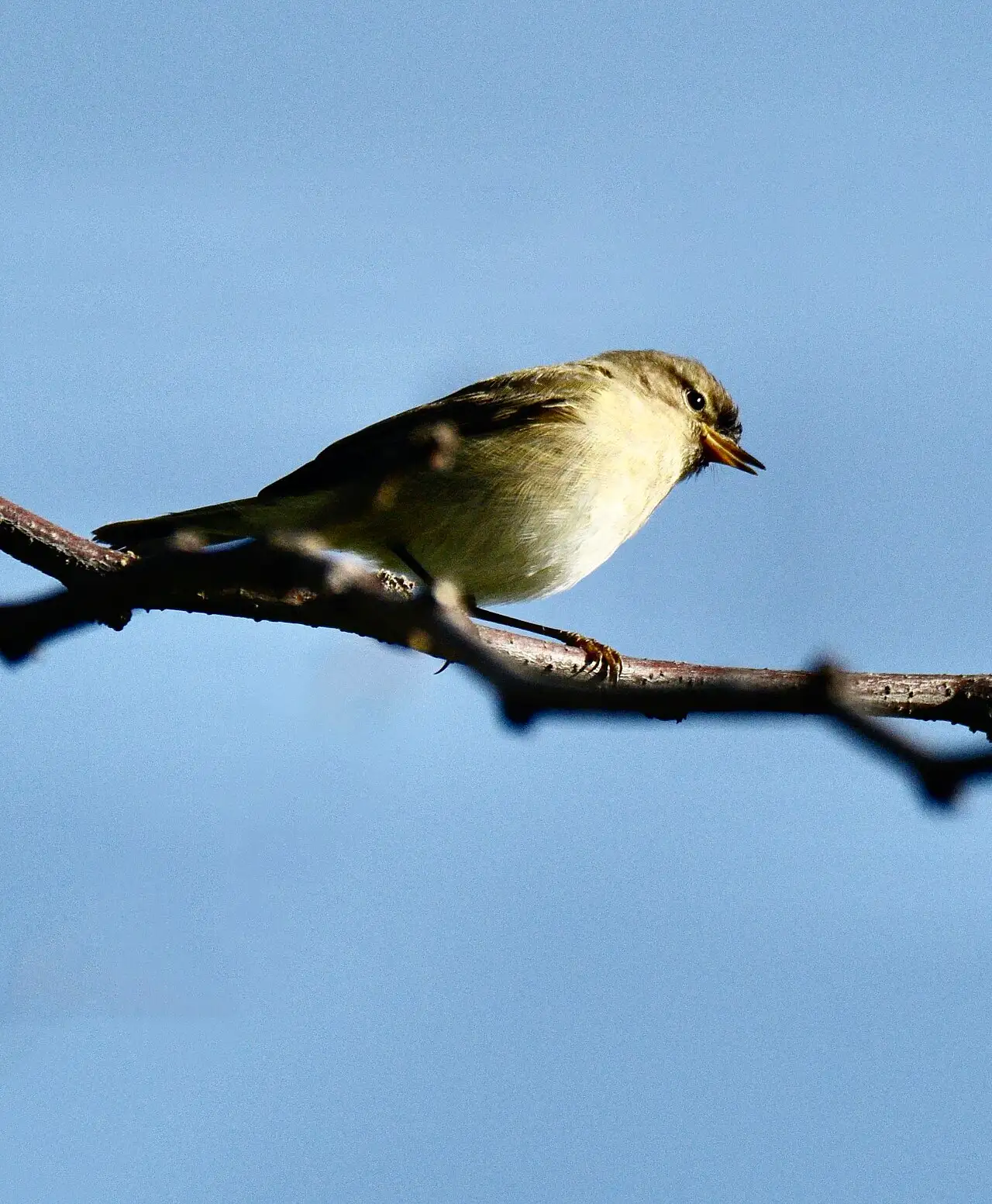
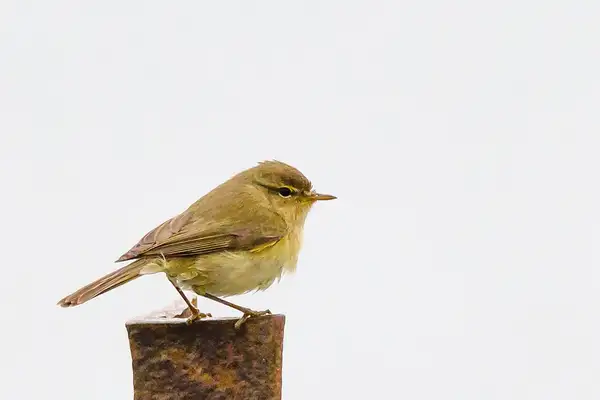
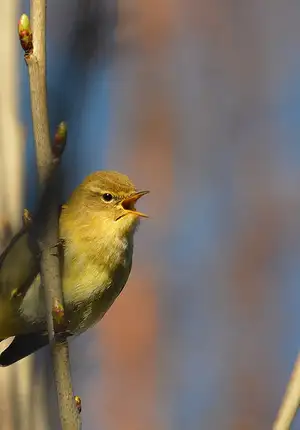
The Willow Warbler is very like its relatives, above all the Common and Iberian Chiffchaffs, from which it differs in having pale bill and legs, more marked face stripes with a very evident supercilium, more yellow underparts and a brighter greenish tone on the back.
Adult
Pale bill and legs.
More marked face stripes and very evident supercilium.
Underparts more yellow and back brighter green.
Habitat and distribution of the Willow Warbler
It is distributed widely and continuously across the temperate, boreal and Arctic latitudes of the whole of Europe and Asia. It is absent or appears very locally in southern Europe. Three subspecies are recognised.
In the III Atlas of Breeding Birds in Spain its presence could not be confirmed with signs or behaviour of breeding, which means the disappearance of this warbler as a breeder compared with earlier studies. During migration passage it can be found throughout Spain; both the subspecies «trochilus», from western Europe, and «acredula», originating in Scandinavia, appear.
It is a species tied to woodland and scrub environments: it usually occupies thinned woods, edges or clearings of woodland, regenerating woods and various shrubby and scrub formations. During migration passage it can be found in a wide variety of habitats, as long as they provide some kind of plant cover.
It is a migrant, with winter quarters that extend across almost all of sub-Saharan Africa, from Senegal to Ethiopia in the east and to South Africa in the south. An important contingent from central and northern Europe crosses the Peninsula, the Balearics and the Canaries during passage. The pre-breeding passage is detected between March and May, with a peak in late April, and the post-breeding one between August and November, with the largest number of birds in early September, on a more westerly route across the Peninsula.
Areas where it is regularly recorded since 2010Squares of about 25 km where it is recorded regularly (occasional passage records are left out). Data from GBIF.org (169,175 records, retrieved October 2026); outline from Natural Earth.
Etymology of the Willow Warbler
According to Wikipedia, «Phylloscopus» comes from ancient Greek «phúllon» («leaf») and «skopós» («the one who looks»), and «trochilus» is the Greek word for «wren» or «goldcrest». In other languages it is called «mosquiter de passa» in Catalan, «picafollas musical» in Galician, «txio horia» in Basque and «willow warbler» in English1.
Population of the Willow Warbler
In the 2021 European Red List of Birds the European breeding population is estimated at between 106,000,000 and 161,000,000 mature individuals, with a decreasing trend. In Spain it is considered only a passage visitor, with no population data to report. No observations of the species as a breeder have been recorded, but not because it suffers specific threats, but because of environmental (temperature, humidity) and biogeographical limitations1.
Nest of the Willow Warbler
In its breeding area, the nest, built by the female, consists of a small cup of leaves, branches and moss, set in the thicket of shrubby or tree vegetation. It does not breed in Spain.
Courtship and breeding of the Willow Warbler
In its breeding area the breeding period runs from May to July, and pairs normally make a single clutch, occasionally two. The clutch is three to nine whitish eggs, speckled with light brown to varying degrees, which the female incubates for 12–14 days. The chicks are usually tended by both parents, are able to fly at 11–16 days and reach independence 12–16 days later. It does not breed in Spain.
Diet of the Willow Warbler
It feeds mainly on small insects and spiders. In autumn it may also eat small berries, such as blackberries or elderberries.
Curious facts about the Willow Warbler
Of the species of leaf warblers that visit us during migration passage, the Willow Warbler is perhaps the most abundant, being one of the most numerous birds in the whole of Europe. According to Wikipedia it makes one of the longest migrations of any animal of its size. EURING lists a bird ringed in the Netherlands that lived 18 years and 8 months, a figure out of line with AnAge’s 11.8 years and with the 13 years and 10 months of another bird on the same list (Germany).
The Willow Warbler in Cabañeros
The habitat pages of this website do not mention it. GBIF.org records 102 observations of the Willow Warbler in Cabañeros and its surroundings, which correspond to migration passages, because it does not breed in Spain.
Where to see the Willow Warbler in Cabañeros
In Cabañeros and its surroundings, on migration passage.
When
On passage: the pre-breeding one, from March to May (with a peak in late April) and the post-breeding one, from August to November (with a peak in early September).
What time
In good light, in thinned woods, tree edges and scrub; on passage it can appear in any habitat with plant cover.
Where
On the branches of trees and shrubs, always on the move.
What to look for
Look for the pale bill and legs, the pale eyebrow and the yellowish tone; listen for its descending phrase.
It is very similar in song and appearance1. The Willow Warbler is told by its pale bill and legs, more marked face stripes, more yellow underparts and greener, brighter back.
Photo: Jacob Spinks from Northamptonshire, England, CC BY 2.0



 Same family
 Same family
 Same family
 Same order
 Same order
 Same order
 Same order
 Same order






