There is no sexual dimorphism; the chicks are tended by both parents and the female incubates alone
Lifespan
Record of 7 years and 11 months according to EURING (a bird ringed in Spain and checked by a ringer)
Conservation status
LC
NT
VU
EN
CR
EW
EX
Global (IUCN)
Least Concern
Spain
Least Concern (LC) in the Red Book of the Birds of Spain; on the List of Wild Species under Special Protection, but not in the Spanish Catalogue of Threatened Species
When to see it
Summer visitor
Months of the year when it is present
J
F
M
A
M
J
J
A
S
O
N
D
In Iberia
no
no
yes
yes
yes
yes
yes
yes
yes
no
no
no
Breeding season
no
no
no
no
yes
yes
yes
no
no
no
no
no
Song or voice of the Western Bonelli’s Warbler
It is a brief, ringing, vigorous trill, of a single note, which the bird performs quickly. It is very like the Cirl Bunting’s, although stronger and faster. The call is a ringing two-syllable whistle: «tu-ui».
SongWestern Bonelli's Warbler
0:00 / 0:22
10 kHz5
The sonogram draws the sound: time runs from left to right, and the higher a trace sits, the higher the note.Recording by Benoît Van Hecke, xeno-canto XC549802 (Francia) (CC BY-SA 4.0).
Flight of the Western Bonelli’s Warbler
It has the typical silhouette of leaf warblers: stocky little body, fragile legs and thin bill. It is a woodland species that moves among the branches of trees.
Flight typeShort, among the branches of trees
It is a woodland species, tied to deciduous woods and, to a lesser extent, to juniper woods or pine woods; the highest concentrations occur in Pyrenean oak and Lusitanian oak woods.
It bases its diet on invertebrates, mainly small woodland insects.
Its song is a brief, ringing, vigorous trill, of a single note, which it performs quickly; the call is a two-syllable whistle, «tu-ui».
Photo gallery of the Western Bonelli’s Warbler
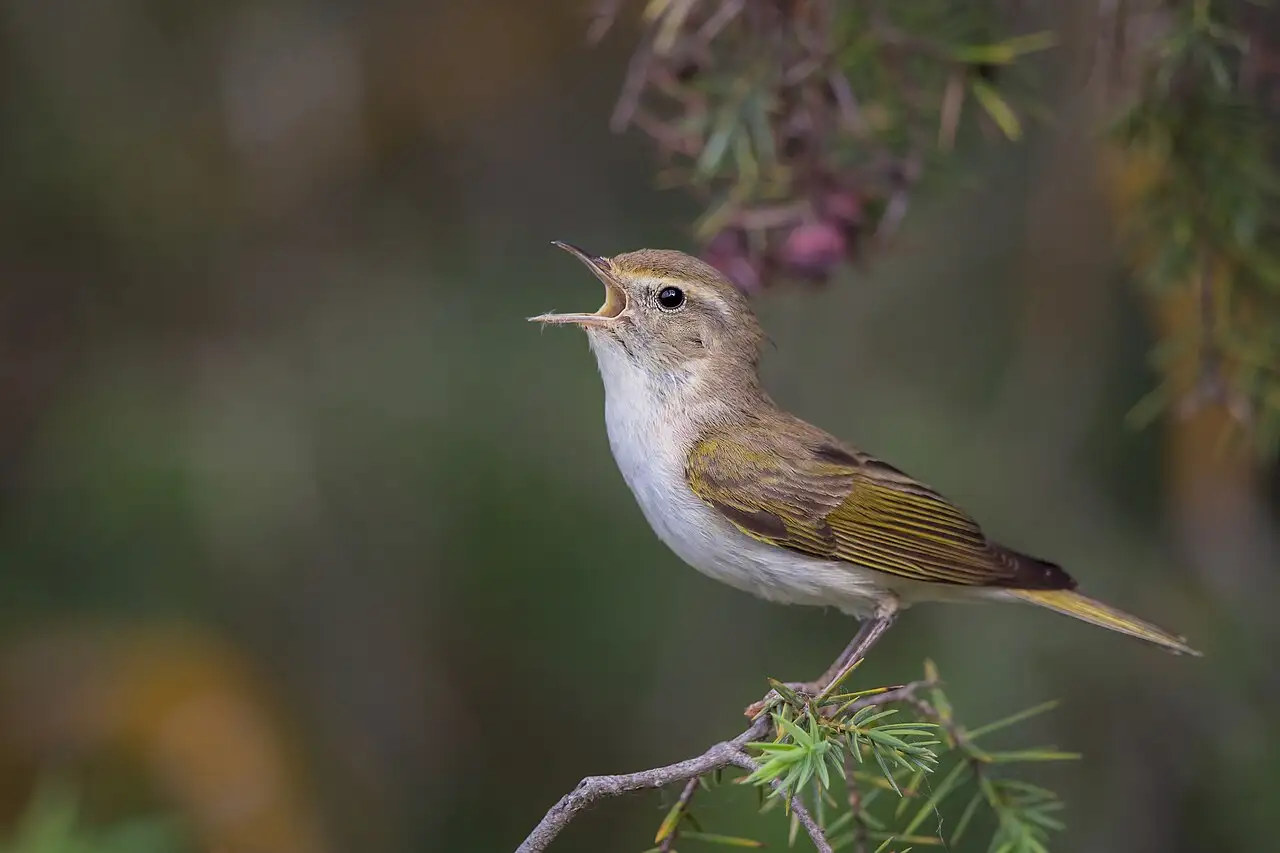
Western Bonelli's Warbler singing with open bill on a pine branch, with greenish back and whitish head and underpartsPhoto: Kookaburra 81, CC BY-SA 4.0Photo 1 of 4
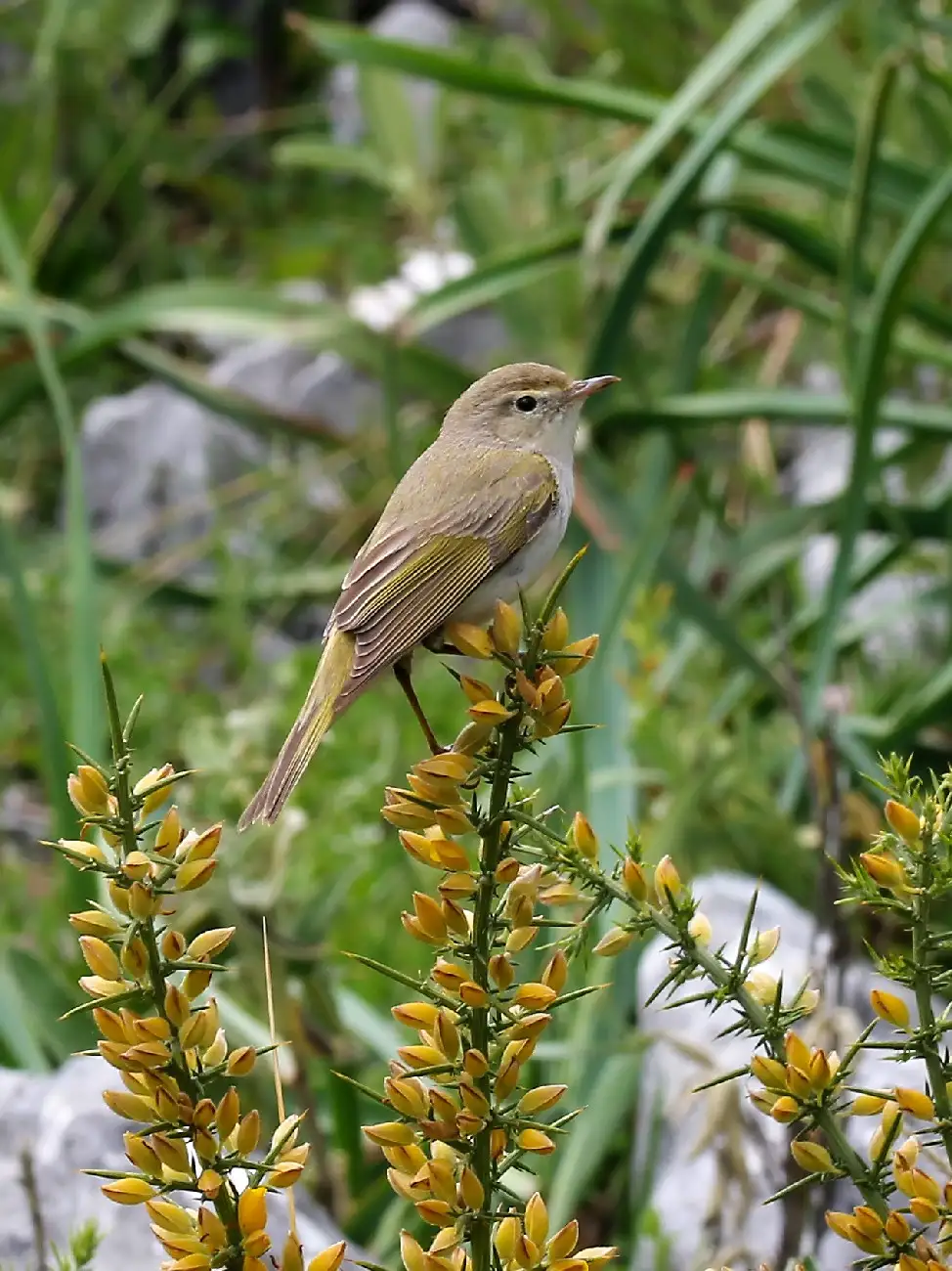
Western Bonelli's Warbler in profile on a flowering gorse, with greenish back and pale underpartsPhoto: Charlie Jackson, CC BY 2.0Photo 2 of 4
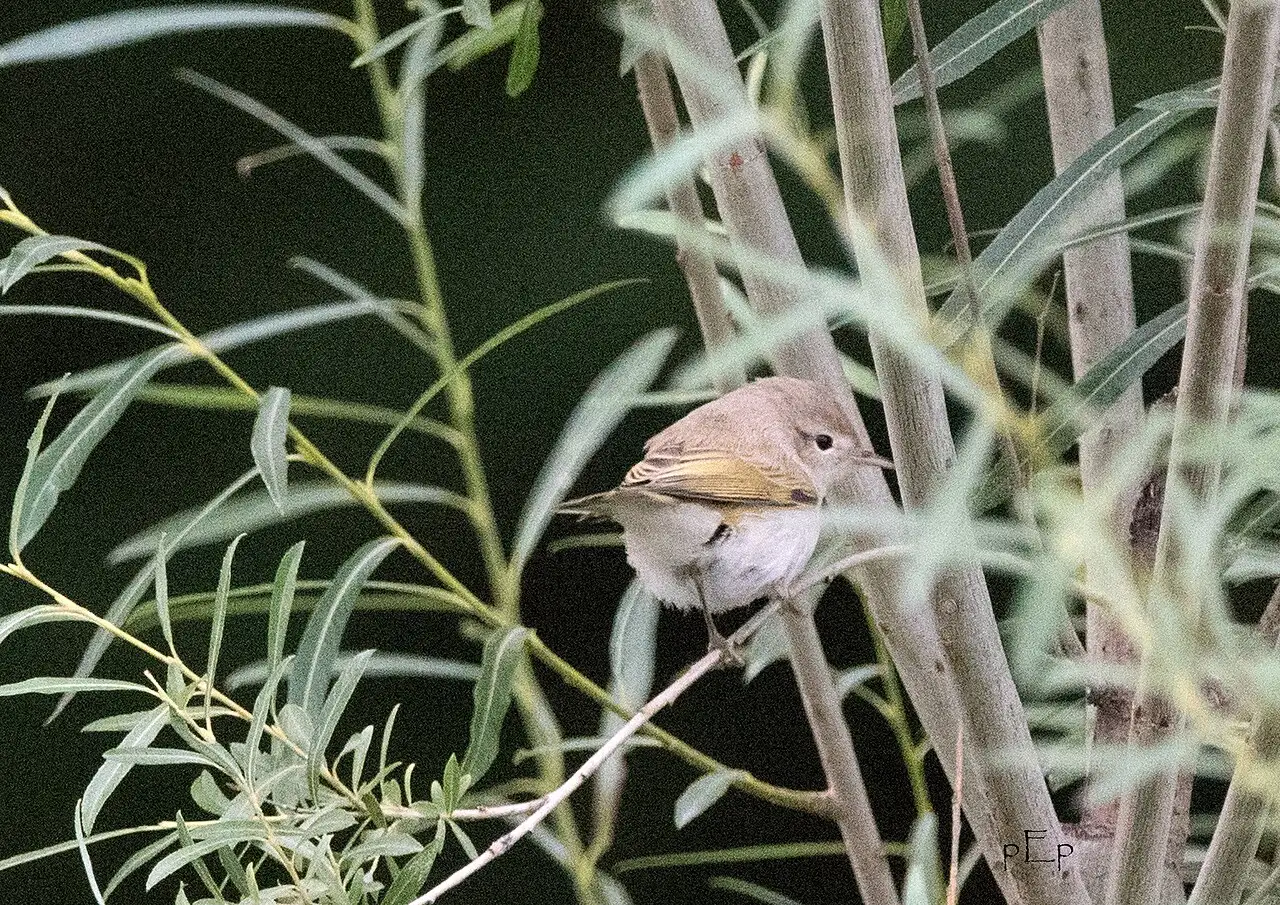
Western Bonelli's Warbler among the branches of a willow, in profile, with whitish head and underparts and greenish wingsPhoto: Pierre-Marie Epiney, CC BY-SA 2.0Photo 3 of 4
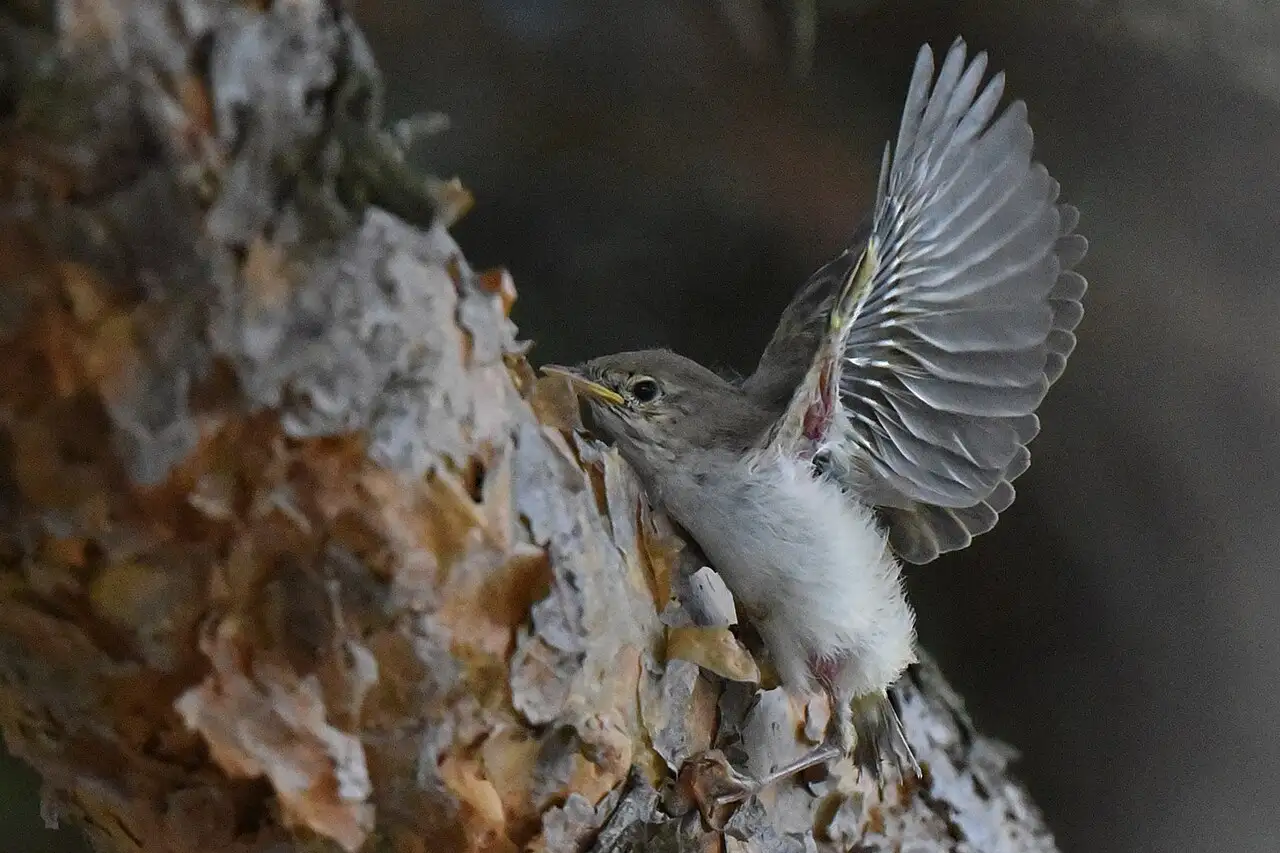
Young Western Bonelli's Warbler clinging to a pine trunk, with one wing unfolded and the flight feathers in viewPhoto: Pierre-Marie Epiney, CC BY-SA 2.0Photo 4 of 4
1 / 4
Identification of the Western Bonelli’s Warbler
The Western Bonelli’s Warbler has the typical silhouette of leaf warblers: stocky little body, fragile legs and thin bill. It differs from the others by its much paler overall colouring, especially on the head and underparts. The legs are black, and the wings, back and outer parts of the tail greenish, in contrast with the rest of the body, whitish. It shows no sexual dimorphism.
Adult
Head and underparts whitish.
Wings, back and outer parts of the tail greenish.
Black legs.
Habitat and distribution of the Western Bonelli’s Warbler
As a breeder, its distribution is restricted to the western Mediterranean region: south-west Europe (France, Italy, Spain and Portugal) and north-west Africa (Morocco and Algeria). It winters in a wide sub-Saharan strip, from Senegal to the Lake Chad basin. No subspecies are distinguished.
In Spain it is a widespread, continuous nesting bird in the northern half of the Peninsula, although more locally in Galicia, the Cantabrian fringe and the Ebro valley. In the southern half it is restricted to sierras and mountain systems (Betic and Penibetic systems, Levante ranges). It is absent from the Balearics and the Canaries, and also from Ceuta and Melilla.
It is a woodland species tied to deciduous woods and, to a lesser extent, to juniper woods or pine woods. The highest concentrations are reached in the oak woods of the north of the Peninsula, above all Pyrenean oak and Lusitanian oak woods. It occupies both mature woods and young or regenerating stands, from sea level to 2,000 metres (Pyrenees, Sierra Nevada), although it prefers between 1,000 and 1,500 metres.
It is a trans-Saharan migrant, with winter quarters in tropical Africa. The pre-breeding passage is detected between March and May, with a peak in late April, and the post-breeding one from July to September, with the largest number of birds in early August.
Areas where it is regularly recorded since 2010Squares of about 25 km where it is recorded regularly (occasional passage records are left out). Data from GBIF.org (46,271 records, retrieved October 2026); outline from Natural Earth.
Etymology of the Western Bonelli’s Warbler
According to Wikipedia, «Phylloscopus» comes from ancient Greek «phýllon» («leaf») and «skopós» («the one who looks»), and the epithet «bonelli» honours the Italian ornithologist Franco Andrea Bonelli. It is the western species, split from the eastern one, which were formerly considered a single one. In other languages it is called «mosquiter pàl·lid» in Catalan, «picafollas de papo branco» in Galician, «txio lepazuria» in Basque and «Western Bonelli’s warbler» in English1.
Population of the Western Bonelli’s Warbler
In the 2021 European Red List of Birds, the European breeding population is estimated at between 4,800,000 and 6,360,000 mature individuals, with an increasing trend. Spain holds most of Europe’s nesting birds, with a population of more than 4,200,000 individuals and the largest concentrations in Castilla y León, Catalonia and Castilla-La Mancha. Its trend is clearly positive, according to the SACRE programme (1998–2018), probably through the reforestation of farmland associated with rural abandonment. The size of its population, its trend, its wide range and the favourable evolution of the woods it inhabits, such as Pyrenean oak woods, mean it is not considered threatened.
Nest of the Western Bonelli’s Warbler
The female selects a small hollow in the ground or in a bank, protected by vegetation, and lines it with grasses and mosses.
Courtship and breeding of the Western Bonelli’s Warbler
The breeding period runs from May to July. The clutch is four to seven white or brown, heavily speckled eggs, which only the female incubates for 12 or 13 days. The chicks are tended by both parents and fly at 12 or 13 days of life. It may make two clutches a year.
Diet of the Western Bonelli’s Warbler
It bases its diet on invertebrates, mainly small woodland insects.
Curious facts about the Western Bonelli’s Warbler
Of the six species of leaf warblers present in Spain, the Western Bonelli’s Warbler is the only one with a colouring somewhat different from the general yellow-green pattern, because it is much paler, above all on the head and underparts1. Spain holds most of Europe’s breeding birds. EURING lists a bird ringed in Spain that lived 7 years and 11 months.
The Western Bonelli’s Warbler in Cabañeros
The habitat pages of this website do not mention it. GBIF.org records 55 observations of the Western Bonelli’s Warbler in Cabañeros and its surroundings.
Where to see the Western Bonelli’s Warbler in Cabañeros
In Cabañeros and its surroundings, from March to September, in Pyrenean oak woods, Lusitanian oak woods and other deciduous woods.
When
From March to September: the pre-breeding passage, from March to May, and the post-breeding one, from July to September.
What time
In good light, when it sings.
Where
In deciduous woods, above all Pyrenean oak and Lusitanian oak woods, and also in juniper woods and pine woods, mature or regenerating.
What to look for
Look for the whitish head and underparts against the greenish back; listen for the one-note trill.



 Same family
 Same family
 Same family
 Same order
 Same order
 Same order
 Same order
 Same order






