It usually moves in large groups in winter, often in the company of other thrushes
Lifespan
Record of 18.8 years in the wild according to AnAge; EURING lists a bird ringed in Belgium that lived 20 years and 4 months and was found dead
Conservation status
LC
NT
VU
EN
CR
EW
EX
Global (IUCN)
Least Concern
Spain
Data Deficient (DD) as a winter visitor and migrant in the Red List of the Birds of Spain; it is on neither the List of Wild Species under Special Protection nor the Spanish Catalogue of Threatened Species
When to see it
Winter visitor
Months of the year when it is present
J
F
M
A
M
J
J
A
S
O
N
D
In Iberia
yes
yes
yes
no
no
no
no
no
no
yes
yes
yes
Song or voice of the Redwing
At our latitudes the song is rarely heard, a strident, quick sequence of squeaks and clicks recalling the warbling of swallows; more frequent are the calls it gives in a flock, «tsiip», or the «chuck» click when it moves on the ground1. The recording (call) is by Lars Edenius and was made at Kåddis, near Umeå (Sweden) (xeno-canto XC1156372, quality A). It lasts 9 seconds and is a trimmed stretch of a 28 s clip, without repeating or lengthening it, from which we have removed the bass below 300 Hz, reduced the background noise and adjusted the volume; neither pitch nor speed has been changed. It is from Sweden, not from Spain.
The flanks and the underside of the wings show a fairly intense reddish tone, visible in flight, which is a good clue for telling it from similar species. In its wintering areas it behaves as a nomad, which takes it over long distances in a short time.
Flight typeMigratory; in its wintering areas it behaves as a nomad, with large movements in a short time
It usually moves in large groups in winter, often in the company of other thrushes.
The flanks and the underside of the wings show a fairly intense reddish tone, visible in flight, which is a good clue for telling it from similar species.
In its wintering areas it is a nomad and moves from montane woods to the fruit orchards and olive groves of the lowlands; in autumn and winter it eats berries, fruit, olives and seeds.
Photo gallery of the Redwing
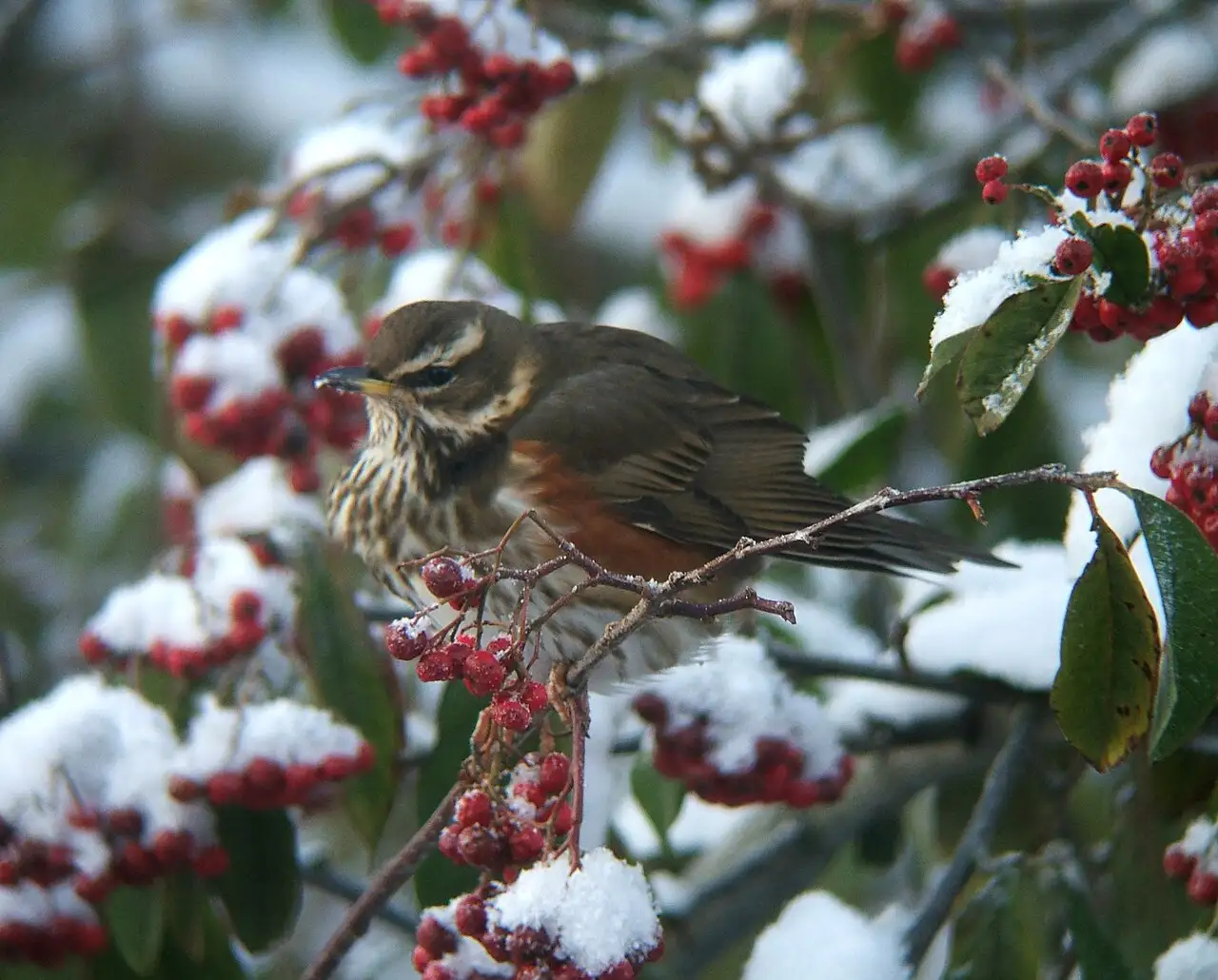
Redwing perched among branches covered in red berries and snow, with pale eyebrow, streaked breast and reddish flanksPhoto: MPF, CC BY-SA 3.0Photo 1 of 6
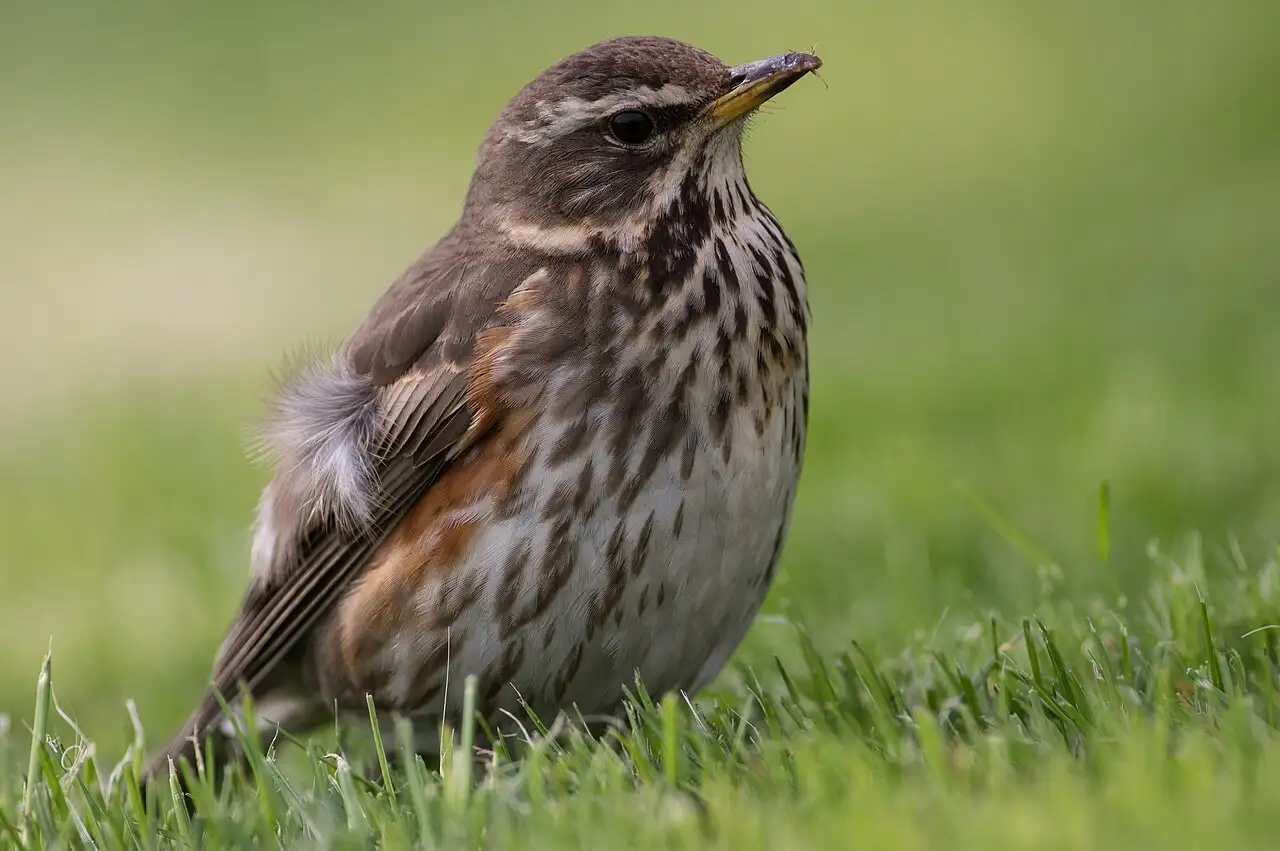
Redwing perched on the grass, with greyish-brown back and white breast with dark streaks, and a hint of red on the flankPhoto: Hobbyfotowiki, CC0Photo 2 of 6
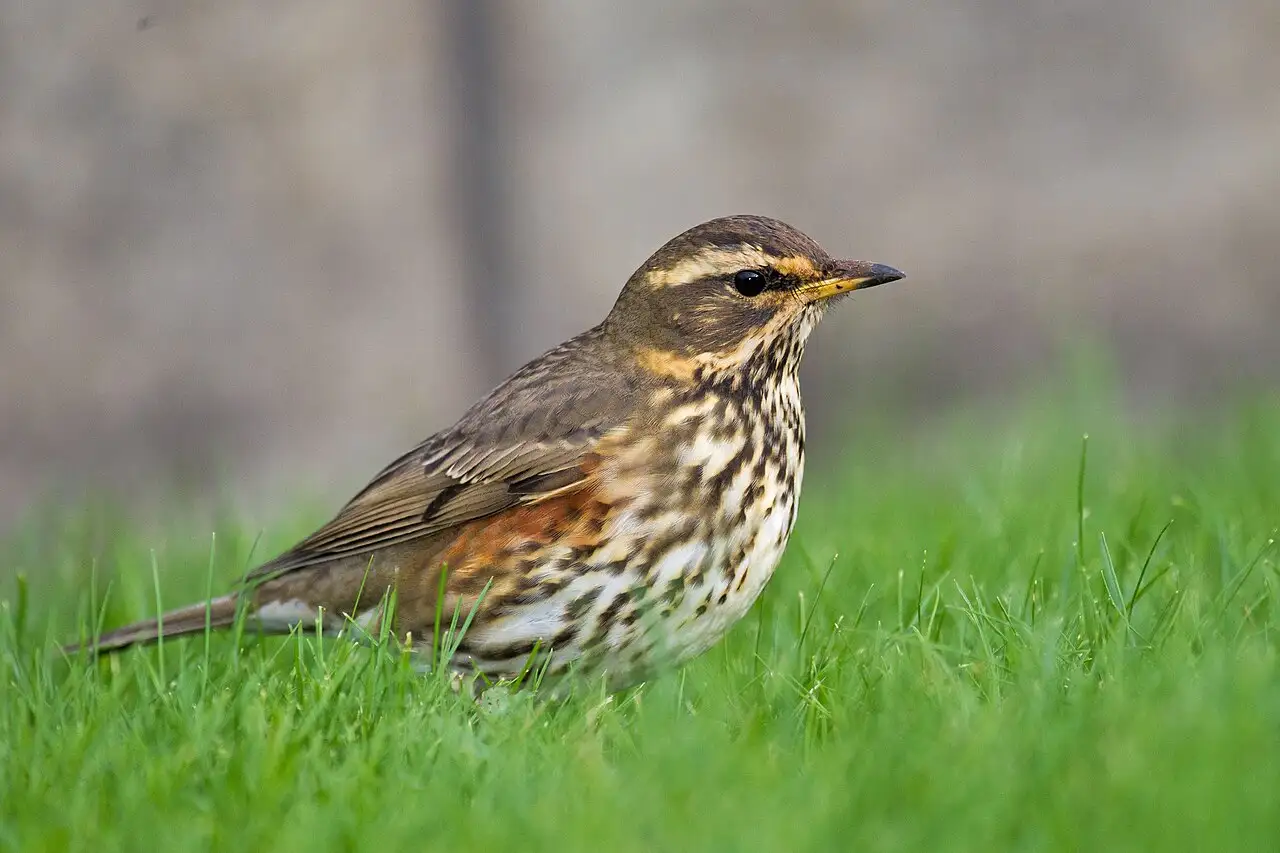
Redwing in profile on a lawn, with pale eyebrow and moustachial stripe, streaked breast and reddish flanksPhoto: Andreas Trepte, CC BY-SA 2.5Photo 3 of 6
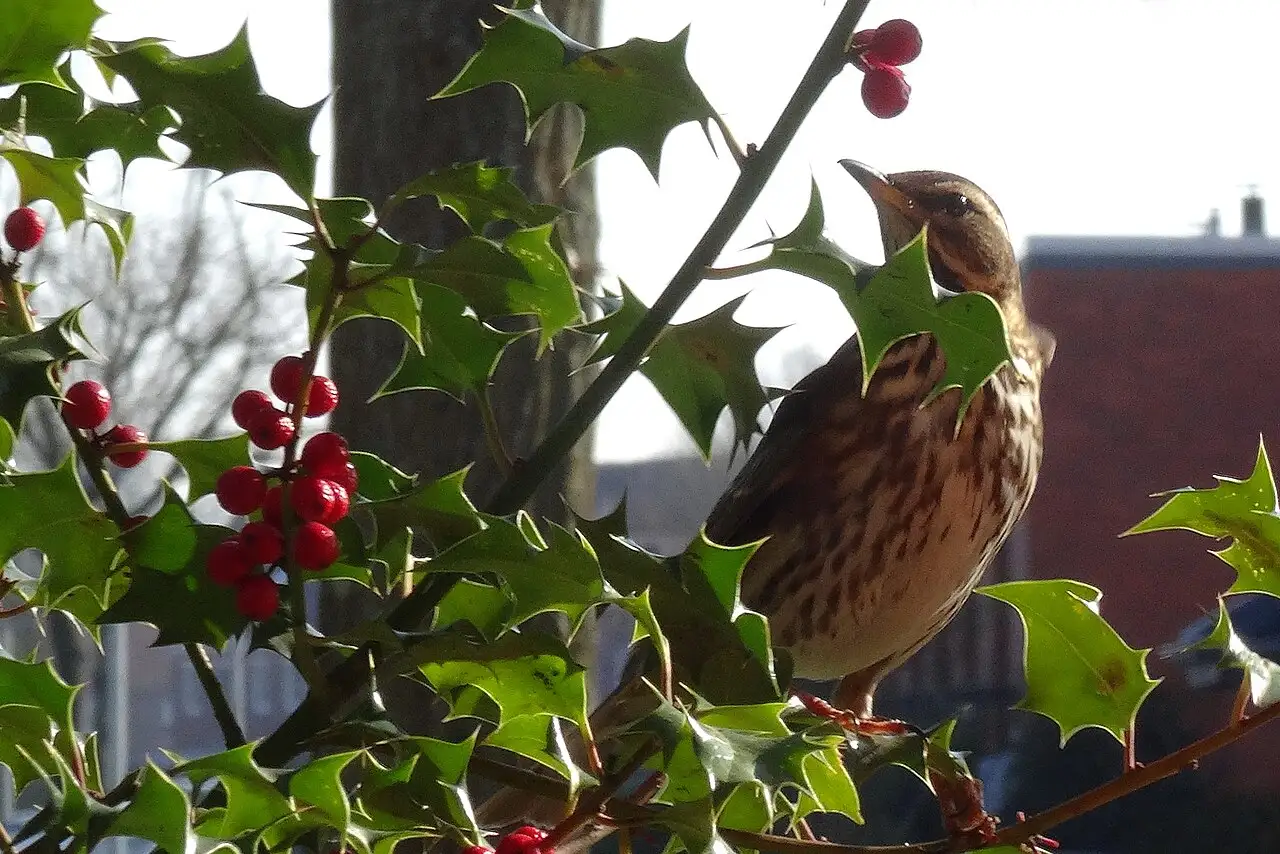
Redwing among the leaves of a holly with red berries, looking upwardsPhoto: Jürgen Howaldt, CC BY-SA 4.0Photo 4 of 6
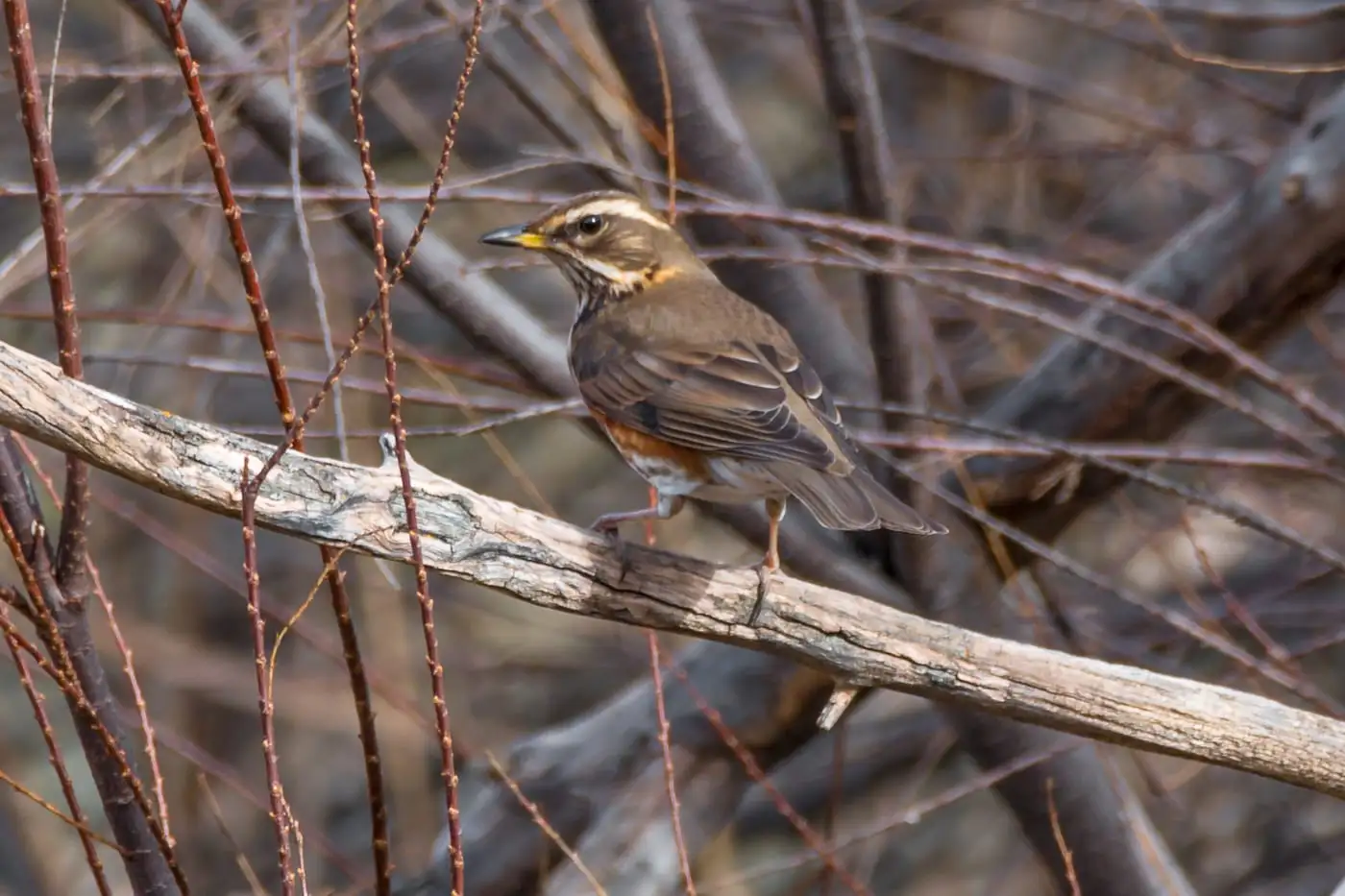
Redwing in profile on a dry branch, with pale eyebrow and reddish flank (Madrid)Photo: Agustín Silgado, CC BY-NC 4.0Photo 6 of 6
1 / 6
Identification of the Redwing
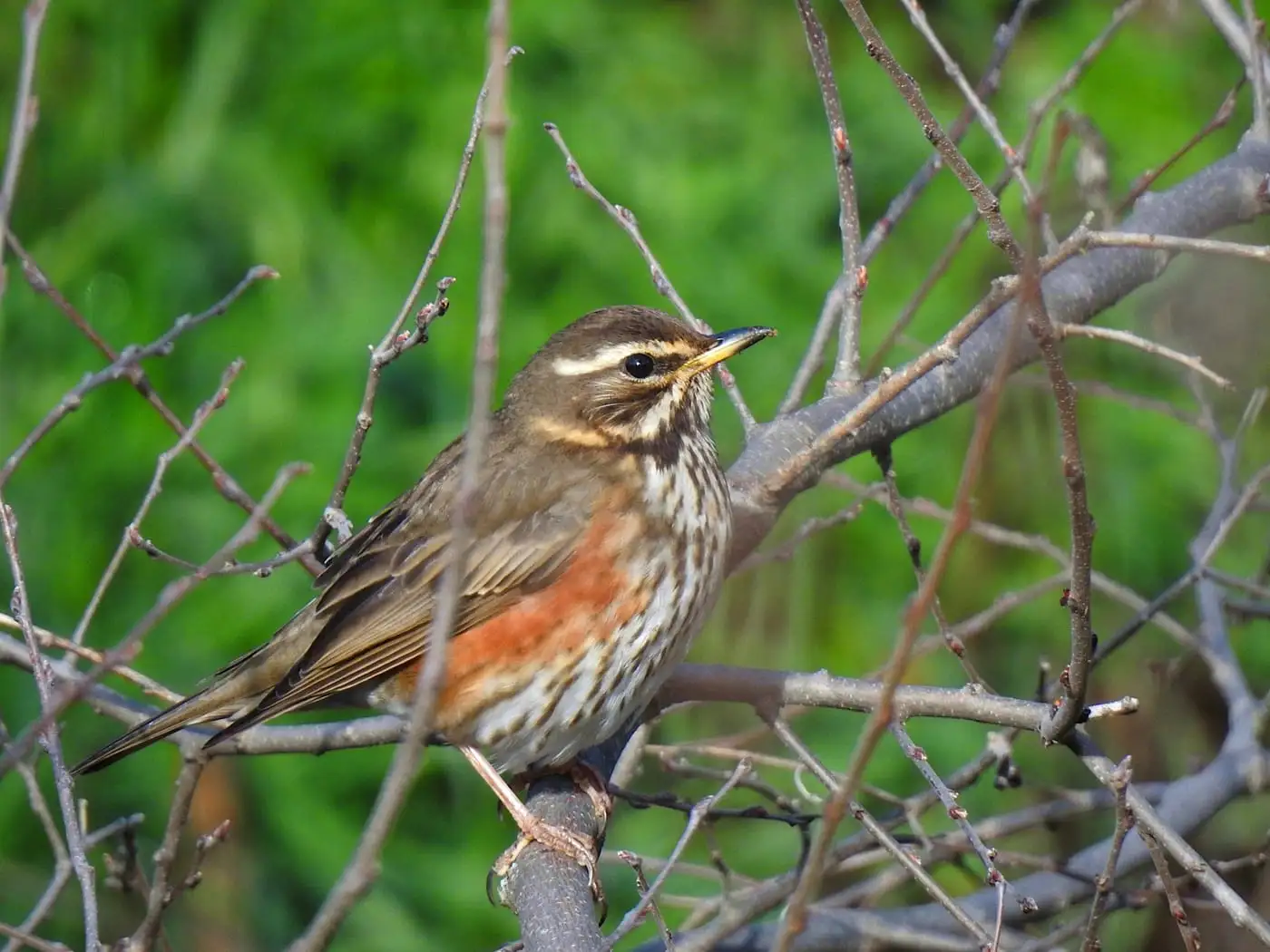
The Redwing is small, compact and relatively short-tailed, and shows no very evident sexual dimorphism. Its plumage is greyish brown on the back and white with dark streaks on the underparts. The flanks and the underside of the wings show a fairly intense reddish tone, visible in flight, which is a good clue for telling it from similar species. Another striking feature of its pattern is the presence of a marked white eyebrow and moustachial stripe, distinguishable even at some distance.
Adult
Greyish-brown back; white underparts with dark streaks.
Flanks and underside of the wings an intense reddish; marked white eyebrow and moustachial stripe.
Habitat and distribution of the Redwing
It breeds at fairly high latitudes of Europe and Asia, from Iceland to eastern Siberia. Several subspecies are known: scientific ringing has shown that both Scandinavian birds of the subspecies «iliacus» and birds from Iceland, of the subspecies «coburni», reach the Peninsula, and birds ringed in Russia, Belgium, Switzerland, Poland or Great Britain have also been recorded.
In Spain it is exclusively a winter visitor, distributed through most regions1. It is most abundant in the northern third, while in the rest of the territory it tends to occupy montane areas above 1,300 metres in altitude, although it can be seen in suitable lower areas.
In its wintering areas it shows nomadic behaviour, which takes it from montane conifer and oak woods to the fruit-tree crops and olive groves of the lowlands, very important to the species during its winter in the Mediterranean region. It prefers habitats with various shrubs, hedges or low trees, since it moves and feeds in the lower storey of the wood.
It is migratory over most of its range, with its main wintering places in the Mediterranean countries of the continent and at numerous sites in western Europe, including the British Isles.
Areas where it is regularly recorded since 2010Squares of about 25 km where it is recorded regularly (occasional passage records are left out). Data from GBIF.org (37,824 records, retrieved October 2026); outline from Natural Earth.
Etymology of the Redwing
In other languages it is called «tord ala-roig» in Catalan, «tordo rubio» in Galician, «birigarro hegagorria» in Basque and «redwing» in English1. We have found no source explaining the origin of the Spanish name «zorzal alirrojo» or of the scientific one, so we do not venture a guess.
Population of the Redwing
The 2021 European Red List of Birds estimates the European breeding population at between 16,200,000 and 28,100,000 mature individuals, with a decreasing trend. Until not long ago, in grey, dreary winters, when cold waves swept the European countries, vast numbers of Redwings spread over the farmland, riverside groves, vineyards and woods of the Peninsula and the Balearics1. Its presence among us is becoming ever stranger1.
The size of the wintering population in Spain depends largely on the severity of winters in northern Europe and fluctuates greatly from one season to another: in some hard winters several million Redwings have been estimated in the territory, while in other seasons they number no more than a few thousand. No significant threats have been cited in its breeding areas; in Spain it occasionally suffers indiscriminate hunting at local scale for its supposed damage to the olive harvest and is a regular victim of unscrupulous bird-catchers, above all those who still use the illegal «parany» practice.
Nest of the Redwing
In its breeding areas it generally places the nest in trees, although it may also put it on banks, climbers, stumps, shrubs or other sites. The female builds a dense cup of fine twigs, grasses, moss and lichens, which she normally reinforces with a layer of mud, and lines it with very fine grasses.
Courtship and breeding of the Redwing
In northern Europe it prefers to settle in wooded formations, either the cold northern birch woods or mixed stands of deciduous species with abundant undergrowth, often near water. It usually lays two clutches per season, between April and June depending on latitude, of four or five bluish or blue-green eggs, heavily covered with tiny reddish-brown speckles, incubated for 11–15 days. The chicks are fed by both parents and leave the nest after two weeks. It does not breed in Spain.
Diet of the Redwing
Its diet varies markedly with the season. In spring and early summer it eats various invertebrates, such as earthworms, insects, spiders and snails; in autumn and winter its diet is mainly fruit- and seed-eating and includes various berries, fruits, olives and seeds.
Curious facts about the Redwing
The birds that reach the Peninsula belong to two subspecies, «iliacus» (Scandinavia) and «coburni» (Iceland), as ringing has revealed1. The longevity given by EURING, 20 years and 4 months in a bird found dead in Belgium, is somewhat greater than the 18.8 years of AnAge.
The Redwing in Cabañeros
The habitat pages of this website do not mention it, but it does appear in the bird list of the «Visitor’s Guide to Cabañeros National Park» (OAPN, page 106). That list attests its presence in the Park, not that it breeds there. GBIF.org records 3 observations of the Redwing in Cabañeros and its surroundings, which fits a winter visitor that varies greatly from year to year. In the rest of the Peninsula, outside the north, it tends to occupy montane areas above 1,300 metres1. It visits lowland olive groves1. Of those observations, 2 fall within the Park boundary (according to OpenStreetMap); the rest are from the surroundings.
Where to see the Redwing in Cabañeros
In Cabañeros and its surroundings, occasionally in winter, in olive groves, riverside groves and scrubby areas.
When
In Spain from October to March; numbers vary greatly with how hard the winter is in northern Europe.
What time
By day, in flocks, eating berries, olives and fruit in the lower storey of the wood, and on the ground.
Where
In groves, hedges and low trees, montane woods and, in the lowlands, olive groves and fruit orchards.
What to look for
Look for the reddish flanks and the white eyebrow; listen for the «tsiip» in flight and the «chuck» on the ground.



 Same family
 Same family
 Same family
 Same order
 Same order
 Same order
 Same order
 Same order






