The populations of northern and central Europe are migratory
Lifespan
Record of 11.4 years in the wild according to AnAge; EURING lists a bird ringed in the Netherlands that lived 14 years and 3 months, and another, in Spain, 13 years and 9 months
Conservation status
LC
NT
VU
EN
CR
EW
EX
Global (IUCN)
Least Concern
Spain
Data Deficient (DD) as a breeder in the Red Book of the Birds of Spain; on the List of Wild Species under Special Protection, but not in the Spanish Catalogue of Threatened Species
When to see it
Winter visitor
Months of the year when it is present
J
F
M
A
M
J
J
A
S
O
N
D
In Iberia
yes
yes
yes
yes
yes
yes
yes
yes
yes
yes
yes
yes
Breeding season
no
no
no
no
yes
yes
no
no
no
no
no
no
Song or voice of the Bluethroat
Males sing perched on shrubs or in flight, and they emulate or reproduce notes of many other songbirds1. Their alarm call recalls that of the chats1. The recording (song) is by João Ferreira Tomás and was made in Tierra de Alba (near Navianos de Alba), Zamora, Castilla y León (xeno-canto XC1164421, quality A). It lasts 9 seconds and is a trimmed section of the original, without repeating or lengthening, from which we have removed the bass below 300 Hz, reduced the background noise and adjusted the volume; neither pitch nor speed has been changed.
The populations of northern and central Europe are migratory and set off in late summer for the African savannas1. On the Peninsula a passage of Bluethroats from western Europe is recorded between August and early October; winter visitors stay until February or March, and from then on the return towards northern Europe is detected.
Flight typeSings perched on shrubs or in flight
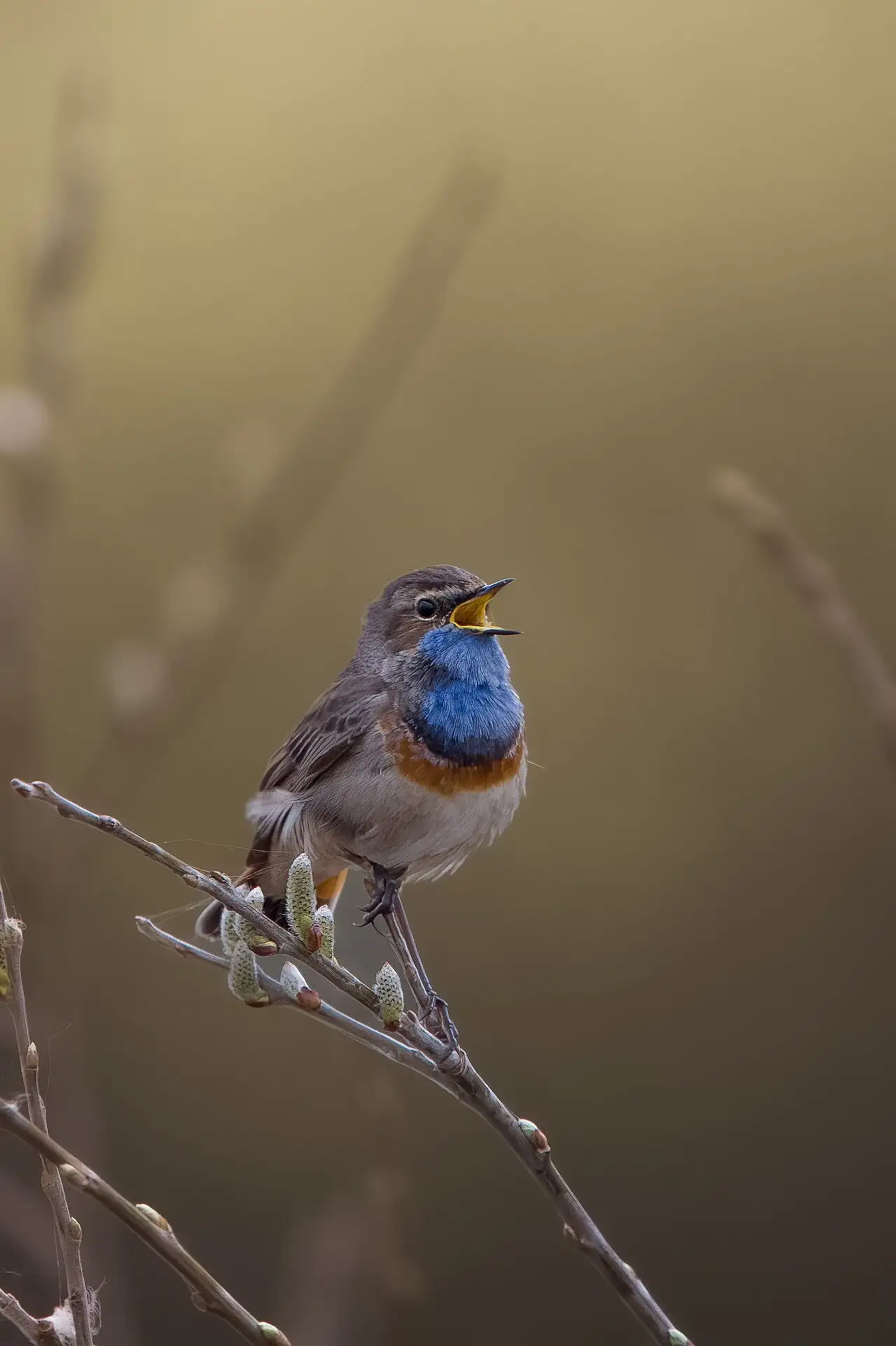
Males sing perched on shrubs or in flight, and emulate or reproduce notes of many other songbirds; among their trills fragments of the larks' melody can be recognised.
It has the tail orange on its basal half, and black or very dark brown on the outer part; the back is greyish brown.
It eats insects, above all beetles and ants, and in autumn also seeds and fleshy fruits.
Photo gallery of the Bluethroat
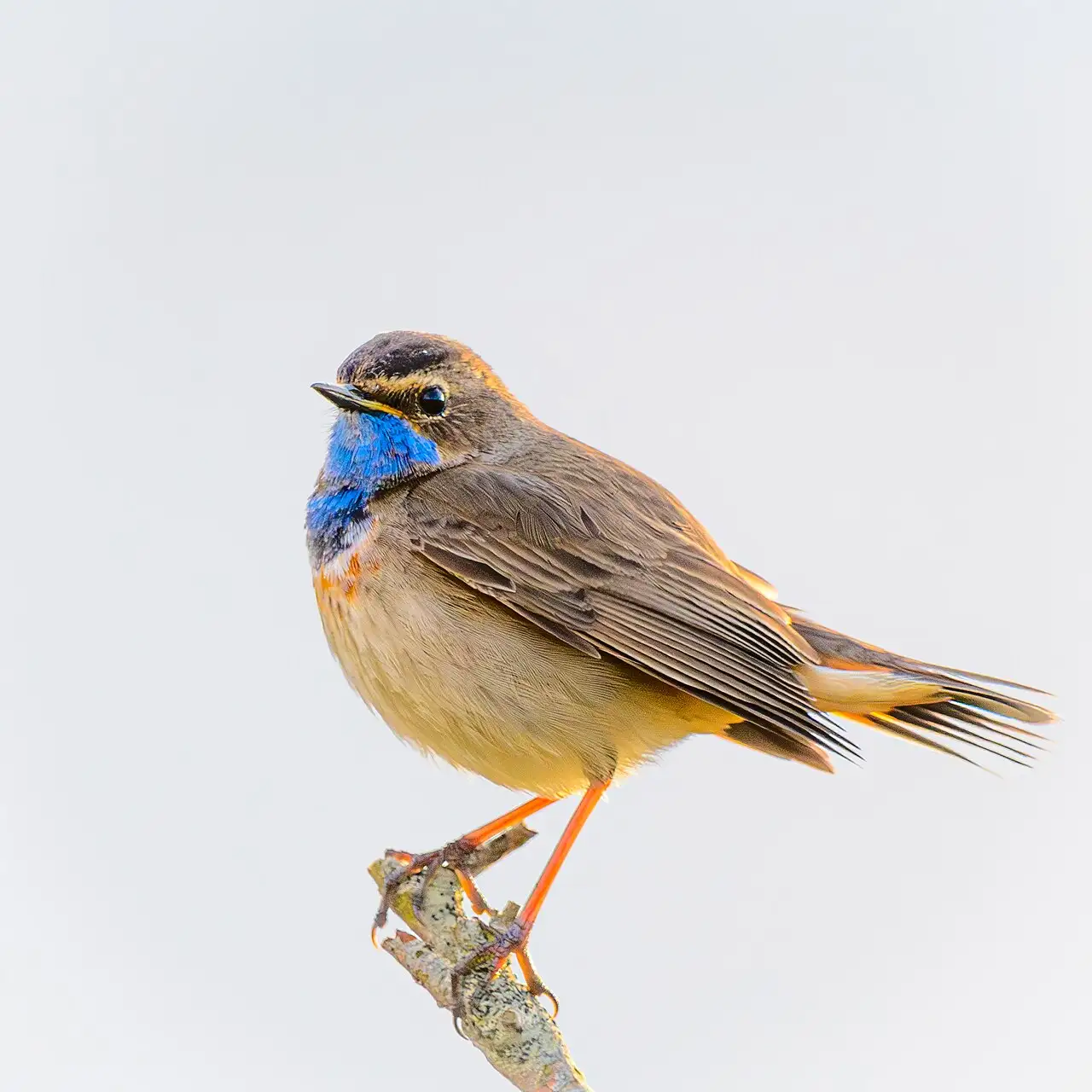
Male Bluethroat perched on a thin branch, with intense blue throat edged with an orange band, white eyebrow, greyish-brown back and orange tailPhoto: Stephan Sprinz, CC BY 4.0Photo 1 of 5
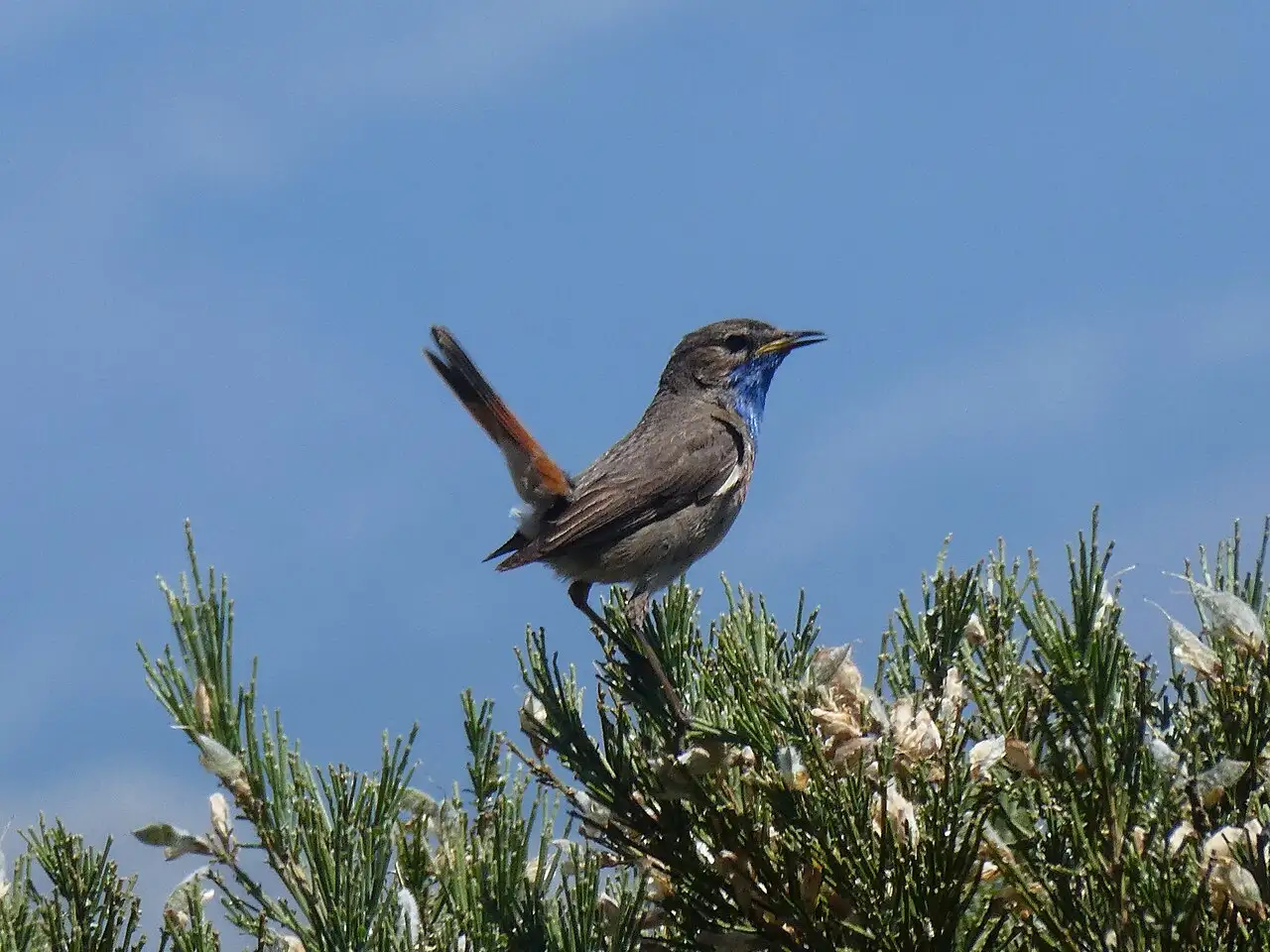
Male Bluethroat of the Iberian subspecies perched on top of a broom bush, with the tail raised and the blue throatPhoto: Celiags14, CC BY-SA 4.0Photo 2 of 5
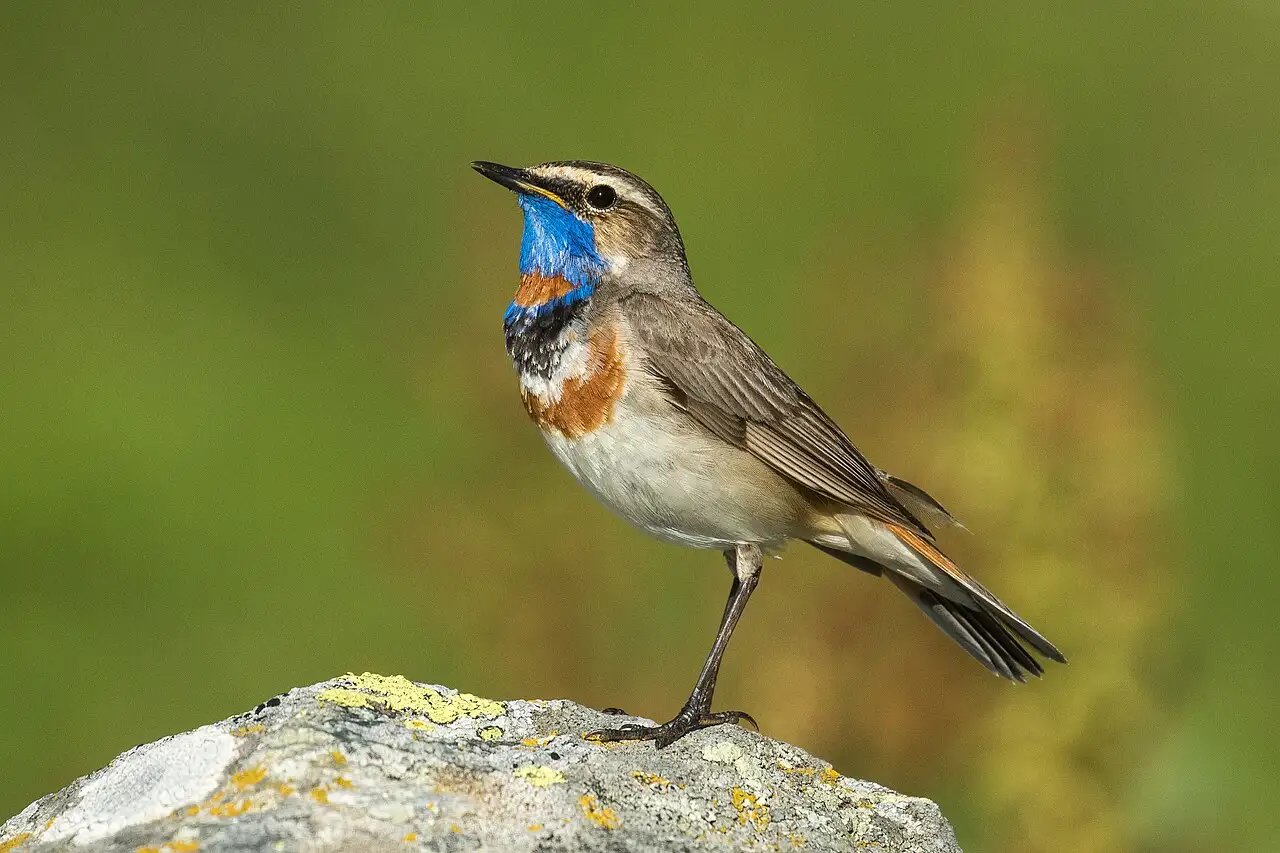
Male Bluethroat standing on a rock with yellow lichens, with blue throat, orange band and white eyebrowPhoto: Francesco Veronesi, CC BY-SA 2.0Photo 3 of 5
Bluethroat with open bill, singing on a thin branch, with the blue throat and a background of soft tonesPhoto: Matthiaswenig.naturfotografie, CC BY-SA 4.0Photo 4 of 5
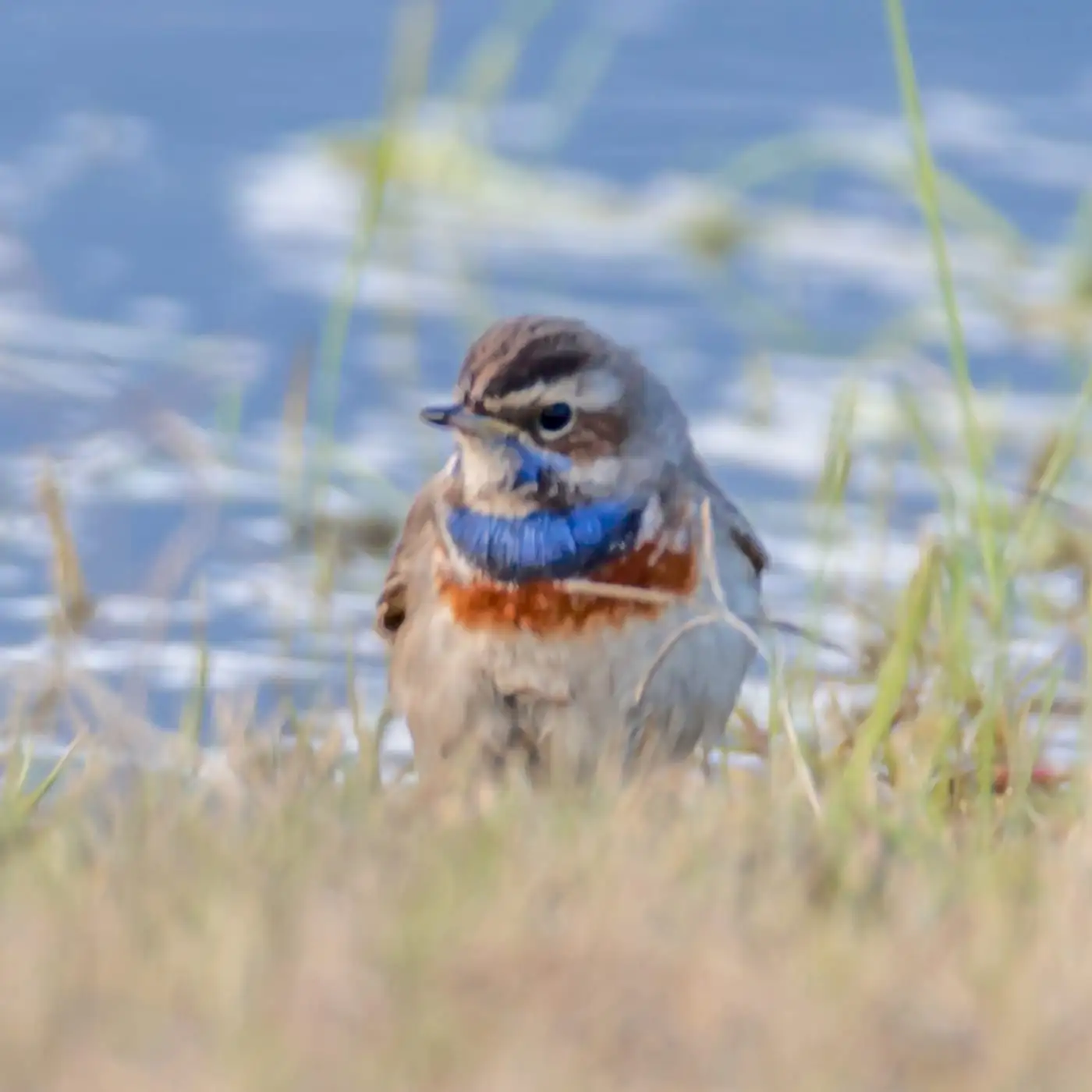
Male Bluethroat from the front among the grass, with the blue bib and the reddish spot (Alicante)Photo: Agustín Silgado, CC BY-NC 4.0Photo 5 of 5
1 / 5
Identification of the Bluethroat
The Bluethroat is a little bird of stocky figure, long tail and thin bill, with a plumage in which its blue-spotted bib stands out, which in adult males is outlined by a fine black band, surrounded in turn by a broader orange band. In addition, males have blue-tinged moustachial stripes that, in some subspecies, merge with the equally bluish throat. Depending on the subspecies, the blue bib carries a medal-like spot, white or orange. The females’ colouring is less striking: they usually show little blue on the breast, often have a cream-white throat and the orange band on the breast is blurred, although older females may resemble males. Both sexes have a distinctive white line above the eye and a greyish-brown back. The tail, orange on its basal half, is black or very dark brown on the outer part. Fledglings are brown and spotted, like young European Robins and Common Nightingales, but young Bluethroats are told by the white supercilium, the pale throat and the orange colour of the tail.
Adult male
Blue bib with a black band and an orange one; blue moustachial stripes.
White eyebrow, greyish-brown back and tail orange at the base.
Female and young bird
Female: little blue on the breast, cream-white throat and blurred orange band.
Young bird: brown and spotted, with white eyebrow, pale throat and orange tail.
Habitat and distribution of the Bluethroat
It shows notable variability in plumage colour, so several subspecies have been described; in western Europe four are recognised: «svecica», «cyanecula», «nannetum» and «azuricollis». In summer it ranges over middle and high latitudes of almost all of Asia and the northern half of Europe, above all the Scandinavian peninsula, and to the south it appears only in some mountain regions; there are also populations in Alaska. In winter it settles in the African savannas, the south of the Near East, Saudi Arabia, Pakistan and Indochina.
In Spain, in spring, it inhabits montane sites of the Cantabrian Range, the Montes de León and the Central System, where it breeds among Spanish broom1. In winter, the Iberian population moves to Africa, and part of the European one takes refuge mainly on the Mediterranean coastal strip, in the Guadalquivir valley and, to a lesser extent, in wetlands and riverbanks of the Tagus and Guadiana basins. The Iberian breeding populations are of the subspecies «azuricollis».
In Europe it breeds in damp clearings of pine and spruce woods (taiga) and in shrubby formations of birches and tundra scrub. On the Peninsula it settles to breed in montane sites between 1,500 and 2,500 metres, in alpine environments with a mosaic of scrub, heath or Spanish broom, and damp meadows; in the northern mountains it even breeds in open holm oak woods with rockroses, at 800–1,000 metres.
Areas where it is regularly recorded since 2010Squares of about 25 km where it is recorded regularly (occasional passage records are left out). Data from GBIF.org (69,489 records, retrieved October 2026); outline from Natural Earth.
Etymology of the Bluethroat
In other languages it is called «cotxa blava» in Catalan, «rousinol papoazul» in Galician, «papourdina» in Basque and «bluethroat» in English; on its page it calls it «ruiseñor pechiazul»1. We have not found a source explaining the origin of the names, so we do not venture one.
Population of the Bluethroat
In the 2021 European Red List of Birds, the European breeding population is estimated at between 7,930,000 and 14,800,000 mature individuals, with a stable trend. There is no information on the Spanish breeding population or its trend1. Among the threats it cites alterations of alpine landscapes by overgrazing, the drying of streams to take water for artificial snow cannons, the urbanisation of ski resorts and unregulated leisure activities, such as hiking or camping.
Nest of the Bluethroat
It chooses areas with dense scrub and sets the nest directly on the ground or at the base of a shrub. It is a cup of stems, dry grasses, mosses and rootlets, with the inside lined with fine grass and hair.
Courtship and breeding of the Bluethroat
It has one brood a year. The clutch, which occurs in May or June, is four to six bluish or greenish eggs, with fine dark speckling. Incubation lasts 13–15 days, and the chicks leave the nest in a similar time. Those dates are those of its breeding cores on the Peninsula; at Cabañeros it is a winter visitor, and the twelve months of the Peninsula’s calendar must not be read as local presence.
Diet of the Bluethroat
It eats insects, above all beetles and ants; in autumn, in addition, it takes seeds and fleshy fruits.
Curious facts about the Bluethroat
It is a beautiful insect-eating bird, typical of the northern areas of Europe, which in the centre and south of the continent takes refuge in mountain areas; in Spain it breeds only in the Central System, the Cantabrian Range and the Montes de León1. Ringing shows that Iberian birds winter in Africa.
The Bluethroat in Cabañeros
The habitat pages of this website do not mention it, and we have not found any other published source on it in the Park; nor does it appear in the bird list of the «Visitor guide to Cabañeros National Park» (OAPN). GBIF.org records 4 observations of the Bluethroat in Cabañeros and its surroundings. Among the places where the European winter visitors take refuge are cited the wetlands and riverbanks of the Tagus and Guadiana basins, and on the Peninsula it breeds only in the Central System, the Cantabrian Range and the Montes de León1. None of those observations falls within the Park boundary (according to OpenStreetMap): all are from the surroundings.
Where to see the Bluethroat in Cabañeros
In Cabañeros and its surroundings, occasionally, in autumn and winter, in the undergrowth of rivers and ponds.
When
Passage from August to early October; winter visitors stay until February or March.
What time
By day, among low vegetation and scrub, often on the ground.
Where
On banks, in wetlands and scrub; breeders, in the mountain Spanish broom.
What to look for
Look for the blue bib and the white eyebrow, and the orange tail in flight; listen for the song that imitates other birds.
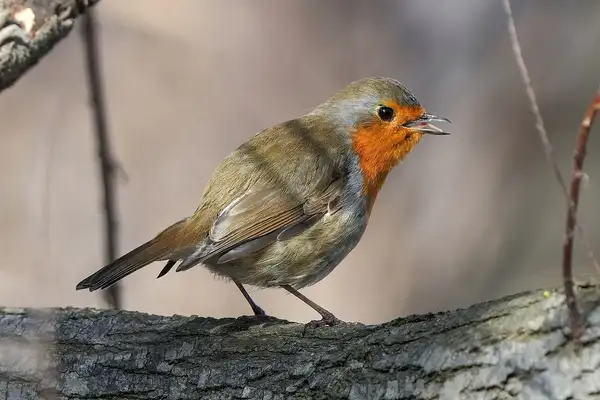
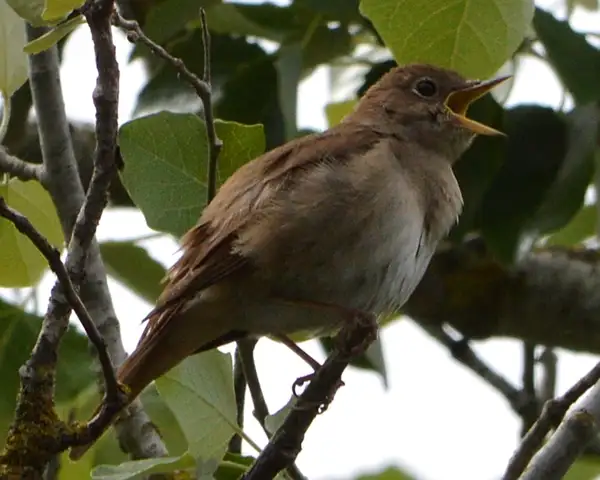
It is similar in physical appearance1: Bluethroat fledglings are brown and spotted, like young European Robins and Common Nightingales, but are told by the white eyebrow, the pale throat and the orange tail.



 Same family
 Same family
 Same family
 Same family
 Same order
 Same order
 Same order
 Same order






