Not known in detail; its status and distribution are still little known
Lifespan
EURING lists a bird ringed in Spain that lived 7 years; another, 5 years and 9 months
Conservation status
LC
NT
VU
EN
CR
EW
EX
Global (IUCN)
Least Concern
Spain
Least Concern (LC) as a breeder in the Red Book of the Birds of Spain; on the List of Wild Species under Special Protection, but not in the Spanish Catalogue of Threatened Species
When to see it
Summer visitor
Months of the year when it is present
J
F
M
A
M
J
J
A
S
O
N
D
In Iberia
no
yes
yes
yes
yes
yes
yes
yes
yes
yes
no
no
Breeding season
no
no
no
yes
yes
yes
yes
no
no
no
no
no
Song or voice of the Iberian Chiffchaff
The song is a succession of short notes, alike, given in an irregular rhythm that gradually speeds up until it ends in a quick trill; although it resembles the Common Chiffchaff’s, it is the best way to tell them apart, because it has another cadence and another structure1. The call is a descending, plaintive «piu». The recording (song) is by Gabriel CAUCANAS and was made in Debabarrena (near Itxaspe), Gipuzkoa, Basque Country (xeno-canto XC1133925, quality A). It lasts 9 seconds and is a trimmed section of the original, without repeating or lengthening, from which we have removed the bass below 300 Hz, reduced the background noise and adjusted the volume; neither pitch nor speed has been changed.
There are only data on its presence: its migratory habits are not known precisely, but its pattern in Spain seems to indicate a trans-Saharan migrant appearing in summer1.
Flight typeAgile among the branches, from branch to branch
It is a woodland species that occupies a wide variety of tree formations, from woods and copses to farming mosaics with some tree cover.
Its song is a succession of short notes, given in an irregular rhythm that speeds up progressively until it ends in a quick trill.
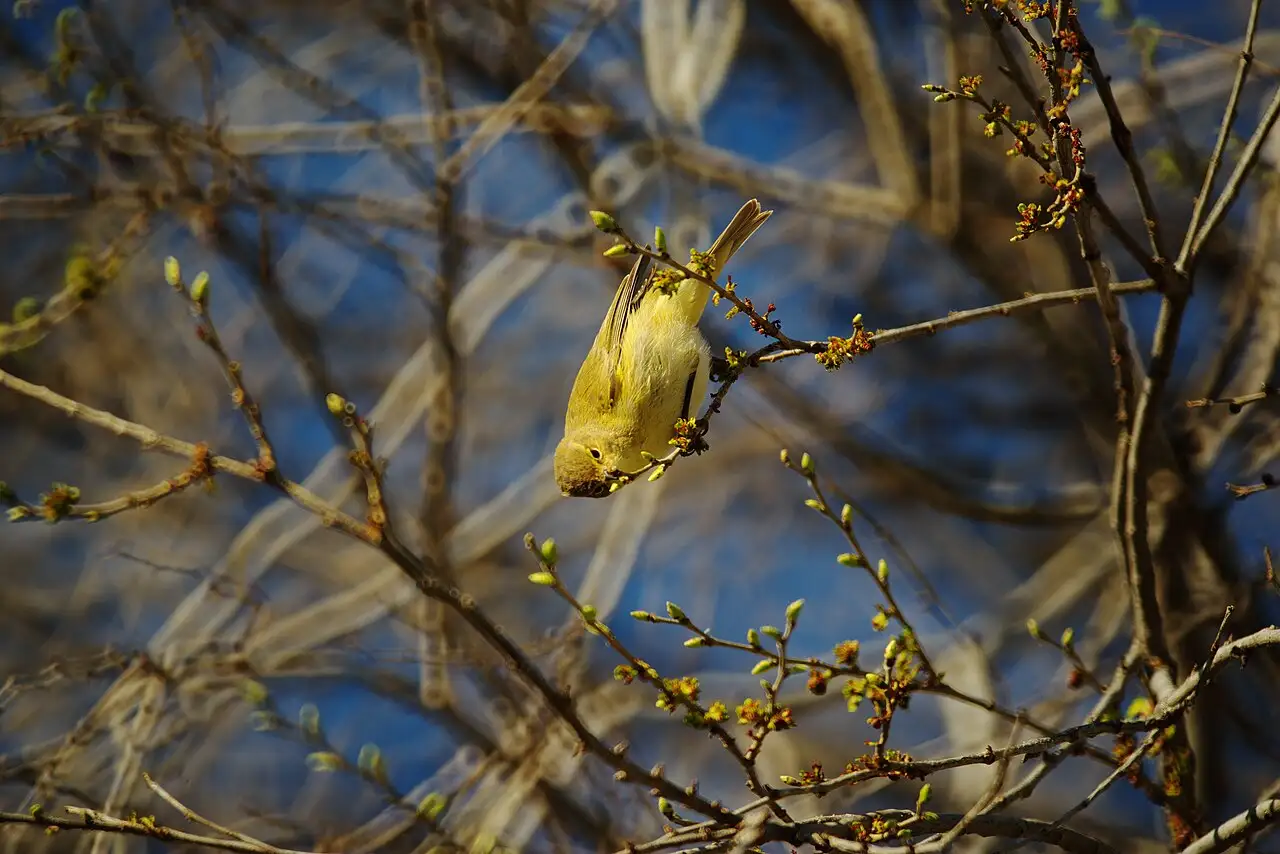
Its diet is based on insects, which it supplements in spring and autumn with small fruits and flower nectar.
Photo gallery of the Iberian Chiffchaff
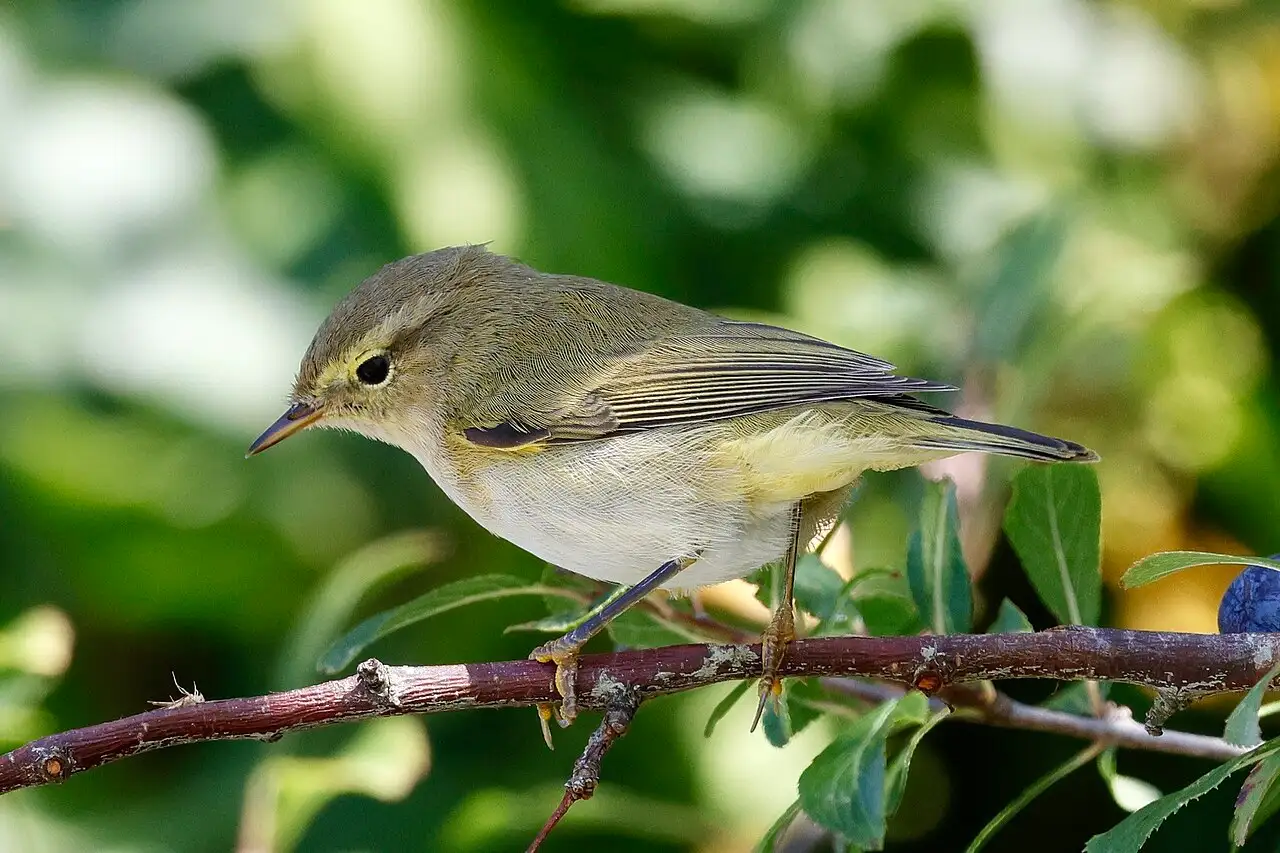
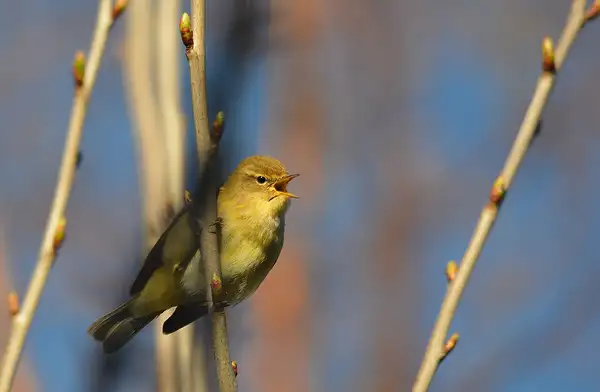
Iberian Chiffchaff in profile, perched on a bramble branch among green leaves, with bright green back and whitish underpartsPhoto: Markus Lampinen, CC BY 4.0Photo 1 of 4
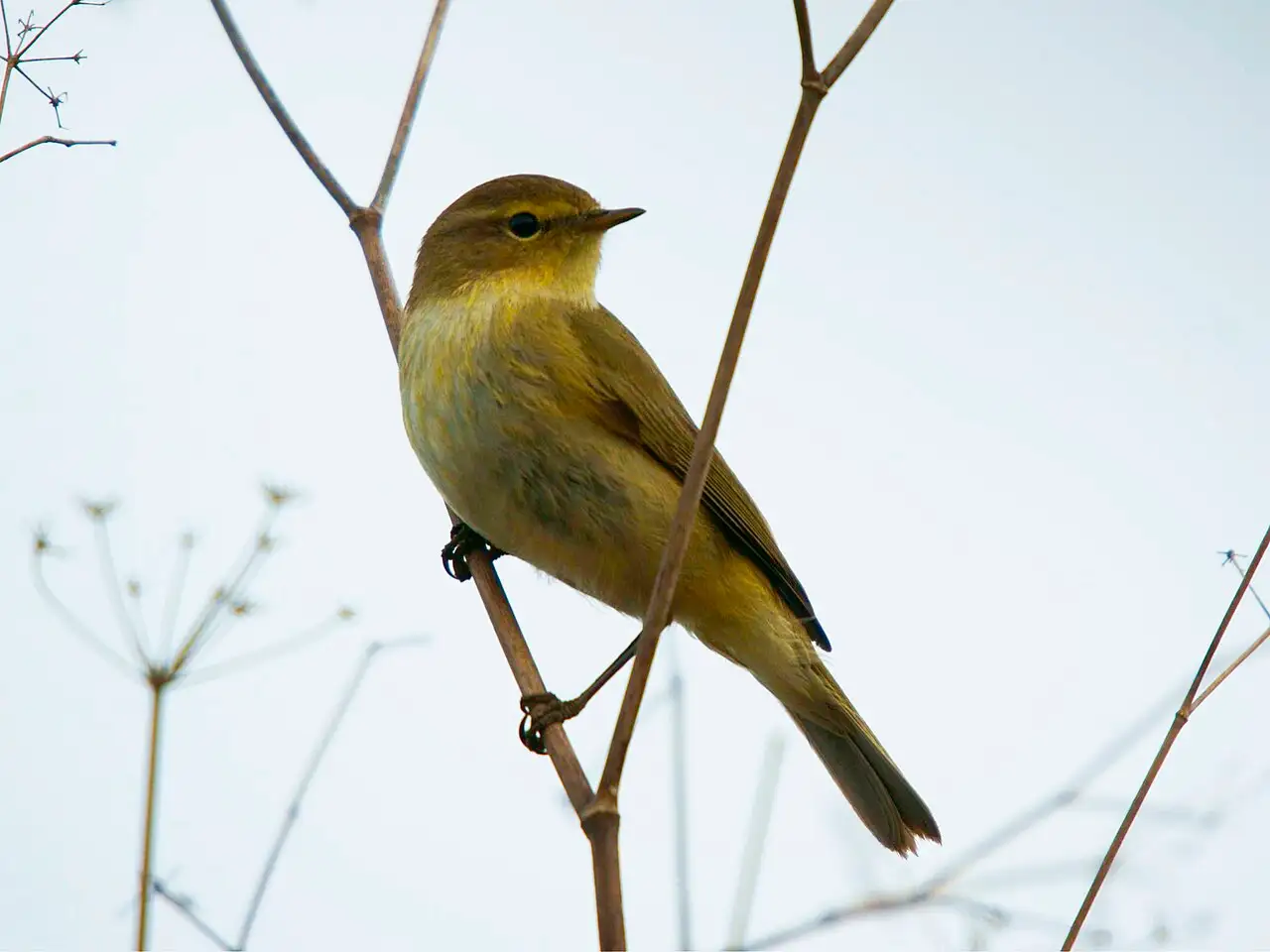
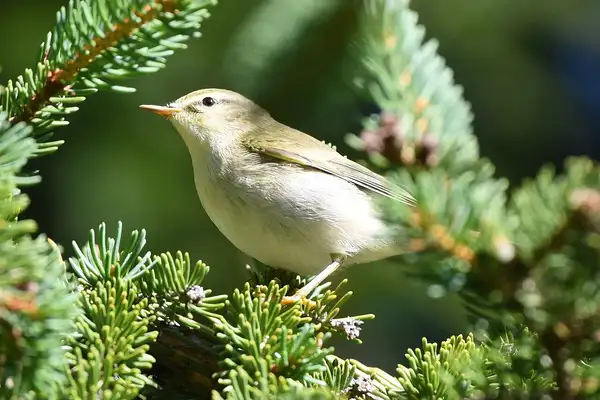
Iberian Chiffchaff perched on a thin branch against a pale sky, in profile, with olive-green back and yellowish underpartsPhoto: ferran pestaña, CC BY-SA 2.0Photo 2 of 4
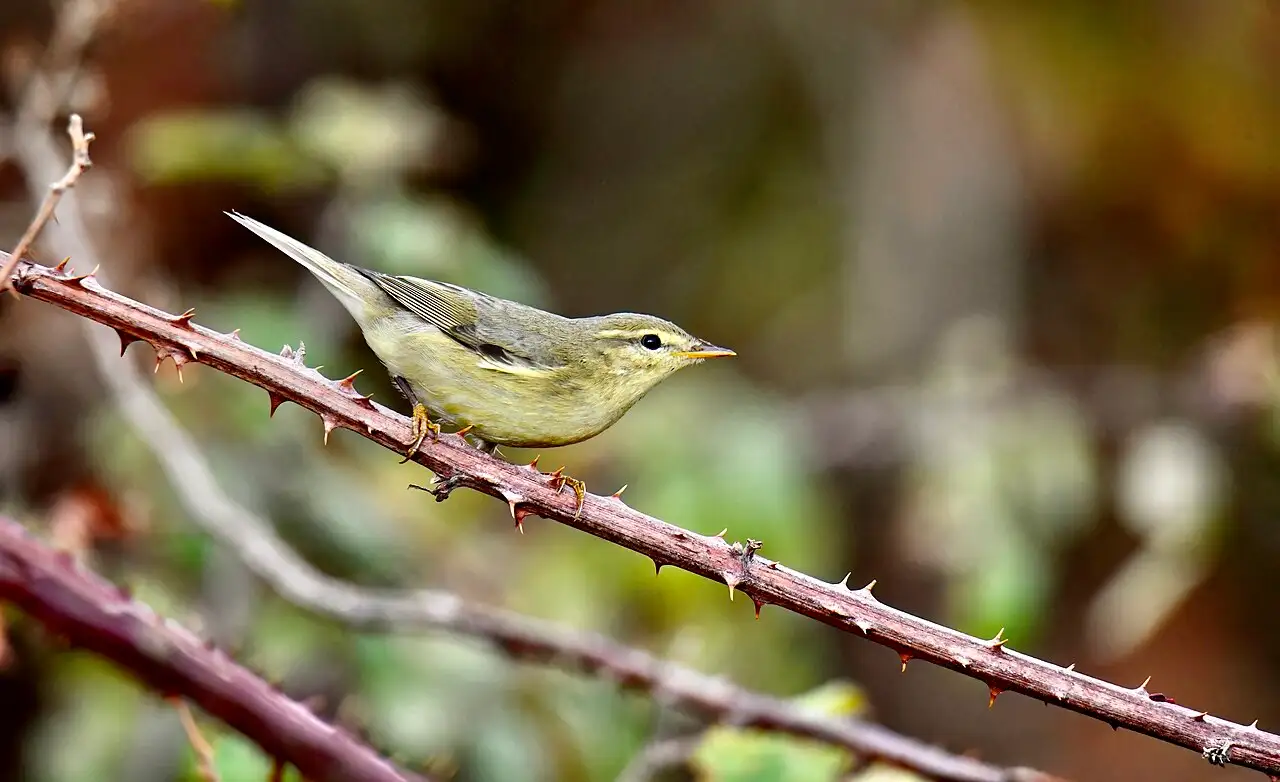
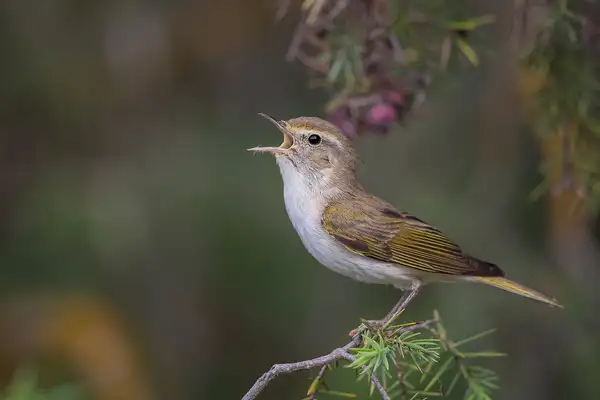
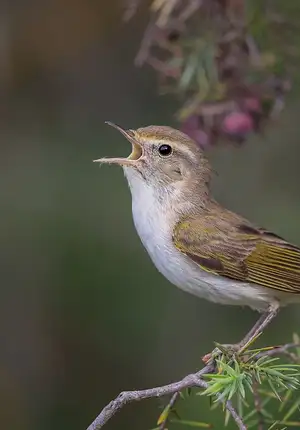
Iberian Chiffchaff on a thorny bramble branch, in profile, with long tail and yellowish-green plumagePhoto: Luiz Lapa from Oeiras, Portugal, CC BY 2.0Photo 3 of 4
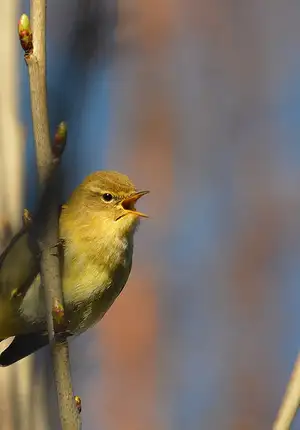
Iberian Chiffchaff hanging upside down from a bare branch with buds, looking for insects, against a blue backgroundPhoto: Javier Perez Montes, CC BY-SA 4.0Photo 4 of 4
1 / 4
Identification of the Iberian Chiffchaff
The Iberian Chiffchaff has the back a bright green colour that contrasts with the whitish underparts. It is practically indistinguishable from the Common Chiffchaff, although it differs by the more yellowish ear-covert area, the whitish breast with a slightly more yellow tint and the caramel-coloured legs; they are, in any case, faint differences that cannot always be appreciated. The best way to separate them is the song.
Adult
Back bright green and underparts whitish.
Ear-covert area more yellowish, breast with a somewhat more yellow tint and caramel legs, compared with the Common Chiffchaff.
Habitat and distribution of the Iberian Chiffchaff
Traditionally considered a subspecies of the Common Chiffchaff, it was given the status of a separate species after recent genetic, morphological, ecological and bioacoustic studies. As a nesting bird, its distribution is restricted to the Iberian Peninsula and a few points in north-west Africa. According to Wikipedia, it winters in West Africa, south of the Sahara.
In Spain it is widely distributed across the northern third of the Peninsula, from Galicia, which it occupies entirely, to Navarre and, more scattered, the north of Aragon1. It thins out south of the Central System, and in the southern half is restricted, in a more fragmented way, to mountain areas, shaded slopes or cooler, damper sites. It is absent from the eastern third (Catalonia, the Levante and most of Castilla-La Mancha), the Balearics, the Canaries, Ceuta and Melilla.
It is a woodland species present in a wide variety of tree formations: woods, copses, farming mosaics with some tree cover, scrub with scattered trees. In the north of the Peninsula it occupies every kind of wood and farmland landscape, and in the south it appears in mountain woodland, shaded slopes or riverside groves.
Areas where it is regularly recorded since 2010Squares of about 25 km where it is recorded regularly (occasional passage records are left out). Data from GBIF.org (29,392 records, retrieved October 2026); outline from Natural Earth.
Etymology of the Iberian Chiffchaff
According to Wikipedia, the genus «Phylloscopus» comes from ancient Greek «phullon», «leaf», and «skopos», «the one who watches», and «ibericus» is Latin for «Iberian». It was first described as a distinct form of the Common Chiffchaff in 1871, as a subspecies. In other languages it is called «mosquiter ibèric» in Catalan, «picafollas ibérico» in Galician, «txio iberiarra» in Basque and «Iberian chiffchaff» in English1.
Population of the Iberian Chiffchaff
In the 2021 European Red List of Birds, the European breeding population is estimated at between 924,000 and 1,540,000 mature individuals, with a stable trend. Because of its recent separation from the Common Chiffchaff and the overlap of the two species in Spain, estimating its numbers is especially difficult; the nesting population is calculated at around 800,000 individuals1. The general trend is positive, with an especially marked increase in the most northerly sectors and in mountain areas.
Its situation is not known in depth, because of the difficulty of telling it from the Common Chiffchaff, but it seems not to be in danger.
Nest of the Iberian Chiffchaff
It is built mainly by the female, low down, in the thicket of shrubby or tree vegetation. It is a small closed structure, made of grasses and mosses, entered by a side opening.
Courtship and breeding of the Iberian Chiffchaff
The breeding period runs from April to July. The clutch is three to seven whitish eggs, speckled to varying degrees, which the female incubates for 13–15 days. The chicks are tended mainly by the mother, fly at 14–16 days and become independent about two weeks later. It may make two clutches a year.
Diet of the Iberian Chiffchaff
Its diet is based on insects, which in spring and autumn it may supplement with small fruits and with flower nectar.
Curious facts about the Iberian Chiffchaff
It is a bird of status and distribution still little known, recently classified as a species after splitting from the Common Chiffchaff, with which it is practically identical1. Its EURING record, 7 years, is of a bird ringed in Spain and checked by the ringer.
The Iberian Chiffchaff in Cabañeros
The habitat pages of this website do not mention it, and we have not found any other published source on it in the Park; nor does it appear in the bird list of the «Visitor guide to Cabañeros National Park» (OAPN). GBIF.org records 7 observations of the Iberian Chiffchaff in Cabañeros and its surroundings. In the southern half it is limited to mountain areas, shaded slopes and cool, damp sites1. It is absent from most of Castilla-La Mancha1. Of those observations, 6 fall within the Park boundary (according to OpenStreetMap); the rest are from the surroundings.
Where to see the Iberian Chiffchaff in Cabañeros
In Cabañeros and its surroundings, from spring to autumn, in woods, riverside groves and cool shaded slopes.
When
It arrives in February and March; present until October.
What time
By day, among the foliage of trees and shrubs, often singing.
Where
In woods, riverside groves, mountain shaded slopes and farmland with trees.
What to look for
Look for the bright green of the back and the yellow of the cheeks; listen for the song that speeds up into a trill, and the plaintive «piu».
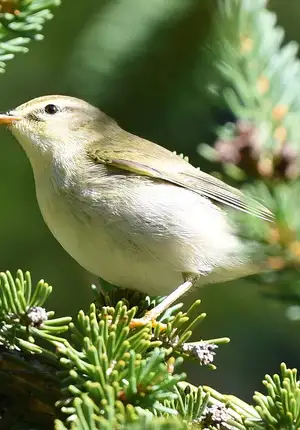
It is similar in song and appearance, so much so that it is practically indistinguishable1. The Iberian Chiffchaff has the more yellowish ear-covert area, the breast with a somewhat more yellow tint and caramel-coloured legs; the song is the best way.
Photo: Jacob Spinks from Northamptonshire, England, CC BY 2.0



 Same family
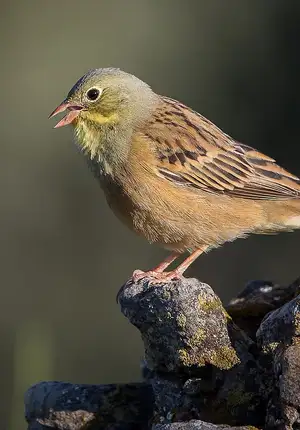
 Same family
 Same family
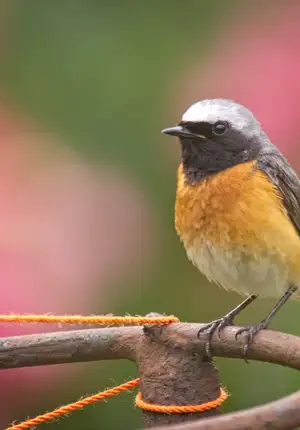
 Same order
 Same order
 Same order
 Same order
 Same order






