Wingspan compared with a person with arms outstretched.
Length
53–57 cm
Wingspan
85–90 cm
Weight
0.8–1.5 kg
Social life
The chicks are very precocious and feed themselves soon after hatching, although the mother tends them, above all at night
Lifespan
Record of 15 years and 10 months in the wild according to EURING (a bird ringed in the Netherlands); AnAge gives 12.9 years
Conservation status
LC
NT
VU
EN
CR
EW
EX
Global (IUCN)
Least Concern
Spain
Least Concern (LC) in the 2021 Red Book of the Birds of Spain; not on the List of Wild Species under Special Protection nor in the Spanish Catalogue of Threatened Species
When to see it
Resident
Months of the year when it is present
J
F
M
A
M
J
J
A
S
O
N
D
In Iberia
yes
yes
yes
yes
yes
yes
yes
yes
yes
yes
yes
yes
Breeding season
no
no
no
yes
yes
yes
yes
yes
no
no
no
no
Song or voice of the Red-crested Pochard
It is a fairly silent bird. The male gives a loud, often repeated «baeht», and a sound like a stifled sneeze. The female, when the male chases her, gives an «urah-urah-urah», and a muted «rerr-rerr» during courtship on the water. The recording is short, of about twelve seconds, and there is a lot of noise in the background; we have trimmed it and filtered it a little.
Male's callsRed-crested Pochard
0:00 / 0:12
10 kHz5
The sonogram draws the sound: time runs from left to right, and the higher a trace sits, the higher the note.Recording by 4Birds Ornithology, Canal de YouTube «4Birds Ornithology», vídeo «Netta rufina» (Vídeo de YouTube, con atribución).
Flight of the Red-crested Pochard
In flight, the white oval patches edged in black, characteristic of the male’s flanks, are very distinctive.
Flight typeWith white oval patches, edged in black, on the flanks
It is the largest diving duck in our fauna; it selects wetlands with large expanses of water and abundant marsh vegetation on the shores.
In flight, the white oval patches edged in black, characteristic of the male's flanks, are very distinctive.
Although it is omnivorous, its diet is above all plant: oogonia, in particular those of the genus «Chara», and other bottom-dwelling aquatic plants.
Photo gallery of the Red-crested Pochard
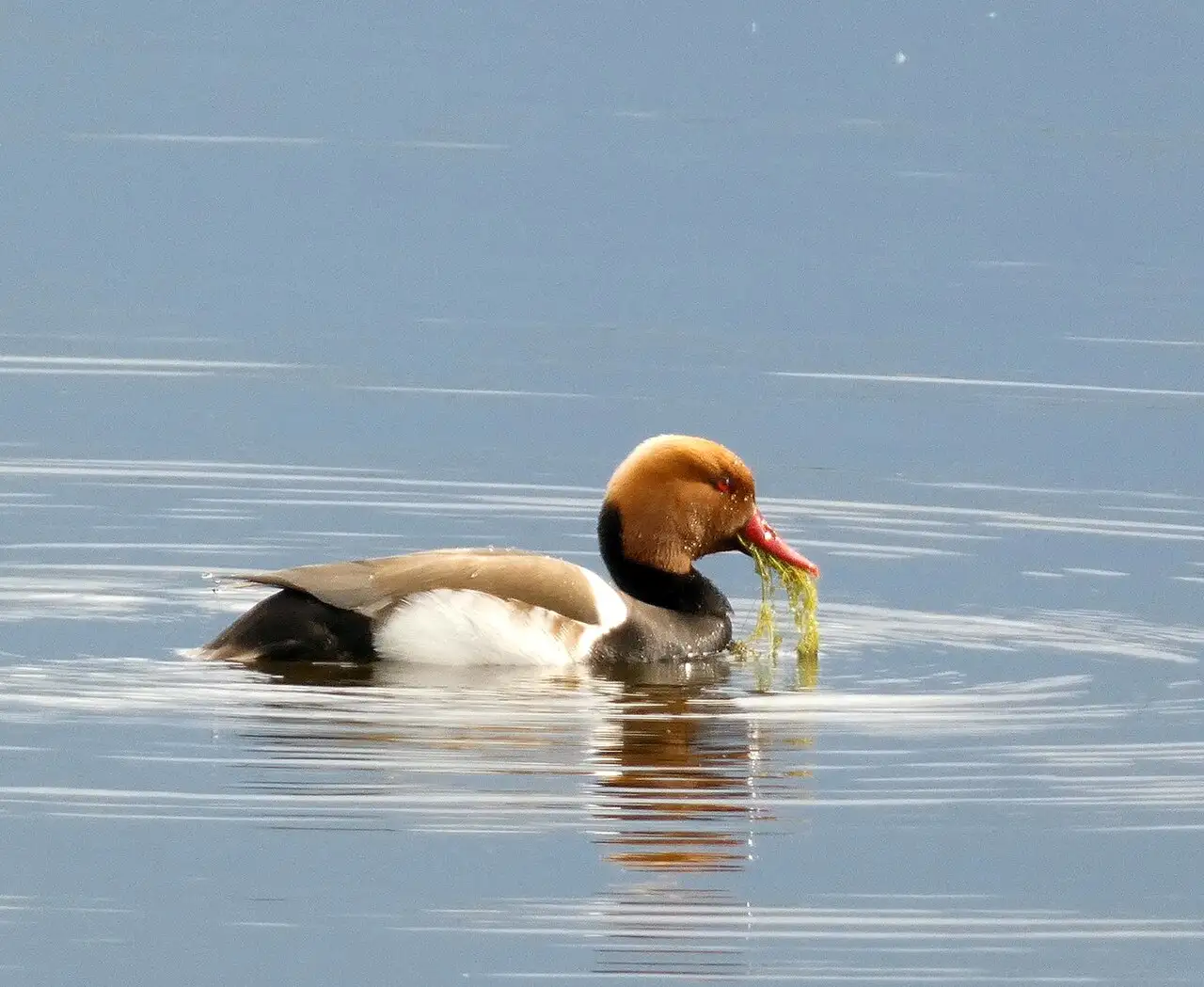
Male Red-crested Pochard swimming with a strand of algae in its bill, with chestnut head, black breast and white flankPhoto: Dominique Armange, CC BY-SA 4.0Photo 1 of 4
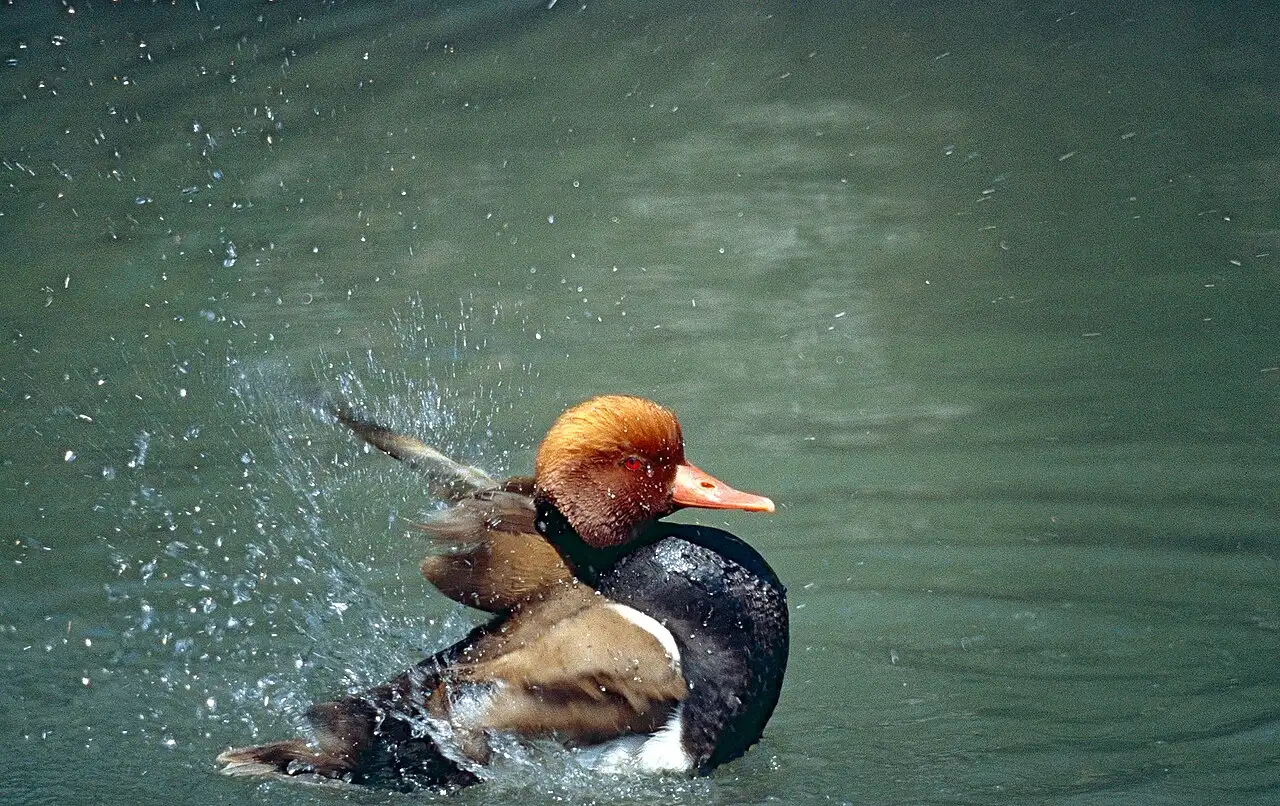
Male Red-crested Pochard flapping its wings and splashing water, with chestnut head, red bill and black breastPhoto: Bernard DUPONT from FRANCE, CC BY-SA 2.0Photo 2 of 4
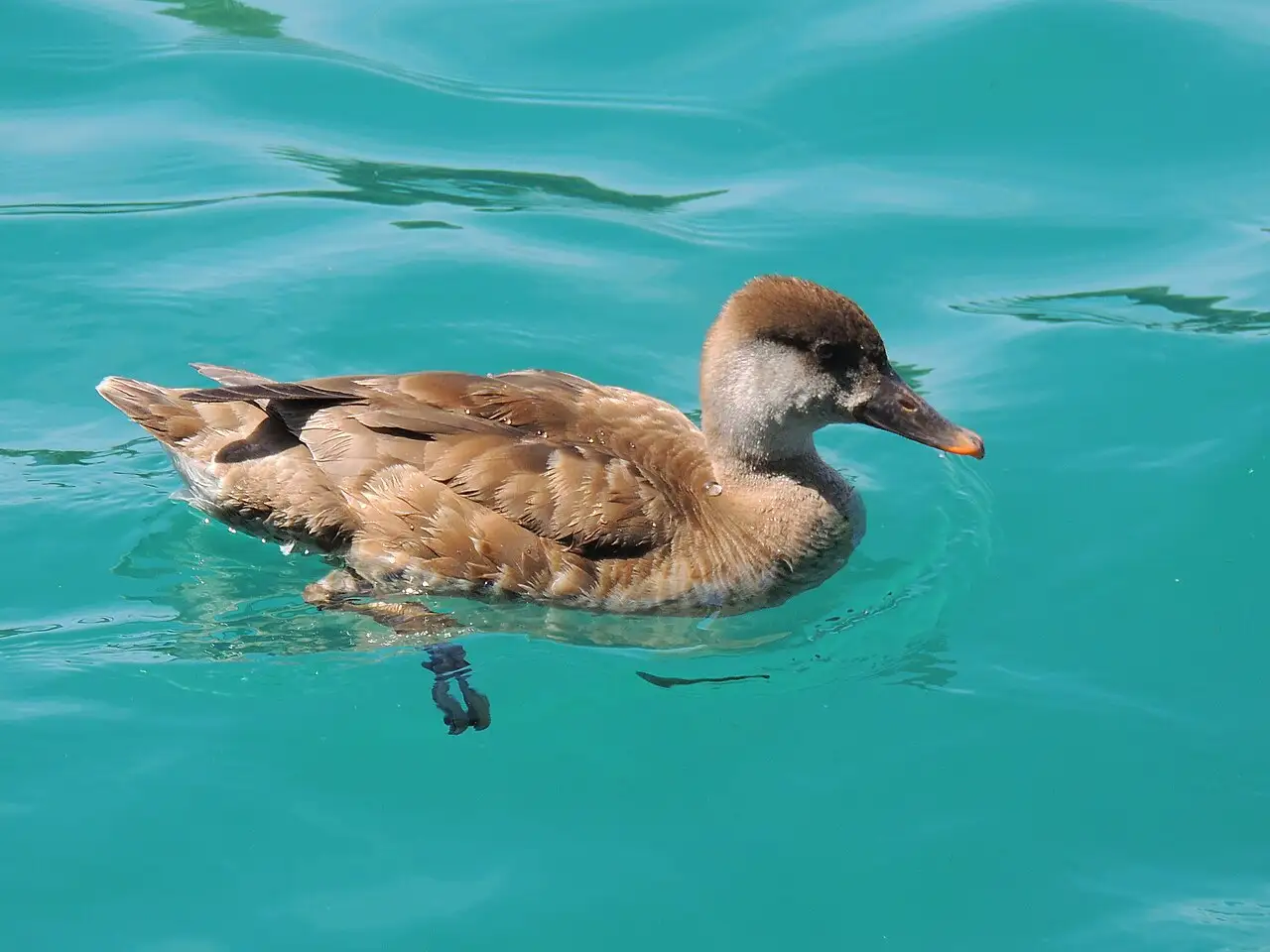
Female Red-crested Pochard swimming, with discreet brown plumage, with the front of the head and neck whitishPhoto: xulescu_g, CC BY-SA 2.0Photo 3 of 4
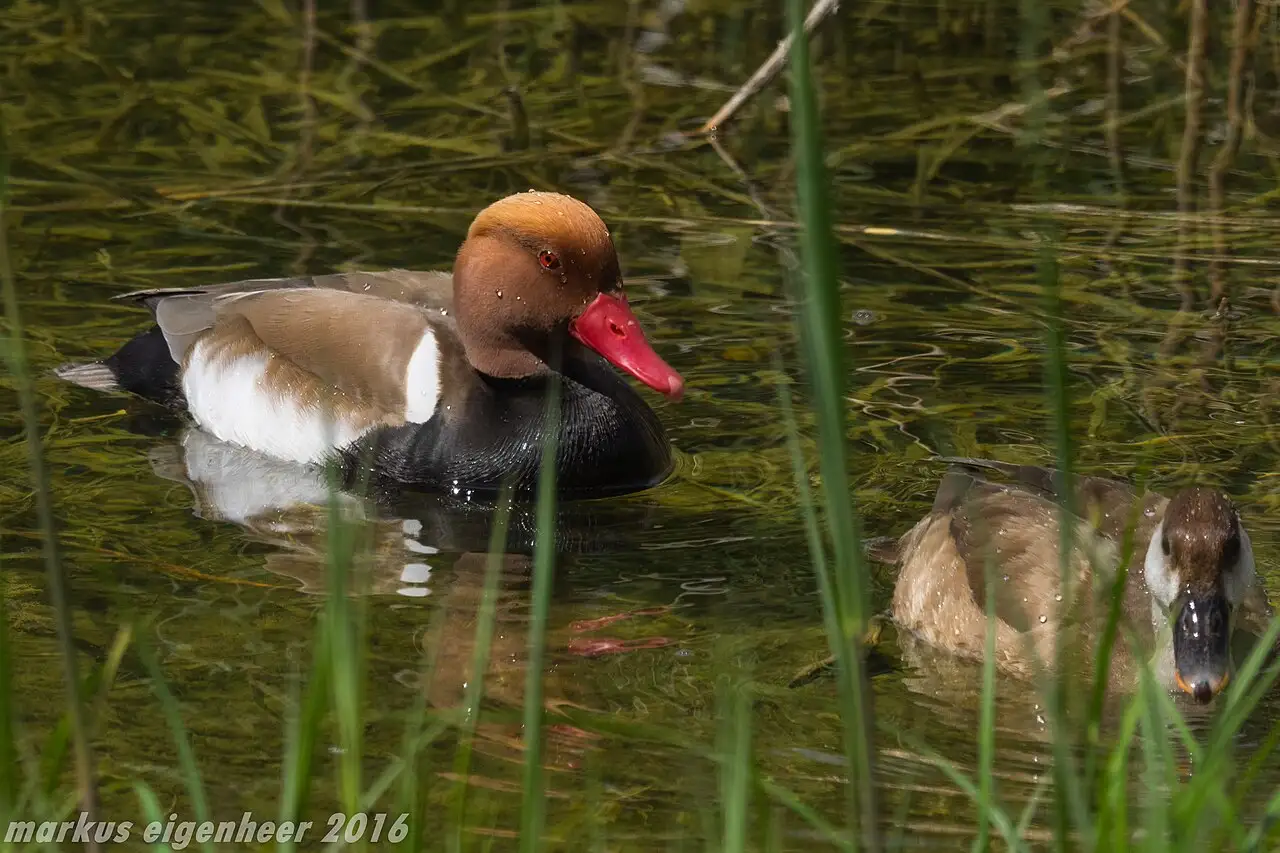
Male and female Red-crested Pochard swimming together among the vegetation of a pond shorePhoto: flybyeigenheer, CC BY-SA 2.0Photo 4 of 4
1 / 4
Identification of the Red-crested Pochard
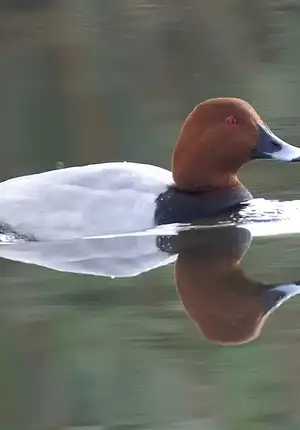
The Red-crested Pochard is the largest diving duck in our fauna. The adult male in breeding plumage is practically unmistakable: he wears an intense reddish-chestnut colour on the head and front of the neck, and a striking coral-red bill. The breast, nape, back of the neck, a broad band down the middle of the belly, the rear and the rump are black, the upperparts are brown and the flanks, like the leading edge of the wings, white. The adult female has extremely discreet plumage, with the front of the head and sides of the neck whitish, the forehead, crown, back of the neck and mantle brown, and a dark grey bill with pinkish spots near the tip.
Male
Head and front of the neck reddish chestnut.
Coral-red bill.
Breast, nape and rear black; flanks white.
Female and young bird
Discreet plumage, with the front of the head whitish.
The young bird resembles the female, but with a completely dark bill.
Habitat and distribution of the Red-crested Pochard
It is a species of Palearctic distribution that nests in a scattered and rather scarce way from the Iberian Peninsula and southern France to central Asia, and winters in the Mediterranean basin, the Middle East, the Indian subcontinent and southern Asia. It has no subspecies.
In Spain it breeds at various sites in wet La Mancha, the Mediterranean coast and the Guadalquivir marshes. It seems that all these cores form a single population that spreads across the different peninsular regions according to hydrological conditions. It has a more restricted distribution in Castilla y León, La Rioja, Navarre, Aragon, Extremadura, Murcia and the Balearics, and is absent from the north-western quadrant, the Canaries, Ceuta and Melilla. During winter the main concentrations are also located at the usual breeding sites.
It is a fairly demanding duck: it selects wetlands with large expanses of fresh or brackish water and abundant marsh vegetation on the shores, mainly in open inland environments, but also in deltas and on the coast. It is closely tied to large expanses of submerged macrophyte plants, although it is not especially sensitive to human presence. It moves easily on land, but rarely far from the shore.
It is partly migratory, although the Iberian population is basically sedentary. It makes movements related to moult after breeding, or flights away in which it may cover long distances, sometimes several hundred kilometres, and which seem to be related to food availability and to the depth and extent of bodies of water. In winter Red-crested Pochards from north-west Europe arrive in Spain and, after wintering, leave the areas occupied, always the males before the females, as the water level drops.
Areas where it is regularly recorded since 2010Squares of about 25 km where it is recorded regularly (occasional passage records are left out). Data from GBIF.org (72,584 records, retrieved October 2026); outline from Natural Earth.
Etymology of the Red-crested Pochard
According to Wikipedia, the scientific name comes from Greek «netta», «duck», and Latin «rufina», «golden red», from «rufus», «reddish». In other languages it is called «xibec» in Catalan, «pato rubio» in Galician, «ahate gorrizta» in Basque and «red-crested pochard» in English1.
Population of the Red-crested Pochard
In the 2021 European Red List of Birds a population of between 69,300 and 104,000 Red-crested Pochards is estimated, with a decreasing trend. According to the III Atlas of Breeding Birds in Spain, the last national census, of 2007, estimated that some 7,200 pairs nested. As for the wintering population, between 1995 and 2016 an average of 16,390 birds was detected, with a minimum of 6,421 in 2007 and a maximum of 29,712 in 2011 (Red Book of the Birds of Spain 2021).
According to the latest censuses it does not seem to suffer declines either as a breeder or as a winter visitor, but it has to cope with the alteration, loss of quality or even disappearance of marsh habitat through the overexploitation of aquifers, burning of vegetation, overgrazing, droughts and pollution. It is also affected by human disturbance in the breeding and moulting areas, hunting pressure, poaching, lead-shot poisoning and episodes of botulism.
Nest of the Red-crested Pochard
The nest is set on the ground, among dense vegetation and never far from water, although occasionally it may be within islands of thick marsh vegetation. It is a hollow lined with grasses, leaves, rushes and down, 28 to 45 centimetres across and 10 to 20 deep, which the female makes alone.
Courtship and breeding of the Red-crested Pochard
The breeding cycle lasts some 80 days, of which 26–28 are spent on incubation and 45–50 on the development of the chicks. Most pairs breed in Spain between April and August, above all in the middle months of this period. The clutch consists of eight to ten rounded, light cream eggs, sometimes tinged with green, which the female incubates. The chicks, like those of all ducks, are very precocious and feed themselves soon after hatching, although the mother tends them, above all at night. Parasitism of other birds’ nests is frequent: it usually lays an egg in the nests of other ducks, such as the Mallard or the Gadwall, so it is not rare to see broods of these with a Red-crested Pochard chick.
Diet of the Red-crested Pochard
Although it is omnivorous, most of its diet is of plant origin and is made up mainly of oogonia, in particular those of the genus «Chara», and other bottom-dwelling aquatic plants, to which it adds small aquatic animals, such as tadpoles, molluscs, crustaceans, larvae and little fish.
Curious facts about the Red-crested Pochard
It is a duck halfway between the diving ducks, among which it is usually classed, and the dabbling ones, which stands out for its large size and the male’s spectacular breeding pattern1. EURING lists a Red-crested Pochard ringed in the Netherlands that lived 15 years and 10 months, somewhat more than AnAge gives (12.9 years).
The Red-crested Pochard in Cabañeros
The habitat pages of this website do not mention it, and we have not found any other published source on it in the Park. GBIF.org records 17 observations of the Red-crested Pochard in Cabañeros and its surroundings.
Where to see the Red-crested Pochard in Cabañeros
In Cabañeros and its surroundings, throughout the year, on reservoirs and lagoons of open water with vegetation on the shores.
When
All year round; the Iberian population is basically sedentary, and in winter birds arrive from north-west Europe.
What time
By day, swimming and diving.
Where
In wetlands with large expanses of fresh or brackish water and abundant marsh vegetation on the shores.
What to look for
Look for the male's reddish-chestnut head and coral-red bill; the female is much more discreet.



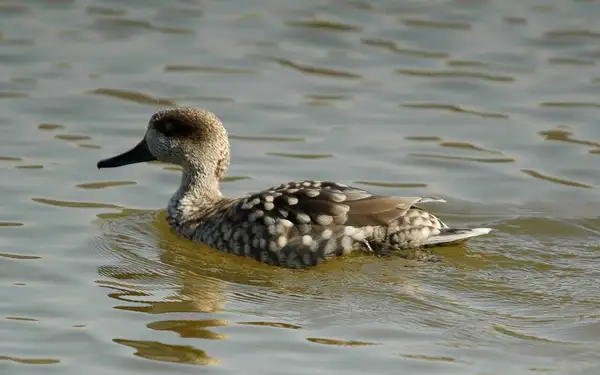
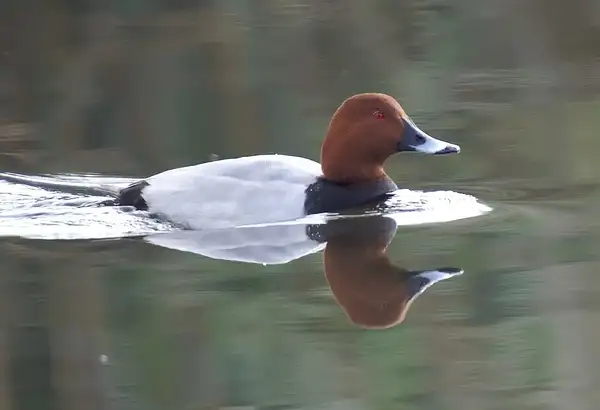
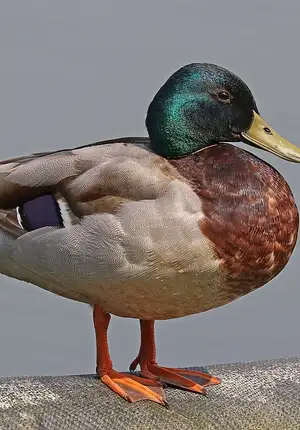 Same family
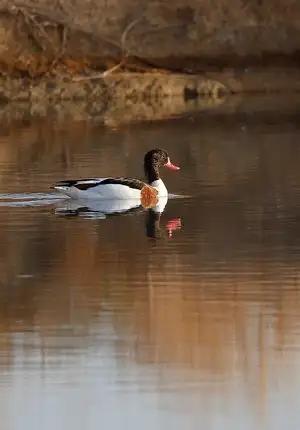 Same family
 Same family
 Same family
 Same season in the park
 Same season in the park
 Same season in the park
 Same season in the park






