Wingspan compared with a person with arms outstretched.
Length
58–71 cm
Wingspan
1–1.33 m
Weight
0.9–1.6 kg
Social life
It usually looks for food in groups; the chicks gather in large crèches
Lifespan
Record of 24.8 years in the wild according to AnAge; EURING lists a bird ringed in France that lived 23 years and 9 months and was shot
Conservation status
LC
NT
VU
EN
CR
EW
EX
Global (IUCN)
Least Concern
Spain
Least Concern (LC) as a winter visitor and as a breeder in the 2021 Red Book of the Birds of Spain; it is on the List of Wild Species under Special Protection, but not in the National Catalogue of Threatened Species
When to see it
Resident
Months of the year when it is present
J
F
M
A
M
J
J
A
S
O
N
D
In Iberia
yes
yes
yes
yes
yes
yes
yes
yes
yes
yes
yes
yes
Song or voice of the Common Shelduck
In spring the male gives a high, buzzing whistle, «slissssliss», when chasing the female1. She answers with a nasal «gagagaga»1. The alarm call is an «a-anc»1. The recording (call, during a display) is by SonoNatura and was made in La Mancha (near Miguel Esteban), Toledo, Castilla-La Mancha (xeno-canto XC786416, quality B). It lasts 9 seconds and is a trimmed stretch of the original, without repeating or lengthening it, from which we have removed the bass below 200 Hz, reduced the background noise and adjusted the volume; neither pitch nor speed has been changed.
In flight, the very dark primaries and secondaries, and the last ones, in a bottle-green tone, contrast with the overall white. It is a resident species on the Peninsula and the Balearics1. In winter populations from northern Europe arrive on the Peninsula and in North Africa1.
Flight typeDirect, with white and green wings over the dark background of the flight feathers
It is a duck intermediate, in shape and behaviour, between a typical goose and a typical duck, with the legs set well forward on the body, in a position that makes grazing easier.
In flight, the very dark primaries and secondaries, and the last ones bottle green, contrast with the overall white.
In spring the male gives a high, buzzing whistle when chasing the female; she answers with a nasal «gagagaga».
Photo gallery of the Common Shelduck
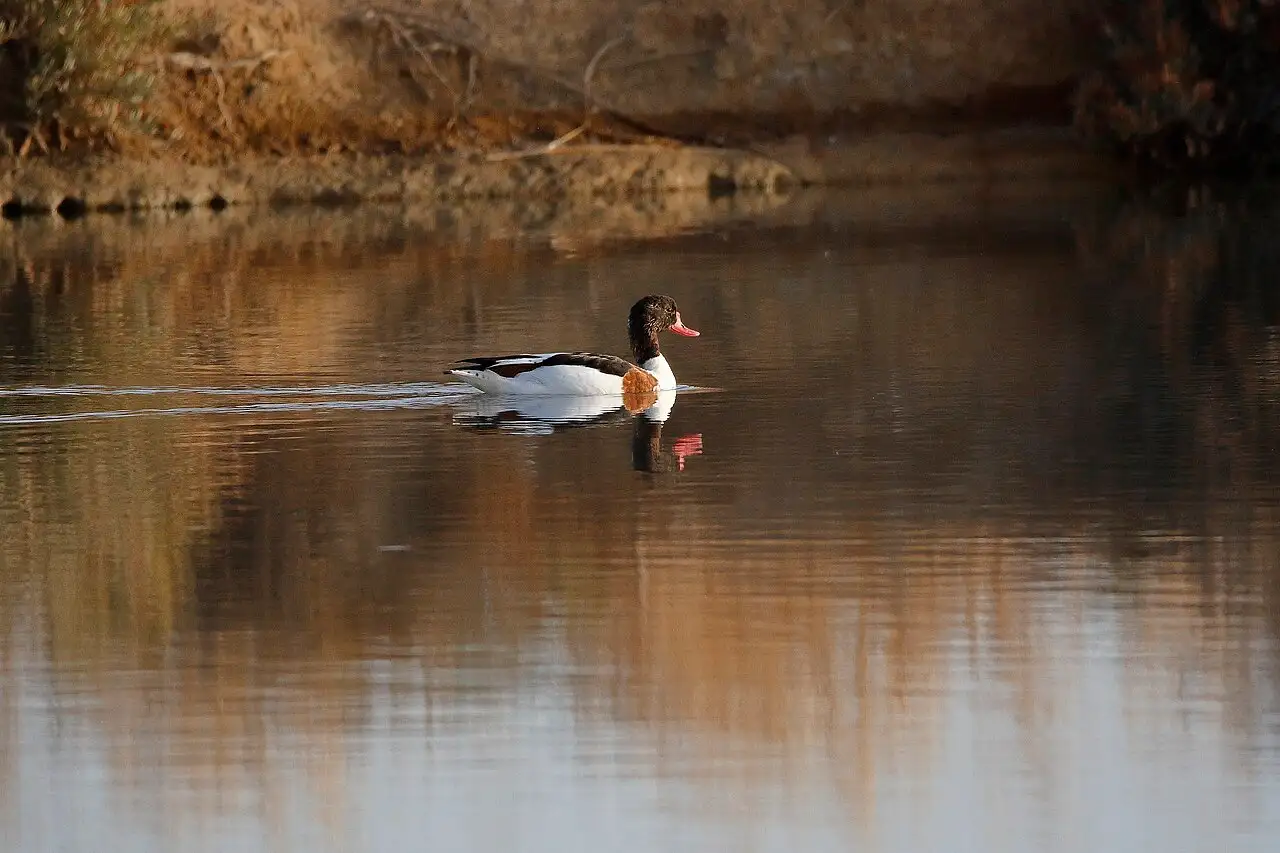
Male Common Shelduck swimming in calm water, with dark green head, red bill with the knob on the forehead, white body and chestnut collar, with its reflectionPhoto: José Prego from Moura, Portugal, CC BY 2.0Photo 1 of 4
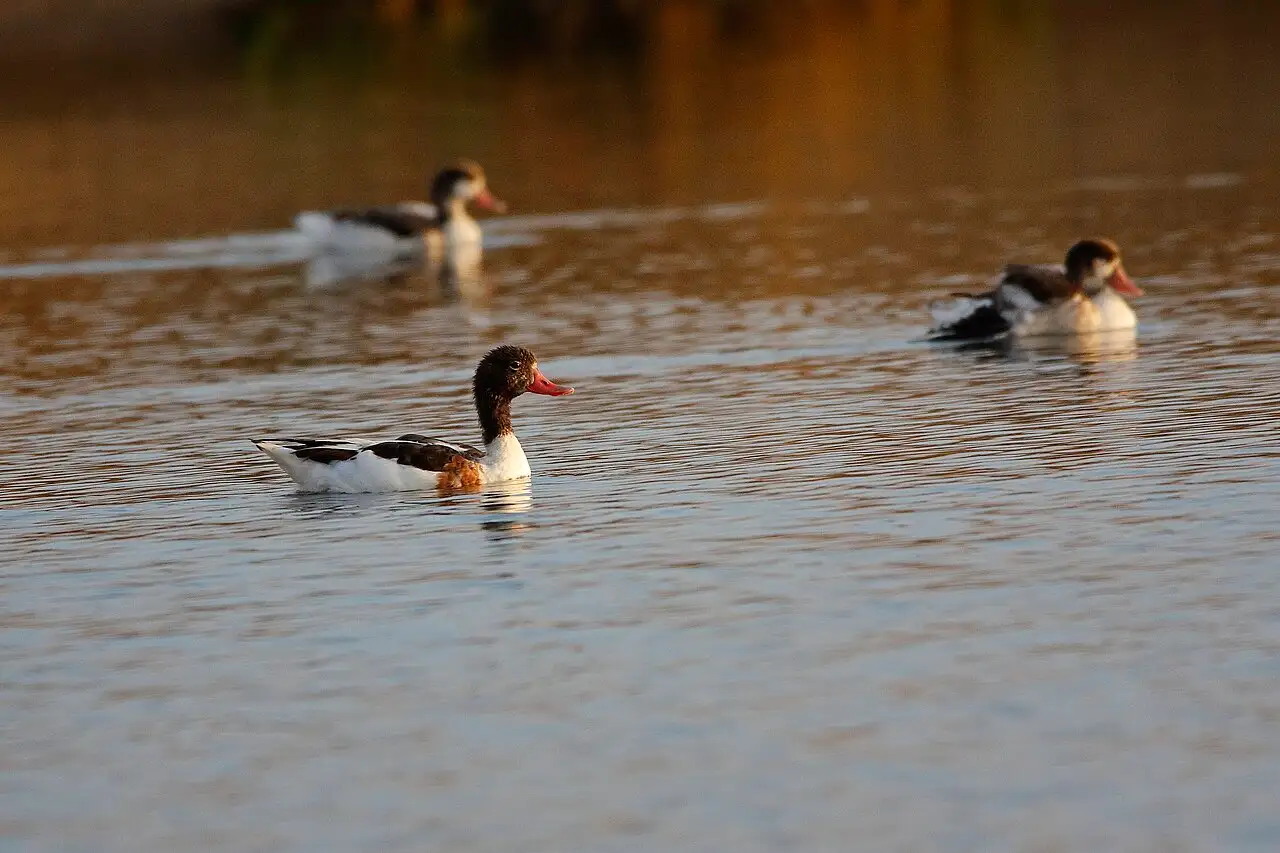
Three Common Shelducks in shallow water with golden reflections at sunset: one of them, closer, with dark green head and chestnut collarPhoto: José Prego from Moura, Portugal, CC BY 2.0Photo 2 of 4
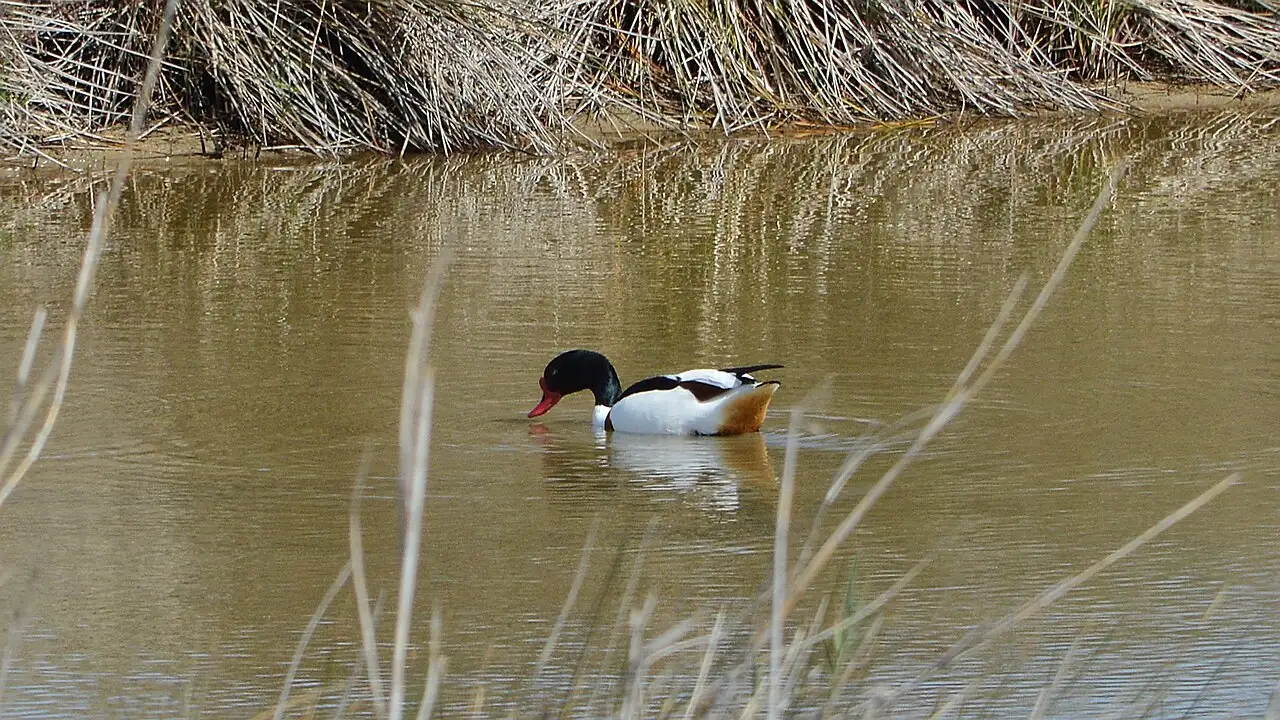
Common Shelduck with its head in the water among dry reeds, with white-and-black back and chestnut collarPhoto: Ryan Hodnett, CC BY-SA 4.0Photo 3 of 4
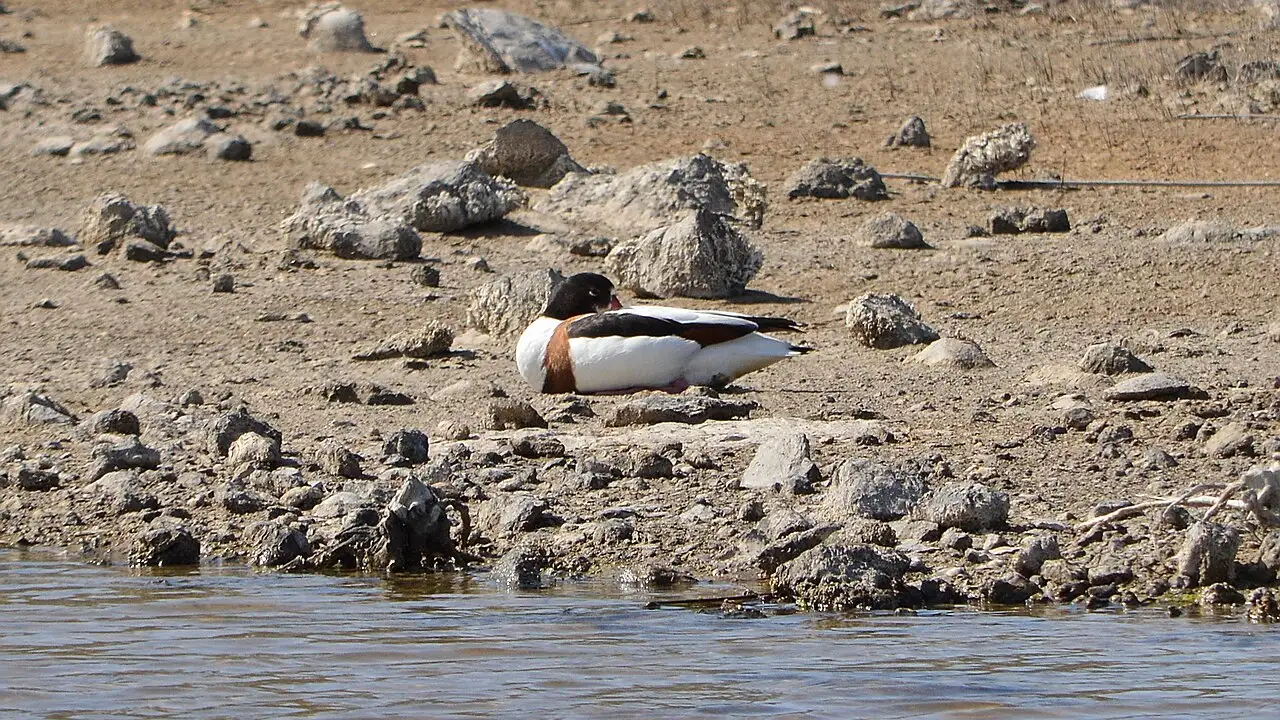
Common Shelduck perched on a stony bank, with dark green head, white body and chestnut collarPhoto: Ryan Hodnett, CC BY-SA 4.0Photo 4 of 4
1 / 4
Identification of the Common Shelduck
The Common Shelduck is a duck intermediate, in shape and behaviour, between a typical goose and a typical duck, with the legs set well forward on the body, in a position that makes grazing easier. Its overall colouring is white, with a dark greenish back and a broad chestnut collar on the breast. The head and neck are dark green, like a hood. The red bill has a striking knob on the forehead of males. Juveniles are much paler, without a collar or a defined hood, with a scaly brown back, dark head and neck, whitish face and pink bill. In flight, the very dark primaries and secondaries, and the last ones, in a bottle-green tone, contrast with the overall white.
Adult
White, with dark greenish back, dark green head and neck and a broad chestnut collar.
Red bill, with a knob on the forehead in males.
Young bird
Paler, without a collar or defined hood; scaly brown back and dark head and neck.
Whitish face and pink bill.
Habitat and distribution of the Common Shelduck
It is distributed across the Palearctic and reaches China; to the north it reaches Scandinavia. There are gaps between the Mediterranean populations, those of central and northern Europe (both coastal) and those of eastern Europe and Asia (inland). It has no subspecies.
In Spain it is distributed over most of the peninsular wetlands and the Balearics, except the north-west, without breeding in the Canaries, Ceuta or Melilla1. It is commonest in the marsh complexes of the eastern peninsular and Balearic coast, but its dispersal has led it to be present in numbers on wetlands in Castilla-La Mancha, Doñana, the Odiel marshes and brackish wetlands and reservoirs in Extremadura and the centre of the country, and even to colonise areas of southern Palencia and the Cantabrian coast.
It is closely tied to halophilic habitats, both inland saline lagoons associated with steppe environments and coastal lagoons and salt pans, but its adaptability lets it settle on reservoirs, irrigation ponds, treatment lagoons and even the marine environment. The Spanish population, both wintering and breeding, is rather coastal. In the breeding season it needs a variety of habitats, not necessarily adjacent: land areas for nesting, shallow, productive wetlands for the females’ food, and aquatic complexes rich in resources for the chicks’ development.
It is a resident species on the Peninsula and the Balearics; in winter populations from northern Europe arrive on the Peninsula and in North Africa. On the continent two migratory populations meet, the north-western one (300,000 birds) and that of the Black and Mediterranean Seas (75,000), both increasing.
Areas where it is regularly recorded since 2010Squares of about 25 km where it is recorded regularly (occasional passage records are left out). Data from GBIF.org (114,452 records, retrieved October 2026); outline from Natural Earth.
Etymology of the Common Shelduck
According to Wikipedia, Linnaeus described it in 1758 in the tenth edition of the «Systema Naturae» under the name «Anas tadorna». In other languages it is called «ànec blanc» in Catalan, «tadorna branca» in Galician, «paita arrunta» in Basque and «common shelduck» in English1. We have found no source explaining the origin of the Spanish name, so we do not venture a guess.
Population of the Common Shelduck
The 2021 European Red List of Birds estimates some 104,000–154,000 Common Shelducks in Europe, with a stable trend. In Spain the first breeding record was in the Ebro delta in 1972, and in 2018 the breeding population reached 477–831 pairs. As a winter visitor at least 7,000 birds are estimated (Third Atlas of Breeding Birds in Spain). The trend has been clearly positive in recent years1.
The main threat to the Iberian populations is the degradation of its habitat, through ploughing, urbanisation, infrastructure and recurrent droughts, as well as the abandonment of salt works. It is very sensitive to barriers, above all roads, which hinder the chicks’ movement from the nest to the wetlands where they grow up and on which whole broods can be run over.
Nest of the Common Shelduck
It needs natural cavities or animal burrows, where it places the nest, to which it adds no material or only a little plant matter. It usually uses rocky outcrops with caves, dunes or banks with rabbit burrows, and even open spaces with dense vegetation. These places are sometimes several kilometres from the feeding and chick-rearing areas, which demands daily to-and-fro by the female and a long, dangerous journey for the newly hatched chicks.
Courtship and breeding of the Common Shelduck
It raises a single brood, and there are replacement clutches if the eggs are destroyed or taken by predators in the early stages of incubation. The clutch is about 3–12 eggs, commonly 8–10, bright white, and the female incubates them for about 29–31 days. The chicks move, soon after hatching, with their parents to their rearing area, where they join other chicks in large groups that soon become independent, even at 15–20 days, and where some parents and birds that have failed to breed also stay. In about 45–50 days they develop their full plumage.
Diet of the Common Shelduck
It feeds mostly on invertebrates, especially molluscs, crustaceans and insects. It generally looks for food in groups, on shallow water or damp meadows, and sometimes also on islands or dry areas.
Curious facts about the Common Shelduck
It is one of our most striking ducks, in pale colours and intermediate in appearance between a duck and a goose, which recently colonised the Peninsula from French populations1. EURING gives 23 years and 9 months to a bird ringed in France and shot, a little less than the 24.8 years of AnAge.
The Common Shelduck in Cabañeros
The habitat pages of this website do not mention it, and we have found no other published source about it in the Park; nor is it in the bird list of the «Visitor’s Guide to Cabañeros National Park» (OAPN). GBIF.org records 5 observations of the Common Shelduck in Cabañeros and its surroundings. The wetlands of Castilla-La Mancha are among those with a significant presence, and so are the reservoirs of Extremadura and the centre of the country1. Only one of those observations falls within the Park boundary (according to OpenStreetMap); the rest are from the surroundings.
Where to see the Common Shelduck in Cabañeros
In Cabañeros and its surroundings, occasionally, on shallow lagoons and reservoirs.
When
Present all year in Spain; in winter birds arrive from northern Europe.
What time
By day, feeding in groups on shallow water and damp meadows.
Where
On lagoons, salt pans, reservoirs, irrigation ponds and coastal marshes.
What to look for
Look for the white of the body with the green hood and the chestnut collar; listen for the female's «gagagaga».




 Same family
 Same family
 Same family
 Same family
 Same season in the park
 Same season in the park
 Same season in the park
 Same season in the park






