Wingspan compared with a person with arms outstretched.
Length
31–36 cm
Wingspan
71–85 cm
Weight
260.5 g
Social life
In winter, concentrations and roosts of several dozen birds have been recorded
Lifespan
Record of 7 years and 5 months in the wild (a bird ringed in Portugal)
Conservation status
LC
NT
VU
EN
CR
EW
EX
Global (IUCN)
Least Concern
Spain
Near Threatened (NT) in the Red Book of the Birds of Spain; on the List of Wild Species under Special Protection and not in the Spanish Catalogue of Threatened Species
When to see it
Resident
Months of the year when it is present
J
F
M
A
M
J
J
A
S
O
N
D
In Iberia
yes
yes
yes
yes
yes
yes
yes
yes
yes
yes
yes
yes
Song or voice of the Black-winged Kite
It is practically mute, but males and females give a penetrating «iii-arrj». The alarm is a high, somewhat explosive whistle. The recording (call, also in flight) is by José Carlos Sires and was made in Espartinas, Seville, Andalusia (xeno-canto XC351405, unrated). It lasts 8.7 seconds and is a trimmed section of the original, without repeating or lengthening, from which we have removed the bass below 300 Hz, reduced the background noise and adjusted the volume; neither pitch nor speed has been changed.
It glides with its wings raised and often hovers. In the courtship display it shows a jerky flutter, with the wings in a «V». Perched on poles beside tracks and roads it looks very pale, big-headed and short-tailed.
Flight typeGlides with wings raised and often hovers
It flies over cereal crops and grasslands in search of small mammals. It glides with its wings raised.
It stops in the air and often hovers, with quick wingbeats and the bulky head still, watching the ground.
When it spots a mouse or a vole, it drops onto it. The usual sight is of it afterwards perched on a pole, very pale, big-headed and short-tailed.
Photo gallery of the Black-winged Kite
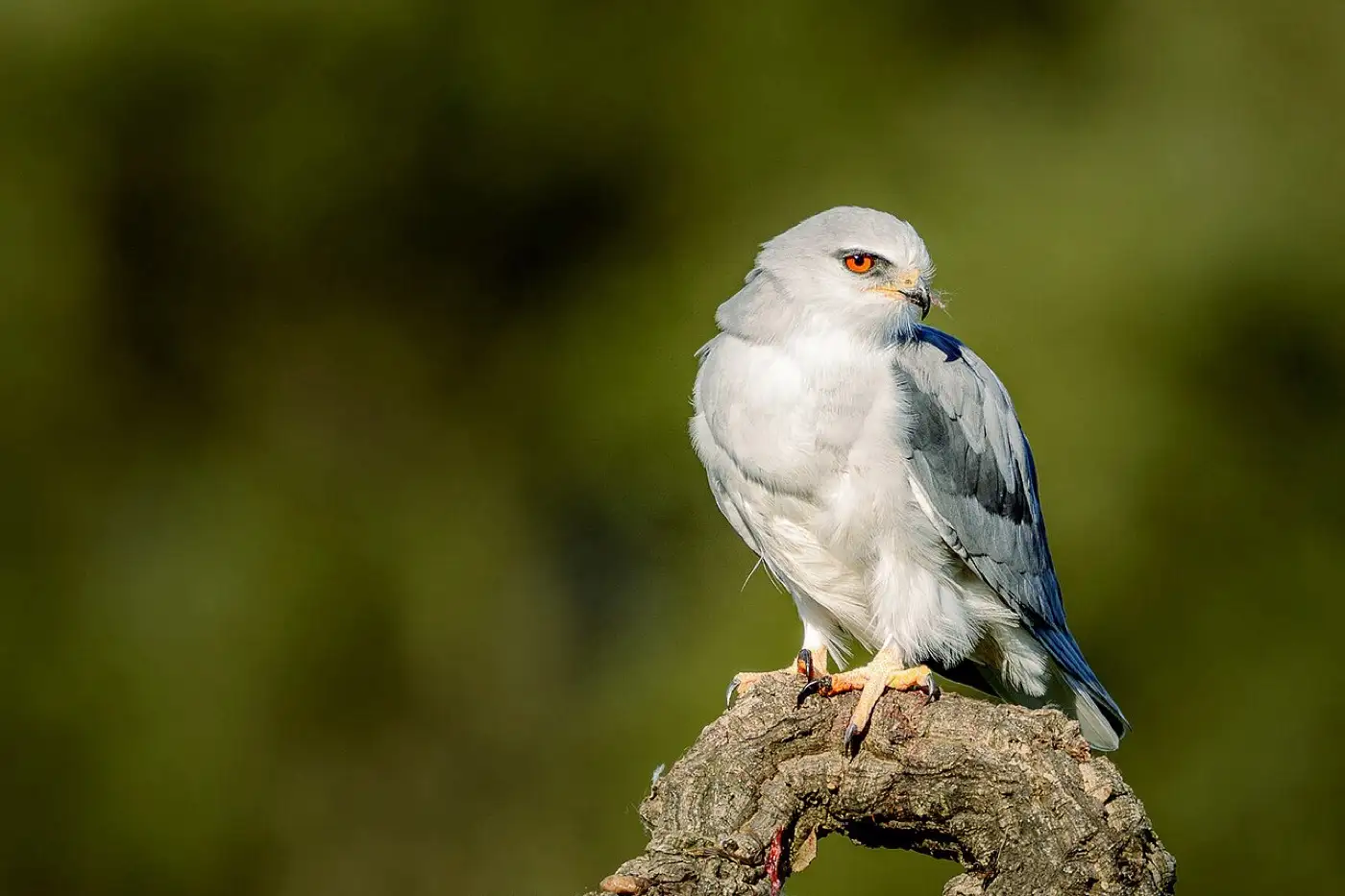
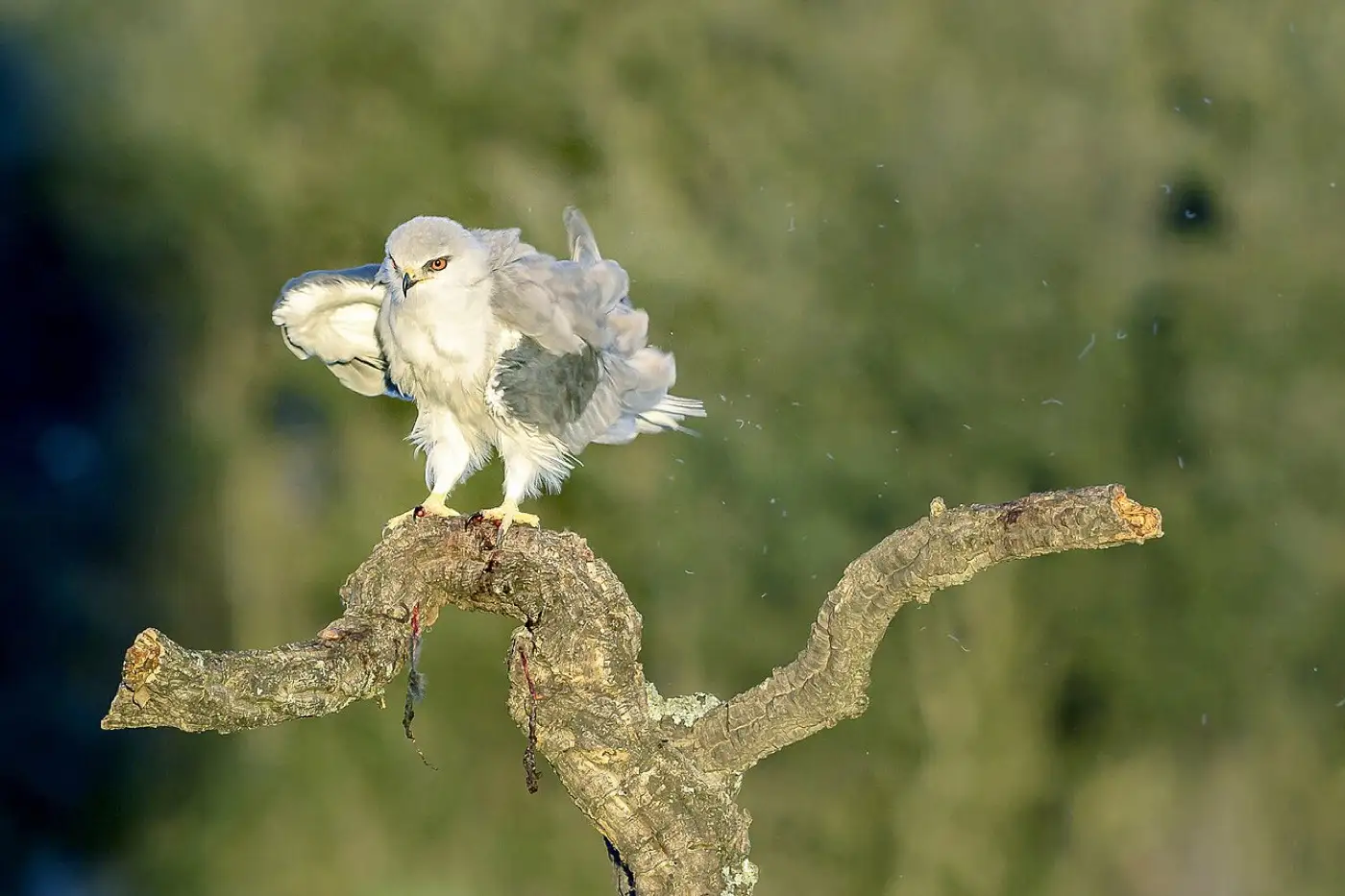
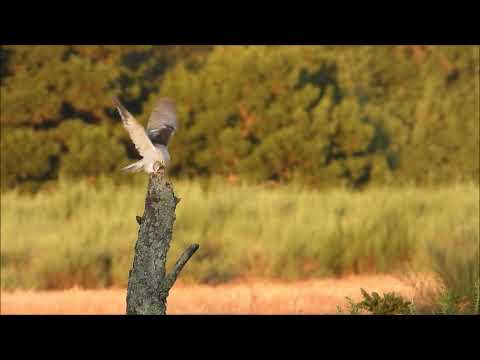
Black-winged Kite perched on a trunk, from the front, with coral-red eye, bulky head and grey and white plumagePhoto: José Antonio Lagier Martin, CC BY 3.0Photo 1 of 4
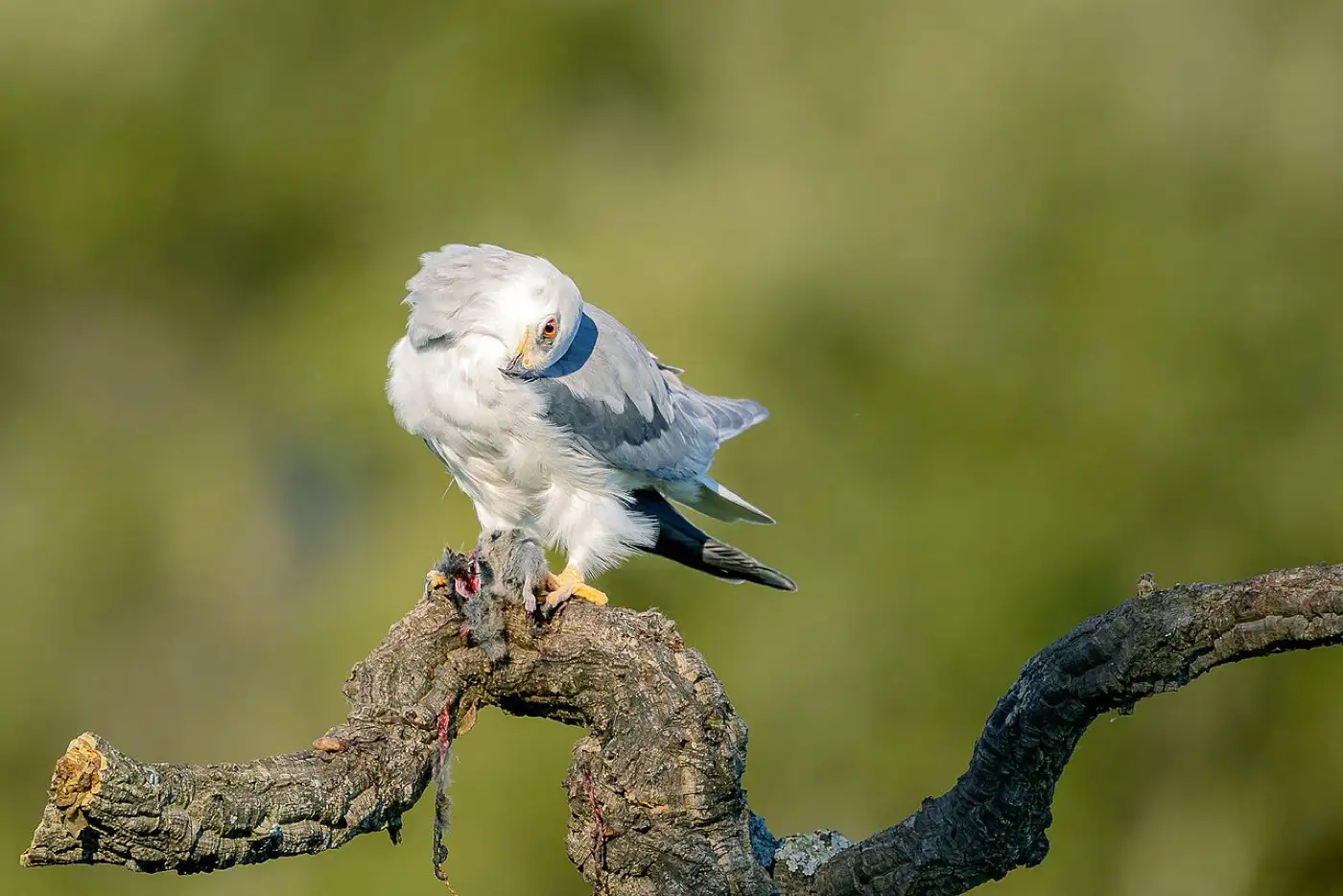
Black-winged Kite on a twisted trunk in Calera y Chozas (Toledo), with its head turned to its feathersPhoto: José Antonio Lagier Martin, CC BY 3.0Photo 3 of 4
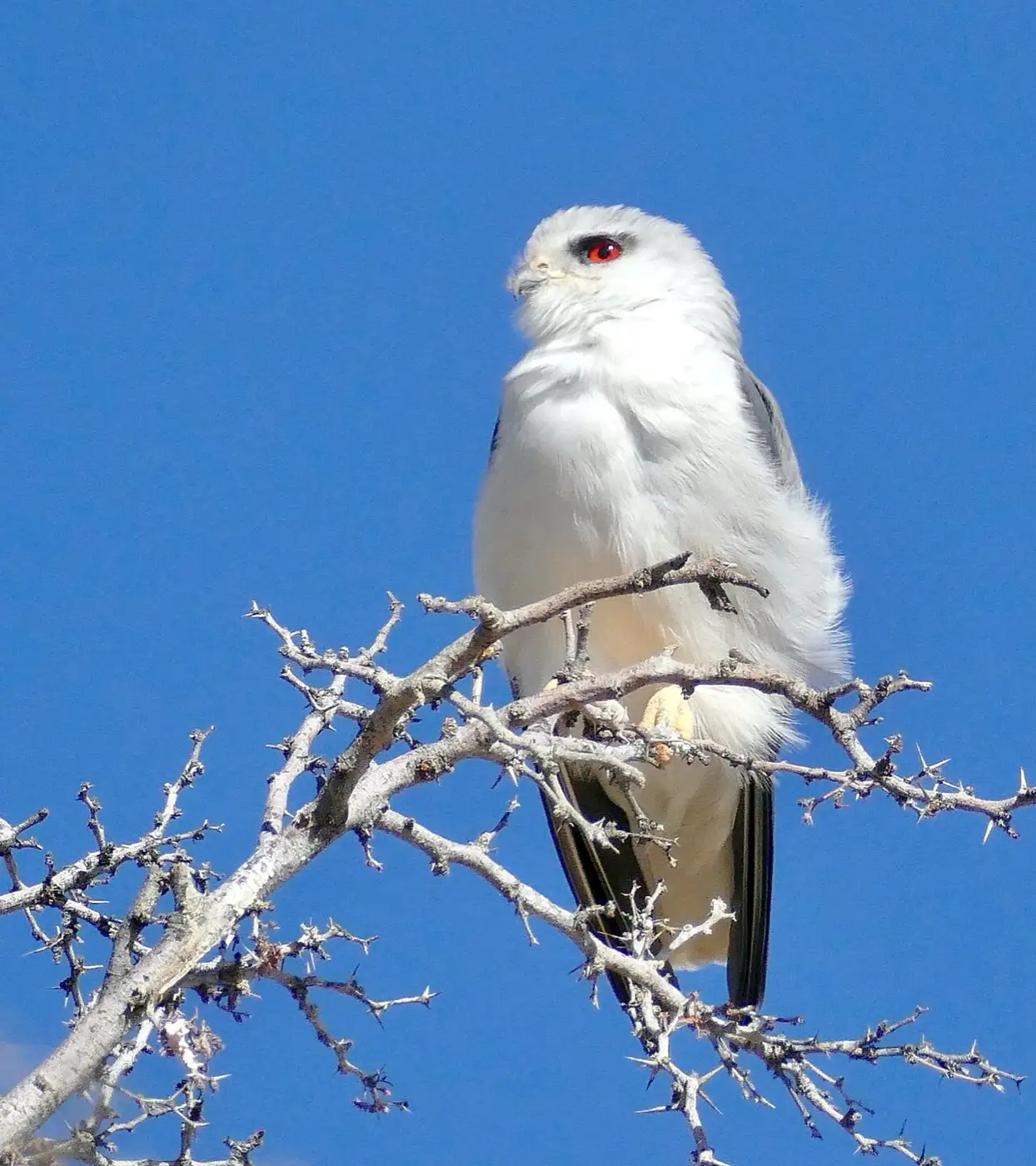
White Black-winged Kite perched at the top of a dry tree against the blue sky, with its red eyePhoto: Bernard DUPONT from FRANCE, CC BY-SA 2.0Photo 4 of 4
1 / 4
Identification of the Black-winged Kite
It is a small raptor with a bulky head. The coral red of its eyes stands out against the snowy white of the underparts, and it has white wingtips. The upperparts are ash grey, with black shoulders. Young birds have a scaly back and ochre tones on the breast and head, which they soon lose.
The kite is often found perched on poles beside tracks and roads; it then looks very pale, big-headed and short-tailed. It glides with its wings raised and often hovers.
Adult
Coral-red eyes; underparts snowy white.
Ash-grey upperparts, with black shoulders and white wingtips.
Young bird
Scaly back; breast and head in ochre tones that it soon loses.
Habitat and distribution of the Black-winged Kite
It is a species distributed across the western Palearctic, Asia (Arabia and from Pakistan to the Philippines and Indonesia) and sub-Saharan Africa. It has four subspecies, and in Spain the subspecies «caeruleus» lives.
It occupies the western half of the Peninsula, with a main core in Extremadura, from where it spread north and south, and is absent from the Balearics, the Canaries, Ceuta and Melilla. It has spread across the Peninsula, above all the south-western quadrant, in the last 50 years and continues to spread beyond the Pyrenees.
It is closely associated with farmland, above all dry-farmed crops with scattered trees (mainly holm oaks, but also cork oaks, Lusitanian oaks, oaks, pines, chestnuts, olives and ash trees), dotted with grasslands, broom thickets or other crops. It has been favoured by the recent thinning and ploughing of numerous dehesas in the west of the Peninsula. Since it depends on rodents, the expansion of dry-farmed crops, more favourable to these small mammals, at the expense of grassland or areas of closed woodland or scrub, has encouraged its spread.
It is resident on the Peninsula. Short-distance movements have been described, so that some birds might move south, to the floodplains of the Tagus and Guadiana rivers, which hold high densities in winter. Roosts of several dozen birds have also been found in the La Janda district (Cádiz) and in eastern Badajoz.
Areas where it is regularly recorded since 2010Squares of about 25 km where it is recorded regularly (occasional passage records are left out). Data from GBIF.org (57,867 records, retrieved October 2026); outline from Natural Earth.
Etymology of the Black-winged Kite
«Elanus» comes from ancient Greek «élanos», «kite». «Caeruleus» is Latin for «blue»: hence its other Spanish name, «elanio azul», for the bluish grey of the back.
Population of the Black-winged Kite
In the 2021 European Red List of Birds the European breeding population is estimated at between 2,600 and 5,700 mature individuals, with a stable trend. Population data for the species are not currently available. At the end of the last century it grew notably, which does not seem to have been kept up, and the estimates of between 500 and 1,000 pairs from the II Atlas of Breeding Birds are taken as valid. The main threat to the Iberian populations is the degradation of its habitat through agricultural change, above all intensification and mechanisation (changes of crop, land consolidation, conversion to irrigation, removal of trees to use machinery) and the abandonment of crops. Among non-natural mortality are road collisions and illegal hunting, in many cases for taxidermy.
Nest of the Black-winged Kite
The nest is a small structure of thin branches, roots and green material, above all grass, which is added during incubation. It is built every year, but the same tree can serve as a support for several seasons. The most frequent tree is the holm oak, although it also nests in cork oaks, Lusitanian oaks, oaks, olives, pines, wild pears and brambles, and makes use of artificial structures such as power-line pylons or irrigation pivots.
Courtship and breeding of the Black-winged Kite
The breeding cycle covers some 100 days: 31 of incubation, 30 to 35 for the development of the chicks and 34 more for the young birds to become independent. Most pairs start breeding between February and May, with a peak in March, but clutches can occur over much of the year, and their dates vary greatly from one year to the next, depending on prey abundance and the preceding weather. The number of eggs is variable, mostly between two and five; their colour ranges from white with a speckled pole to almost completely brown, and several consecutive clutches may take place.
Diet of the Black-winged Kite
It is specialised in catching small mammals, which it hunts mainly in cereal crops. Its density, movements, breeding phenology and breeding success depend on the abundance and availability of prey. In Extremadura, the Algerian Mouse is the staple, together with field mice, voles, shrews and some lacertid lizards, as well as small birds and, more rarely, insects. In Badajoz winter concentrations of more than fifty birds have been recorded exploiting alfalfa plots with abundant voles.
Curious facts about the Black-winged Kite
It has spread across the Peninsula in the last 50 years and is able to breed at almost any time of year if food is plentiful. It is practically mute. It is looked for perched on poles beside tracks and roads.
The Black-winged Kite in Cabañeros
This website’s page on grasslands cites it among the winter predators in the ploughed areas of the raña of Cabañeros, where it appears «occasionally» and describes it as «unusual», together with the Merlin.
Where to see the Black-winged Kite in Cabañeros
In the ploughed areas of the raña of Cabañeros, in winter, and always only occasionally.
When
All year round; in Cabañeros, in winter and occasionally.
What time
Throughout the day; often perched on a pole or an isolated tree.
Where
In dry-farmed cereal crops with scattered trees, thinned dehesas and grasslands; in winter, in floodplains with irrigation.
What to look for
A small, pale, big-headed raptor with a red eye, which hovers over the cereal.
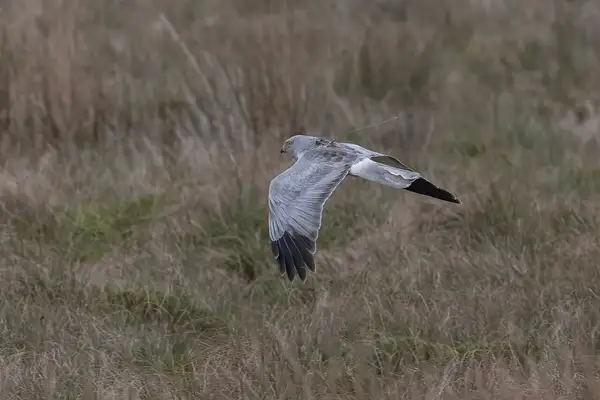
They are similar in appearance1. It is a medium-sized raptor, with long wings and tail, very long tarsi and a graceful look, larger and more slender than the kite.
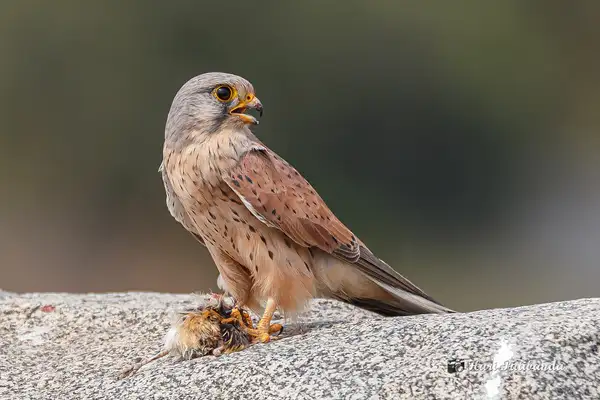
It is a small falcon with a long tail and broad, relatively pointed wings. The male has a greyish head and a reddish back with black spots, with cream, spotted underparts, without the kite’s snowy white.
Photo: Hari K Patibanda, CC BY 2.0
Other birds
Birds related to the Black-winged Kite or sharing its habitats in Cabañeros.




 Same family
 Same family
 Same family
 Same family
 Also in grasslands and rañas
 Also in grasslands and rañas
 Also in grasslands and rañas
 Also in grasslands and rañas





