Invasive non-native. It is considered an invasive alien bird: natural colonisation has been ruled out because its presence is not recorded in Morocco. Its largest breeding core is in Extremadura and it is on the Spanish Catalogue of Invasive Alien Species. This page deals with the species and does not present it as a native wild bird.
Order
Anseriformes
Family
Anatidae
Species
Alopochen aegyptiaca
Wingspan compared with a person with arms outstretched.
Length
63–73 cm
Wingspan
1.4–1.5 m
Weight
1.5–2.3 kg
Social life
The female incubates and the male keeps watch and defends the nest from predators; after hatching, the chicks leave the nest and follow their parents
Lifespan
Record of 25.5 years in captivity according to AnAge; EURING lists a bird identified by its marks in the field, in Belgium, that lived 19 years and 1 month
Conservation status
LC
NT
VU
EN
CR
EW
EX
Global (IUCN)
Least Concern
Spain
On the Spanish Catalogue of Invasive Alien Species; no relevant threats to the species are recorded in Spain
When to see it
Resident
Months of the year when it is present
J
F
M
A
M
J
J
A
S
O
N
D
In Iberia
yes
yes
yes
yes
yes
yes
yes
yes
yes
yes
yes
yes
Song or voice of the Egyptian Goose
Both sexes hiss when they feel threatened, and give croaking notes on taking off1. The male’s main call is a hoarse whistle, and the female’s a harsh, strident «hur-hur-hur». The recording (call) is by Alexandre Renaudier and was made in the Sierra de Andújar, in Andalusia (xeno-canto XC128857, quality A). It lasts 9 seconds and is a trimmed section of a 26 s clip, without repeating or lengthening, from which we have removed the bass below 300 Hz, reduced the background noise and adjusted the volume; neither pitch nor speed has been changed.
It has long legs and an upright bearing, and in flight shows white wing coverts like those of the shelducks. In general it is sedentary, although the African populations move according to water availability. The English population seems totally sedentary1.
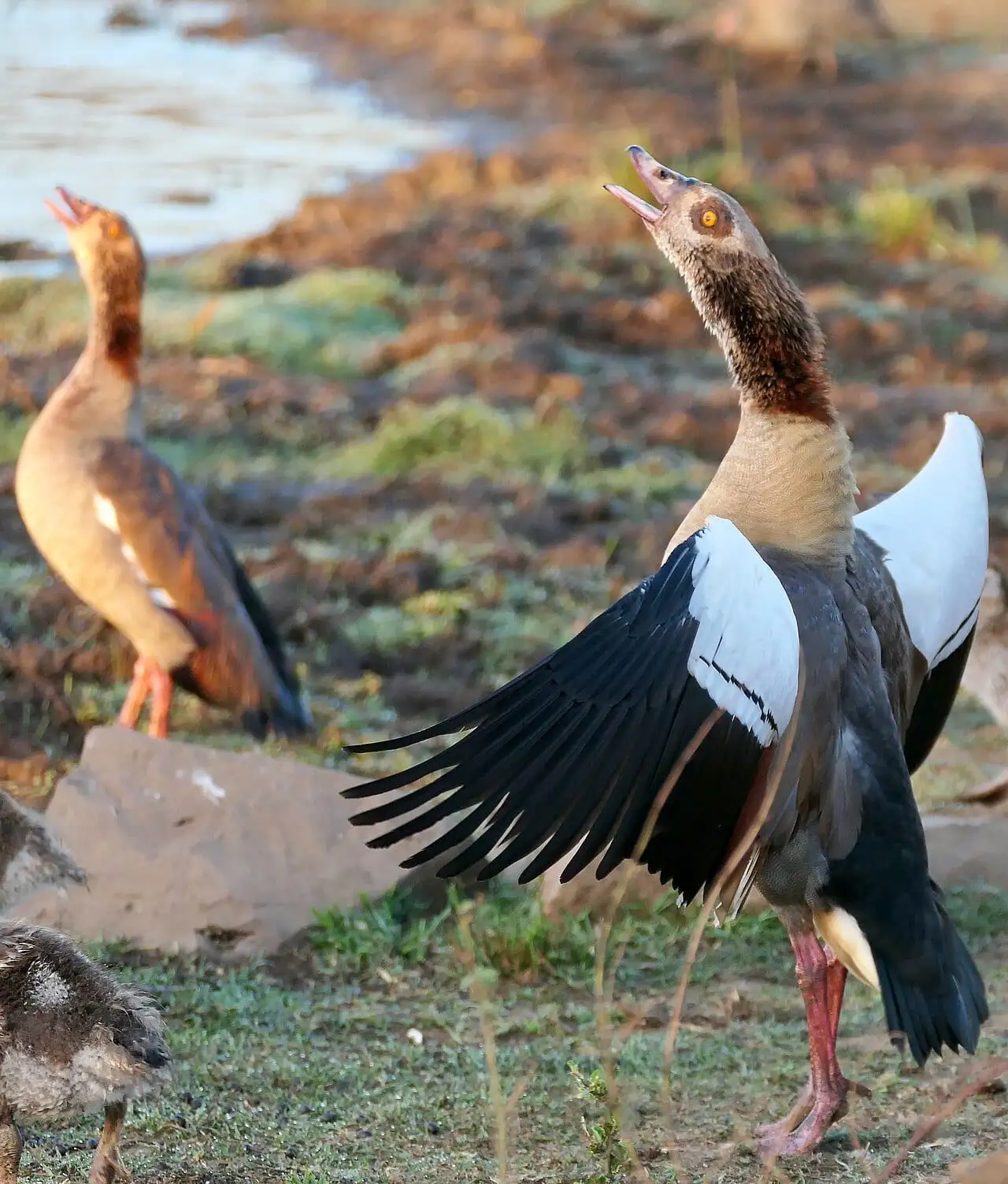
Flight typeDirect and heavy, like a goose's, with the white wing coverts clearly visible
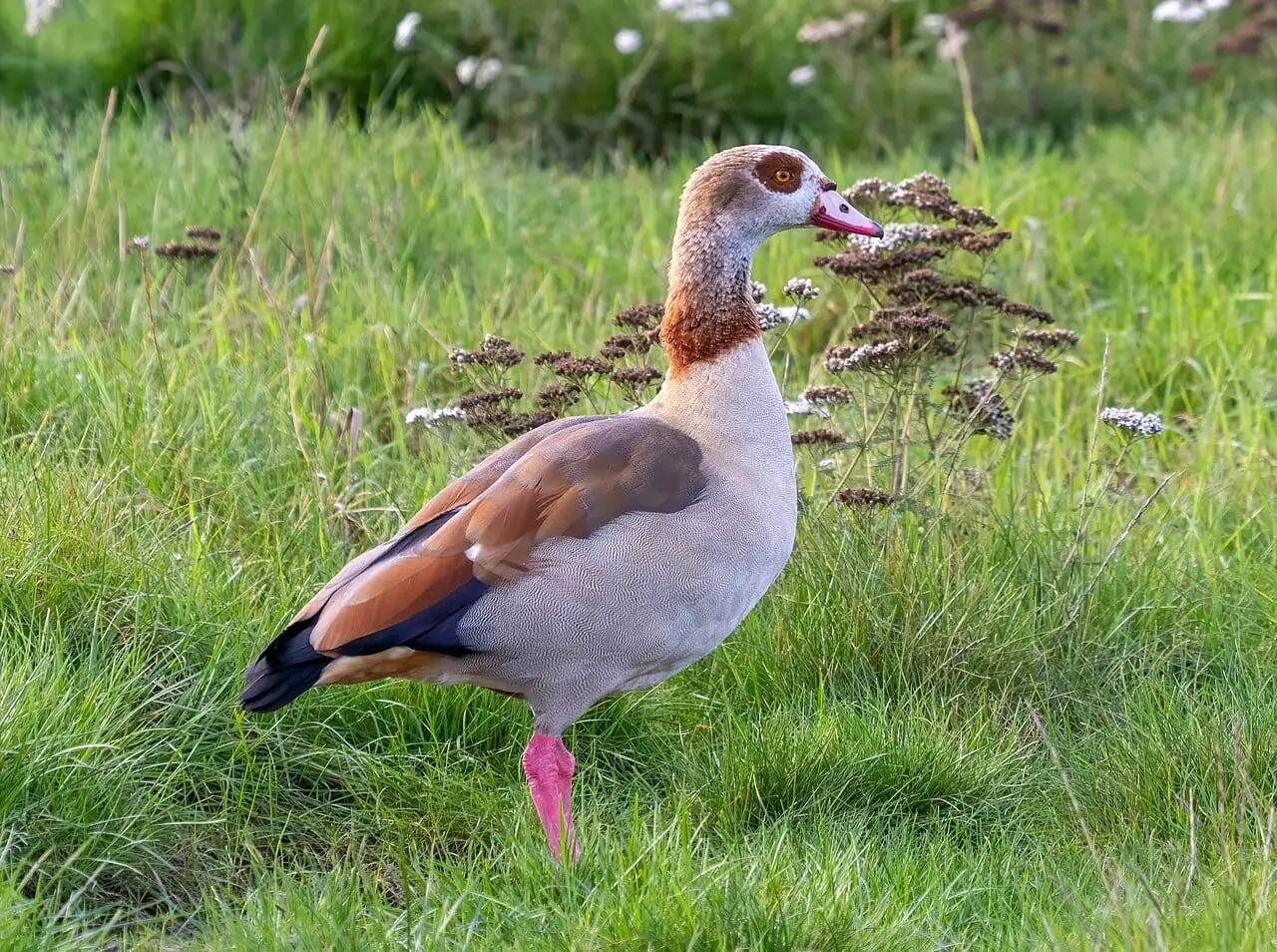
Intermediate in size between a goose and a duck, it is predominantly brown in colour, with chestnut patches around the eyes and on the lower breast.
In flight it shows white wing coverts, like those of the shelducks.
Both sexes hiss when they feel threatened and give croaking notes on taking off.
Photo gallery of the Egyptian Goose
Egyptian Goose standing in the grass, in profile, with the chestnut patch around the eye, breast mottled with chestnut, white wing coverts and pink legsPhoto: Rhododendrites, CC BY-SA 4.0Photo 1 of 4
Two Egyptian Geese on a shore: one, with wings open and neck stretched out, shows the white coverts and dark flight feathersPhoto: Bernard DUPONT from FRANCE, CC BY-SA 2.0Photo 2 of 4
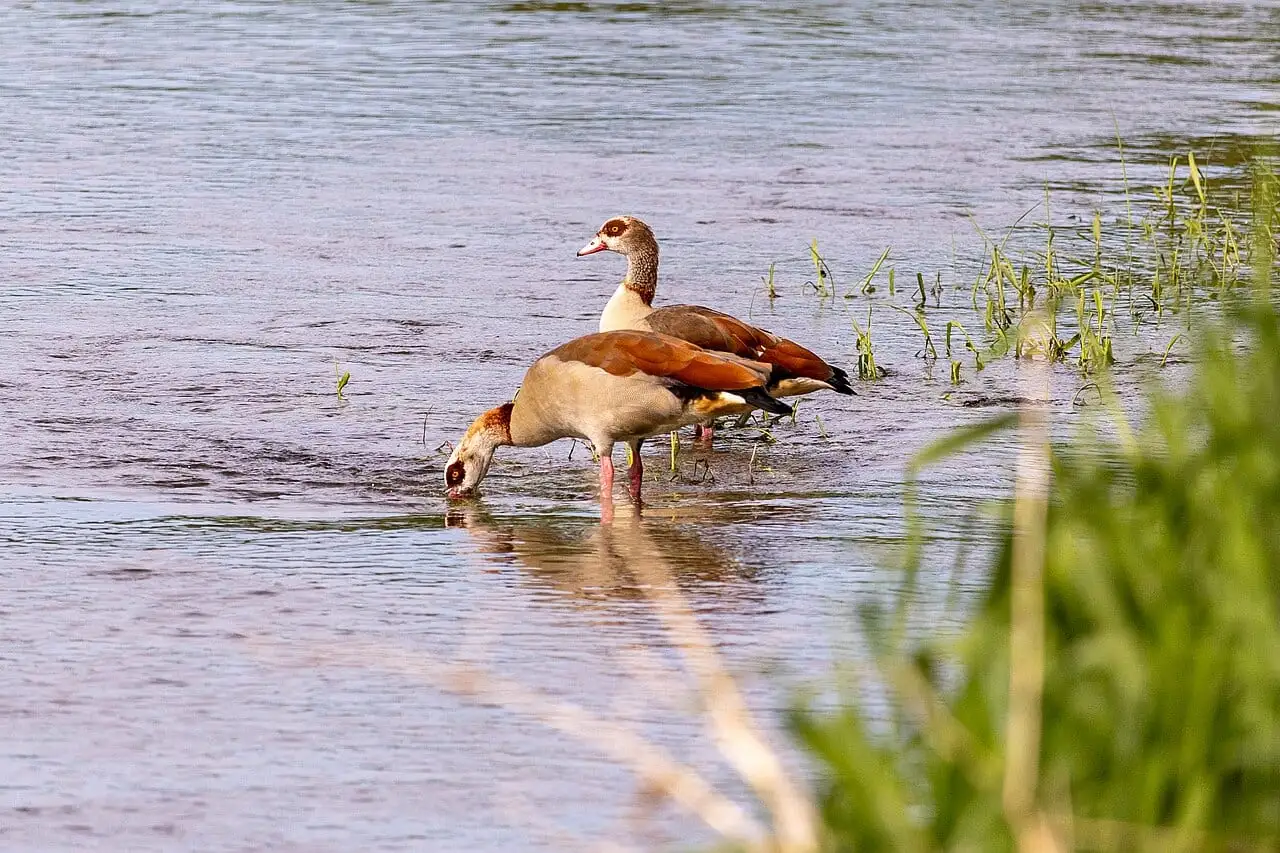
Pair of Egyptian Geese feeding in shallow water, with brown plumage and chestnut patchesPhoto: WikiMartinuss, CC BY 4.0Photo 3 of 4
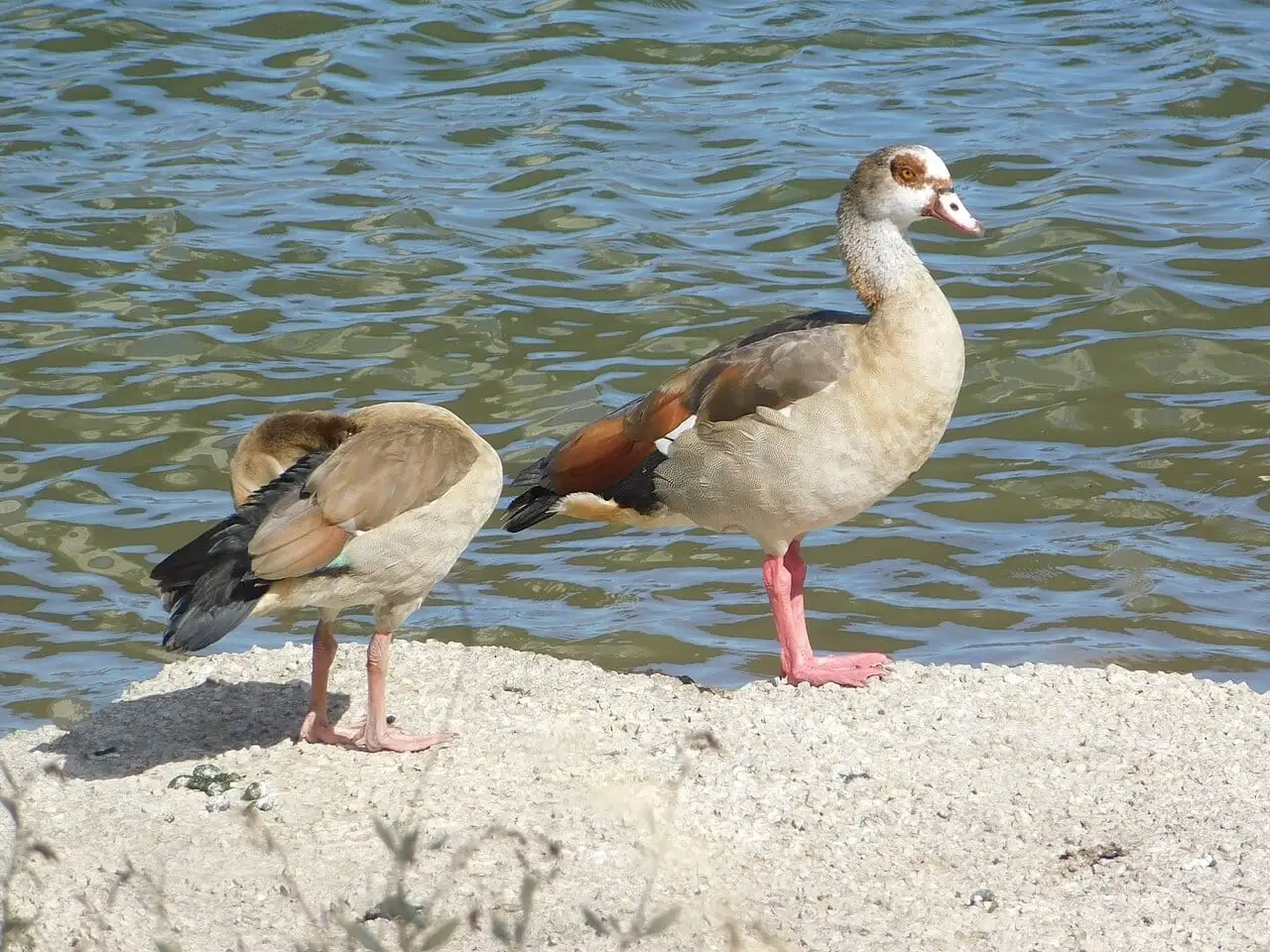
Two Egyptian Geese on a sandy shore, with pink legs and chestnut patches around the eye and on the breastPhoto: The Blue Rider, CC BY 4.0Photo 4 of 4
1 / 4
Identification of the Egyptian Goose
Intermediate in size between a goose and a duck, this goose is predominantly brown in colour, and in adults chestnut patches around the eyes and on the lower breast stand out. Long-legged and upright in bearing, in flight it shows white wing coverts like those of the shelducks.
Habitat and distribution of the Egyptian Goose
It is typically Afrotropical. It also bred in the past at sites in the Palearctic, such as Israel (until the early 20th century) and south-east Europe (until the 17th or perhaps the 18th century). It has feral populations in England (300–400 pairs) and in other European countries, such as the Netherlands (some 1,300 pairs in the mid-nineties), Belgium, Germany and France, where it is expanding.
In Spain it is present only on the Peninsula, and is absent from the Balearics, the Canaries, Ceuta and Melilla1. It extends across Extremadura, Madrid and Catalonia as a breeder, and is also on the Galician and Cantabrian coast, in the Ebro valley, in Castilla-La Mancha and in western Andalusia. In Africa it occupies very varied freshwater wetlands, in lowlands and at greater altitude, and adapts easily to human presence: it colonises parks and gardens.
Areas where it is regularly recorded since 2010Squares of about 25 km where it is recorded regularly (occasional passage records are left out). Data from GBIF.org (61,559 records, retrieved October 2026); outline from Natural Earth.
Etymology of the Egyptian Goose
According to Wikipedia, Linnaeus described it in 1766 in the twelfth edition of the «Systema Naturae» with the name «Anas aegyptiaca». In other languages it is called «oca egípcia» in Catalan, «ganso de Exipto» in Galician, «antzara egiptoarra» in Basque and «Egyptian goose» in English1. We have not found a source explaining the origin of the Spanish name or the scientific one, so we do not venture one.
Population of the Egyptian Goose
The 2021 European Red List of Birds gives no data on the European breeding population, and there is no precise figure for the Spanish population either. The total demography comes both from escapes and from arrivals from other countries, although today the main and almost only source of new birds is local breeding1. The trend across the country is increasing, as befits an invasive species.
Its spread in Spain has not been studied, but in Central Europe, with data up to 2010, an advance of 20 km a year and a population increase of 17 % a year is calculated, which could be falling because of culls of some 20,000 birds shot a year in the Netherlands, Belgium, the United Kingdom and Germany. Being invasive, how its growth affects native species must be watched, with control measures if necessary1.
Nest of the Egyptian Goose
The female places the nest on the ground, on heaps of grasses or reeds and hidden among thick vegetation, although sometimes she sets it in hollows, cliffs or trees; in the last case she uses old nests of other species. She lines it with leaves, grass and down.
Courtship and breeding of the Egyptian Goose
The breeding season is variable, but mainly in spring. The clutch is 6 to 10 eggs, laid at intervals of 24 hours. Incubation is done by the female for 28–30 days, and the male watches over and defends the site from possible predators. After hatching, the chicks leave the platform to follow their parents.
Diet of the Egyptian Goose
The diet is fundamentally vegetarian: buds and seeds of grasses, flowers, leaves and aquatic plants.
Curious facts about the Egyptian Goose
Its growth and dispersal show that the species faces no relevant threats in Spain1. Wikipedia gives a weight of 1,500 to 2,348 g, and AnAge, 1,900 g adult weight. AnAge gives 25.5 years of longevity, but in captivity; EURING lists a bird identified in the field in Belgium at 19 years and 1 month.
The Egyptian Goose in Cabañeros
The habitat pages of this website do not mention it, and we have not found any other published source on it in the Park; nor does it appear in the bird list of the «Visitor guide to Cabañeros National Park» (OAPN). GBIF.org records 60 observations of the Egyptian Goose in Cabañeros and its surroundings, which fits a species that is spreading across Castilla-La Mancha and Extremadura, where its largest breeding core is1. Of those observations, 3 fall within the Park boundary (according to OpenStreetMap); the rest are from the surroundings.
Where to see the Egyptian Goose in Cabañeros
In Cabañeros and its surroundings, in wetlands, reservoirs and ponds, often near inhabited areas.
When
Present all year; breeding is mainly in spring.
What time
By day, feeding on meadows and shores, in pairs or small groups.
Where
On rivers, lakes, reservoirs and ponds, also in parks and gardens.
What to look for
Look for the chestnut eye patch, the mottled breast and the white coverts in flight; listen for the male's hoarse whistle.



 Same family
 Same family
 Same family
 Same family
 Same season in the park
 Same season in the park
 Same season in the park
 Same season in the park






