Gregarious: outside the breeding season it moves in large flocks, often mixed; when breeding it is not very territorial and several pairs may set their nests a few metres apart
Lifespan
Record of 13 years and 4 months in the wild (a bird ringed in Belgium that entered an artificial structure)
Conservation status
LC
NT
VU
EN
CR
EW
EX
Global (IUCN)
Least Concern
Spain
Least Concern (LC) in the Red Book of the Birds of Spain; not on the List of Wild Species under Special Protection or in the Spanish Catalogue of Threatened Species
When to see it
Resident
Months of the year when it is present
J
F
M
A
M
J
J
A
S
O
N
D
In Iberia
yes
yes
yes
yes
yes
yes
yes
yes
yes
yes
yes
yes
Song or voice of the Common Linnet
In flight it gives a very characteristic two-note call («chii-chie»), which it repeats insistently. The males’ song, much more elaborate, combines screeches and gurgles that may recall some notes of the European Greenfinch.
SongCommon Linnet
0:00 / 0:09
10 kHz5
The sonogram draws the sound: time runs from left to right, and the higher a trace sits, the higher the note.Recording by Nefronus, Wikimedia Commons (CC BY-SA 4.0).
Flight of the Common Linnet
In flight, both sexes and young of the year show a weak but perceptible white patch that stands out against the blackish colour of the wings. The pair of outer tail feathers is white.
Flight typeUndulating, in flocks, with constant calling
Outside the breeding season it moves in large flocks, often mixed, which rise from the ground, where they look for seeds.
In flight it gives a very characteristic two-note call, «chii-chie», which it repeats insistently. Both sexes show a weak white patch on the wings and the outer pair of tail feathers is white.
It lands on a shrub or comes down again to the ground of a fallow or a track edge.
Photo gallery of the Common Linnet
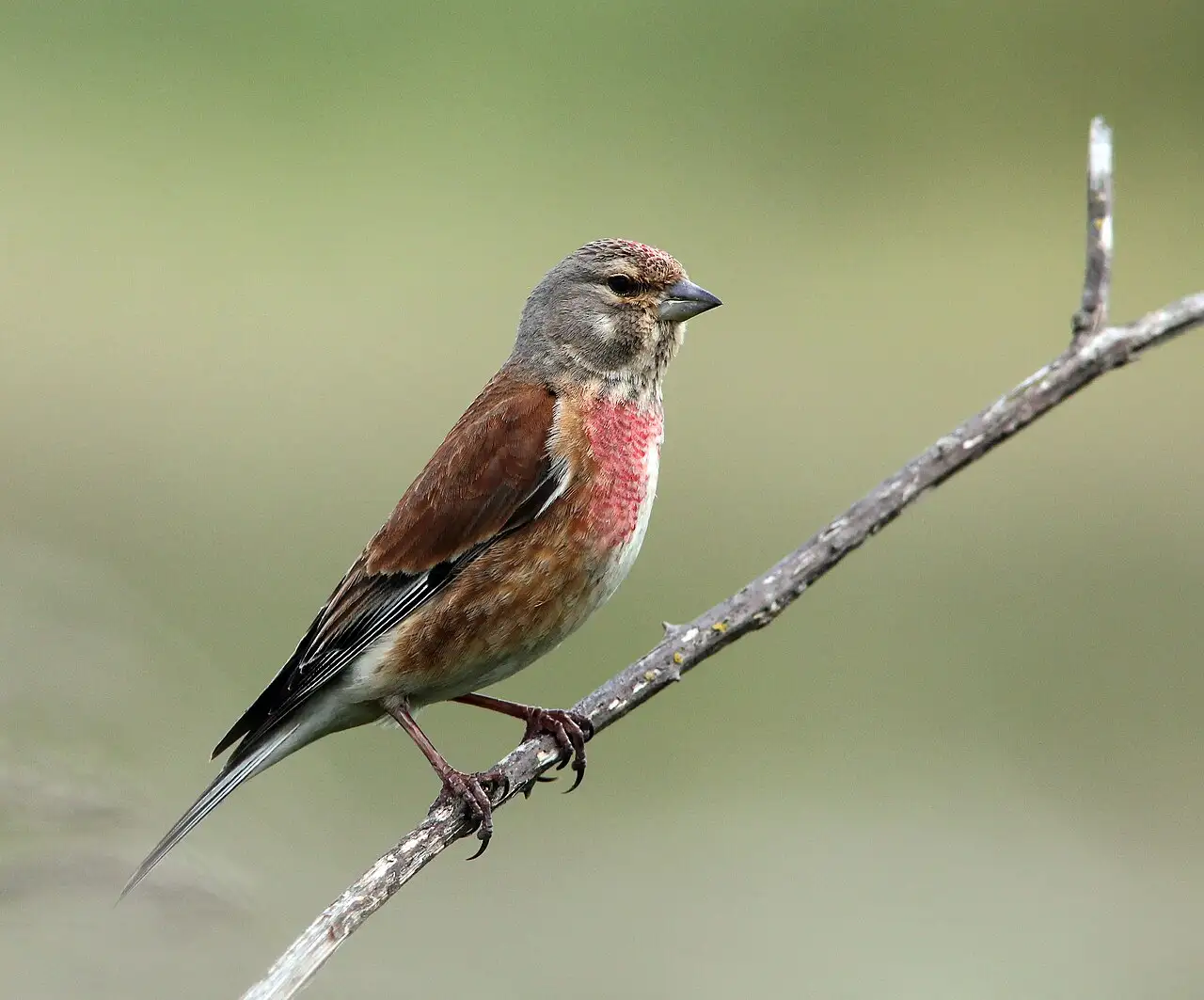
Male Common Linnet perched on a dry branch, with crimson forehead and breast, brown back and grey headPhoto: Joe Pell, CC BY 2.0Photo 1 of 4
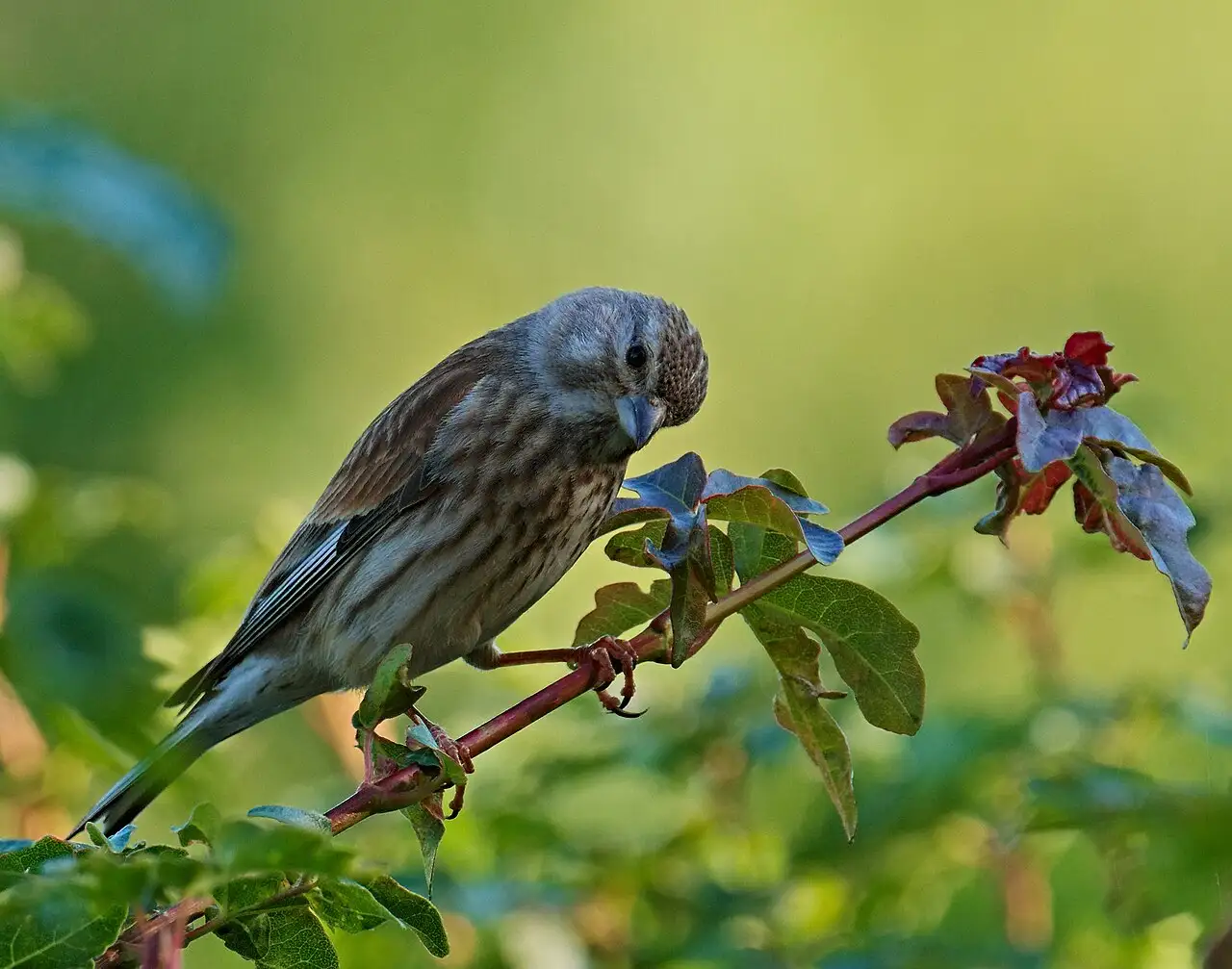
Female Common Linnet on a branch with reddish leaves, with heavily streaked brown plumagePhoto: Andreas Eichler, CC BY-SA 4.0Photo 2 of 4
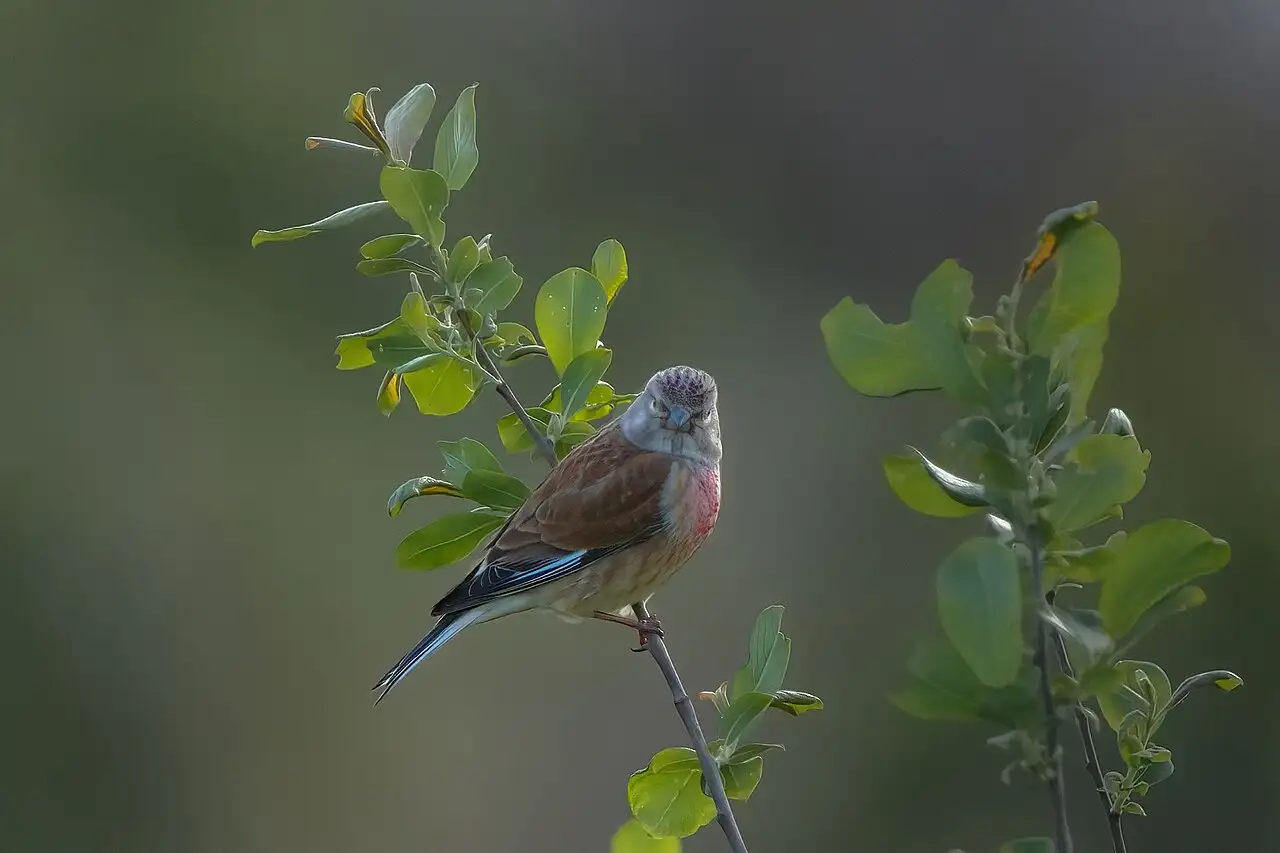
Male Common Linnet on a leafy branch, with crimson forehead and breast and long, notched tailPhoto: Valuer Hardy, CC BY 4.0Photo 3 of 4
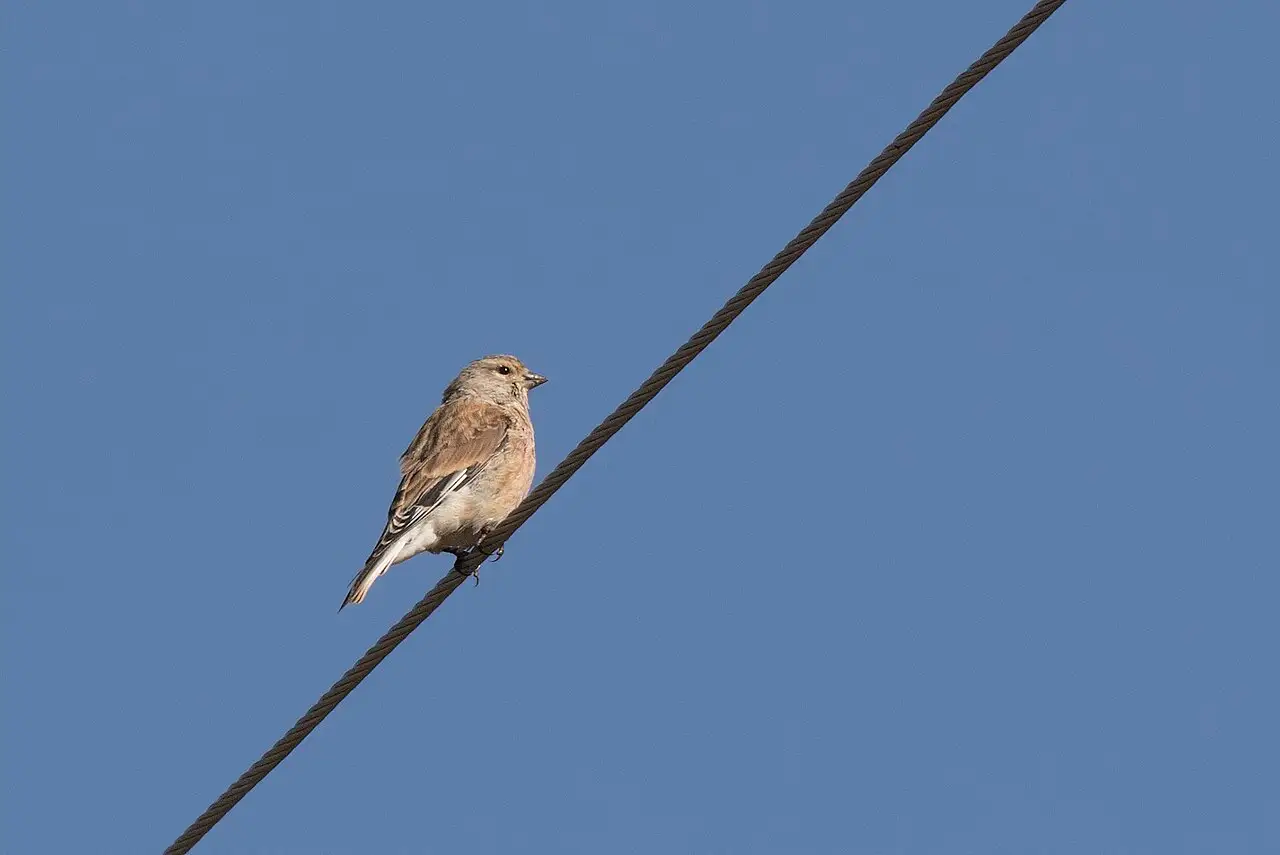
Common Linnet perched on a wire against the blue sky, with streaked brown plumagePhoto: Zeynel Cebeci, CC BY-SA 4.0Photo 4 of 4
1 / 4
Identification of the Common Linnet
The linnet is a slender, thin bird, with a short bill and a long, notched tail. Its plumage is brown on the back and very pale ochre on the flanks and belly, with elongated spots or streaks, much more abundant and visible in females. Males are unmistakable in spring, as they wear a striking crimson colour on the forehead and breast.
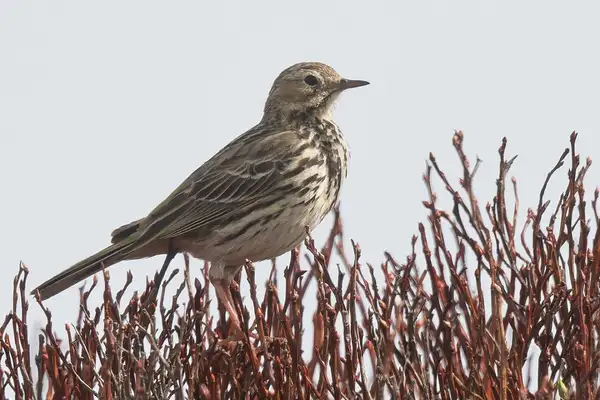
In flight, both sexes and young of the year show a weak but perceptible white patch that stands out against the blackish colour of the wings, and the outer pair of tail feathers is white. Females and young birds, because of their unshowy plumage, can be mistaken for Meadow Pipits or for female and young buntings. Pipits have a thin, long bill and «walk», whereas linnets, like the rest of the finches, «hop» as they move on the ground. Buntings are larger and less gregarious, and are usually seen perched on shrub branches, whereas the linnet looks for food on the ground.
Male in spring
Forehead and breast a striking crimson colour.
Back brown and flanks and belly very pale ochre.
Female and young bird
Unshowy plumage, with more streaks.
They may be mistaken for Meadow Pipits or for buntings.
Habitat and distribution of the Common Linnet
It is a bird widely spread across Eurasia, for which several subspecies have been described. It lives over much of Europe, except the northern half of Scandinavia and the most northerly region of Russia; to the east it reaches China, and to the south it appears in Israel, north-west Africa and the Canary Islands. On the Peninsula only the subspecies «cannabina» is admitted, although «mediterranea» has also been cited; in the Canaries «dewaldoi» and «harterti» are recognised.
It is found throughout the Peninsula and on all the islands of the Canaries and the Balearics. In winter it is absent only from a few points of the Cantabrian coast and range and the Pyrenees.
It prefers open landscapes, whether coastal, plateau or mountain: cereal plains, olive groves, juniper woods, very open holm oak dehesas… It is also common in the scrub that replaces degraded woods (rockrose scrub, broom thickets, gorse thickets), as long as there are open spaces with herbaceous plants, and it breeds successfully in Spanish broom and heath above the treeline. In winter it gathers where the herbaceous plants that give it seeds abound: it forms large flocks in the dry-farmed crops of both plateaus and the depressions of the great rivers, and explores fallows and track edges accompanied by goldfinches, greenfinches, chaffinches, serins and siskins.
European populations are partial migrants: those that breed in the most northerly latitudes move towards the Mediterranean surroundings. On the Peninsula, those that breed in cold and mountain areas come down to the lowlands and spend the winter in the depressions of the great rivers (Tagus, Ebro, Guadalquivir…) and on the Mediterranean coast, where they mix with linnets from the Netherlands, Germany, France, Switzerland, Great Britain, Italy, Poland or the Baltic countries. They arrive in September and October; some stay to winter and others, together with Iberian birds, cross to North Africa, and in March and April they return to Europe.
Areas where it is regularly recorded since 2010Squares of about 25 km where it is recorded regularly (occasional passage records are left out). Data from GBIF.org (481,590 records, retrieved October 2026); outline from Natural Earth.
Etymology of the Common Linnet
According to Wikipedia, «Linaria» comes from Latin and means «flax weaver», from «linum» («flax»), and «cannabina» is «of hemp» in Latin; the English name, «linnet», derives from Old French «linette», from «lin» («flax»). Both the scientific name and the English one allude to its fondness for hemp and flax seeds. In other languages it is called «passerell comú» in Catalan, «liñaceiro común» in Galician, «txoka arrunta» in Basque and «common linnet» in English1.
Population of the Common Linnet
In the 2021 European Red List of Birds the European breeding population is estimated at between 35,800,000 and 64,400,000 mature individuals, with an increasing trend. In Spain, data from 1998–2018 give a current population of some 10 million birds, with two thirds between the two Castiles, Aragon and Andalusia, and a stable trend.
Like other birds, it suffers from hunting by bird-catchers: thousands of birds die or are caged each year. It also suffers from the intensification of agriculture, and has become scarcer where irrigation has been introduced and herbicides and pesticides are used.
Nest of the Common Linnet
The female builds the nest and sites it in dense shrubs. For the first clutch she usually chooses evergreen plants, but for the following ones she also chooses deciduous shrubs that have already developed their leaves.
Courtship and breeding of the Common Linnet
It usually breeds in pairs, although there are males that mate with more than one female. It is not very territorial: occasionally several pairs set their nests a few metres apart. It begins the first clutch in April and May, although in the warmer areas it can begin much earlier and, in mountain territories above the treeline, it is delayed. The female lays four to six bluish-white eggs, with reddish or purple speckling at the broad end, and incubates them for 10–14 days. The chicks, as soon as they hatch, are brooded by the female and fed by the male. They leave the nest two weeks later.
Diet of the Common Linnet
It eats small seeds, which it looks for on the ground. It also catches insects, above all in spring and summer, to feed the chicks.
Curious facts about the Common Linnet
Although it is somewhat hard to recognise in its winter colouring, it is very easy to detect by its flight call or by the striking crimson colour of the males in spring. According to EURING, the longest-lived ringed bird, in Belgium, reached 13 years and 4 months; AnAge gives 9.4 years.
The Common Linnet in Cabañeros
The habitat pages of this website do not mention it. GBIF.org records 152 observations of the Common Linnet in Cabañeros and its surroundings.
Where to see the Common Linnet in Cabañeros
In Cabañeros and its surroundings, all year.
When
All year round: in winter birds arrive from other European countries, in September and October, and return in March and April.
What time
In good light, in open landscapes: cereal, olive groves, open dehesas and scrub with herbaceous plants.
Where
On the ground of fallows and track edges, in a flock, or perched on a shrub.
What to look for
Look for the male's crimson in spring and the long, notched tail, and listen for the «chii-chie» in flight.



 Same family
 Same family
 Same family
 Same family
 Same order
 Same order
 Same order
 Same order






