Record of 19 years in the wild according to AnAge; EURING lists a bird ringed in France that lived 17 years and 11 months
Conservation status
LC
NT
VU
EN
CR
EW
EX
Global (IUCN)
Least Concern
Spain
Endangered (EN) in the 2021 Red Book of the Birds of Spain; the Spanish Catalogue of Threatened Species considers it Vulnerable (VU) only for the Canary population, and it is on the List of Wild Species under Special Protection
When to see it
Resident
Months of the year when it is present
J
F
M
A
M
J
J
A
S
O
N
D
In Iberia
yes
yes
yes
yes
yes
yes
yes
yes
yes
yes
yes
yes
Breeding season
no
no
no
yes
yes
yes
yes
yes
no
no
no
no
Song or voice of the Kentish Plover
It gives a short, hard «pirr» or «píorrrr», and in the breeding season a fairly dry «krruuui-krruuui», with variations, which sometimes ends in an explosive «ki-ki-ki»1. The recording (flight call and song) is by Esperanza Poveda and was made in El Condado (near El Rocío), Huelva, Andalusia (xeno-canto XC1066287, quality A). It lasts 9 seconds and is a trimmed section of the original, without repeating or lengthening, from which we have removed the bass below 300 Hz, reduced the background noise and adjusted the volume; neither pitch nor speed has been changed.
It is a wader of nervous movements, with dark legs almost as long as the body is wide: it runs fast after prey, stops and runs again. The chicks, like those of almost all waders, walk and feed themselves as soon as they hatch.
Flight typeRuns quickly towards the prey and stops to scan the beach
A wader of nervous movements, when it spots prey it runs quickly towards it and catches it.
It then stops and scans the beach to repeat the operation.
It gives a short, hard «pirr» or «píorrrr»; in the breeding season, a rather dry «krruuui-krruuui».
Photo gallery of the Kentish Plover
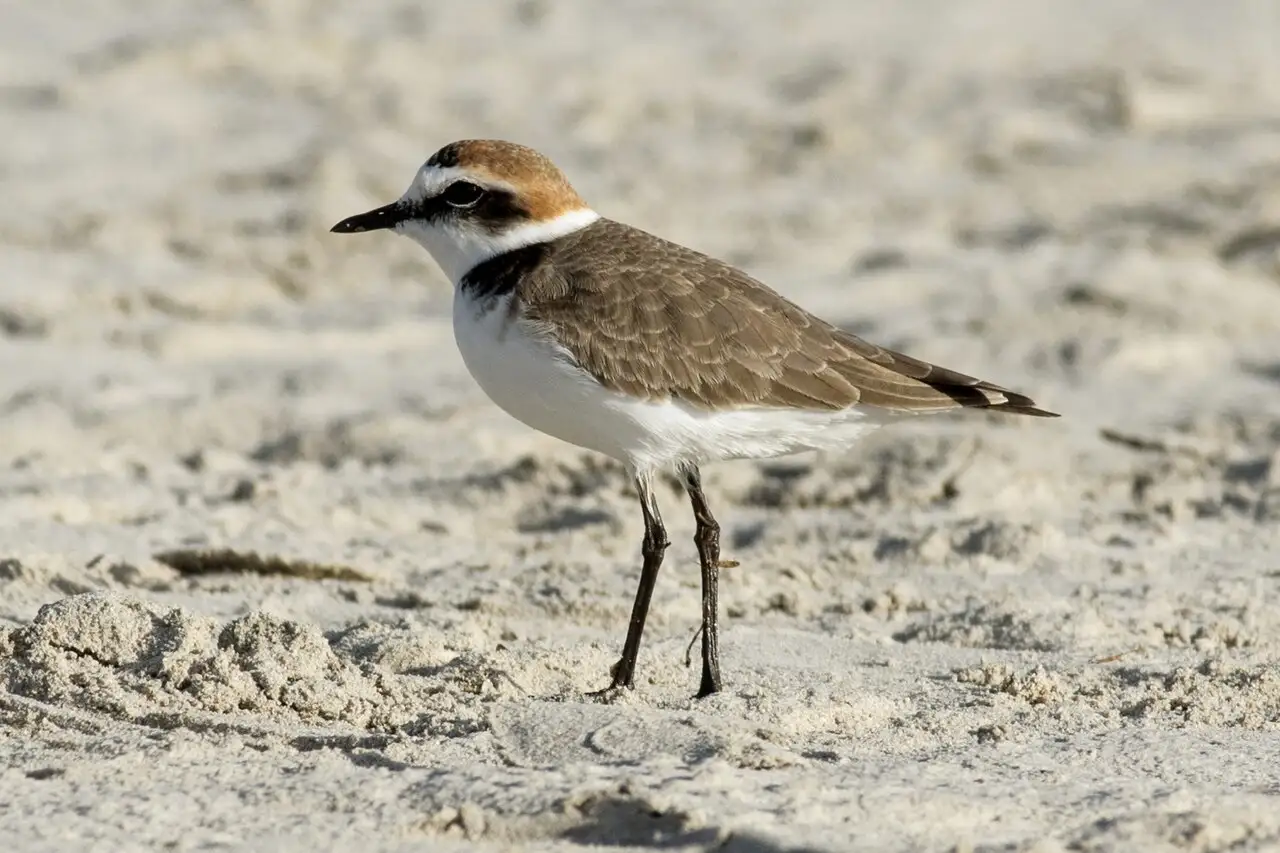
Male Kentish Plover on the pale sand of a beach, in profile, with reddish nape, white forehead and open black collarPhoto: Original Hobbyfotowiki, this edit MPF, CC0Photo 1 of 4
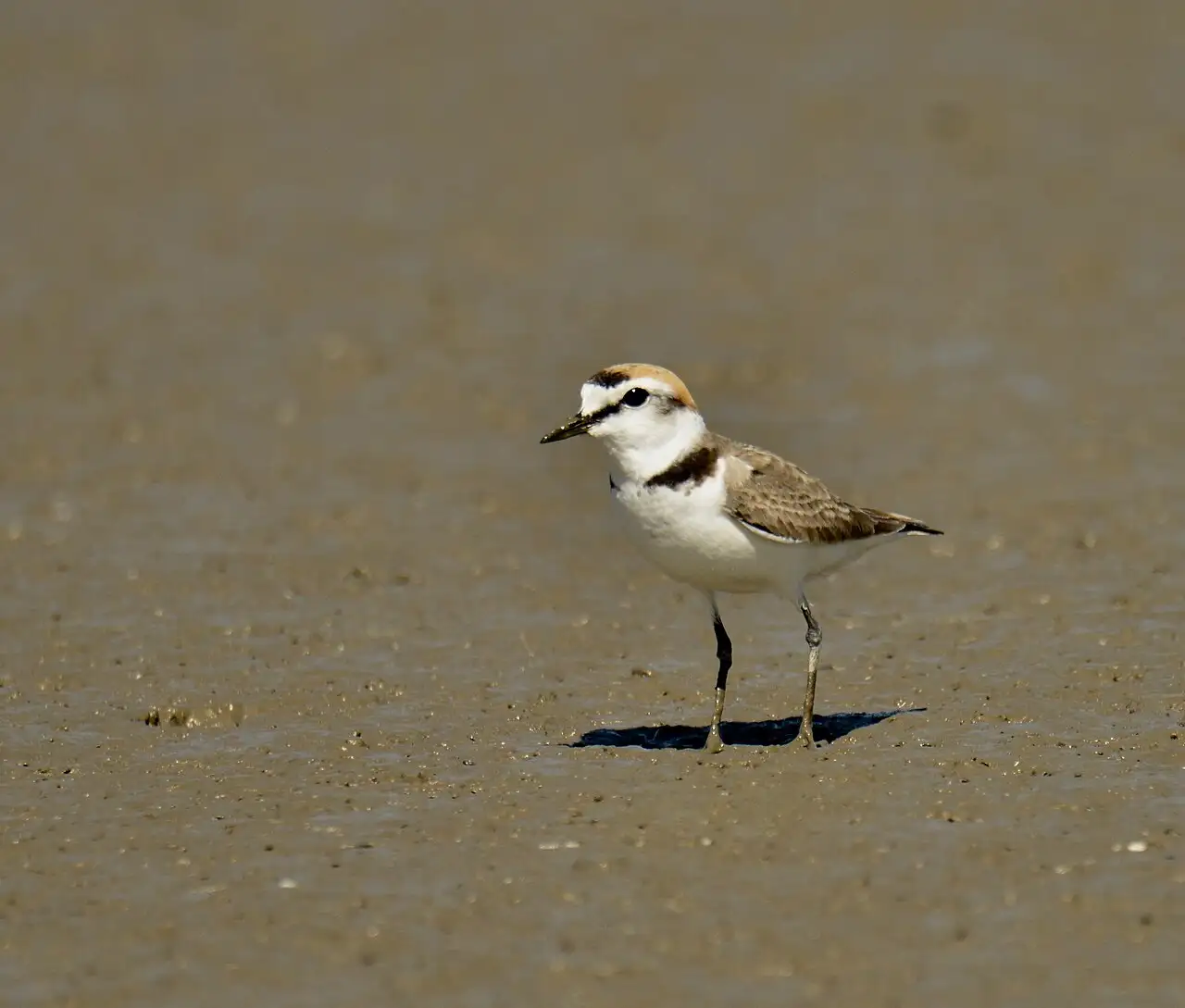
Male Kentish Plover standing on the wet mud of a shore, with black forehead bar and collar and reddish napePhoto: Luiz Lapa from Oeiras, Portugal, CC BY 2.0Photo 2 of 4
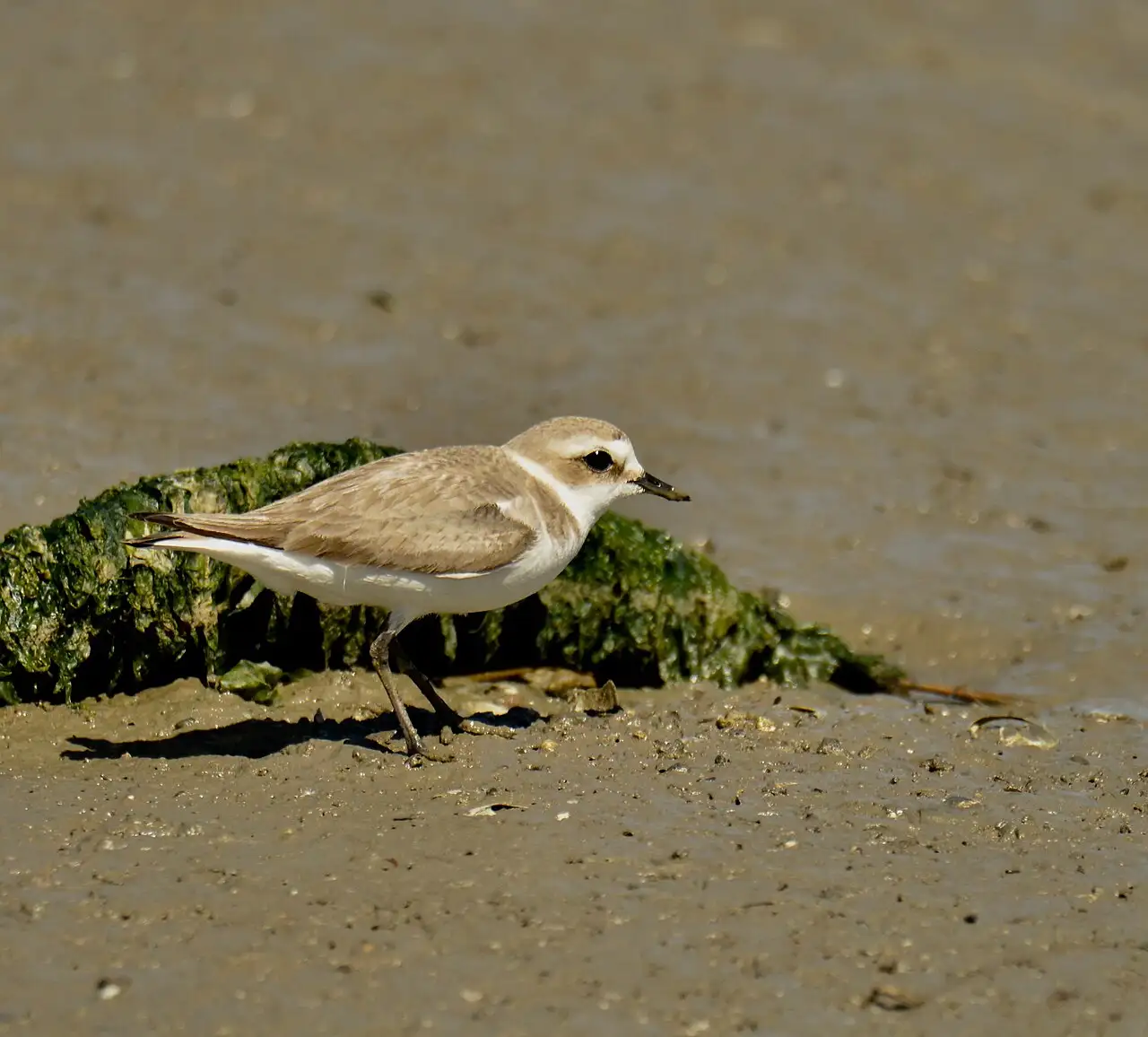
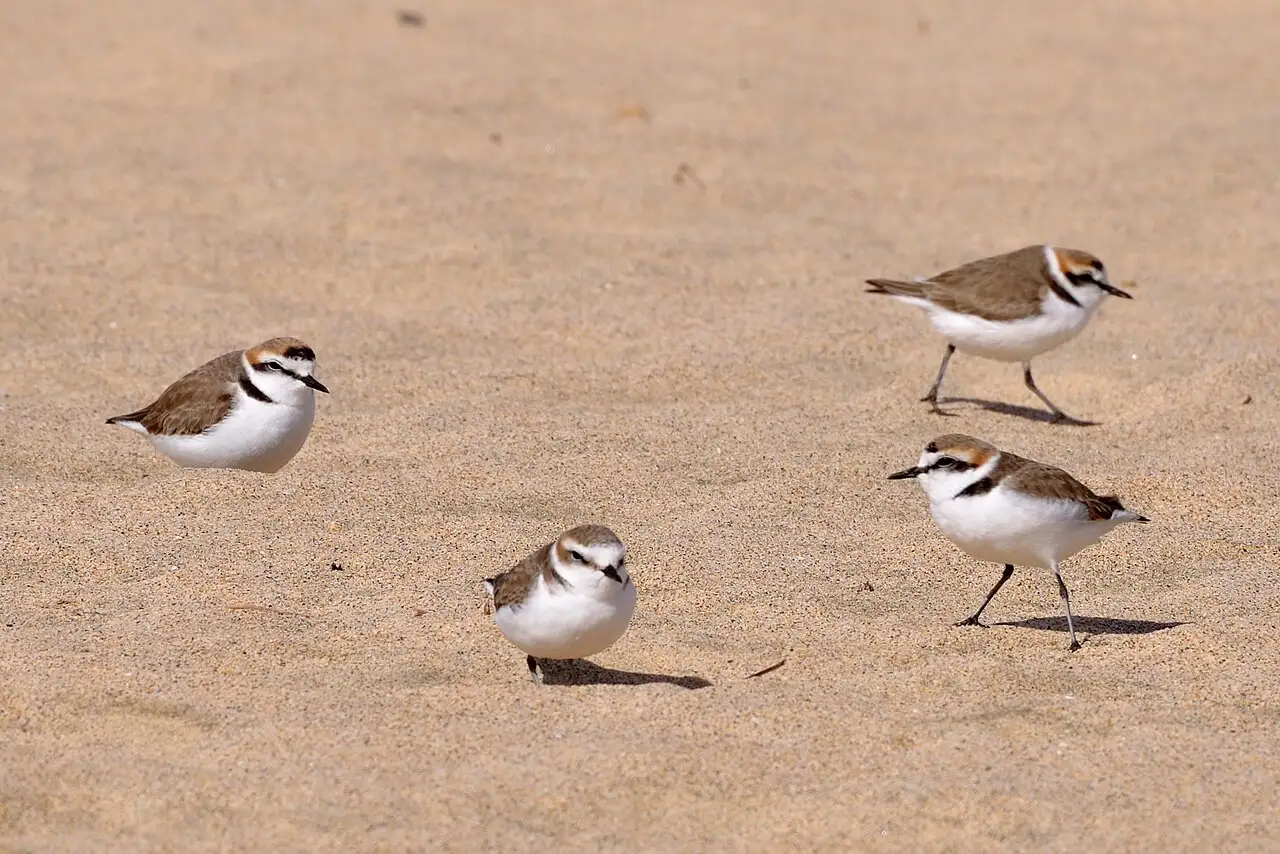
The Kentish Plover is a small wader of nervous movements, with a short, pointed bill and very dark legs, about as long as the body is wide. The adult male in breeding plumage wears striking head patterns: white eyebrows and forehead, contrasting with the black forehead bar, lores and ear feathers. The crown is greyish, but turns reddish on the nape, and the collar is open and black. The female is similar, but the black is replaced by a brown darker than the upperparts and she lacks reddish feathers on the nape. The non-breeding adult and the young bird are similar to the female in breeding plumage, although the feathers of the upperparts have pale edges, more prominent in the immature.
Breeding male
White eyebrows and forehead, black forehead bar, lores and ear-coverts.
Greyish crown, reddish nape and open black collar.
Female, non-breeding adult and young bird
Brown instead of black and without reddish feathers on the nape.
Young bird: upperpart feathers with pale edges.
Habitat and distribution of the Kentish Plover
It is a species of very wide, almost cosmopolitan distribution: it occurs in North and South America, Africa, Asia and Europe, where it breeds mainly around the Mediterranean and Black Seas. Several subspecies are recognised, and the nominate, «alexandrinus», is that of Eurasia and North Africa.
In Spain it is a partial migrant: on the Peninsula it is spread across the whole Mediterranean coast, the Atlantic coast of Andalusia and some points of the Galician coast, as well as at various inland sites in Andalusia and in La Mancha1. It also breeds in the Balearics and the Canaries, but does not appear in Ceuta or Melilla. In winter, those that stay concentrate on the Andalusian Atlantic, the coasts of Almería and Murcia, the Balearics and the Ebro Delta.
It nests on sandy beaches and in inland salt lagoons, with little plant cover. The highest nest densities occur on sandy soils with very sparse, scattered shrub vegetation, and on beaches without vegetation but with plenty of debris deposited by the tides.
It is present all year: a small part of the population stays in the breeding areas, to which it is very faithful, and in winter birds arrive from France, the Netherlands and Germany. The post-breeding passage along the Mediterranean coasts is very sparse. It shows a certain dispersive character and great capacity to colonise new nesting areas.
Areas where it is regularly recorded since 2010Squares of about 25 km where it is recorded regularly (occasional passage records are left out). Data from GBIF.org (95,388 records, retrieved October 2026); outline from Natural Earth.
Etymology of the Kentish Plover
According to Wikipedia, Linnaeus described it in 1758 in the tenth edition of the «Systema Naturae» under the name «Charadrius alexandrinus», and current taxonomies place it in the genus «Anarhynchus» (Anarhynchus alexandrinus), although xeno-canto and other databases keep «Charadrius alexandrinus»; observations under the two names should not be added together without removing duplicates. In other languages it is called «corriol camanegre» in Catalan, «píllara das dunas» in Galician, «txirritxo hankabeltza» in Basque and «Kentish plover» in English1. According to Jobling, «alexandrinus» means «of Alexandria»; we have not found a source explaining the origin of its Spanish name, so we do not venture one.
Population of the Kentish Plover
The 2021 European Red List of Birds estimates about 34,900–67,400 Kentish Plovers in Europe, with a decreasing trend. In Spain, the most recent overall estimate is from 2007: between 4,322 and 4,645 breeding pairs (Third Atlas of Breeding Birds). Since then no other overall census has been done, but those of several communities show an indisputable decline, and with the most recent data from each autonomous community about 3,312 pairs are calculated1. The five communities with estimates (Andalusia, the Canaries, the Valencian Community, Galicia and the Balearics) held 56.2 % of the 2007 population and have suffered since then an average decline of 52.2 %.
The main threat is habitat loss and disturbance from recreational use of coasts and beaches in summer. Also influential are the «cleaning» of beaches, which removes dune vegetation and destroys nests, coastal urbanisation, the ploughing of crop fields and the abandonment of traditional salt pans. Like all birds that breed at ground level, it suffers nest predation by gulls, corvids, foxes, cats and rats, and climate change adds local extinctions in prolonged droughts and heat stress in nests. It is proposed to declare it «Endangered with Extinction» throughout the territory, approve regional conservation plans, extend the SPAs, manage tidal debris sustainably, fence nesting areas and control dogs’ access to beaches1.
Nest of the Kentish Plover
The nest is on the ground, often near water and always in open areas or those with little vegetation. It is a shallow hollow, delimited by pebbles, algae or shell fragments.
Courtship and breeding of the Kentish Plover
In Spain, most pairs breed between April and August, generally in June. It is not unusual for them to make two clutches, the first in April or early May and the second between late May and June, and replacement clutches are common because of the many losses. The female usually lays three very cryptic eggs, which are incubated for 24–27 days. The chicks, like those of most waders, are very active as soon as they hatch and can move and feed themselves, but both parents tend them for about a month. It is a national calendar, not proof of nesting in the Park.
Diet of the Kentish Plover
Inland it feeds mainly on insects, adults and larvae of beetles, flies, ants and aquatic invertebrates; in salt water, on crustaceans, worms and molluscs. It detects prey by sight: when it spots it, it runs quickly towards it and catches it, and then stops and scans the beach to repeat the operation.
Curious facts about the Kentish Plover
The last overall estimate is from 2007 and, even without recent data, the decline is indisputable1; the Kentish Plover was SEO/BirdLife’s Bird of the Year 2019. On the EURING list there is a bird ringed in the Netherlands that was read in the field at 15 years and 11 months.
The Kentish Plover in Cabañeros
The habitat pages of this website do not mention it, and we have not found any other published source on it in the Park; nor does it appear in the bird list of the «Visitor guide to Cabañeros National Park» (OAPN). GBIF.org records 10 observations of the Kentish Plover in Cabañeros and its surroundings. Its presence is placed in inland Andalusia and in La Mancha, without specifying sites1. None of those observations falls within the Park boundary (according to OpenStreetMap): all are from the surroundings.
Where to see the Kentish Plover in Cabañeros
In Cabañeros and its surroundings, only occasionally, beside lagoons and shores with little vegetation.
When
It is present all year in Spain; on the coast, breeding runs from April to August.
What time
By day, on the shore, running over sand or mud.
Where
On sandy beaches and salt lagoons, with little plant cover; inland, on lagoons and shores of La Mancha and Andalusia.
What to look for
Look for the open black collar and the male's reddish nape; listen for the short, hard «pirr».



 Same family
 Same family
 Same family
 Same order
 Same order
 Same order
 Same order
 Same order






