Both sexes incubate and both adults care for the chicks, although the chicks feed themselves
Lifespan
Record of 22 years and 5 months according to EURING (a bird ringed in Sweden and shot); AnAge gives up to 14.5 years
Conservation status
LC
NT
VU
EN
CR
EW
EX
Global (IUCN)
Least Concern
Spain
Least Concern (LC) in the Red Book of the Birds of Spain, both as a breeder and as a winter visitor or migrant; on the List of Wild Species under Special Protection, but not in the Spanish Catalogue of Threatened Species
When to see it
Resident
Months of the year when it is present
J
F
M
A
M
J
J
A
S
O
N
D
In Iberia
yes
yes
yes
yes
yes
yes
yes
yes
yes
yes
yes
yes
Song or voice of the Common Sandpiper
The male gives a hissing, rapid, continuous «tu tu fi fi tu tu fi fi». The species also makes a whistle like a «fit fit fit fiiii».
SongCommon Sandpiper
0:00 / 0:18
10 kHz5
The sonogram draws the sound: time runs from left to right, and the higher a trace sits, the higher the note.Recording by Jochem Verweij, xeno-canto XC901773 (Suecia) (CC BY-SA 4.0).
Flight of the Common Sandpiper
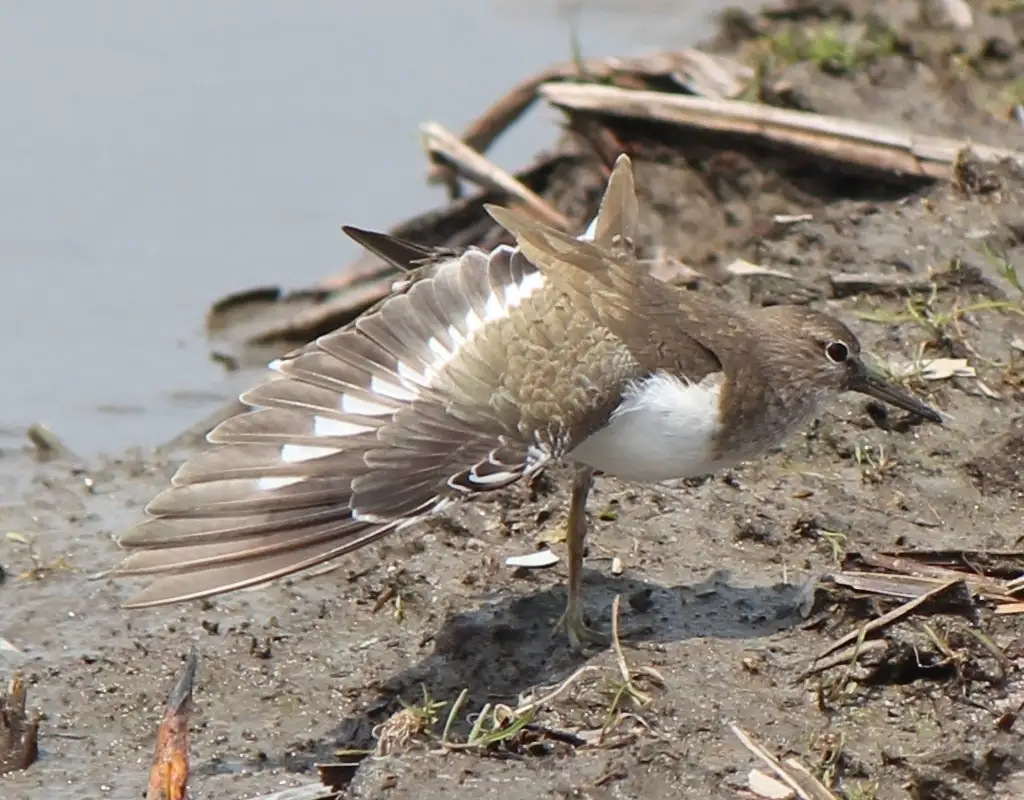
In flight it shows a characteristic wing pattern, with a broad white bar framed by darker feathers.
Flight typeLow, showing a broad white bar on the wing
It breeds on rivers, streams and reservoirs, in coves, sandbanks and gravel deposits, and from there it takes off.
In flight it shows a characteristic wing pattern, with a broad white band framed by darker feathers.
Perched, it bobs its tail and head in a characteristic way while it catches insects on the water surface or on muddy shores.
Photo gallery of the Common Sandpiper
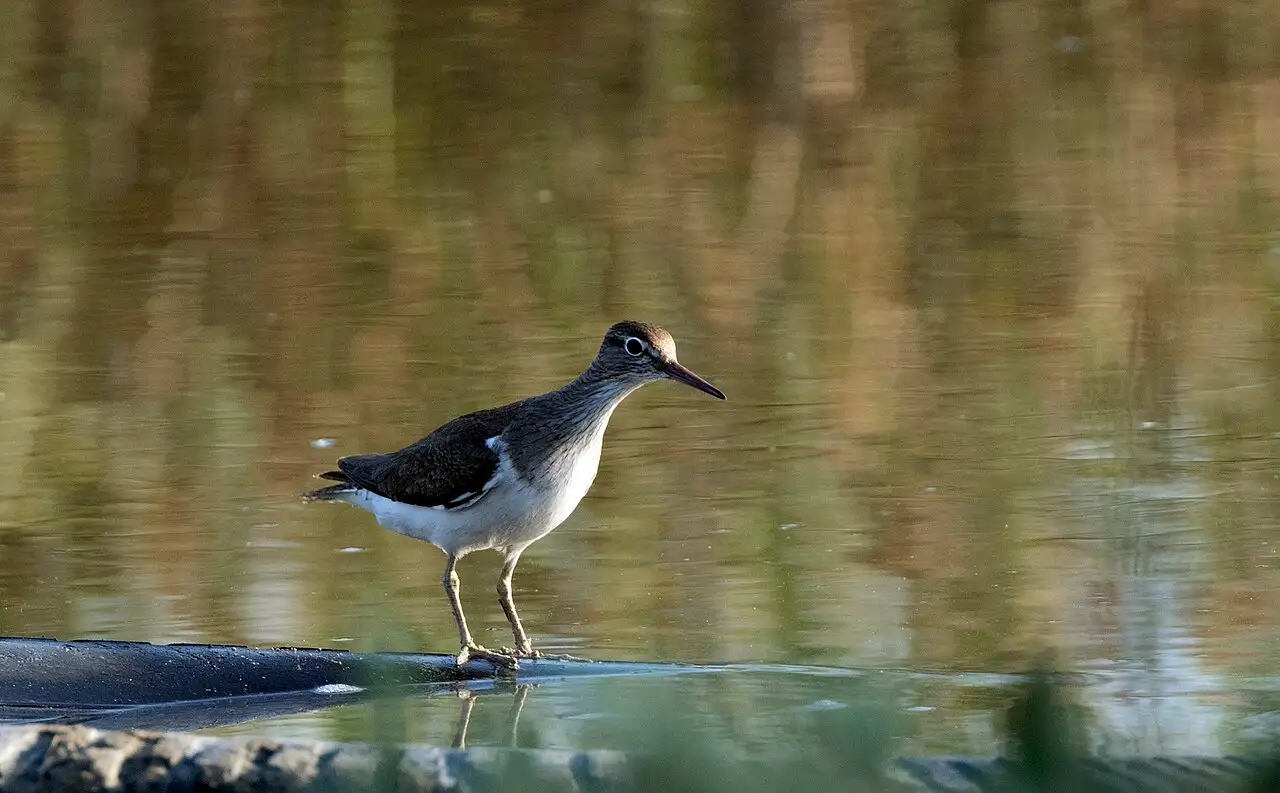
Common Sandpiper in profile on a log in the water, with dark brown back, white breast and belly and thin billPhoto: Zeynel Cebeci, CC BY-SA 4.0Photo 1 of 4
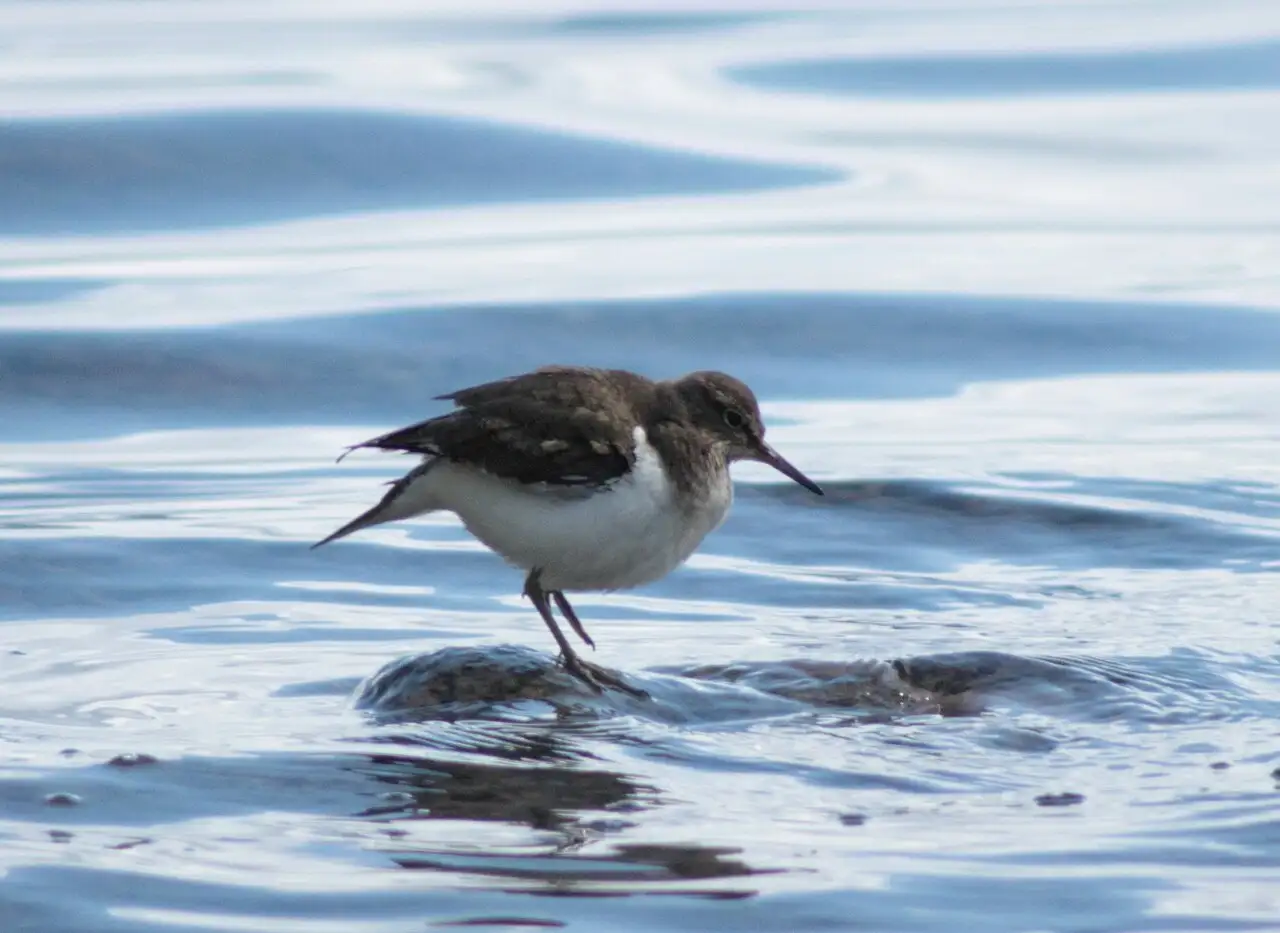
Common Sandpiper perched on a stone in the water, with its tail raised and the white wedge from the breast towards the neckPhoto: Estormiz, CC0Photo 2 of 4
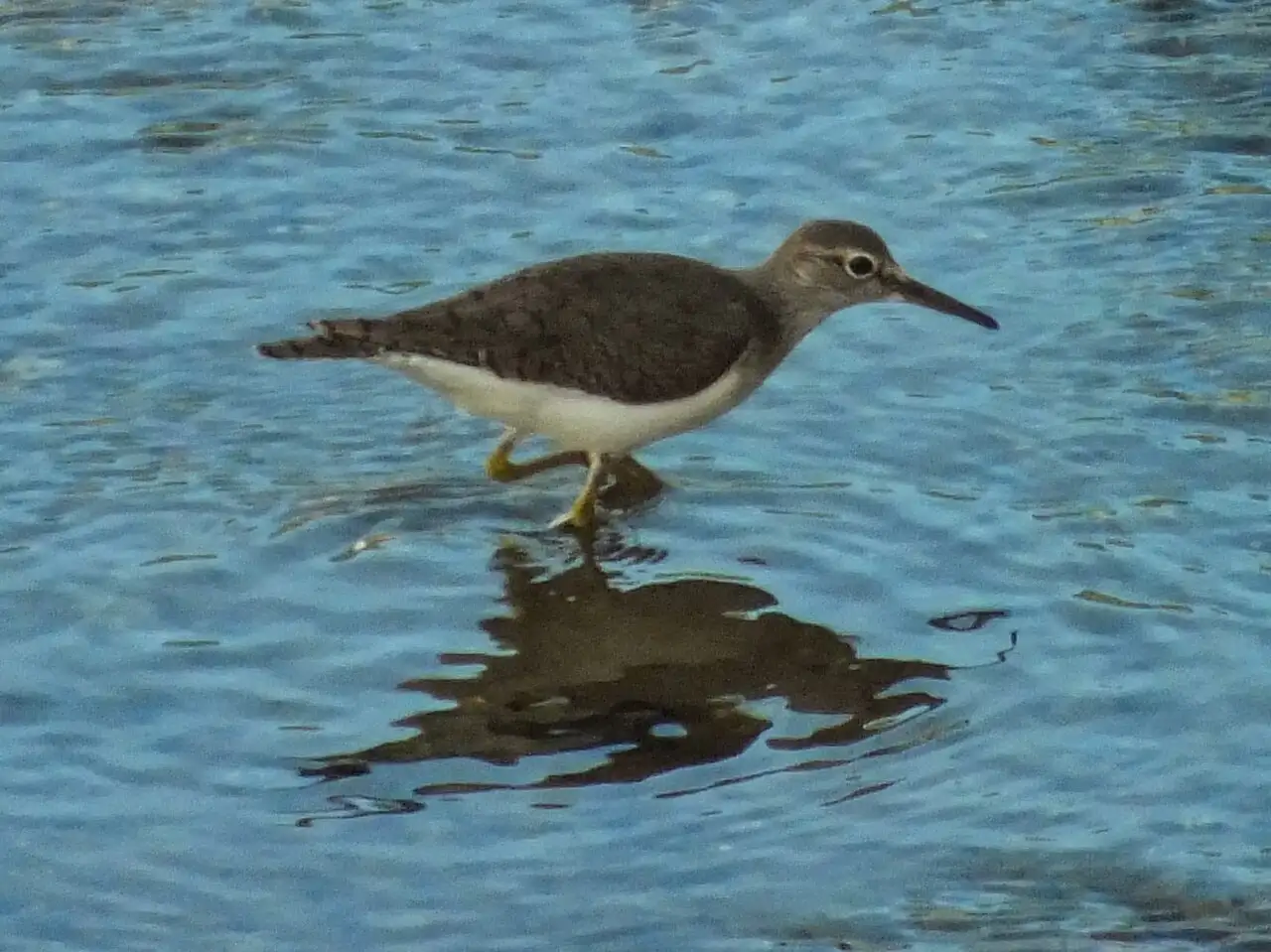
Common Sandpiper wading in shallow water, with brown back and white breast, and its reflection in the waterPhoto: Mariomassone, CC BY-SA 4.0Photo 3 of 4
Common Sandpiper standing on one leg, with one wing stretched out showing the white barPhoto: Alpsdake, CC BY-SA 3.0Photo 4 of 4
1 / 4
Identification of the Common Sandpiper
The Common Sandpiper is a slender wader, small (the smallest of the sandpipers) and fairly short-legged, which bobs its tail and head in a characteristic way when perched. Its upperparts are brown and its underparts white, with a characteristic pale wedge rising from the sides of the breast to the neck, in front of the bend of the wing. In flight it shows a characteristic wing pattern, with a broad white bar framed by darker feathers.
Adult in breeding plumage
Upperpart feathers greyish brown, with barring and spotting that give it a patchy look.
Non-breeding adult and young bird
Outside the breeding season, the feathers show the shaft finely picked out in dark and a buff edge, with a black subterminal band; the coverts show a double black-and-buff terminal barring.
The juvenile is similar to the non-breeding adult, but with more prominent feather margins.
Habitat and distribution of the Common Sandpiper
It spreads across much of Eurasia as a breeder, although it becomes rarer and more patchily distributed towards the south. Part of the population migrates and winters in southern Europe, southern Asia, Africa and Oceania. It has no subspecies.
In Spain it is distributed across the whole Peninsula, its presence depending on that of streams, rivers and reservoirs, so it is more frequent in the northern half and in areas of some altitude, where its breeding areas are, and scarce over wide areas of the south and Levante. It is present in the upper and middle basins of the Miño, Duero, Tagus and Guadiana rivers, and especially the Ebro and its tributaries. It does not breed in the Balearics, the Canaries, Ceuta or Melilla. In winter the population is very scattered, but tends to occupy suitable sites in Atlantic Andalusia, Galicia, Asturias and some wetlands on the Mediterranean coast.
It breeds very sparsely on rivers, streams and reservoirs of the Peninsula, where it occupies inlets, sandbanks and accumulations of gravel. On migration and in winter it can also appear in estuaries, marshes, beaches and rocky areas.
It is a resident species on the Peninsula, although also common on migration passages. Most movements of resident birds are inter-peninsular: they shun the high, cold areas where they breed to seek refuge in areas with mild, frost-free winters. In winter the Iberian population is reinforced by birds from western Europe, whose post-breeding passage is seen mainly in August. The return begins in March and the breeding areas are reoccupied in May and June.
Areas where it is regularly recorded since 2010Squares of about 25 km where it is recorded regularly (occasional passage records are left out). Data from GBIF.org (292,220 records, retrieved October 2026); outline from Natural Earth.
Etymology of the Common Sandpiper
According to Wikipedia, «Actitis» comes from the ancient Greek «aktítes» («coast dweller», from «aktḗ», «coast») and «hypoleucos» joins «hypó» («under») and «leukós» («white»). In other languages it is called «xivitona comuna» in Catalan, «bilurico das rochas» in Galician, «kuliska txikia» in Basque and «common sandpiper» in English1.
Population of the Common Sandpiper
In the 2021 European Red List of Birds the European breeding population is estimated at between 2,060,000 and 2,980,000 mature individuals, with a decreasing trend. In Spain there is not enough recent information to estimate the breeding population; the last estimate put it at about 1,066 birds in the period 2008–2010, but it is considered very conservative, because of the enormous dispersion of winter visitors on rivers, reservoirs and uncensused stretches of coast1. The main conservation problems are human disturbance (sport fishing, tourism and hiking) and the alteration and destruction of river habitat: bank engineering, small hydroelectric plants, gravel extraction and the like.
Nest of the Common Sandpiper
The nest, built mainly by the female, is on the ground, not far from the water, and consists of a soft hollow lined with plant material and stones.
Courtship and breeding of the Common Sandpiper
Laying takes place in late April or early May and normally consists of four beige or cream eggs with brown or reddish spots and streaks. Incubation lasts 21 or 22 days and is done by both sexes. The chicks are cared for by both adults, although they feed themselves, and develop in about 26–28 days.
Diet of the Common Sandpiper
It feeds on invertebrates, essentially insects, both terrestrial and flying, which it catches on the water surface or on muddy shores.
Curious facts about the Common Sandpiper
It is one of our few breeding waders, which also has very specific environmental requirements: it needs mountain rivers and streams with plenty of pebbles, gravel and sandy banks1. EURING lists a ringed bird from Sweden that lived 22 years and 5 months, a figure at odds with AnAge’s 14.5 years.
The Common Sandpiper in Cabañeros
The habitat pages of this website do not mention it. GBIF.org records 76 observations of the Common Sandpiper in Cabañeros and its surroundings.
Where to see the Common Sandpiper in Cabañeros
In Cabañeros and its surroundings, beside rivers, streams and reservoirs, all year.
When
All year; in August the post-breeding passage of birds from western Europe can be seen.
What time
In good light, on the shores.
Where
On rivers, streams and reservoirs with banks of sand, gravel and pebbles; on passage and in winter also in estuaries and marshes.
What to look for
Look for the bobbing of the tail and head, the white wedge on the breast and, in flight, the broad white wing bar.



 Same family
 Same family
 Same family
 Same family
 Same order
 Same order
 Same order
 Same season in the park






