Wingspan compared with a person with arms outstretched.
Length
24–27 cm
Wingspan
47–53 cm
Weight
126–184 g
Social life
Population mostly resident on the Peninsula, with partly migratory habits
Lifespan
Record of 32 years and 10 months in the wild according to EURING (a bird ringed in the Netherlands); AnAge gives 26.9 years
Conservation status
LC
NT
VU
EN
CR
EW
EX
Global (IUCN)
Least Concern
Spain
Data Deficient (DD) as a breeder and Least Concern (LC) as a winter visitor in the Red Book of the Birds of Spain; on the List of Wild Species under Special Protection, but not in the Spanish Catalogue of Threatened Species
When to see it
Resident
Months of the year when it is present
J
F
M
A
M
J
J
A
S
O
N
D
In Iberia
yes
yes
yes
yes
yes
yes
yes
yes
yes
yes
yes
yes
Breeding season
no
no
no
yes
yes
yes
yes
no
no
no
no
no
Song or voice of the Common Redshank
It gives a typical, very melancholy «tiu-tiu», and its alarm call is a repetitive «caiip-caiip». The recording, from Norway, captures several of its calls and, at the end, a brief sequence of chained notes.
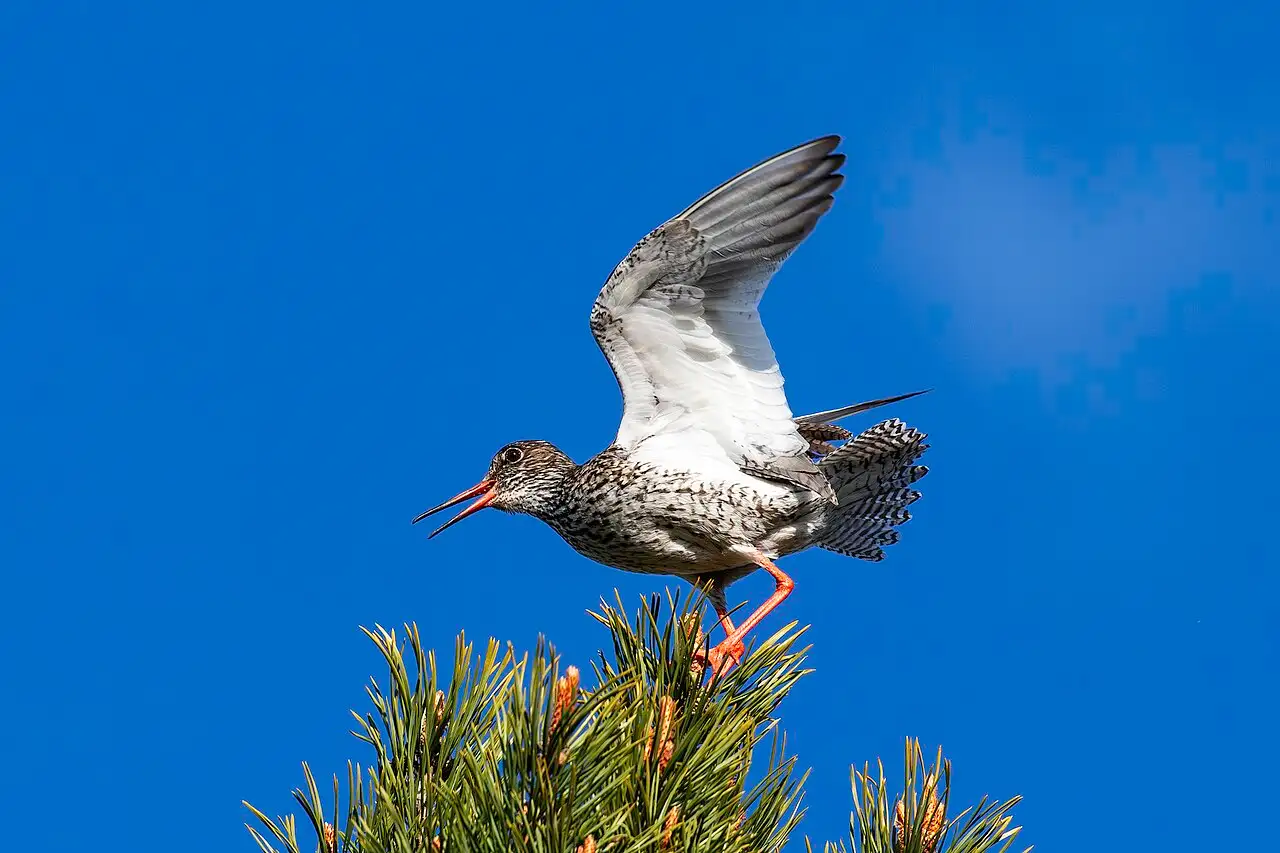
In flight the broad white bar on the trailing edge of the wing is very characteristic, together with a pale wedge on the back.
Flight typeWith a broad white bar on the trailing edge of the wing
It makes use of inland and coastal aquatic habitats, generally with some plant cover, such as the edges of channels, marshes and saltmarshes.
In flight the broad white band on the trailing edge of the wing and the pale wedge on the back are very characteristic; the tail is covered in fine cross bars.
It gives a typical, very melancholy «tiu-tiu», and its alarm call is a repeated «caiip-caiip».
Photo gallery of the Common Redshank
Common Redshank landing on the top of a pine with its bill open and one wing raised, showing the white edgePhoto: Bene Riobó, CC BY-SA 4.0Photo 1 of 4
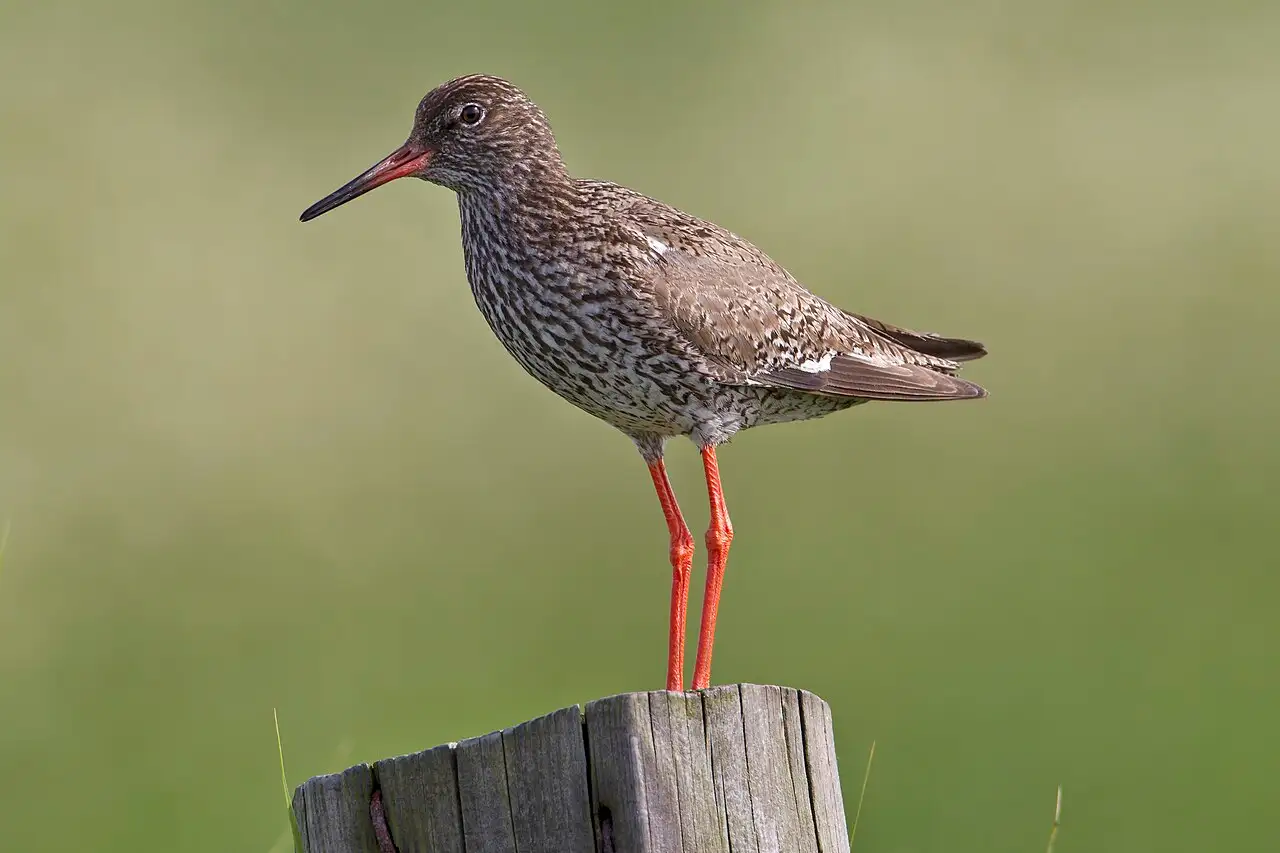
Common Redshank in breeding plumage, upright on a post, with streaked underparts and orange legsPhoto: Andreas Trepte, CC BY-SA 2.5Photo 3 of 4
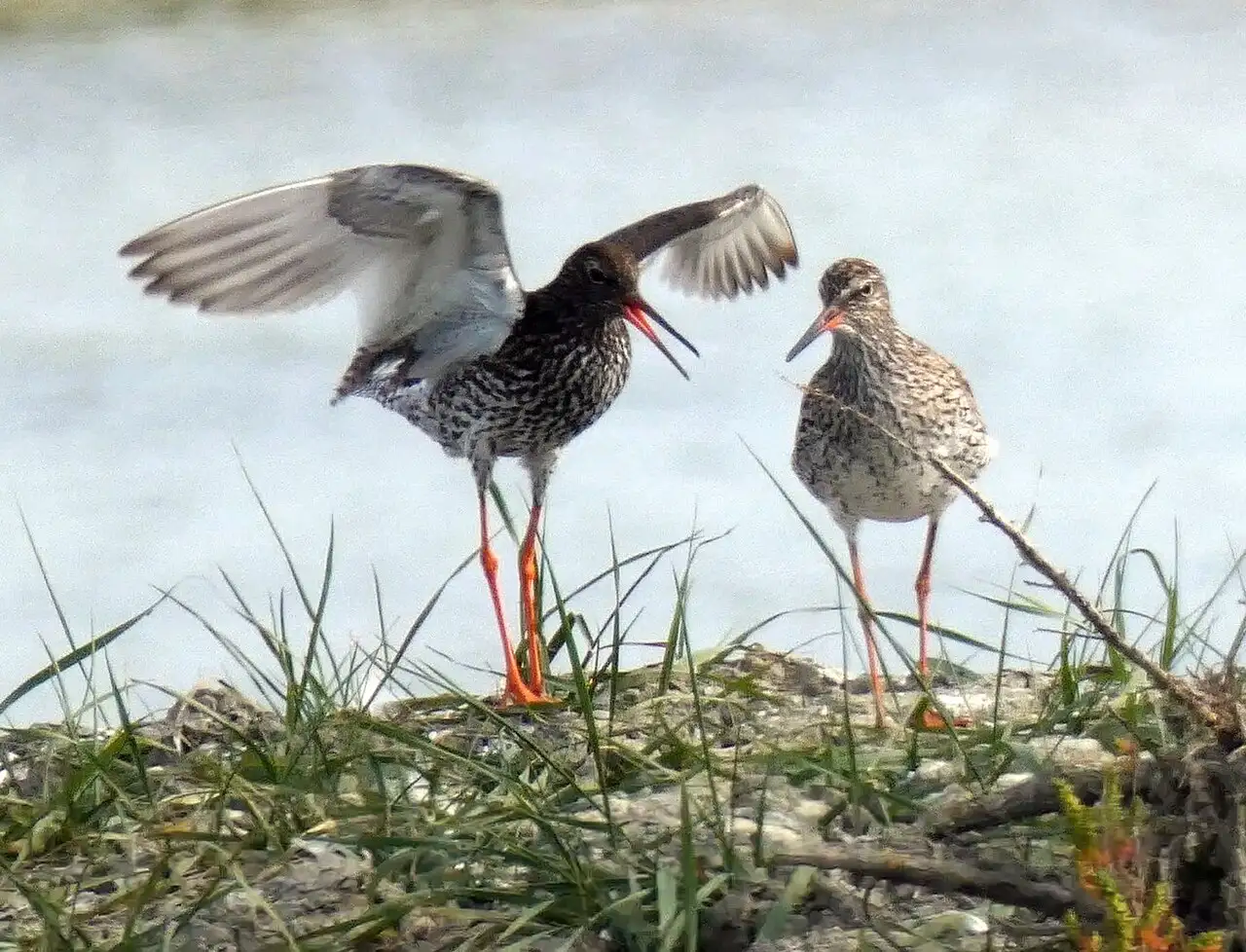
Two Common Redshanks on a grassy islet, one with wings and bill open in full courtship displayPhoto: Dominique Armange, CC BY-SA 4.0Photo 4 of 4
1 / 4
Identification of the Common Redshank
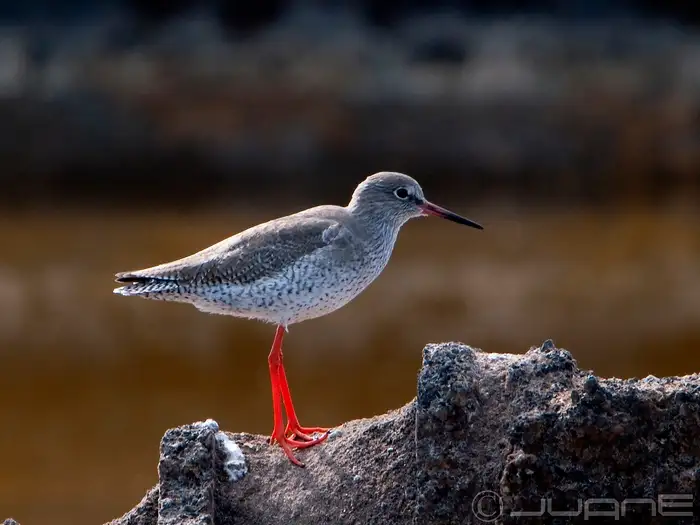
It is a medium-sized wader, with a fairly long bill and greyish-brown tones, with some seasonal variation in plumage. In the breeding season the adult has dark brown feathers with paler streaks, which on some wing coverts show white margins; the underparts are pale, but heavily marked with brown streaks and chevrons. The non-breeding adult has a much more uniform brown back and very diffuse barring on the breast. Both show a deep orange colour on the legs and at the base of the bill, somewhat less bright in the non-breeder. In flight the broad white bar on the trailing edge of the wing and the pale wedge on the back are very characteristic; the tail is covered with fine transverse bars.
Adult in breeding plumage
Dark brown back with paler streaks.
Pale underparts, heavily streaked.
Legs and bill base a deep orange.
Non-breeding adult
Much more uniform brown back and very diffuse barring on the breast.
Legs and bill base somewhat less bright.
Juvenile
Legs and bill base a faded orange.
Upper feathers brown with paler edges; neck and breast buff with dark barring.
Habitat and distribution of the Common Redshank
It breeds in the middle and high latitudes of the Palaearctic, from western Europe to central Asia and from the Himalayas to China. In winter it moves far south in latitude and reaches the equator. Several subspecies are recognised: on the Peninsula and in the Balearics «totanus» breeds, and in winter «britannica» is also present.
In Spain it winters abundantly, but in a scattered way, and is more frequent on the Andalusian Atlantic coast (Bay of Cádiz, Odiel marshes and Doñana) and in the Mediterranean (Ebro delta); it also winters in the Canaries. It breeds in western Andalusia, Castilla y León, Castilla-La Mancha, Catalonia, the Iberian south-east and the Balearic Islands and, occasionally, in Aragón, Galicia and Extremadura.
To breed it uses inland and coastal aquatic habitats, generally with some plant cover, such as canal edges, marshes and salt marshes, and in winter it usually frequents similar places.
It is a mostly resident bird on the Peninsula, with a partly migratory population, and it also hosts winter visitors from all of western Europe. The post-breeding migration takes place during August on the Mediterranean coasts and between August and October on the Cantabrian ones and near the Strait of Gibraltar, while the pre-breeding one occurs between March and May along the whole coast. The passage is also noticeable in suitable areas of the interior.
Areas where it is regularly recorded since 2010Squares of about 25 km where it is recorded regularly (occasional passage records are left out). Data from GBIF.org (159,975 records, retrieved October 2026); outline from Natural Earth.
Etymology of the Common Redshank
According to Wikipedia, Linnaeus described it in 1758 under the name «Scolopax totanus». The genus «Tringa» is the Neo-Latin name that Ulisse Aldrovandi gave the Green Sandpiper in 1603, from the ancient Greek «trungas», a thrush-sized wading bird, white-rumped and with its tail always on the move, mentioned by Aristotle. The epithet «totanus» comes from «tótano», the Italian name for this bird. In other languages it is called «gamba roja vulgar» in Catalan, «bilurico común» in Galician, «bernagorri arrunta» in Basque and «common redshank» in English1.
Population of the Common Redshank
The European breeding population is estimated at between 520,000 and 690,000 individuals (European Red List 2021). In Spain the wintering population is put at about 6,700 birds (Red Book), with marked stability, although with a negative trend in the number of wetlands where it appears each year. The breeding population is estimated at about 5,600 birds and has a more scattered distribution than the wintering one.
The most important threats are the loss and transformation of habitat through agricultural intensification, the ploughing of pastures around the marshes (with particularly intense effects in the Ebro delta and the Guadalquivir marshes) and the abandonment of traditional salt pans. Predation by cats, dogs, rats and gulls and disturbance during breeding also weigh on it.
Nest of the Common Redshank
The nest is set on the ground, among low vegetation, and is lightly lined with grasses.
Courtship and breeding of the Common Redshank
On the Peninsula and in the Balearics it breeds from April to early July. Laying, which on average takes place during the third week of May, consists of three to five smooth, slightly glossy eggs, in cream tones with brown spots, which are incubated for 25 days. The chicks develop in about 25–35 days.
Diet of the Common Redshank
Its diet is quite varied and consists essentially of aquatic invertebrates, such as molluscs, crustaceans and polychaete worms.
Curious facts about the Common Redshank
It is one of the few waders that breed, though in small numbers, in our territory, and recalls that on migration passages it can be considered frequent in many localities1. EURING lists a Redshank ringed in the Netherlands that lived 32 years and 10 months, quite a bit more than AnAge gives (26.9 years).
The Common Redshank in Cabañeros
The habitat pages of this website do not mention it, and we have not found any other published source on it in the Park. GBIF.org records 18 observations of the Common Redshank in Cabañeros and its surroundings.
Where to see the Common Redshank in Cabañeros
In Cabañeros and its surroundings, through the year, on the shores of reservoirs and wetlands with some vegetation.
When
All year; in Spain it is mostly resident, and on migration passages it is frequent.
What time
By day, while it looks for food on the shore.
Where
On the edges of canals, marshes and salt marshes, and in inland wetlands with plant cover.
What to look for
Look for the orange legs and the white wing bar when it flies; listen for its melancholy «tiu-tiu».



 Same family
 Same family
 Same family
 Same family
 Same order
 Same order
 Same order
 Same season in the park






