Wingspan compared with a person with arms outstretched.
Length
55–67 cm
Wingspan
1.3–1.58 m
Weight
1.2 kg
Social life
It breeds in colonies; in many regions it is sedentary and stays all year near them
Lifespan
Record of 19.2 years in the wild according to AnAge; EURING lists a bird ringed in Italy that lived 23 years and 9 months and was shot
Conservation status
LC
NT
VU
EN
CR
EW
EX
Global (IUCN)
Least Concern
Spain
Near Threatened (NT) in the 2021 Red Book of the Birds of Spain, because of the decline of the population; not on the List of Wild Species under Special Protection
When to see it
Resident
Months of the year when it is present
J
F
M
A
M
J
J
A
S
O
N
D
In Iberia
yes
yes
yes
yes
yes
yes
yes
yes
yes
yes
yes
yes
Breeding season
no
no
yes
yes
yes
yes
yes
no
no
no
no
no
Song or voice of the Yellow-legged Gull
The call is a deep «auua», brief or prolonged1. The alarm is an «ag-ag-ag» like a guffaw1. The recording (call) is by Pere Josa and was made in Plana Alta, Castellón, Valencian Community (xeno-canto XC1161338, quality A). It lasts 9 seconds and is a trimmed section of the original, without repeating or lengthening, from which we have removed the bass below 200 Hz, reduced the background noise and adjusted the volume; neither pitch nor speed has been changed.
Across its whole range it shows sedentary or dispersive behaviour, with movements of variable reach: it is sedentary in a good part of the regions it inhabits and, in others, goes up the courses of the great rivers to penetrate inland1. Some Mediterranean colonies, at the end of breeding in summer, make longer journeys towards the French Atlantic coasts.
Flight typeSedentary or dispersive, following coasts and rivers
It is considerably adaptable in choosing habitat: to breed it prefers sea cliffs or nearby islands, but it occupies marshes, salt pans, beaches, coastal or inland wetlands and even buildings.
The call is a deep «auua», brief or prolonged, and the alarm is an «ag-ag-ag» like a guffaw.
It swallows almost anything, from plant matter to fish, small mammals, crustaceans, molluscs or carrion, and frequents rubbish tips and trawler discards.
Photo gallery of the Yellow-legged Gull
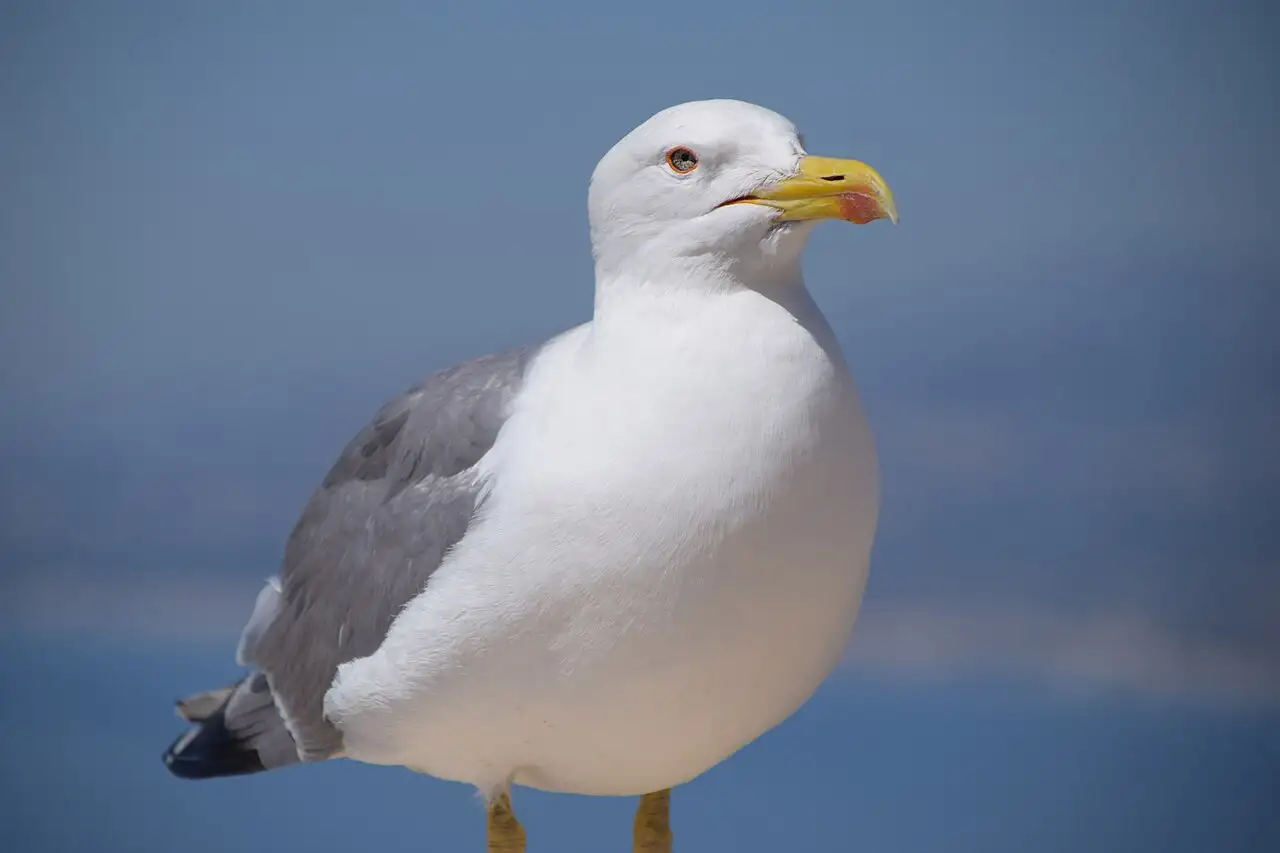
Portrait of an adult Yellow-legged Gull, from the front and tilted, with white head and breast, grey back, yellow bill with a red tip and pale eyePhoto: Alejandro Gómez Vilches, CC BY-SA 4.0Photo 1 of 4
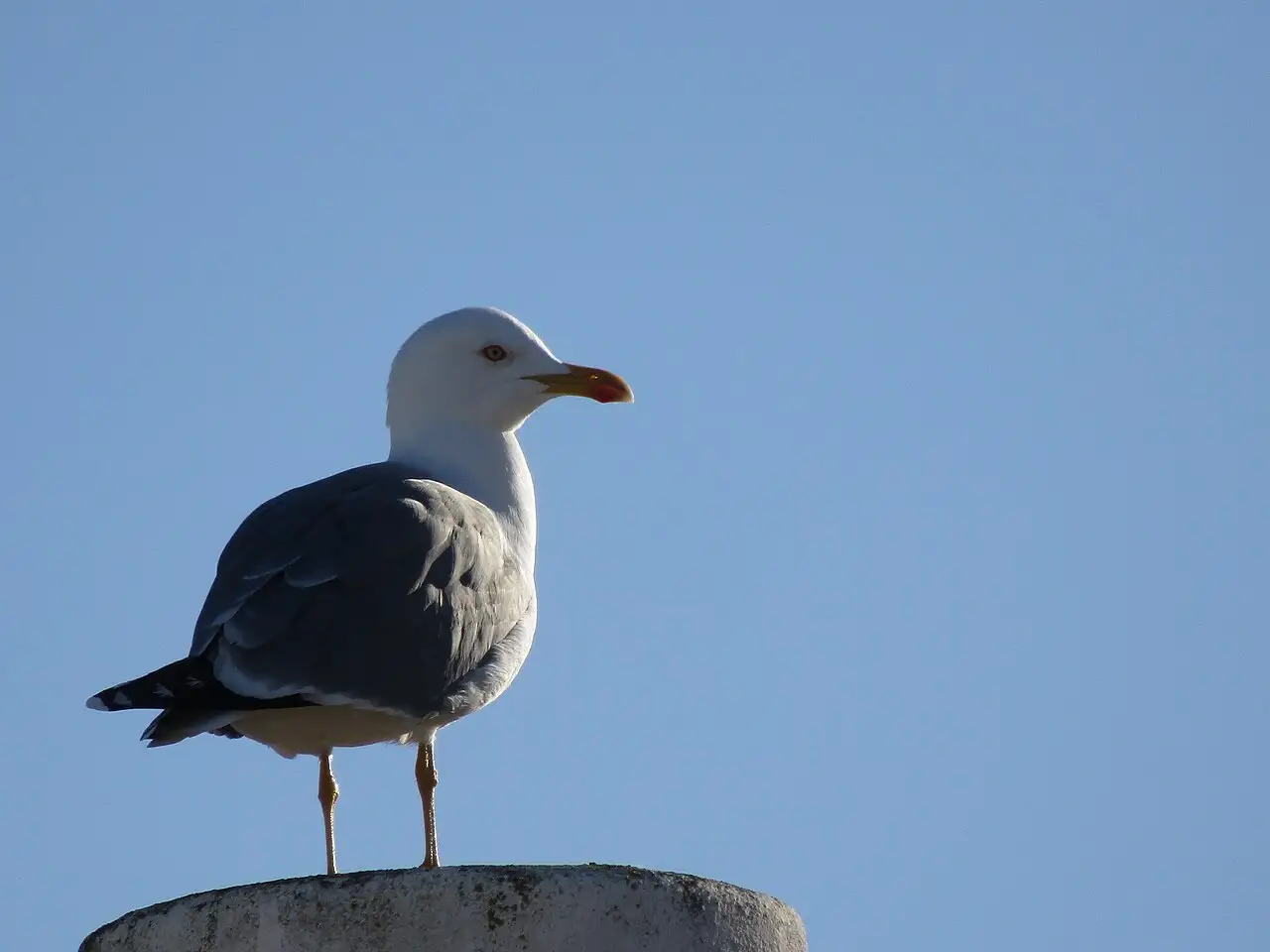
Adult Yellow-legged Gull perched in profile on a pillar against the blue sky, with grey back, yellow legs and the red tip of the billPhoto: Kolforn, CC BY-SA 4.0Photo 2 of 4
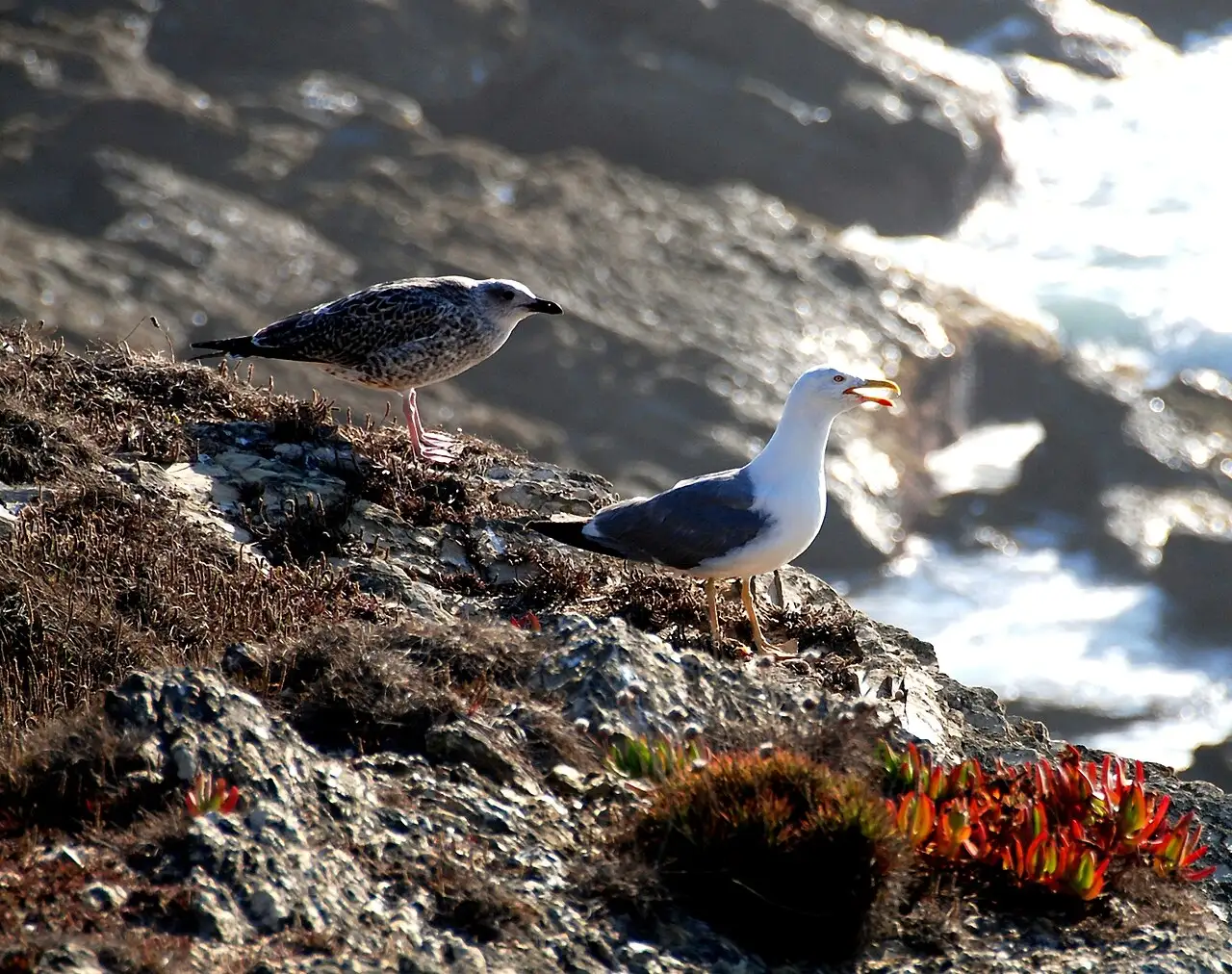
An adult Yellow-legged Gull, with open bill, and a young bird of mottled brown plumage on some coastal rocksPhoto: Alvesgaspar, CC BY 2.5Photo 3 of 4
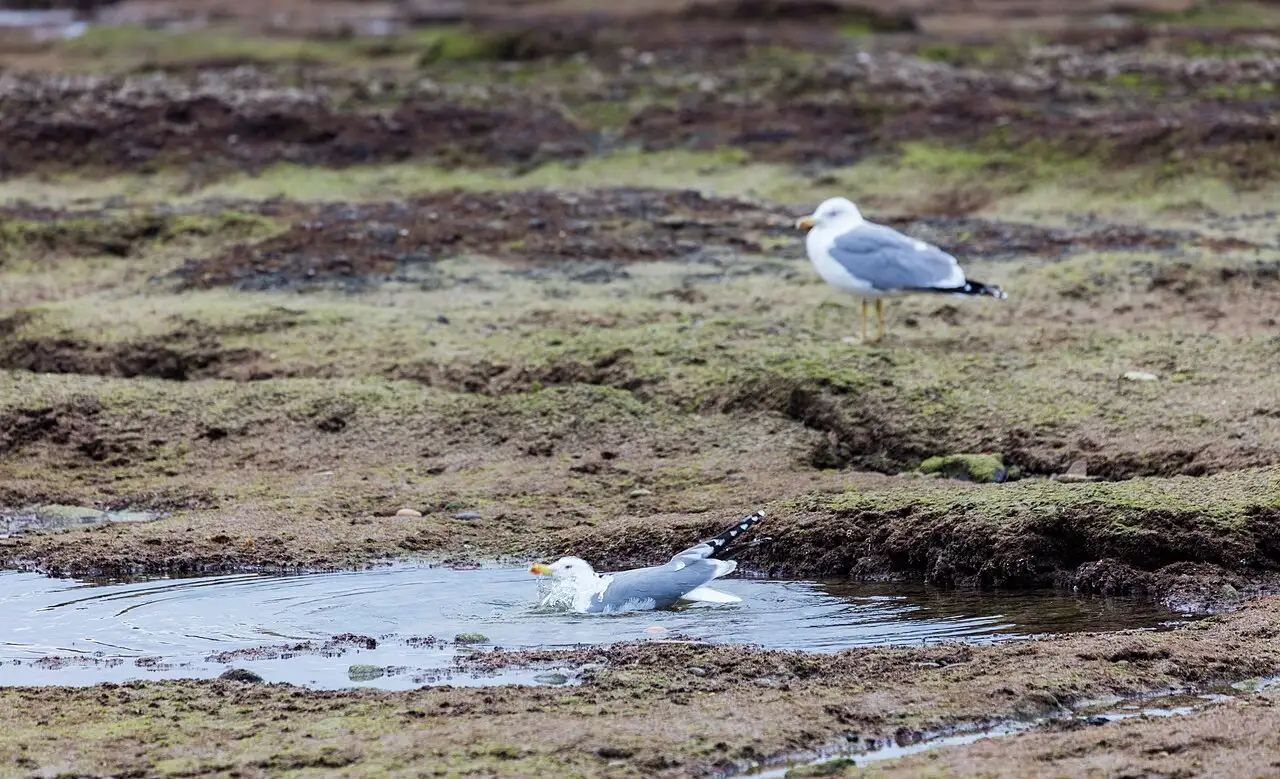
Yellow-legged Gull bathing in a pool of water among algae-covered rocks, with another perched behindPhoto: Diego Delso, CC BY-SA 4.0Photo 4 of 4
1 / 4
Identification of the Yellow-legged Gull
Until very recently this gull was considered a subspecies of the Herring Gull, with which it shows few differences morphologically, some of them barely evident. Among the distinctive features of the Yellow-legged Gull are the yellow colour of the legs, which are pink in the Herring Gull, the more intense tone of the bill, orange-yellow and with the red of the tip more extensive, and the red eye-ring. Otherwise, the back is greyish, slightly darker than in the Herring Gull, and the underparts white. In winter plumage, the Yellow-legged Gull lacks the dark spotting that its relative wears on the head and neck.
Adult
Yellow legs, orange-yellow bill with a more extensive red tip and red eye-ring.
Greyish back and white underparts; no dark spotting on the head in winter.
Habitat and distribution of the Yellow-legged Gull
It is widely distributed across the southern regions of the Palearctic, from the west of the Black Sea to the Mediterranean basin, the Iberian Peninsula, North Africa and Macaronesia. Since the mid-20th century it has colonised the Atlantic coasts of France, the English Channel and central Europe. Four subspecies have been described across its whole range.
In Spain there are three: «michahellis», on the Mediterranean coast, with recent colonisations at Gibraltar and the Gulf of Cádiz; «atlantis», on the Atlantic coasts of the Peninsula and the Canaries, and «lusitanicus», from the Galician coasts to those of the Basque Country1. The species has extended its range from the coasts inland, where it occupies various sites, such as the Ebro reservoir, some wetlands in Ourense and Toledo and river stretches in inland Catalonia.
It is considerably adaptable in choosing habitat. To breed it prefers sea cliffs or islands close to the coast, but in general it occupies a great variety of sites, such as marshes, salt pans, beaches and coastal or inland wetlands. It is very frequent in the vicinity of coastal settlements, where it can breed successfully on human buildings.
It can be considered sedentary in a good part of the regions it inhabits, where it stays all year near its colonies, while in other areas it goes up the courses of the great rivers to penetrate inland.
Areas where it is regularly recorded since 2010Squares of about 25 km where it is recorded regularly (occasional passage records are left out). Data from GBIF.org (772,390 records, retrieved October 2026); outline from Natural Earth.
Etymology of the Yellow-legged Gull
In other languages it is called «gavià de potes grogues» in Catalan, «gaivota de patas amarelas» in Galician, «kaio hankahoria» in Basque and «yellow-legged gull» in English; the Spanish name alludes to the yellow legs1. According to Wikipedia, the scientific name was given by Naumann in 1840, as a subspecies of the Herring Gull. We have not found a source explaining the origin of the genus name, so we do not venture one.
Population of the Yellow-legged Gull
According to the 2021 European Red List of Birds, the population stands at between 830,000 and 1,110,000 birds, with an unknown trend. According to the III Atlas of Breeding Birds in Spain, the population seems to have a clearly negative trend, despite the apparent increase in range in the last national census, of 2007–2009. The decline is attributed mainly to the lower availability of urban organic waste and fishing discards, and to mortality associated with a «paralysing disease» still under study, linked to a new adenovirus1. The pattern varies greatly by region: in Biscay it has fallen by around 68 % in certain areas and in Gipuzkoa it seems stable, in Galicia a significant decline has been observed, and in the Balearics it has fallen by 47 % between 1992 and 2015, 74 % on the island of Dragonera.
Thanks to the use of human resources, the species expanded greatly in range and population throughout the 20th century and at the start of the 21st, but since then the population size has fallen, particularly sharply in the subspecies «lusitanicus», of the Cantabrian-Galician area1.
Nest of the Yellow-legged Gull
The pair makes the nest in the shelter of some scrub or in the cracks of rocks. It is a small hollow in the ground, lined with algae, grass and other plant remains.
Courtship and breeding of the Yellow-legged Gull
The breeding period begins in late March or early April in the Mediterranean and the Canaries, and in the second half of April or early May on the Cantabrian coast; the chicks fly in June and July depending on the region (MNCN). March–July sums up the Spanish variation, not a local date. The clutch is two or three eggs of variable colour, mostly olive and speckled, which the female mainly incubates for 25–33 days. The chicks hatch covered in dense down of very cryptic colouring, which makes their precocious wanderings around the nest easier, and both adults tend them until, at 45 days, they become independent.
Diet of the Yellow-legged Gull
Its great adaptability in choosing habitat extends to feeding: it is able to eat almost anything, from plant matter to fish, including small mammals, crustaceans, molluscs or carrion. It has two very important food sources: rubbish tips, which it frequents in large numbers at any time of year, and the discards of trawlers, with which it is closely associated.
Curious facts about the Yellow-legged Gull
Until very recently it was considered a subspecies of the Herring Gull1. EURING gives 23 years and 9 months to a bird ringed in Italy and shot, quite a bit more than AnAge’s 19.2 years.
The Yellow-legged Gull in Cabañeros
The habitat pages of this website do not mention it, and we have not found any other published source on it in the Park; nor does it appear in the bird list of the «Visitor guide to Cabañeros National Park» (OAPN). GBIF.org records 5 observations of the Yellow-legged Gull in Cabañeros and its surroundings. Wetlands of Toledo are among the inland sites it has colonised1. Of those observations, 2 fall within the Park boundary (according to OpenStreetMap); the rest are from the surroundings.
Where to see the Yellow-legged Gull in Cabañeros
In Cabañeros and its surroundings, occasionally, over reservoirs, ponds and landfills.
When
Present all year in Spain; inland, mainly on reservoirs and rivers.
What time
By day, perched beside the water or looking for food at rubbish tips and behind trawlers.
Where
On cliffs, islands, marshes, salt pans, beaches, wetlands and near settlements.
What to look for
Look for the yellow legs and the red eye-ring; listen for the deep «auua» and the alarm guffaw.



 Same family
 Same family
 Same family
 Same family
 Same order
 Same order
 Same order
 Same order






