Wingspan compared with a person with arms outstretched.
Length
33–38 cm
Wingspan
55–65 cm
Weight
220–377 g
Social life
An elusive, discreet bird that moves among the leaf litter; the female alone does the incubation
Lifespan
Record of 15.5 years in the wild according to AnAge; EURING lists a bird ringed in France that lived 16 years and 4 months and was shot
Conservation status
LC
NT
VU
EN
CR
EW
EX
Global (IUCN)
Least Concern
Spain
Data Deficient (DD) in the 2021 Red Book of the Birds of Spain; not on the List of Wild Species under Special Protection or in the Spanish Catalogue of Threatened Species
When to see it
Resident
Months of the year when it is present
J
F
M
A
M
J
J
A
S
O
N
D
In Iberia
yes
yes
yes
yes
yes
yes
yes
yes
yes
yes
yes
yes
Song or voice of the Eurasian Woodcock
The male, when he performs his display flight over the forest canopy, repeats a hoarse sound that ends in a squeaky call: «uorc uorc uorc schiquit»1. The recording (display flight, with the song and the «roding» sound) is by Xavier Riera and was made in Pallars Sobirà (near Llavorsí), Lleida, Catalonia (xeno-canto XC571507, quality B). It lasts 9 seconds and is a trimmed section of the original, without repeating or lengthening, from which we have removed the bass below 200 Hz, reduced the background noise and adjusted the volume; neither pitch nor speed has been changed.
It is a bird reluctant to fly, since it trusts fully in the virtues of its mimetic dress, but, if it feels a threat nearby, it sets off in an erratic, zigzag flight low among the trees. In flight it looks heavier than other related species and is characterised by its rounded wings and massive silhouette.
Flight typeReluctant to fly; if it feels threatened, an erratic, zigzag flight low among the trees
It is a bird reluctant to fly, since it trusts fully in the virtues of its camouflaged plumage.
If it senses a threat nearby, it sets off on an erratic, zigzag flight low among the trees; in flight it is heavier than other nearby species, with rounded wings and a massive silhouette.
The male performs his display flight over the forest canopy repeating a hoarse sound that ends in a grating call: «uorc uorc uorc schiquit».
Photo gallery of the Eurasian Woodcock
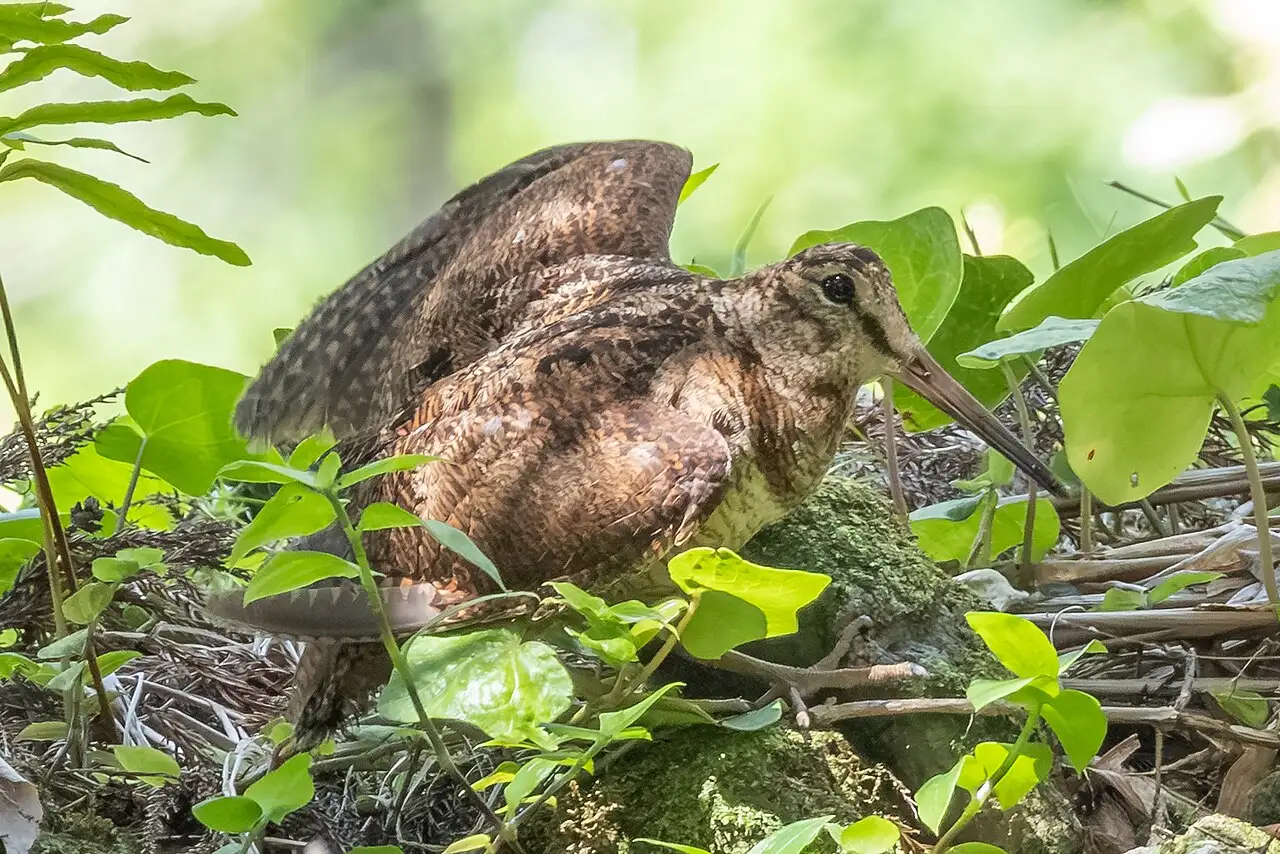
Eurasian Woodcock perched among green leaves and moss, with a wing raised, cryptic brown and reddish plumage and the long billPhoto: william_stephens, CC BY 4.0Photo 1 of 6
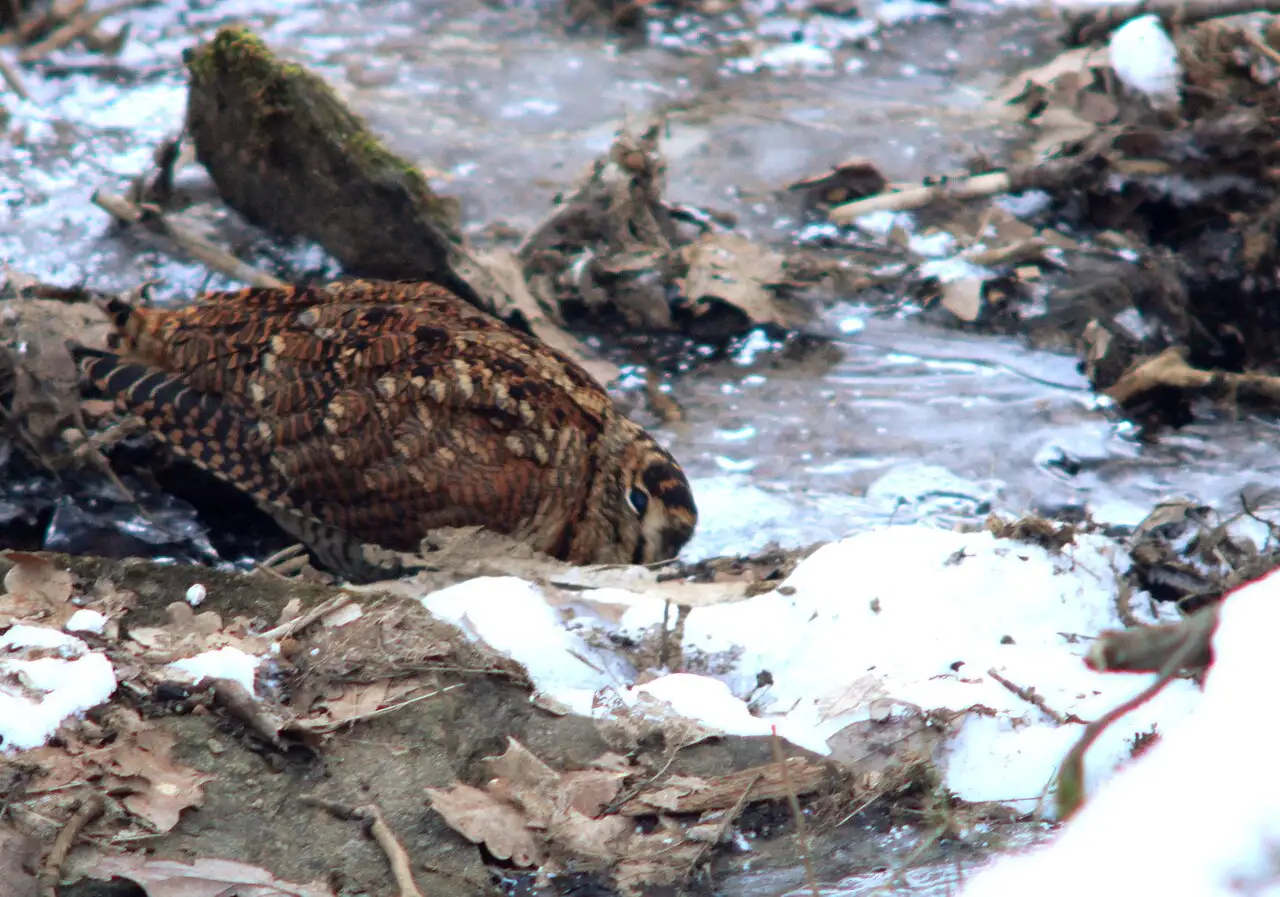
Eurasian Woodcock almost invisible among the leaf litter of a stream with patches of snow, with mottled reddish-brown backPhoto: Blondinrikard Fröberg, CC BY 2.0Photo 2 of 6
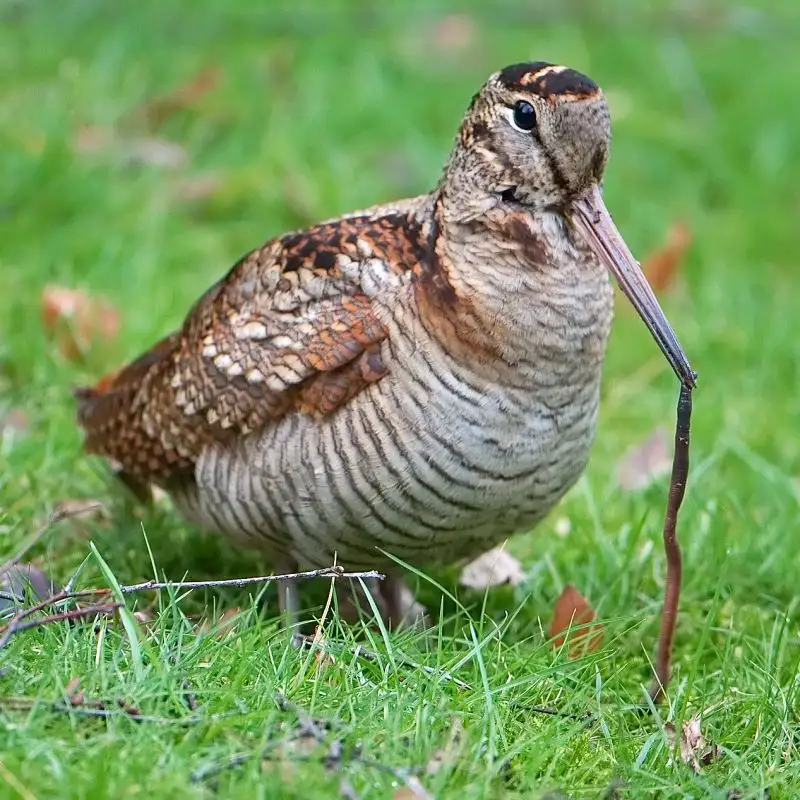
Eurasian Woodcock on the grass with a worm held by the tip of its long bill, with streaked head and creamy breast with dark streaksPhoto: Ronald Slabke, CC BY-SA 3.0Photo 3 of 6
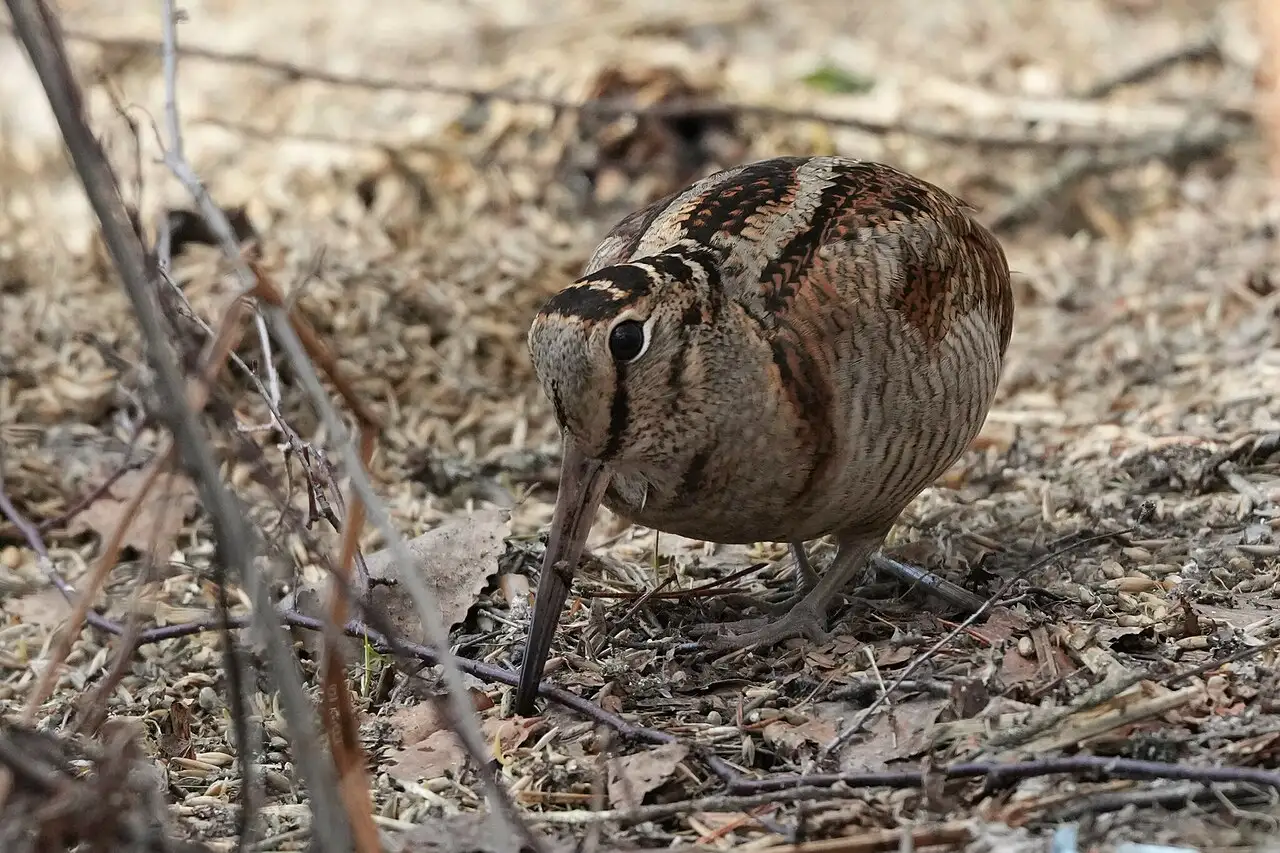
Eurasian Woodcock probing the forest floor leaf litter with its bill, with the dark bands on the head and the big eyes set far backPhoto: lindalotjonen, CC BY 4.0Photo 4 of 6
Eurasian Woodcock motionless among leaf litter and branches, with cryptic plumage and big eye (Castilla-La Mancha)Photo: antoterryn, CC BY 4.0Photo 5 of 6
Eurasian Woodcock walking beside a stream among dry leaves, with its long bill pointing down (Madrid)Photo: Natalia Rojas-Estevez, CC BY-NC 4.0Photo 6 of 6
1 / 6
Identification of the Eurasian Woodcock
The Eurasian Woodcock is a relatively large wader, with a long bill, fairly short legs and big dark eyes, set far back and up on the head. It has an extremely cryptic plumage, dominated by brown and reddish tones, which on the back becomes remarkably complex, with a mottled pattern of barring, speckles and patches of different tones. The underparts are creamy, with abundant darker transverse streaks. Adults and young birds are practically identical. In flight it looks heavier than other related species and is characterised by its rounded wings and massive silhouette.
Adults and young birds
Long bill, short legs and big dark eyes set back and up.
Mottled brown and reddish back; creamy underparts with dark transverse streaks.
Habitat and distribution of the Eurasian Woodcock
It breeds in continental Europe, the British Isles, Macaronesia, a strip across central Asia to its far east and some areas by the Black Sea. No subspecies have been described.
As a breeder it is restricted on the Peninsula to the damp northern strip, from Galicia to Catalonia, as well as to certain mountain woods of the Iberian System and the Central System; it also breeds on Gran Canaria, Tenerife, La Gomera, El Hierro and La Palma, and possible breeding has been cited in the Balearics1. In winter its distribution is wider: it occupies suitable places across almost the whole Peninsula and the Balearics, although it is more abundant in the north and the western half, and always tied to cool, damp woodland environments.
It is a wader with absolutely woodland habits all year round. It nests in deciduous, coniferous and mixed woods, preferring damp Eurosiberian-type woods, such as birch woods, oak woods and beech woods, over more Mediterranean ones, such as Pyrenean oak woods or pine woods. In winter it is much less demanding and occupies a great diversity of wooded areas, from montane oak woods to lowland holm oak woods, including pine woods, river groves of some extent and even isolated copses lost on the Meseta; at this stage pastures and livestock meadows near woods are important feeding areas.
It is resident on the Peninsula and in the Canaries, and on the Peninsula it makes seasonal altitudinal movements in search of better environmental conditions. Most of the birds on passage and in winter come from central and western Europe: the autumn passage occurs from the second week of November, with a peak at the end of that month and another in the second half of December, and the spring migration begins in the second half of January and reaches its peak in the second half of February.
Areas where it is regularly recorded since 2010Squares of about 25 km where it is recorded regularly (occasional passage records are left out). Data from GBIF.org (10,205 records, retrieved October 2026); outline from Natural Earth.
Etymology of the Eurasian Woodcock
It is also known as «becada» in many places; in other languages it is «becada eurasiàtica» in Catalan, «arcea europea» in Galician, «oilagorra» in Basque and «Eurasian woodcock» in English1. We have not found a source explaining the origin of the name «chocha perdiz» or of the scientific name, so we do not venture one.
Population of the Eurasian Woodcock
The 2021 European Red List of Birds estimates the European population at between 9 and 13 million individuals. The Spanish breeding population has been put at 3,600–4,000 pairs, although its recent trend is unknown1. The wintering one of the Peninsula and Balearics is put at about 640,000–680,000 birds, a number that varies quite a lot from one season to another (Red Book)1.
The main problems cited are the alteration and destruction of the woodland environments where it breeds, the shrinking extent of the livestock meadows, essential for its winter feeding, and, since it is a much-coveted quarry, overhunting. To conserve it, measures are proposed linked to the conservation of the woodland areas where it spends its whole life, monitoring of populations and study of the impact of hunting.
Nest of the Eurasian Woodcock
The nest is set directly on the ground, hidden in leaf litter among low vegetation, at the base of a tree or sheltered by a bramble. It consists of a soft hollow about 12–15 centimetres across and 2–5 deep, lined with dry leaves and grasses, pine needles and some feathers.
Courtship and breeding of the Eurasian Woodcock
With the arrival of spring and in close relation to ambient temperature, males begin their display flights, which they accompany with frequent calls to attract females. The clutch normally consists of four eggs (between two and five), beige or pinkish brown with brown spots, which the female alone incubates for 21–24 days. The chicks are covered in soft, cryptic down and, soon after hatching, already move easily across the forest floor; they develop fully in about 15–20 days. The MNCN documents display flights from March to July in the general context and, on the Cantabrian coast, from April to June; that does not prove it breeds in Cabañeros, where it is mainly a winter visitor.
Diet of the Eurasian Woodcock
The diet is basically made up of invertebrates of all kinds, which it almost always gets in the cool, humus-rich soil of the forest, or in the damp grasslands and peat bogs it frequents. To catch its prey it uses a long bill with, at its tip, a multitude of small sensitive pores and numerous nerve endings, which it uses as a delicate probe to detect and catch worms, earthworms, larvae and small molluscs in the mud and leaf litter. Occasionally it takes some food of plant origin.
Curious facts about the Eurasian Woodcock
Its extraordinary adaptations stand out: the cryptic plumage, a long, sensitive bill and a very wide field of vision, thanks to the position of the eyes in the skull1. The longevity given by EURING, 16 years and 4 months in a bird shot in France, is somewhat greater than AnAge’s 15.5 years.
The Eurasian Woodcock in Cabañeros
The habitat pages of this website do not mention it, but it does appear in the bird list of the «Visitor guide to Cabañeros National Park» (OAPN, page 104). That list vouches for its presence in the Park, not for breeding there. GBIF.org records 3 observations of the Eurasian Woodcock in Cabañeros and its surroundings. In winter it occupies suitable places across almost the whole Peninsula, from montane oak woods to lowland holm oak woods, river groves and copses lost on the Meseta1. Only one of those observations falls within the Park boundary (according to OpenStreetMap); the rest are from the surroundings.
Where to see the Eurasian Woodcock in Cabañeros
In Cabañeros and its surroundings, occasionally in winter, in woods and groves with humus and nearby damp grassland.
When
In Spain all year; in winter many birds from northern and central Europe join (autumn passage from November).
What time
Discreet, among the leaf litter of the forest floor; in spring the male performs his display flight over the forest canopy.
Where
In damp woods, oak woods, holm oak woods, pine woods and river groves, and in nearby grassland in winter.
What to look for
Look for the long bill and the cryptic plumage; listen for the «uorc uorc uorc schiquit» of the display flight.



 Same family
 Same family
 Same family
 Same family
 Same order
 Same order
 Same order
 Same season in the park





