Scarce but regular in many wetlands, above all on passage
Lifespan
Record of 12.9 years in the wild according to AnAge; EURING lists a bird ringed in Finland that lived 15 years and 11 months
Conservation status
LC
NT
VU
EN
CR
EW
EX
Global (IUCN)
Least Concern
Spain
Data Deficient (DD) as a winter visitor and migrant in the Red Book of the Birds of Spain; on the List of Wild Species under Special Protection, but not in the Spanish Catalogue of Threatened Species
When to see it
Passage migrant
Months of the year when it is present
J
F
M
A
M
J
J
A
S
O
N
D
In Iberia
no
no
yes
yes
yes
no
yes
yes
yes
yes
no
no
Song or voice of Temminck’s Stint
When it takes flight, it gives a dry, ringing trill, «tirr tirr tirr»1. The recording (flight call) is by Daniel Lopez Velasco and was made at San Andres – reservoir – (near Gijón), Asturias, Principality of Asturias (xeno-canto XC474312, quality B). It lasts 8.7 seconds and is a trimmed section of the original, without repeating or lengthening, from which we have removed the bass below 300 Hz, reduced the background noise and adjusted the volume; neither pitch nor speed has been changed.
When it takes flight it gives a dry, ringing trill. The pre-breeding migration through the Peninsula takes place between mid-March and late May, and the autumn one from mid-July to late October; the birds crossing belong to the general flow from central and western Europe1.
Flight typeIt rises with a dry, ringing trill
It is a small wader with a fairly elongated body, with the throat and breast very dark in all plumages, like a bib.
When it takes off it gives a dry, ringing trill, «tirr tirr tirr».
It feeds mainly on insects and their larvae, above all beetles and flies, in inland areas, and on worms, crustaceans and small molluscs on the coast.
Photo gallery of Temminck’s Stint
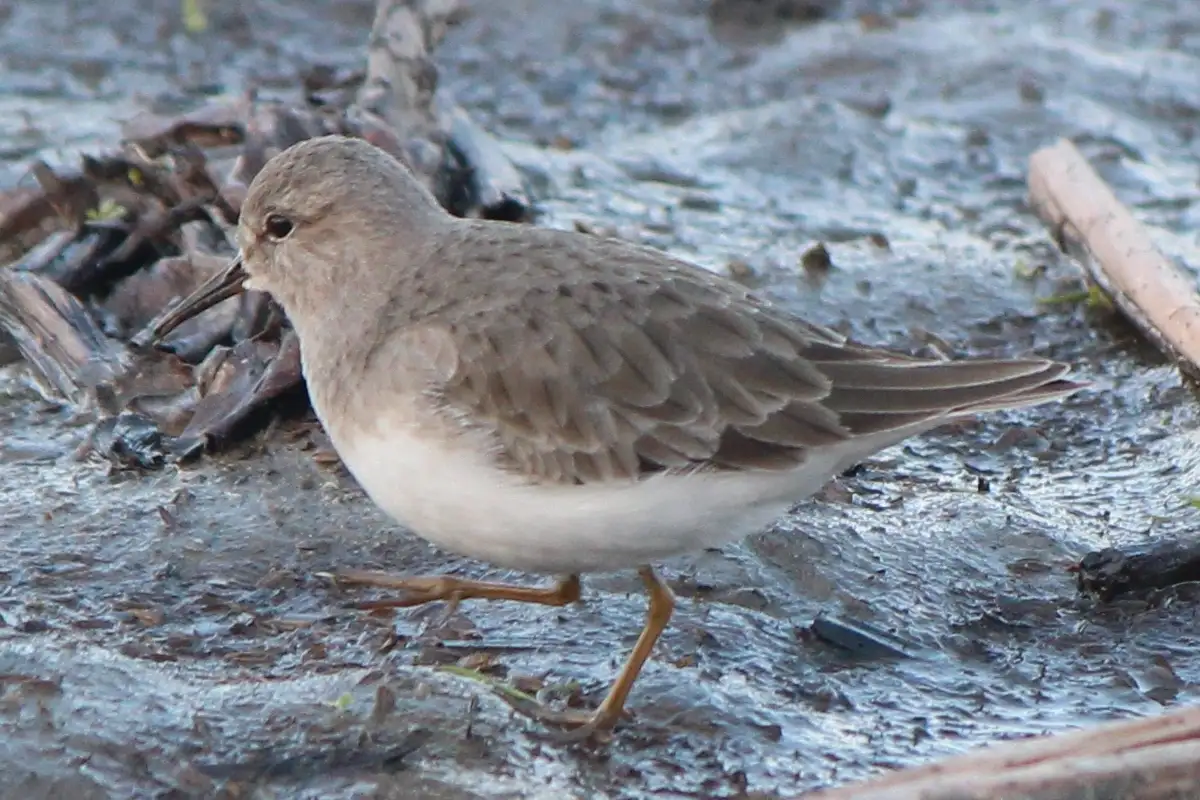
Temminck's Stint in profile, walking on mud, with uniform grey-brown plumage and pale breast, thin bill and greenish legsPhoto: Alpsdake, CC BY-SA 3.0Photo 1 of 5
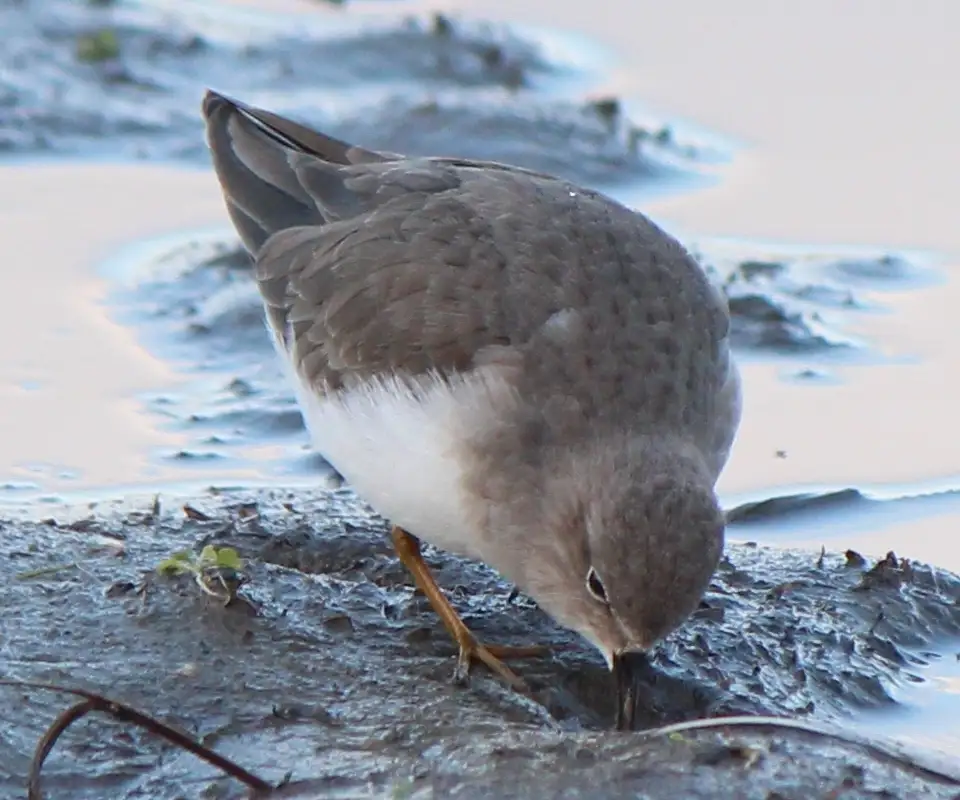
Temminck's Stint crouched pecking the mud of a shore, with grey-brown back, white belly and greenish-orange legsPhoto: Alpsdake, CC BY-SA 3.0Photo 2 of 5
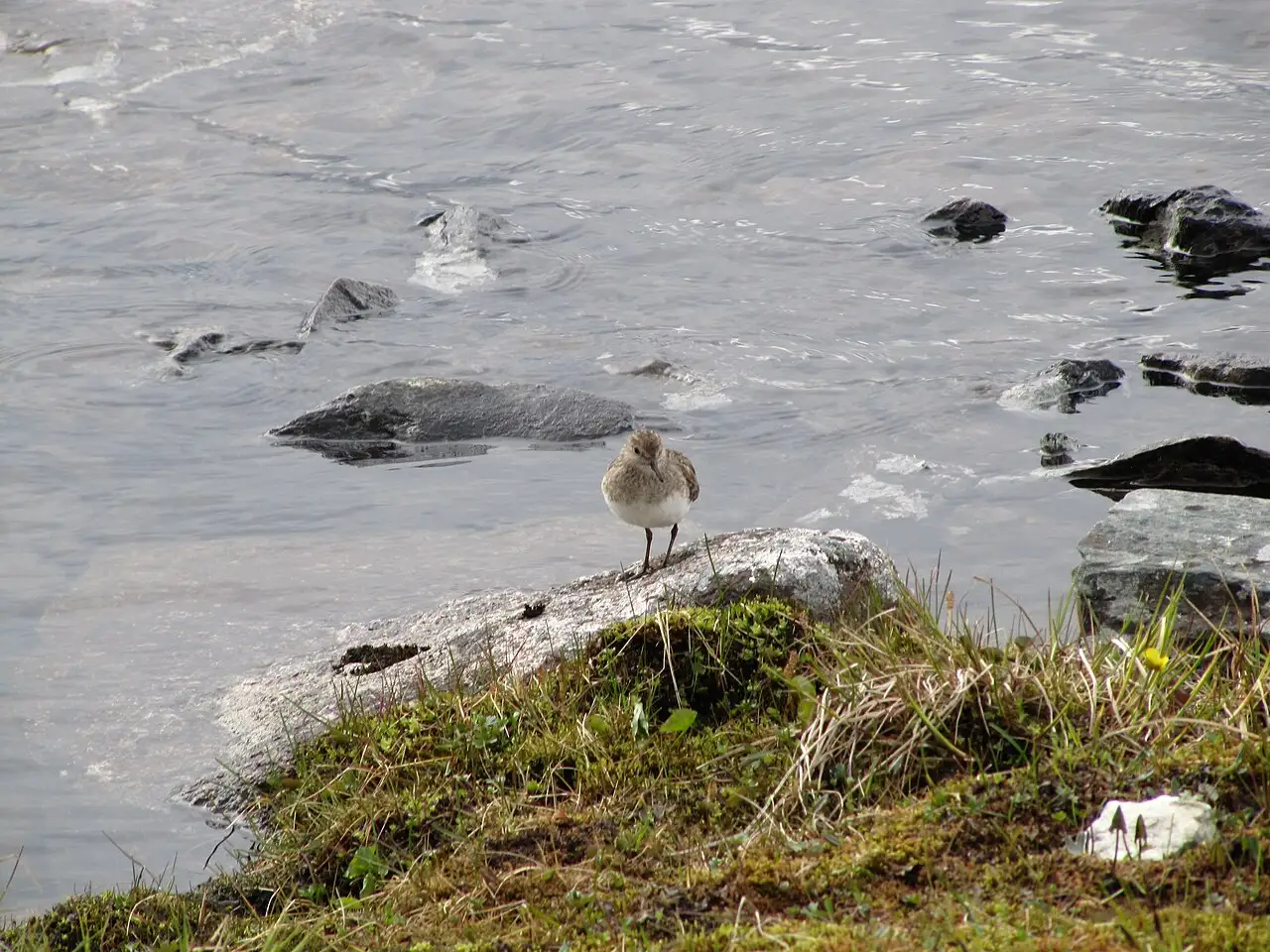
Temminck's Stint perched on a mossy rock beside the water of a stream, small and brownPhoto: Mlkniemi, CC0Photo 3 of 5
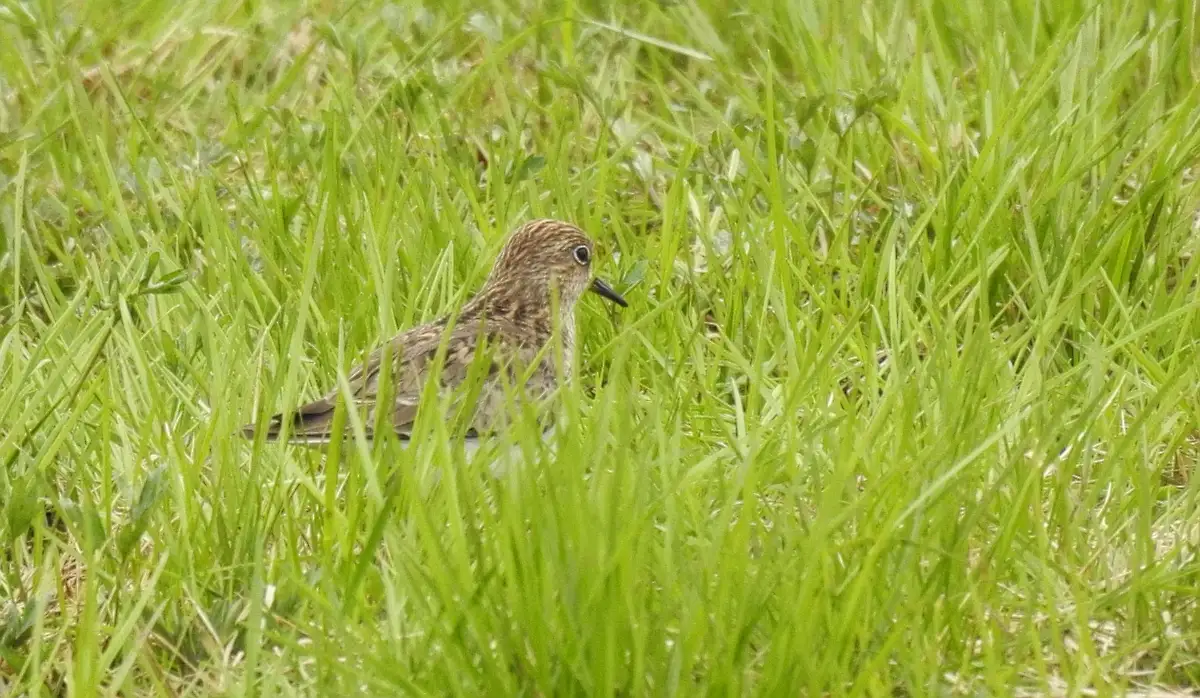
Temminck's Stint in profile among tall green grass, with streaked brown plumage that camouflages itPhoto: Åsa Berndtsson, CC BY 2.0Photo 4 of 5
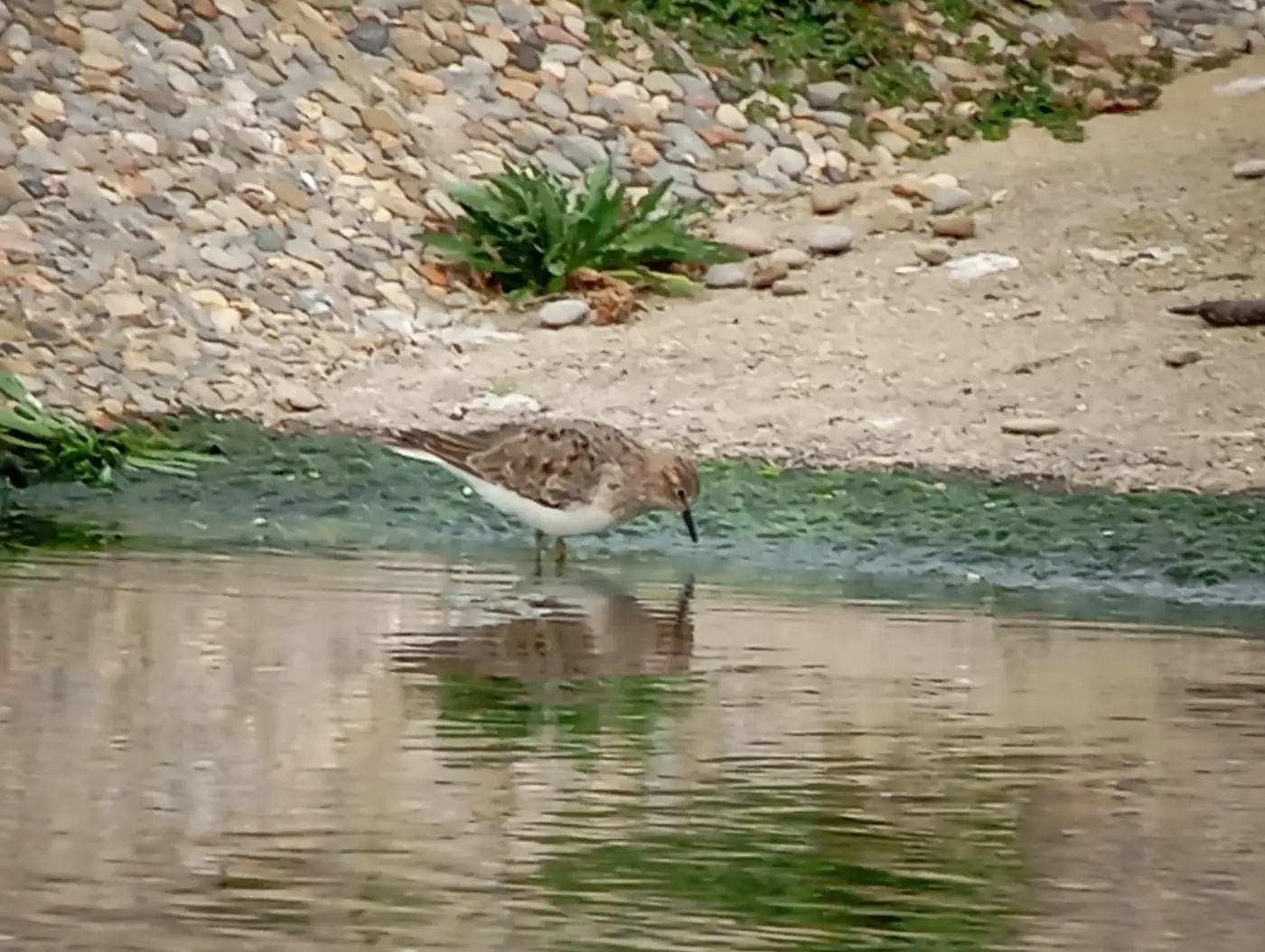
Temminck's Stint pecking at the water's edge, with a shore of gravel and green algae in the background (Catalonia)Photo: Joan Ventura, CC BY-NC 4.0Photo 5 of 5
1 / 5
Identification of Temminck’s Stint
Temminck’s Stint is a small wader with a fairly elongated body, with a rather small bill and legs shorter than the height of the body. In all plumages, the very dark throat and breast define a sort of bib. It has greenish legs and a black bill. The adult in breeding plumage usually shows a mix on the upperparts of new feathers, dark with light chestnut edges, and others from the winter plumage, grey, with the shaft barely marked; the sides of the neck and breast are buff, with finer, darker streaks, and the underparts white. The non-breeder wears a uniform, not very pale grey, with the breast greyer than in breeding plumage and without streaks, while the young bird has a lightly streaked breast and grey upper feathers, with dark shaft and subterminal band and creamy edges.
Breeding adult
Back with new dark feathers with chestnut edges and others winter grey.
Sides of the neck and breast buff, with fine streaks; underparts white.
Non-breeding and young bird
Non-breeder: uniform, not very pale grey, with greyish breast and no streaks.
Young bird: breast lightly streaked and grey upper feathers with creamy edges.
Habitat and distribution of Temminck’s Stint
It breeds in areas close to the Arctic, both in northern Europe and in Asia. It winters in tropical Africa, southern Asia and, in smaller numbers, in the Mediterranean basin. It is a monotypic species.
In Spain the population is very small and fluctuates from one year to the next, with cores in Extremadura, Cádiz, Murcia–Alicante and the Ebro delta1. In spring it is a scarce but habitual species, and its passage is recorded in all autonomous communities except Galicia, Madrid and the Canaries.
It is an Arctic breeder, although it avoids extreme environments and highly exposed coasts, and occupies fjords, deltas, inlets, rivers and even more inland areas. It occupies the widest variety of habitats of all the stints and, unlike the rest of the group, during breeding it settles in environments similar to those it occupies on passage and in winter.
Breeders leave the breeding areas in July, and the young stay until August, to return around the second half of May.
Areas where it is regularly recorded since 2010Squares of about 25 km where it is recorded regularly (occasional passage records are left out). Data from GBIF.org (8,580 records, retrieved October 2026); outline from Natural Earth.
Etymology of Temminck’s Stint
According to Wikipedia, the species name, common and scientific, recalls the Dutch naturalist Coenraad Jacob Temminck. In other languages it is called «territ de Temminck» in Catalan, «pilro de Temminck» in Galician, «Temminck txirria» in Basque and «Temminck’s stint» in English1.
Population of Temminck’s Stint
In the 2021 European Red List of Birds, the European breeding population is estimated at between 166,000 and 248,000 mature individuals, with an unknown trend. Because of the scarcity of records, its current population in Spain cannot be approximated1. The main threats cited are human disturbance in the breeding areas, illegal hunting and the transformation and destruction of passage and wintering habitat, such as drainage of wetlands and agricultural transformations1.
Nest of Temminck’s Stint
In the breeding areas, the nest is on the ground, among low vegetation or in clearings, and is a shallow cup lined with stems and leaves.
Courtship and breeding of Temminck’s Stint
In the breeding areas, laying, at the end of May or early June, is of up to four greyish-green to beige eggs, well speckled with brown. Incubation lasts 21 or 22 days and the chicks develop in about 15–18 days.
Diet of Temminck’s Stint
It feeds essentially on insects and their larvae, above all beetles and flies, in inland areas, and on worms, crustaceans and small molluscs at coastal sites.
Curious facts about Temminck’s Stint
It resembles the Common Sandpiper in its elongated shape and dark bib1. Its longevity record at EURING, 15 years and 11 months, in a Finnish bird identified by its marks in the field, exceeds AnAge’s 12.9 years.
Temminck’s Stint in Cabañeros
The habitat pages of this website do not mention it, and we have not found any other published source on it in the Park; nor does it appear in the bird list of the «Visitor guide to Cabañeros National Park» (OAPN). GBIF.org records 5 observations of Temminck’s Stint in Cabañeros and its surroundings. Extremadura is among the cores of the species, and its passage has been detected in many wetlands, above all those further inland1. None of those observations falls within the Park boundary (according to OpenStreetMap): all are from the surroundings.
Where to see Temminck’s Stint in Cabañeros
In Cabañeros and its surroundings, only on passage, on muddy shores of ponds and reservoirs.
When
On passage: between mid-March and late May, and from mid-July to late October.
What time
By day, walking on the mud and pecking, alone or in small groups.
Where
On muddy shores of wetlands, ponds and reservoirs inland; on the coast, in protected sites.
What to look for
Look for the dark bib and the greenish legs; listen for the «tirr tirr tirr» trill on taking off.



 Same family
 Same family
 Same family
 Same family
 Same order
 Same order
 Same order
 Same order






