During incubation the male feeds the female, and feeds the chicks in their first week of life before sharing the task with her
Lifespan
Record of 18 years and 1 month in the wild according to EURING (a bird ringed in Germany); AnAge gives 17.5 years
Conservation status
LC
NT
VU
EN
CR
EW
EX
Global (IUCN)
Least Concern
Spain
Least Concern (LC) as a breeder in the Red List of Birds of Spain; on the List of Wild Species under Special Protection, but not in the Spanish Catalogue of Threatened Species
When to see it
Resident
Months of the year when it is present
J
F
M
A
M
J
J
A
S
O
N
D
In Iberia
yes
yes
yes
yes
yes
yes
yes
yes
yes
yes
yes
yes
Breeding season
no
no
no
yes
yes
yes
yes
yes
no
no
no
no
Song or voice of the Eurasian Bullfinch
The male’s spring repertoire is not very melodious, a simple combination of long, vibrant notes. Males also give a simple call, a high, deep «buiiii», and females try to imitate them, although their songs are shorter and weaker and are sometimes accompanied by a click, «chat». The recording is from the Netherlands and captures its calls, spaced out; we have filtered and normalised it.
CallEurasian Bullfinch
0:00 / 0:19
10 kHz5
The sonogram draws the sound: time runs from left to right, and the higher a trace sits, the higher the note.Recording by Jochem Verweij, xeno-canto XC738832 (Diever, Drenthe, Países Bajos) (CC BY-SA 4.0).
Flight of the Eurasian Bullfinch
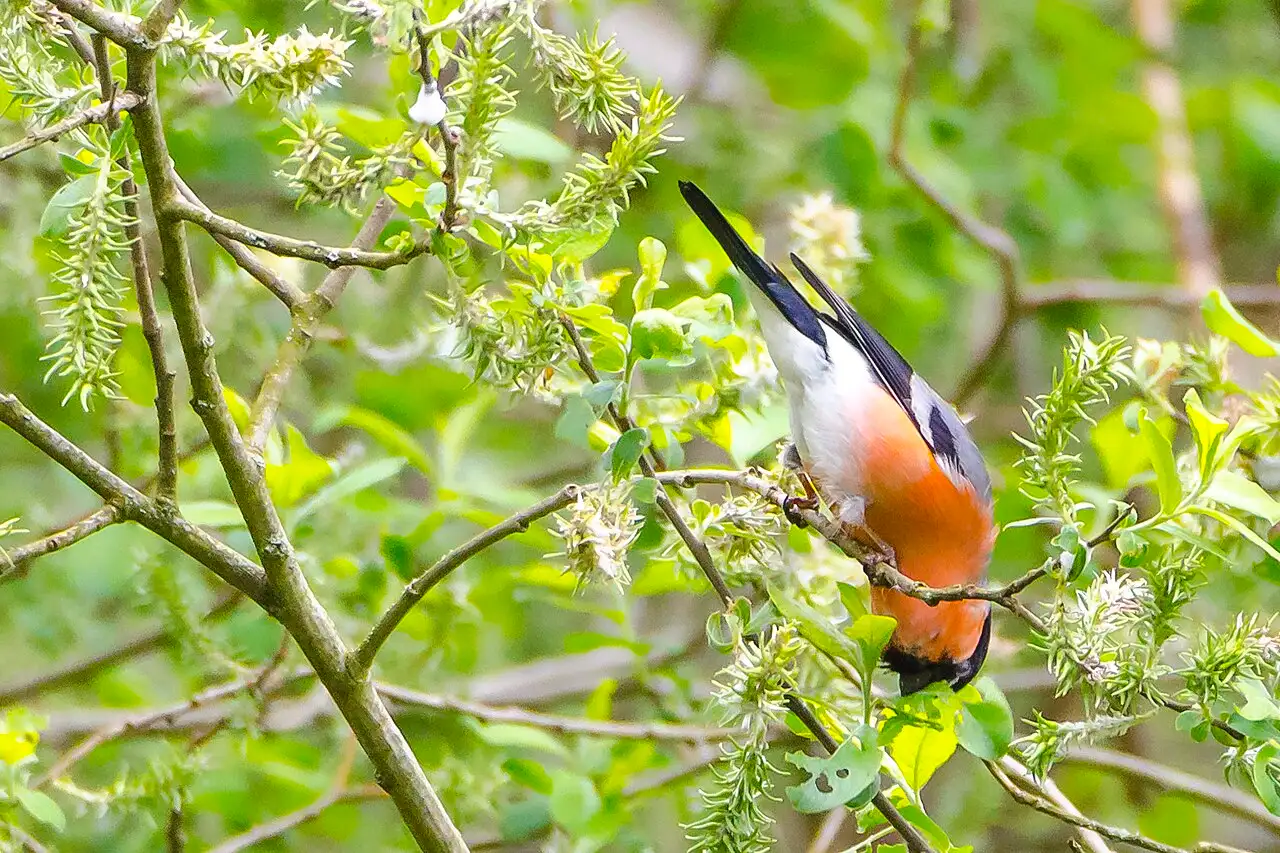
In flight the white rump and the ash-grey back stand out, in contrast with the broad black wings with a conspicuous white bar.
Flight typeWith a white rump and the white wing bar
A woodland bird, it settles in cool, damp environments, in deciduous broadleaf woods and in farmland with tree and shrub hedgerows.
In flight the white rump and the ash-grey back stand out, and the black wings show a conspicuous white band.
Omnivorous, in winter and early spring it is an avid consumer of buds of fruit trees and wild deciduous trees.
Photo gallery of the Eurasian Bullfinch
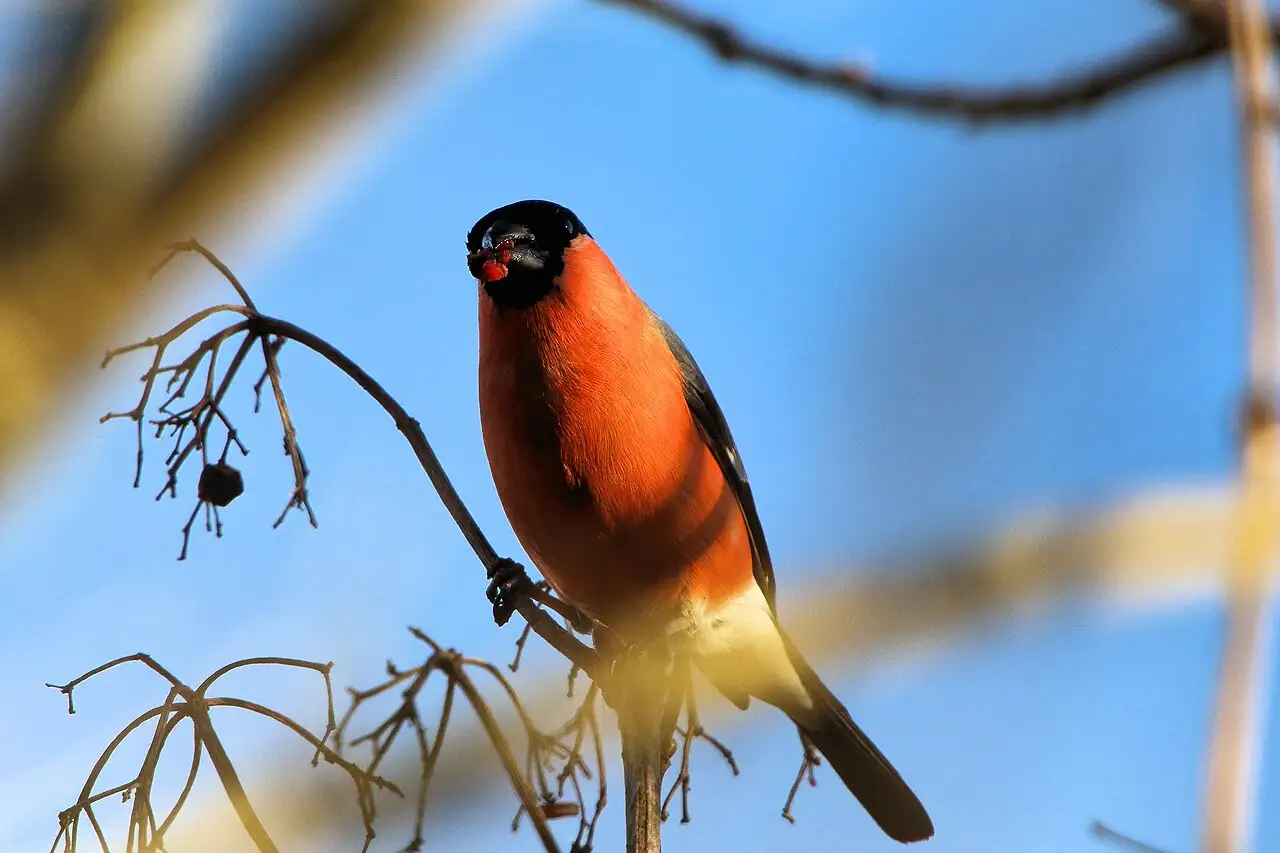
Male Eurasian Bullfinch seen from the front on a branch, with black cap, deep red breast and cheeks and a short black billPhoto: Airwolfhound from Hertfordshire, UK, CC BY-SA 2.0Photo 1 of 4
Male Eurasian Bullfinch hanging from a flowering willow branch, eating buds, with red breast and white rumpPhoto: Sébastien FAILLON, CC BY 2.0Photo 2 of 4
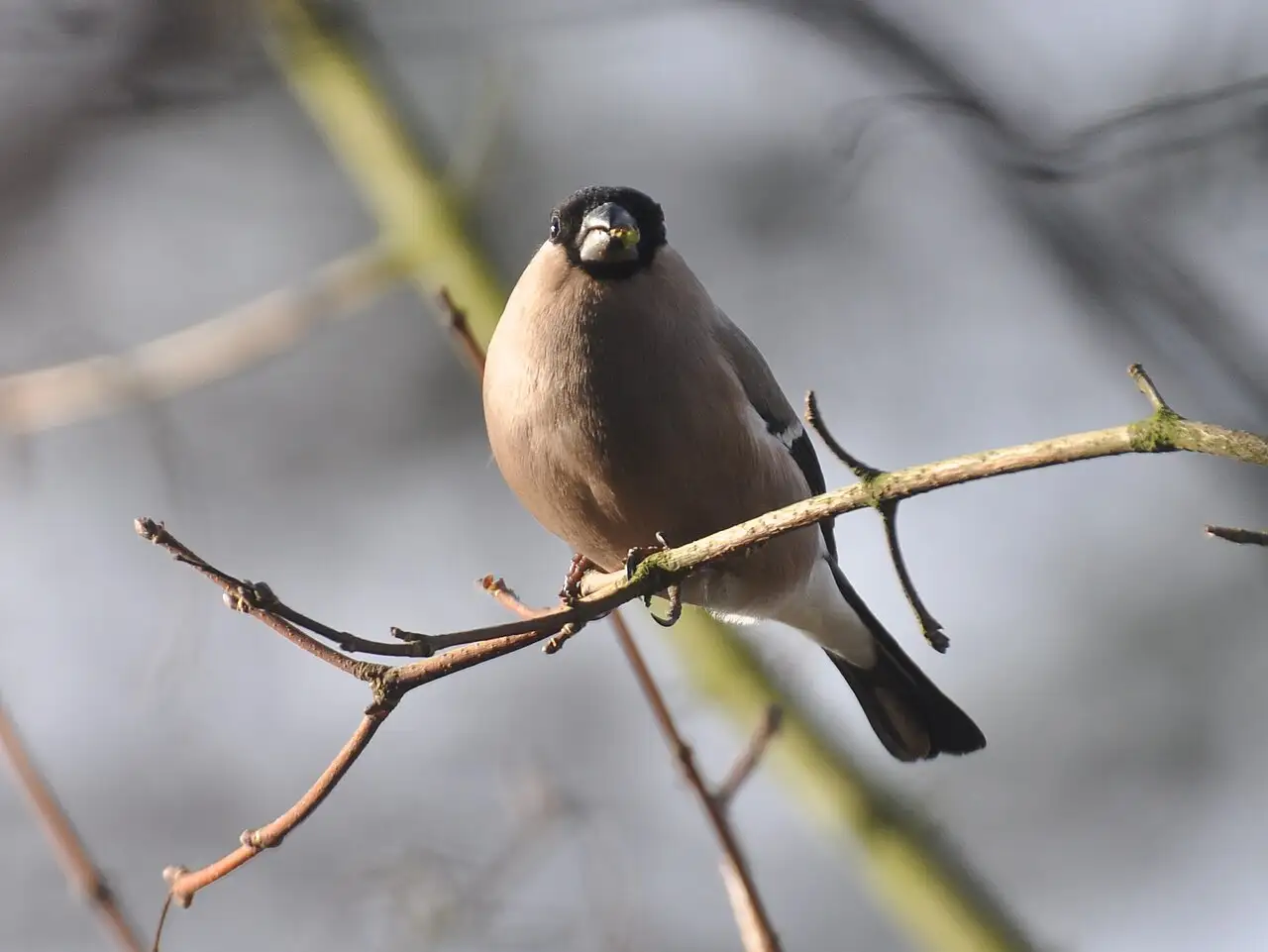
Female Eurasian Bullfinch from the front on a thin branch, with pinkish-brown breast, black cap and short billPhoto: Aiwok, CC BY-SA 3.0Photo 3 of 4
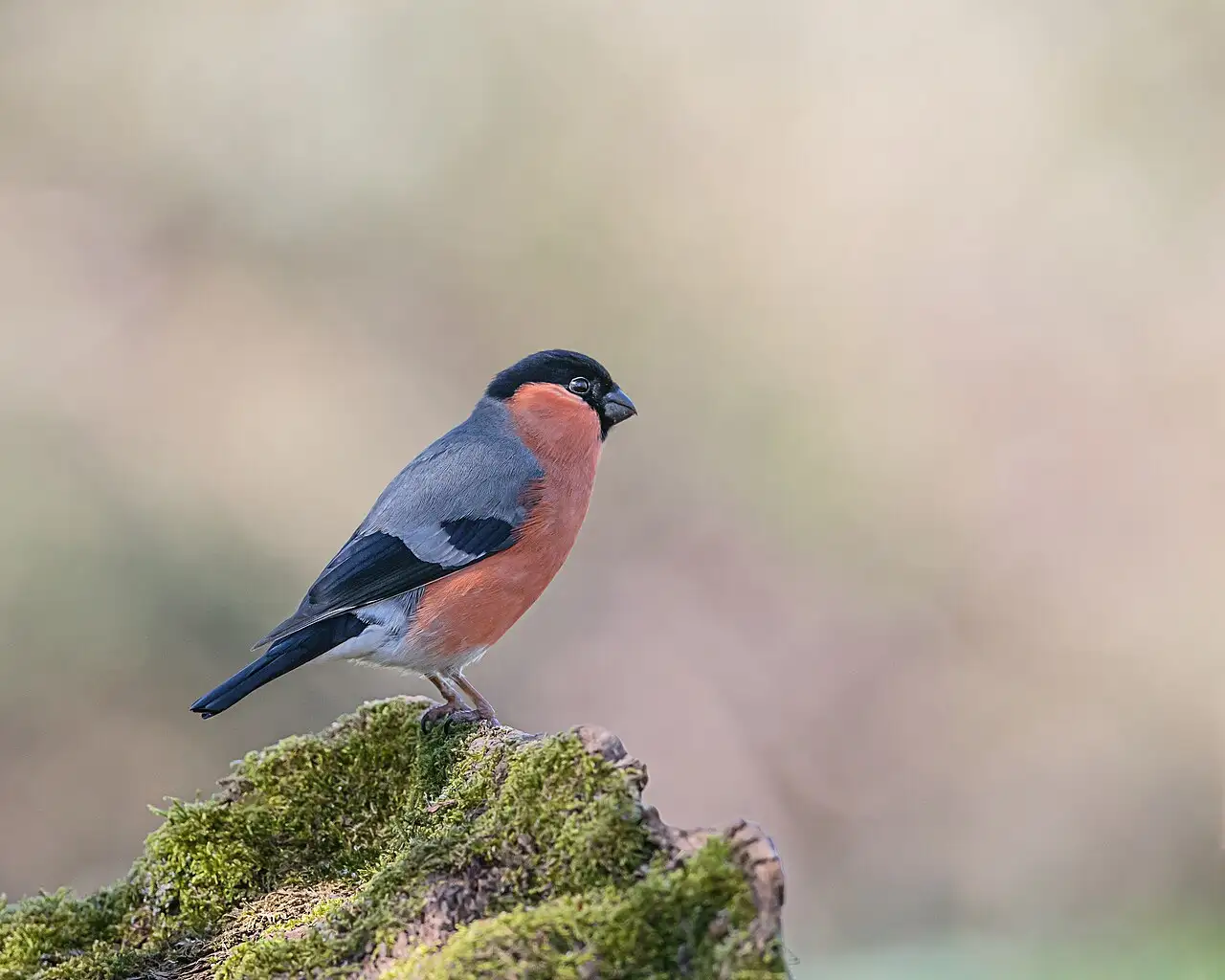
The male Eurasian Bullfinch is unmistakable for the deep red of the breast and cheeks, and the female is also recognised without difficulty, although with duller colouring. Both sexes have a broad black cap that covers the whole top of the head and projects towards the equally black, short bill. The tail and wings are also black, the latter broad and with a conspicuous white bar. In contrast with them, in flight the white rump and the ash-grey back stand out.
Male
Breast and cheeks a deep red.
Black cap, short black bill, ash-grey back.
Female
Duller colouring, brown where the male is red.
Same black cap and black wings with a white bar.
Habitat and distribution of the Eurasian Bullfinch
Nine subspecies are currently recognised, living in the temperate woods of Europe and Asia, from Great Britain to Japan. Around the Mediterranean it is found mainly in the mountains, and in winter extends its range southwards. The populations of Spain belong to the subspecies «iberiae».
In Spain it breeds across practically the whole northern third of the peninsula: Galicia, both slopes of the Cantabrian range, the northern Iberian System (Sierra de la Demanda, Cameros, Neila, Urbión) and the whole Pyrenees and Pre-Pyrenees, from Navarre to the western half of Girona, including Montseny. In winter the peninsular populations are reinforced by birds from more northerly latitudes and it is recorded occasionally across the whole Peninsula, except arid or treeless territories.
When breeding it settles in cool, damp environments, oceanic and continental, and is frequent in deciduous broadleaf woods and in the taiga. In Spain it prefers beech woods, oak woods, Pyrenean oak woods, birch woods, mixed woods, Scots pine woods, fir woods, coastal holm oak woods and riverside formations, both dense and open and altered, and appears in mosaic farmland landscapes, with tree and shrub hedges around hay meadows, orchards and fruit plantations.
It is a partial migrant. The northernmost populations of Russia migrate south in winter, and the rest of the European ones descend in altitude and also migrate to the Mediterranean basin. In Spain it is seen in autumn and winter both at low elevations in the northern half and in the southern half of the peninsula, and in autumn and early spring a moderate passage of birds crossing the Mediterranean is recorded.
Areas where it is regularly recorded since 2010Squares of about 25 km where it is recorded regularly (occasional passage records are left out). Data from GBIF.org (41,508 records, retrieved October 2026); outline from Natural Earth.
Etymology of the Eurasian Bullfinch
According to Wikipedia, Linnaeus described it in 1758 under the name «Loxia pyrrhula», and Brisson introduced the genus «Pyrrhula» in 1760, a Latin word that comes from the Greek «pyrrhós», «flame-coloured», and which designated a worm-eating bird mentioned by Aristotle. In other languages it is called «pinsà borroner» in Catalan, «cardeal europeo» in Galician, «gailupa» in Basque and «Eurasian bullfinch» in English1.
Population of the Eurasian Bullfinch
In the 2021 European Red List of Birds the European breeding population is estimated at between 9,790,000 and 17,300,000 mature individuals, with a stable trend. The 2014–2018 census gives Spain a population of between 353,874 and 528,884 individuals, of which 71 % are spread across four communities: Galicia, Castilla y León, Catalonia and Asturias. The SACRE programme data show a moderate decline, which could be explained by the loss of birds in alpine areas and at the edges of its northern Mediterranean range, perhaps a first sign of the northward range shift that climate change scenarios predict.
Although its distribution is relatively wide, it is a scarce species dependent on wooded environments, above all deciduous. It disappears when farmland or beech and oak woods are replaced by pine and eucalyptus plantations, and it is harmed by the «cleaning» of woods, because it depends on shrubs to nest.
Nest of the Eurasian Bullfinch
In wooded environments it chooses shrubs, above all evergreen ones, to place the nest. The female builds it with very fine twigs, wisps of moss and lichens, and inside she places fine roots and hair more carefully.
Courtship and breeding of the Eurasian Bullfinch
It usually breeds twice a year and, in favourable conditions, can even raise three broods. Breeding begins between April and May and ends during summer, although there are records of breeding in autumn. The clutch is made up of four to six eggs, white or pale blue, with dark spots at the broader end. During incubation, which lasts 12–14 days, the male feeds the female, and also feeds the chicks in their first week of life, then sharing the task with her for a couple more weeks.
Diet of the Eurasian Bullfinch
It is an omnivorous bird. It usually eats seeds of fleshy fruits, but also nuts, including ash samaras. In summer it completes its diet with insects, and in winter and early spring it is an avid consumer of buds of fruit trees (plums, peaches, apples) and of wild deciduous trees (alders, birches and ashes).
Curious facts about the Eurasian Bullfinch
It is a habitual inhabitant of the Cantabrian coast, relatively frequent in the Atlantic montane woods of the northern third of the peninsula, and of striking colouring: red on the breast and cheeks of males, brown in females1. EURING lists a Bullfinch ringed in Germany that lived 18 years and 1 month, almost the same as AnAge gives (17.5 years).
The Eurasian Bullfinch in Cabañeros
The habitat pages of this website do not mention it, and we have not found any other published source on it in the Park. In autumn and winter it is also seen at low elevations in the southern half of the peninsula1. GBIF.org records 11 observations of the Eurasian Bullfinch in Cabañeros and its surroundings.
Where to see the Eurasian Bullfinch in Cabañeros
In Cabañeros and its surroundings, in autumn and winter, in riverside woods and wooded areas with shrubs.
When
All year in the north; in the south it is seen in autumn and winter, when birds arrive from more northerly latitudes.
What time
By day; in winter it looks for buds on trees and shrubs.
Where
In cool, damp woods, hedges and riverside formations.
What to look for
Look for the black cap, the male's red breast and the white rump in flight; listen for its high «buiiii».



 Same family
 Same family
 Same family
 Same family
 Same order
 Same order
 Same order
 Same order






