Wingspan compared with a person with arms outstretched.
Length
37–41 cm
Wingspan
68–80 cm
Weight
280–370 g
Social life
Gregarious and noisy; it organises into flocks, although it may nest alone
Lifespan
Record of 19 years and 6 months in the wild according to EURING (a bird ringed in Spain and later recaptured); AnAge gives 20.3 years in captivity
Conservation status
LC
NT
VU
EN
CR
EW
EX
Global (IUCN)
Least Concern
Spain
Near Threatened (NT) as a breeder in the Red List of Birds of Spain; on the List of Wild Species under Special Protection, but not in the Spanish Catalogue of Threatened Species
When to see it
Resident
Months of the year when it is present
J
F
M
A
M
J
J
A
S
O
N
D
In Iberia
yes
yes
yes
yes
yes
yes
yes
yes
yes
yes
yes
yes
Song or voice of the Red-billed Chough
When travelling in flocks, this corvid often gives a characteristic penetrating, metallic call, which could be transcribed as «quíak». The rest of its vocalisations are mostly derivations of that sound, such as «chiia» or «cheew». The recording is of a flight call, in Galicia; we have only filtered it and raised the volume.
Flight callRed-billed Chough
0:00 / 0:27
10 kHz5
The sonogram draws the sound: time runs from left to right, and the higher a trace sits, the higher the note.Recording by Amadeo A. Pombo Eirín, xeno-canto XC951809 (Ortegal, A Coruña, Galicia) (CC BY-SA 4.0).
Flight of the Red-billed Chough
Gregarious and noisy birds, they organise into huge flocks that fly over cliffs and gullies while performing acrobatic manoeuvres and dives. Their silhouette in flight is characteristic: broad, deeply fingered wings and a short, squarish tail.
Flight typeAcrobatic, in flocks over cliffs and gullies, with dives
Gregarious and boisterous, it organises into multitudinous flocks that fly over cuts and gullies, performing acrobatic manoeuvres and dives.
In flight it has a characteristic silhouette, with broad, deeply fingered wings and a short, square tail.
When it travels in flocks, it often gives a penetrating, metallic call, which could be written as «quíak».
Photo gallery of the Red-billed Chough
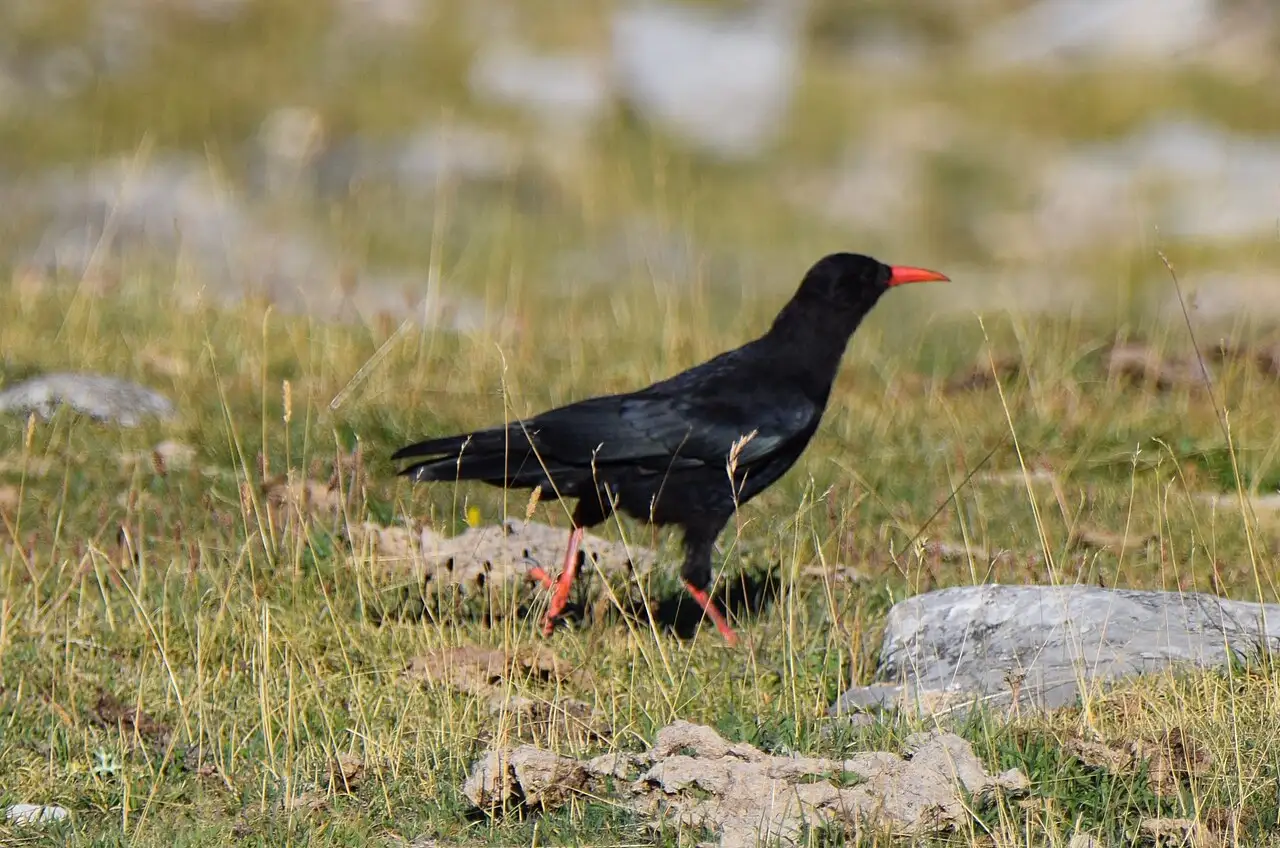
Red-billed Chough walking across a mountain pasture in the Picos de Europa, with black plumage and red bill and legsPhoto: Domènec Leal Martínez, CC BY-SA 4.0Photo 1 of 4
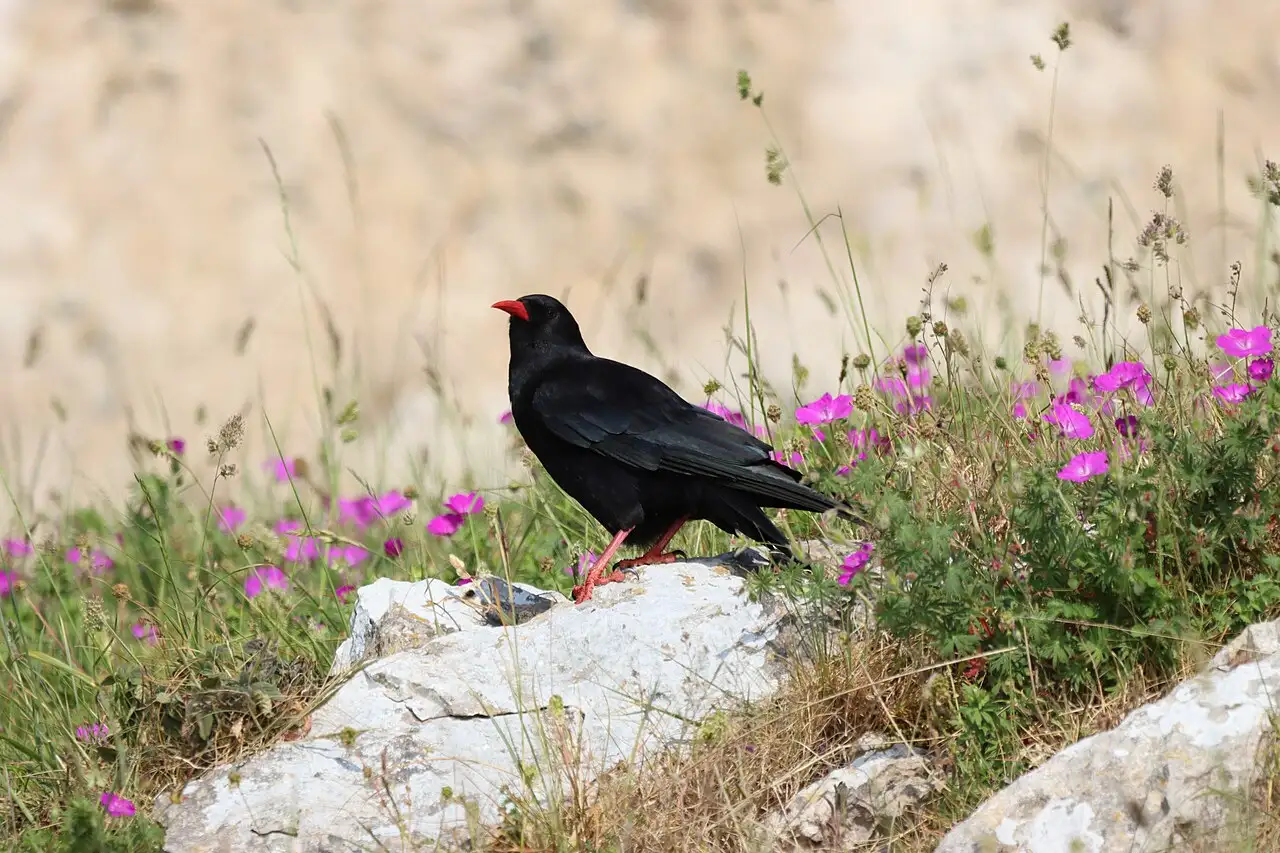
Red-billed Chough perched on a white rock among pink flowers, with red bill and legsPhoto: Timfy23, CC BY-SA 4.0Photo 3 of 4
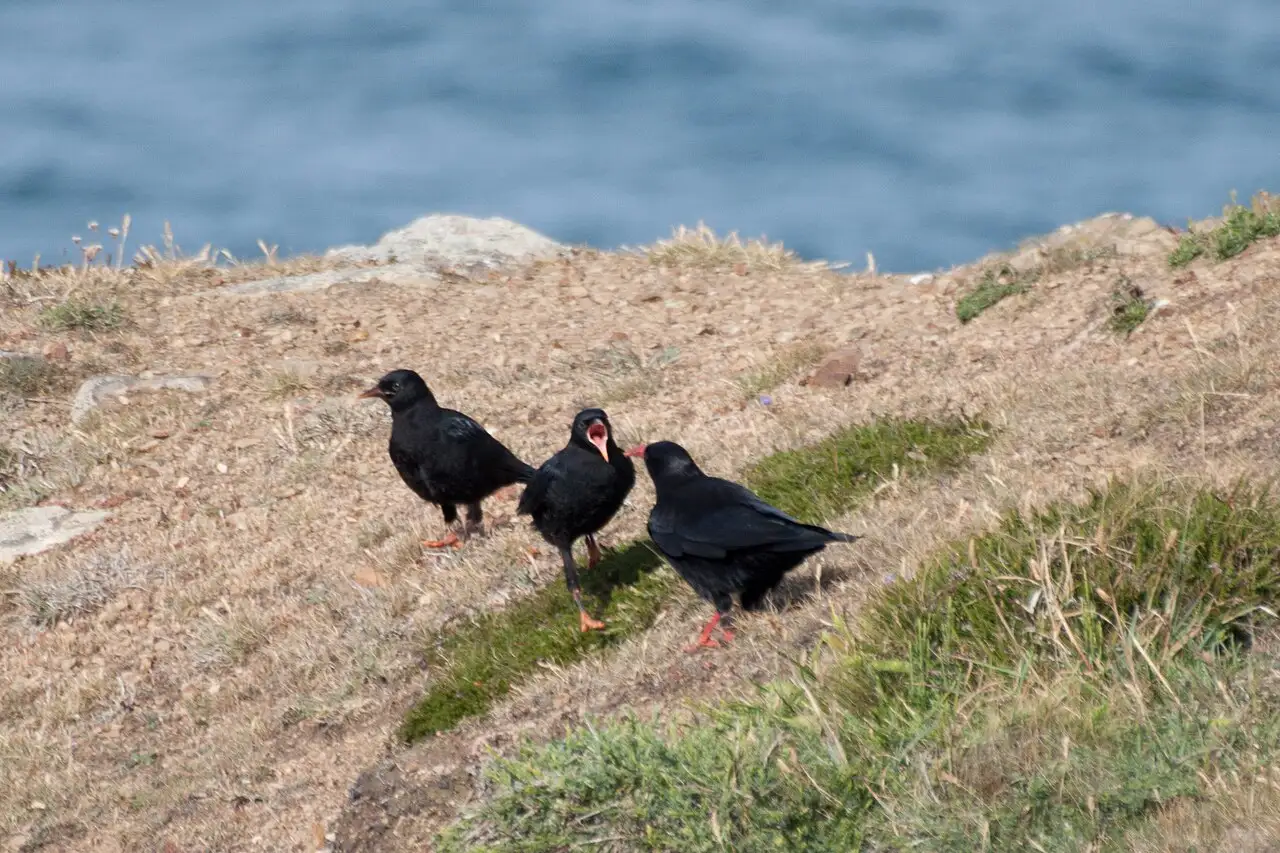
Three young Red-billed Choughs on top of a sea cliff, one of them with its bill openPhoto: Joanne Goldby, CC BY-SA 2.0Photo 4 of 4
1 / 4
Identification of the Red-billed Chough
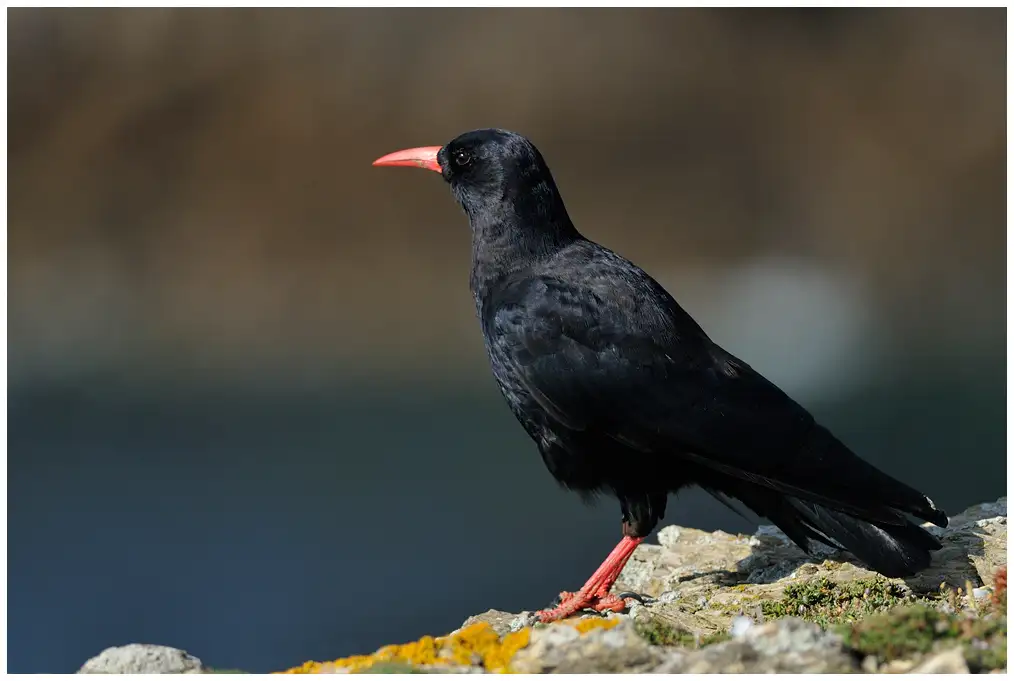
This medium-sized corvid, somewhat bigger than a Jackdaw, looks very like its close relative the Alpine Chough, from which it differs basically by having a longer, more curved bill, with an intense reddish colour. This vivid colour is acquired during the bird’s first winter, because in young birds the bill is a brownish-yellow tone. As is usual in the family, the plumage is intensely black, adorned with blue and greenish metallic sheen. In flight they show a characteristic silhouette, with broad, deeply fingered wings and a short, squarish tail.
Adult
Intensely black plumage, with blue and greenish metallic sheen.
Long, curved, deep red bill.
Young bird
Bill of a brownish-yellow tone, which turns red during the first winter.
Habitat and distribution of the Red-billed Chough
It is distributed across Europe and Asia as far as Mongolia, and across north and east Africa, although its populations, very dependent on rock formations, are fragmentary. In Europe it lives mainly in the Mediterranean region, with some populations in central France and in cliff areas of French Brittany, Ireland and Scotland. Up to eight subspecies are recognised: on the Peninsula «erythrorhamphus» lives and in the Canaries «barbarus».
In Spain it is fairly widely distributed, although more common in the mountainous, broken areas of the great massifs and on cliff coasts of the Atlantic, Cantabrian and Levante shores. In general small populations or isolated pairs appear in almost every province, but it is scarce on the great plateaus and cultivated depressions. It does not breed in the Balearics, although it appears occasionally, nor in Ceuta or Melilla, but it does in the Canaries, where it now lives only on La Palma after disappearing from Tenerife, La Gomera and El Hierro.
It settles in a great variety of habitats, provided they have vertical rock walls with cracks and hollows in which to nest and shelter: mountain regions, coastal cliffs, dry watercourses, river cliffs and towns with large monumental buildings. To feed it frequents open spaces, such as alpine grassland, crops and even coastal sands.
It is resident throughout its range; little is known of its dispersive habits, but it is known to make some altitudinal movements, at least where the climate is harsher.
Areas where it is regularly recorded since 2010Squares of about 25 km where it is recorded regularly (occasional passage records are left out). Data from GBIF.org (108,271 records, retrieved October 2026); outline from Natural Earth.
Etymology of the Red-billed Chough
According to Wikipedia, Linnaeus described it in 1758 under the name «Upupa pyrrhocorax», and Marmaduke Tunstall moved it in 1771 to its present genus. «Pyrrhocorax» comes from the Greek «pyrrhós», «flame-coloured», and «kórax», «raven». In other languages it is called «gralla de bec vermell» in Catalan, «choia de bico vermello» in Galician, «belatxinga mokogorria» in Basque and «red-billed chough» in English1.
Population of the Red-billed Chough
In the 2021 European Red List of Birds the European breeding population is estimated at between 84,600 and 197,000 mature individuals, with an unknown trend. In Spain there are no specific censuses giving an estimate of the current figure, but recent regional studies in Segovia, the province of Madrid and partly Los Monegros point to a marked decline: the species almost disappears from the river cliffs of the Manzanares, Jarama, Tajuña and Tagus rivers, has its nesting sites limited in Los Monegros and other districts of the Ebro valley and loses pairs on historic buildings in Segovia through maintenance works.
The main threat is the transformation of feeding habitat by agricultural intensification and the progressive disappearance of extensive livestock farming. The loss of nesting sites and direct persecution affect above all isolated pairs and small cores, and uncontrolled tourism, climbing and caving can be a danger in certain breeding areas and roosts.
Nest of the Red-billed Chough
Normally it is a crack, small cave or hollow in some rock wall, or even a rural building. The nest consists of a fairly untidy accumulation of very varied plant materials. It often forms quite scattered breeding colonies where the population is abundant, although it also nests alone.
Courtship and breeding of the Red-billed Chough
The breeding period begins in April with a courtship of acrobatic aerial displays, while the pair explores its territory in search of the right nest site. The female lays three to five cream eggs and incubates them alone for 17–20 days. The chicks hatch through June and need about 30–40 days of care from both parents; after leaving the crack, they still depend on the adults for some more weeks. Each pair makes only one clutch a year.
Diet of the Red-billed Chough
It feeds mainly on invertebrates that it catches on the ground or in rock cracks with its long, curved bill: larvae of beetles and butterflies, worms, spiders and grasshoppers. It very often probes livestock droppings for the invertebrates that gather there, and occasionally eats a small vertebrate. In winter the proportion of seeds and fruit, cultivated and wild, rises, given the scarcity of animal prey.
Curious facts about the Red-billed Chough
It is an inhabitant of river gorges, steep high-mountain walls, sierra crags and coastal cliffs, an acrobatic and fairly sociable bird1. It was once frequent in many parts of the country, and agricultural intensification, pesticides and the loss of nesting sites have noticeably reduced its populations. According to Wikipedia, its English name, «chough», comes from the Jackdaw.
The Red-billed Chough in Cabañeros
The habitat pages of this website do not mention it, and we have not found any other published source on it in the Park. GBIF.org records 17 observations of the Red-billed Chough in Cabañeros and its surroundings.
Where to see the Red-billed Chough in Cabañeros
In Cabañeros and its surroundings, all year, on crags and cliffs with cracks and in the surrounding grasslands.
When
All year; it is resident throughout its range.
What time
By day, in flocks that fly over the cliffs and come down to the grasslands.
Where
On vertical rock walls, river cliffs and crags; to eat it comes down to grasslands and crops.
What to look for
Look for the long, curved red bill and the silhouette of the fingered wings; listen for its metallic «quíak».
Videos of the Red-billed Chough
Similar species
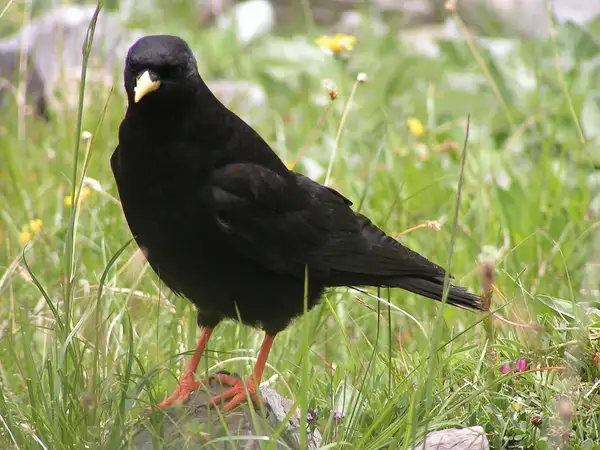
Alpine Chough
Pyrrhocorax graculus
How to tell them apart
It is similar in song and physical appearance1. The Red-billed is distinguished by its longer, more curved bill, with an intense reddish colouring1.



 Same family
 Same family
 Same family
 Same family
 Same order
 Same order
 Same order
 Same order





