Not listed: it is not on the special-protection list nor on that of threatened species
When to see it
Resident
Months of the year when it is present
J
F
M
A
M
J
J
A
S
O
N
D
In Iberia
yes
yes
yes
yes
yes
yes
yes
yes
yes
yes
yes
yes
Breeding season
no
no
yes
yes
yes
yes
yes
no
no
no
no
no
Song or voice of the Common Blackbird
A fluty, melodious song, of brief, ever-different phrases, with which the male marks his territory at dawn and dusk. If startled, it gives a succession of high notes, ever faster, and a cackle as it flies off.
SongCommon Blackbird
0:00 / 0:20
10 kHz5
The sonogram draws the sound: time runs from left to right, and the higher a trace sits, the higher the note.Recording by Tony Wills, Wikimedia Commons (CC BY-SA 3.0).
Flight of the Common Blackbird
It flies low, direct and agile, with quick wingbeats and a slight rocking, from bush to bush. It almost never goes far from the ground: as soon as it can it hides among the branches. On the ground it does not run, but advances in hops, very upright.
Flight typeLow, direct and agile
It leaps up from the ground, almost always startled, with the characteristic alarm cackle.
It crosses at low height, with agile wingbeats and a slight rocking, on its way to the next bush.
It brakes with its tail spread and slips in among the branches, where it stays still.
Photo gallery of the Common Blackbird
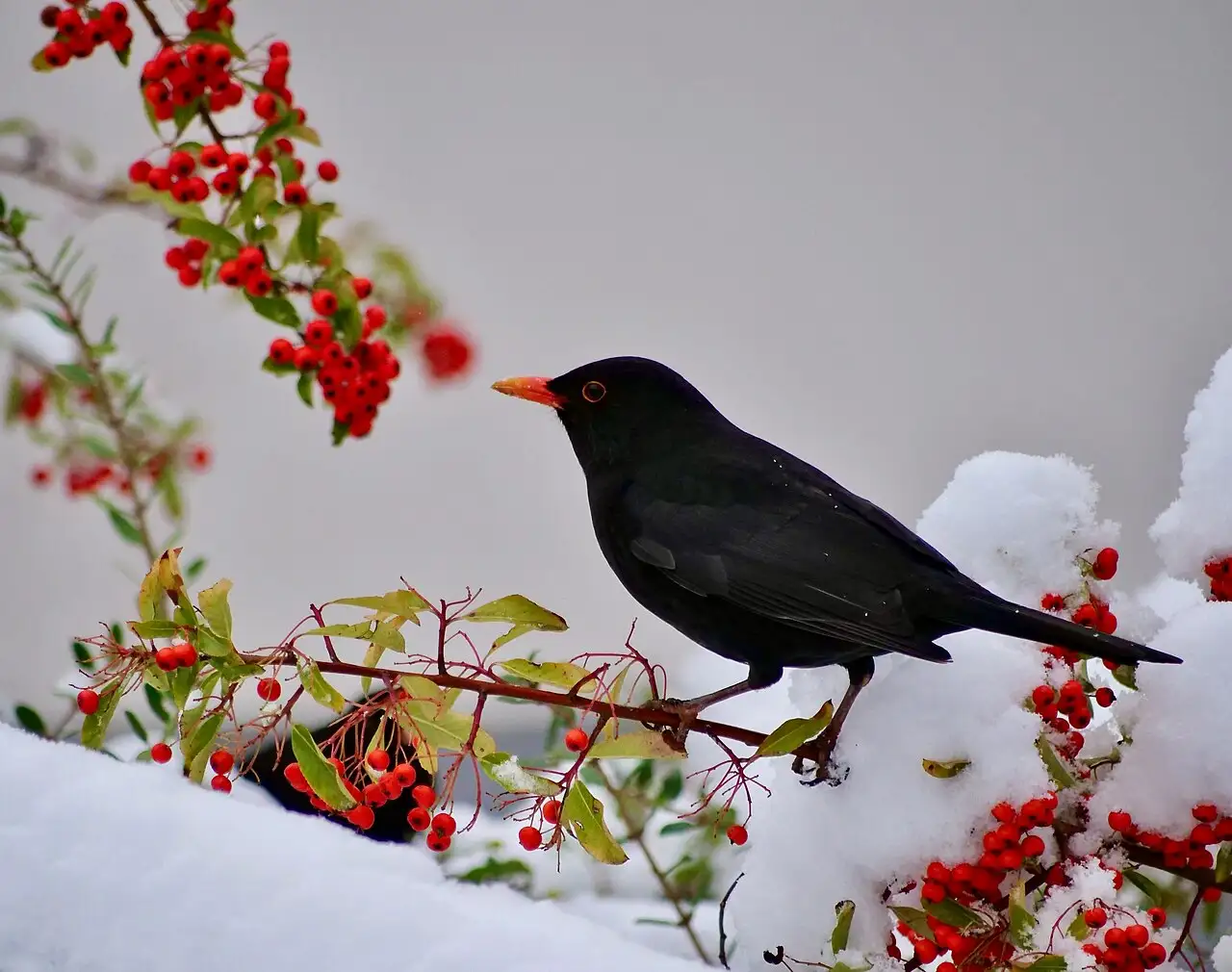
Male Common Blackbird among red berries: black plumage and orange billPhoto: Federlesen, CC BY-SA 4.0Photo 1 of 4
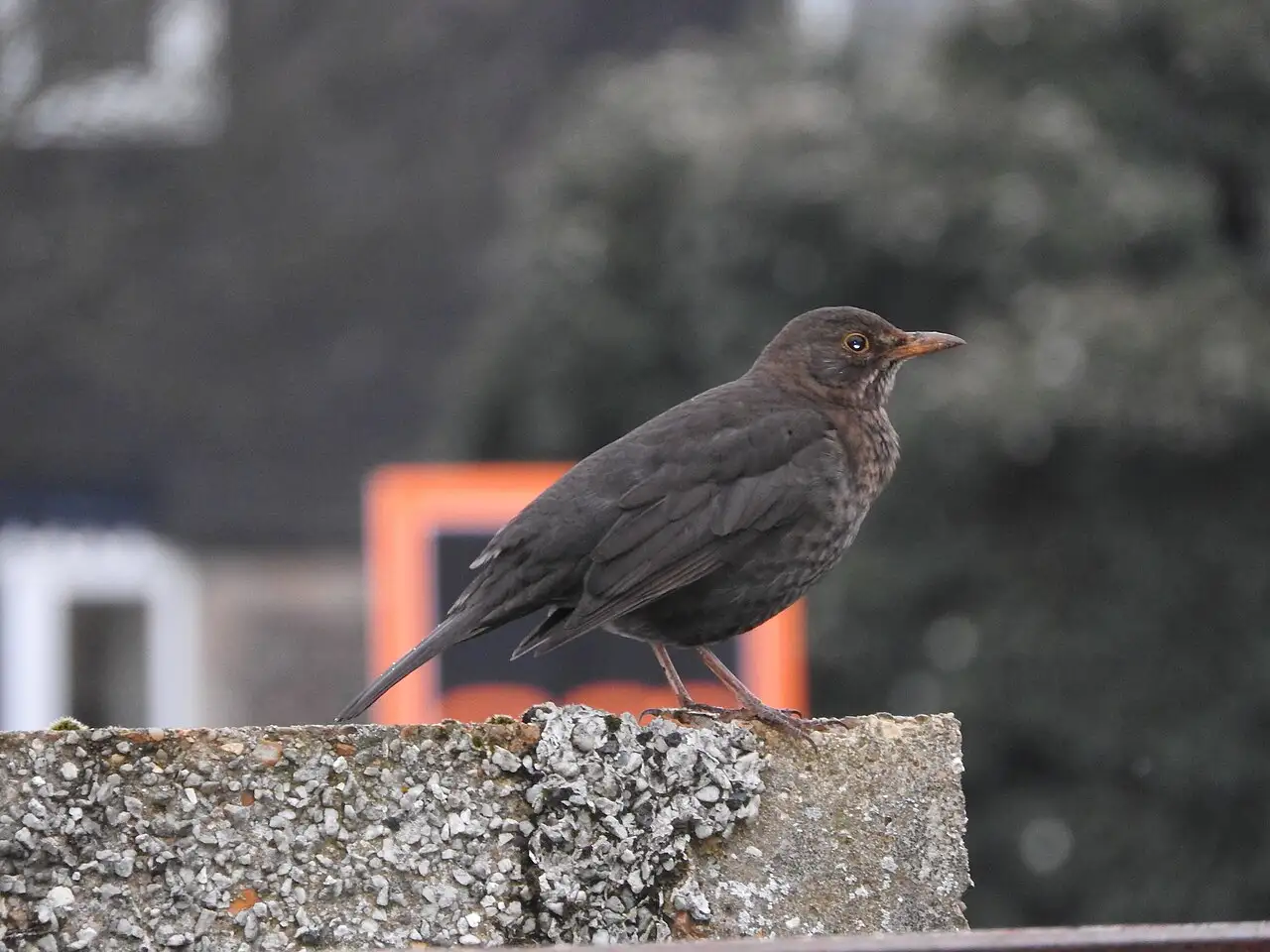
Female Common Blackbird perched on a wall: brown, with paler breast and brown billPhoto: Rob Mitchell, CC0Photo 2 of 4
It is a bird we all know, but it deserves a careful look. There is clear dimorphism between the sexes and young birds resemble females, which can mislead us.
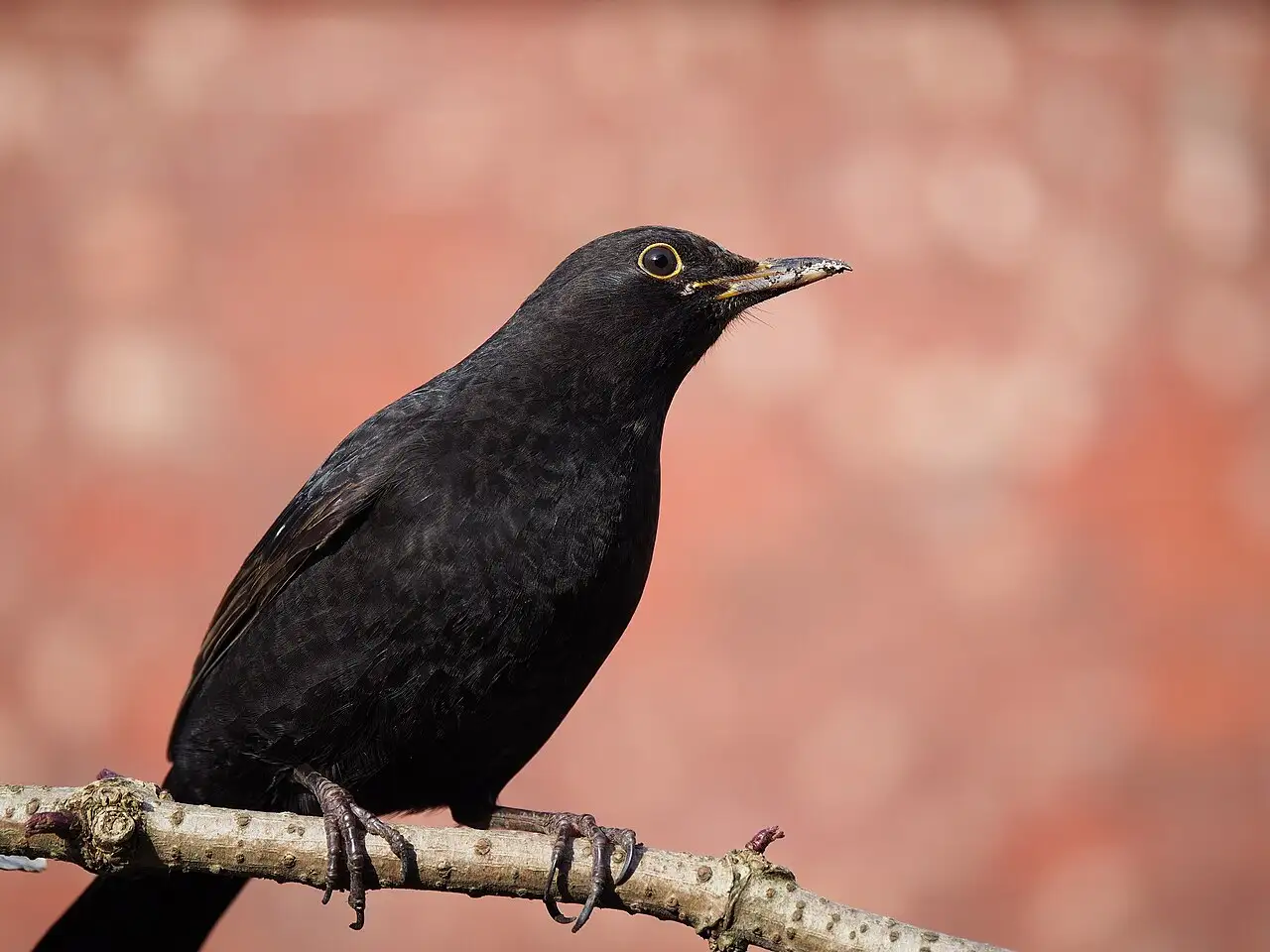
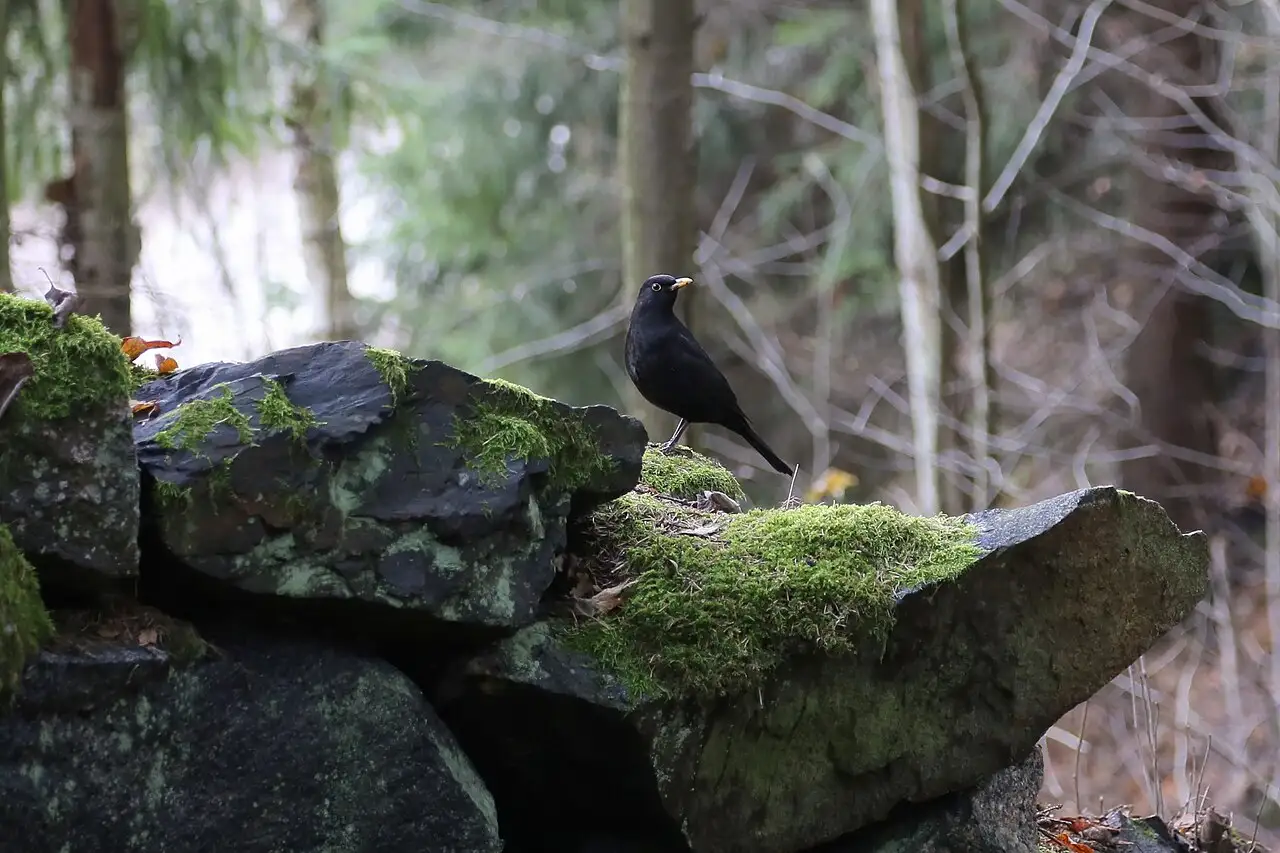
Male
He is completely black, with a more matt tone on the wings.
The bill is yellow-orange, and around the eye he wears a very showy yellow ring.
The legs are dark.
Female and young bird
The female is dark brown, with the breast paler and flecked with spots.
The bill is brown, sometimes with a touch of pale yellow, and the eye-ring is also brown.
Young birds are greyish brown, like the females, but with beige spots on the breast.
Habitat and distribution of the Common Blackbird
It lives in Europe, Asia and North Africa. On the Iberian Peninsula we find it almost everywhere, from sea level to 2,200 metres altitude: woods, scrub, farming mosaics, some wetlands and also the parks and gardens of cities, where it has become very trusting.
Iberian populations are mostly sedentary, but in autumn and winter blackbirds from northern and central Europe join them. The passage of those that travel is noticeable between September and November, with a peak in late October, and again in February and March, when they return.
Areas where it is regularly recorded since 2010Squares of about 25 km where it is recorded regularly (occasional passage records are left out). Data from GBIF.org (1,359,941 records, retrieved October 2026); outline from Natural Earth.
Etymology of the Common Blackbird
The scientific name is quite clear: «Turdus» is the Latin name for the thrush, and «merula» is that of the blackbird. From «merŭlus», a masculine variant of the same word, comes Spanish «mirlo». It is one of the few species whose scientific name is echoed almost as it is in Spanish.
Population of the Common Blackbird
It is one of the most abundant birds in Spain: more than 14.5 million birds are calculated, with a clearly positive trend between 1998 and 20181. It is classified as Least Concern and, in some communities, is a game species.
Nest of the Common Blackbird
The female builds a cup-shaped nest with moss, grass and roots, reinforced inside with mud. She places it in a shrub, in the fork of a tree and, in cities, even on a windowsill or in a flowerpot.
Courtship and breeding of the Common Blackbird
The breeding season runs from March to July. Males begin to sing and defend their territory with the first light of spring, and make two or three clutches a year, sometimes more. Each is of between two and six bluish eggs with reddish-brown spots. Only the female incubates them, for 12 to 14 days, and the chicks leave the nest at about 13 days, although the parents care for them for about three weeks more. That is why in spring it is so common to find young blackbirds, clumsy and tailless, on the ground: they are not abandoned.
Diet of the Common Blackbird
It is omnivorous. It searches the ground, turning over the leaf litter with its bill, for earthworms, insects and other invertebrates, and in autumn and winter it eats a lot of fruit: berries, cherries, grapes and figs. Its way of searching, with little runs and hops and pauses with the head tilted, is unmistakable.
Curious facts about the Common Blackbird
Its song is considered one of the most beautiful in Europe, and it improvises it: it does not repeat the same phrase twice. In cities, blackbirds have come to sing at night, beside street lamps, and to bring their song forward to make themselves heard over the noise.
The Common Blackbird in Cabañeros
It is one of the most abundant species of the woods of Cabañeros: we find it among the most common birds of the sclerophyllous forest, in holm oak woods, Lusitanian oak woods and cork oak woods, and also in deciduous woodland, in the Pyrenean oak woods of the damper areas.
Where to see the Common Blackbird in Cabañeros
In practically any area of scrub with bushes and good leaf litter; it is enough to look carefully at the ground, in the shade, at the edge of a track.
When
All year round. In winter there are more, because those from the north join in; the song is more intense from March to June.
What time
At dawn and dusk, when it sings from the top of a shrub or tree, and when it rummages in the leaf litter.
Where
In the clearings and edges of holm oak, Lusitanian oak and cork oak woods, and in the Pyrenean oak woods; also beside tracks and springs.
What to look for
A slender black bird that advances in hops along the ground, stops suddenly with its head tilted and escapes low, with an alarm cackle.



 Same family
 Same family
 Same family
 Also in sclerophyllous woodland
 Also in sclerophyllous woodland
 Also in sclerophyllous woodland
 Also in sclerophyllous woodland
 Also in sclerophyllous woodland






