Wingspan compared with a person with arms outstretched.
Length
31–33 cm
Wingspan
47–55 cm
Weight
172–236 g
Social life
Both parents incubate and care for the chicks
Lifespan
Record of 22 years and 2 months in the wild (a bird ringed in the Netherlands, killed when it hit a structure)
Conservation status
LC
NT
VU
EN
CR
EW
EX
Global (IUCN)
Least Concern
Spain
Least Concern (LC) in the Red Book of the Birds of Spain; not on the List of Wild Species under Special Protection or in the Spanish Catalogue of Threatened Species
When to see it
Resident
Months of the year when it is present
J
F
M
A
M
J
J
A
S
O
N
D
In Iberia
yes
yes
yes
yes
yes
yes
yes
yes
yes
yes
yes
yes
Breeding season
no
yes
yes
yes
yes
yes
yes
yes
yes
yes
no
no
Song or voice of the Eurasian Collared Dove
The song consists of a high, penetrating coo («cu-cuu-cu»), repeated insistently. The recording, of a bird singing on top of a building on the Dordt College campus (Iowa, United States), comes from xeno-canto and Wikimedia Commons.
SongEurasian Collared Dove
0:00 / 0:14
10 kHz5
The sonogram draws the sound: time runs from left to right, and the higher a trace sits, the higher the note.Recording by Jonathon Jongsma, Wikimedia Commons (CC BY-SA 3.0).
Flight of the Eurasian Collared Dove
It has a fast, light flight, with powerful wingbeats.
Flight typeFast and light, with powerful wingbeats
It is a sedentary bird of urban and suburban environments and their surroundings: gardens, groves, housing estates and crops.
It has a fast, light flight, with powerful wingbeats; the long tail is seen, with a white tip and black base.
It insistently repeats its high, penetrating coo, «cu-cuu-cu», and nests in trees and shrubs.
Photo gallery of the Eurasian Collared Dove
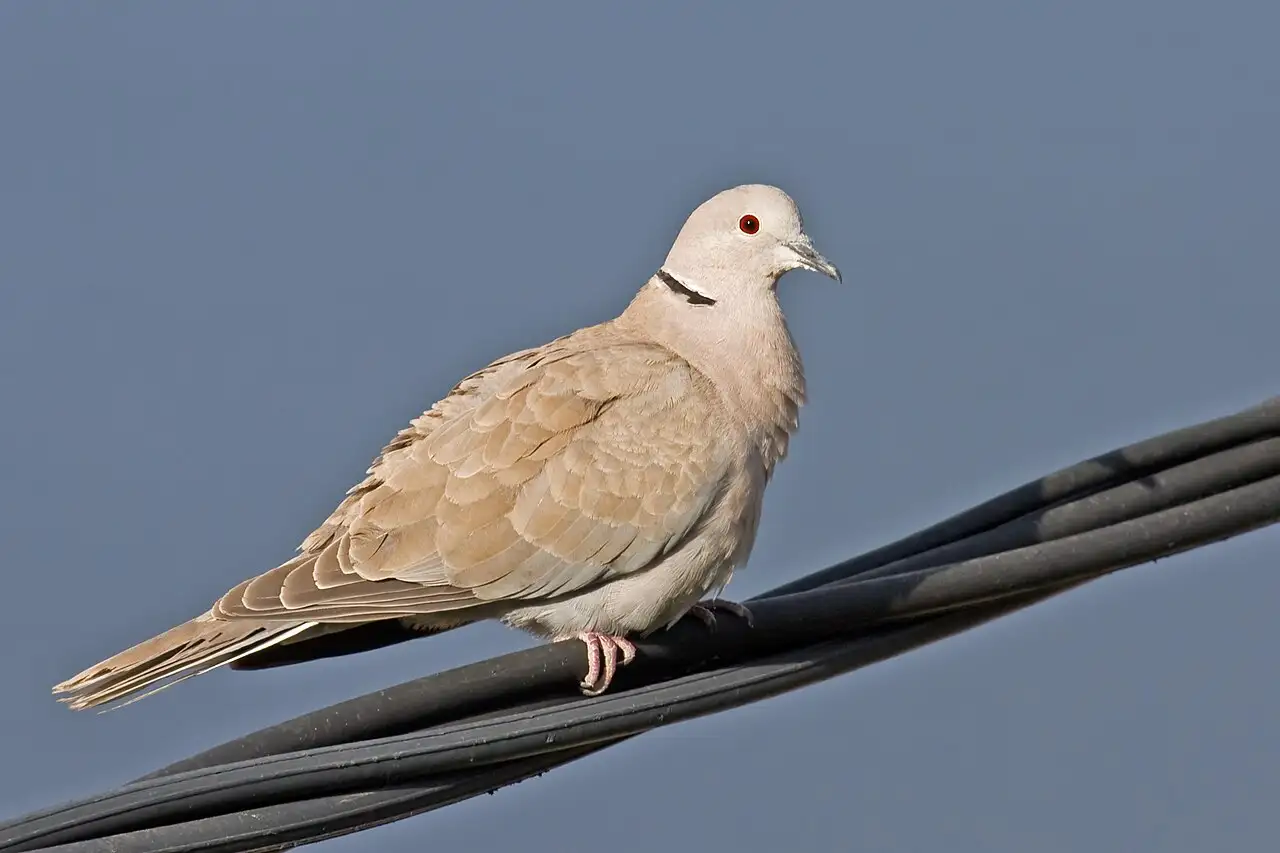
Eurasian Collared Dove perched on a wire, in profile, with pale buff tones, the thin black collar and red eyePhoto: Andreas Trepte, CC BY-SA 2.5Photo 1 of 4
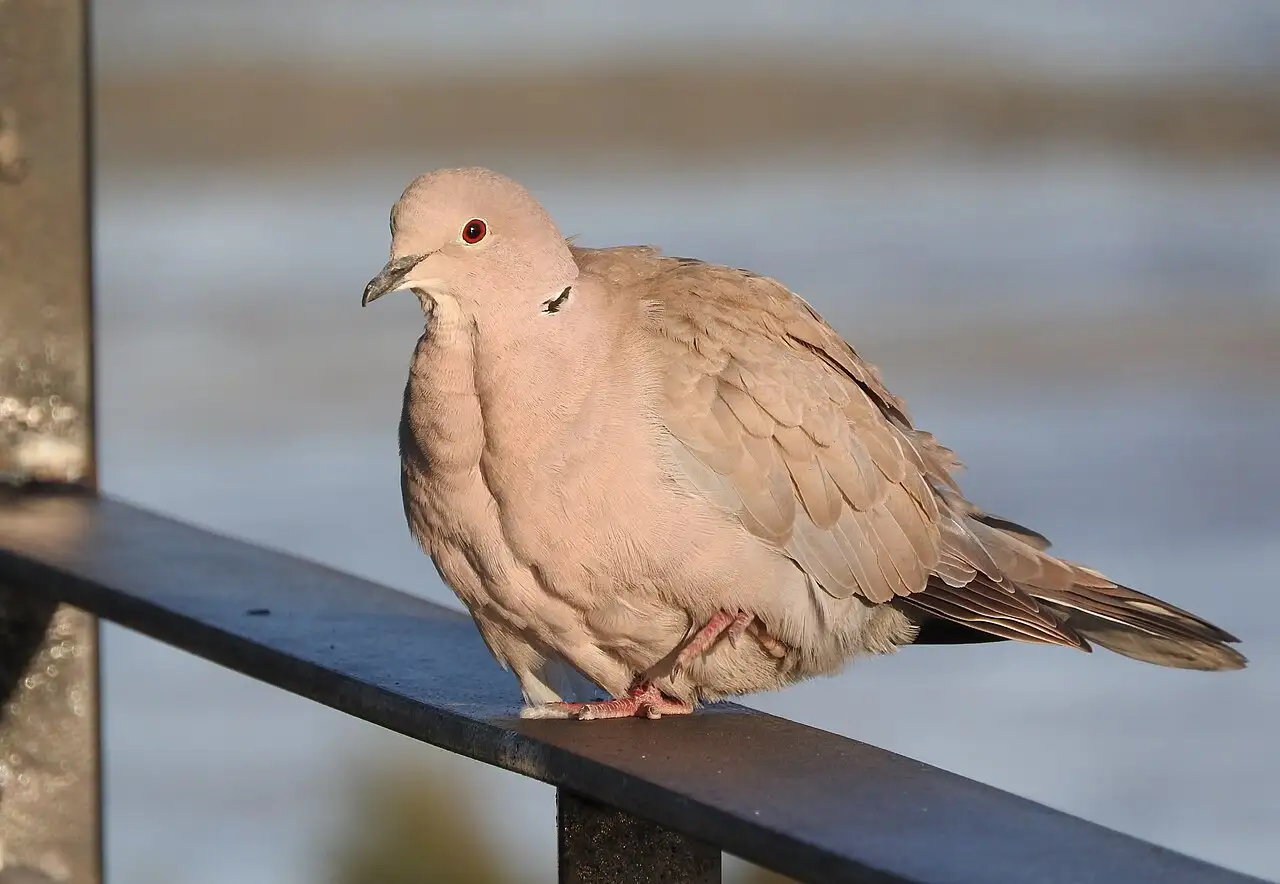
Eurasian Collared Dove perched on a metal railing, with fluffed-up plumage and long tailPhoto: Rob Mitchell, CC0Photo 2 of 4
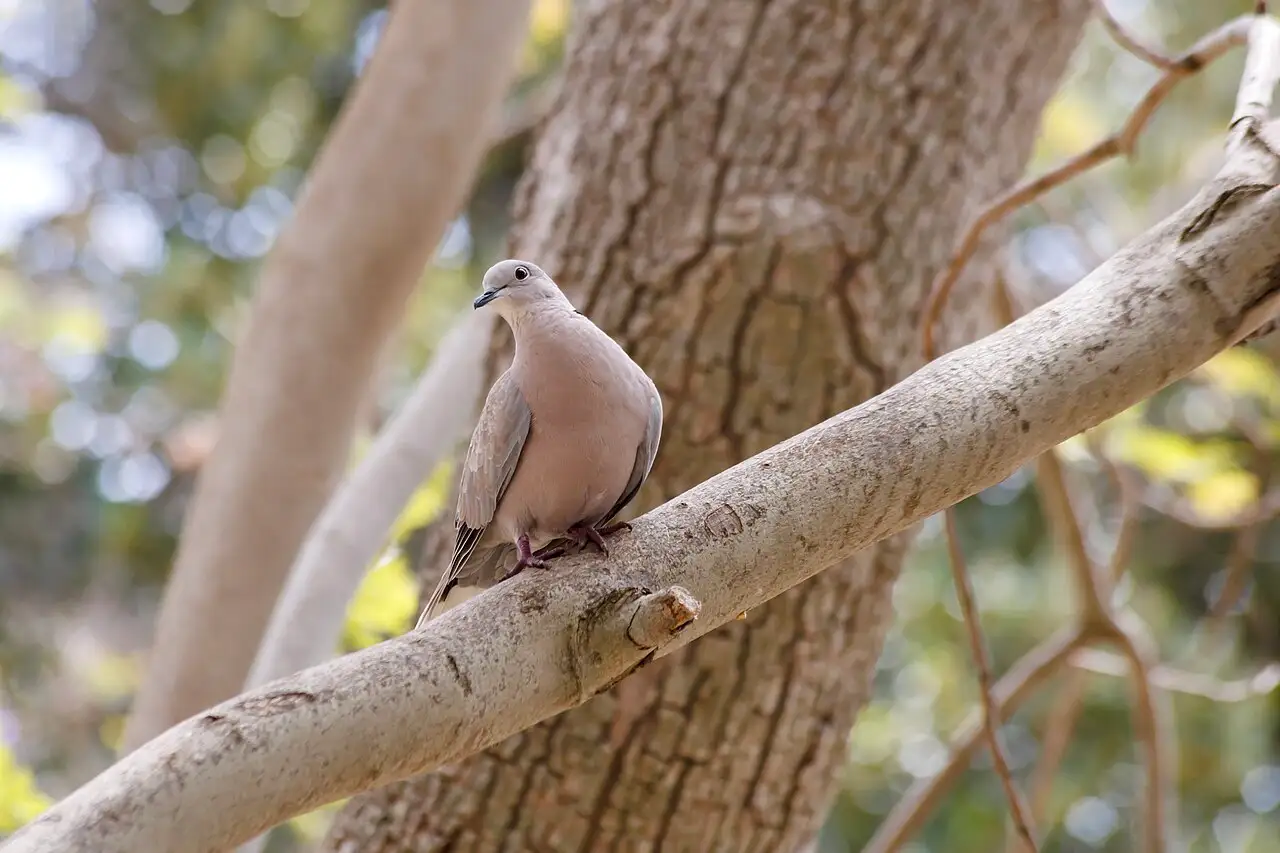
Eurasian Collared Dove perched on a thick, pale-barked branch, with pale buff plumagePhoto: Godwin Borg, CC BY-SA 4.0Photo 3 of 4
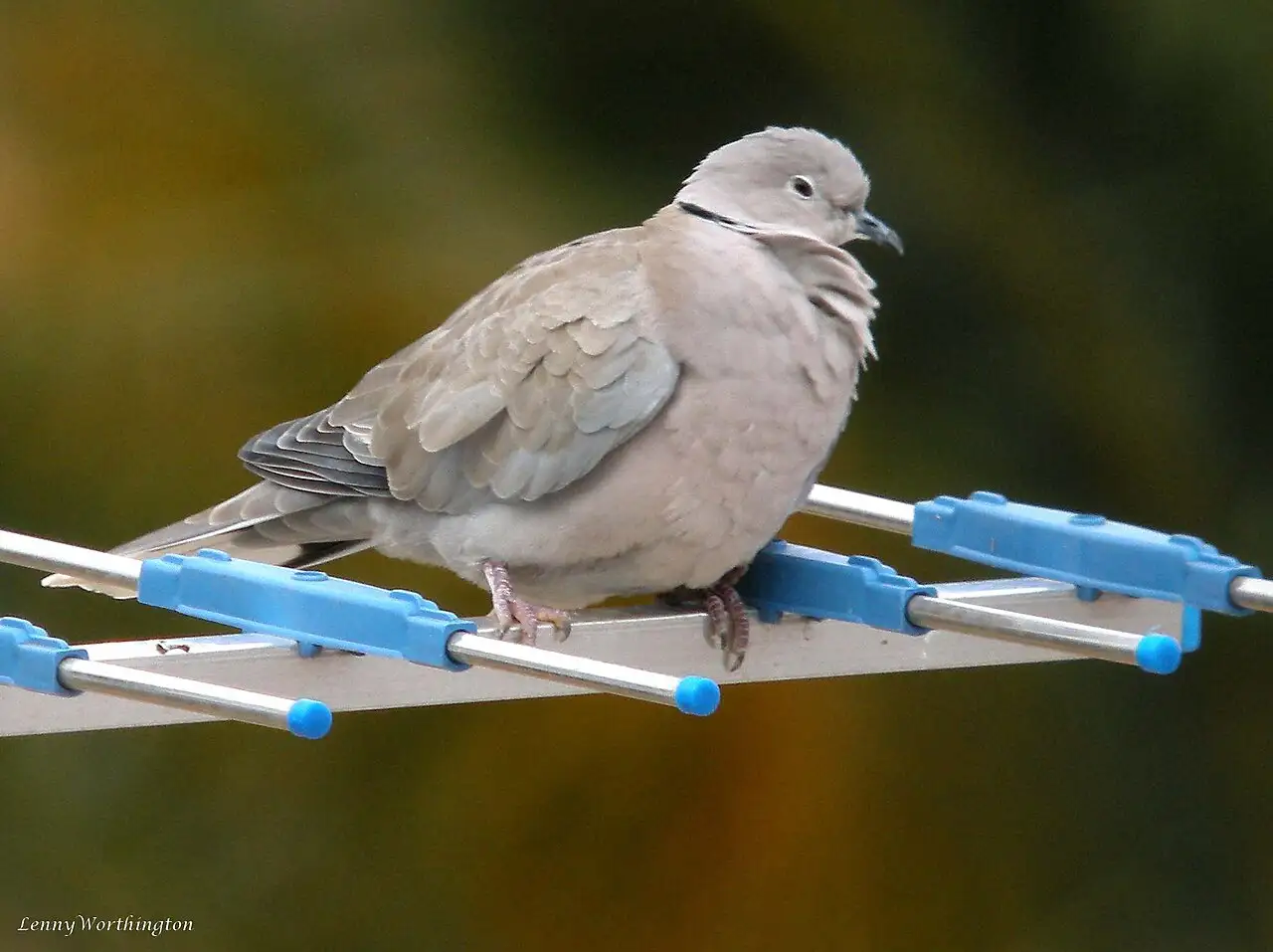
Eurasian Collared Dove perched on a television aerial, in profile, with the black collarPhoto: Len Worthington, CC BY-SA 2.0Photo 4 of 4
1 / 4
Identification of the Eurasian Collared Dove
It is a medium-sized bird, similar to the European Turtle Dove, though slightly bigger. It is characterised by its pale buff tones and its long tail, with a white tip and black base. It has a thin black collar, which extends along the sides of the neck but is absent in juveniles. Both sexes are alike. It has a fast, light flight, with powerful wingbeats.
Adult
Pale buff tones and long tail, with white tip and black base.
Thin black collar along the sides of the neck.
Juvenile
Without the black collar.
Habitat and distribution of the Eurasian Collared Dove
Naturally it is distributed across the Middle East and Asia, as far as China and Korea. But since 1930 it has spread spectacularly across the whole of Europe, from the Balkans and central Europe to the Scandinavian countries, the Iberian Peninsula and the Maghreb. Two subspecies are recognised, of which «decaocto» is the one that occupies Europe.
In Spain it spread across the whole Peninsula in the period 1974–1990, advancing from north to south. In the 1990s it also colonised the Balearics and the Canaries. It is now distributed throughout the Peninsula, the Balearics and the Canaries, with the best populations in the Cantabrian strip, the Ebro valley, the Levante and the two Mesetas. In the east and south of the peninsular interior the distribution is more scattered, depending on the presence of urban centres.
In its original range it behaves as a typical bird of open, semi-steppe areas with scattered shrubby formations, such as acacias. The populations established in Europe and in Spain occupy urban and suburban environments and their surroundings: gardens, groves, housing estates, crops… In our country it is a sedentary bird, although it makes dispersal movements of varying extent.
Areas where it is regularly recorded since 2010Squares of about 25 km where it is recorded regularly (occasional passage records are left out). Data from GBIF.org (739,156 records, retrieved October 2026); outline from Natural Earth.
Etymology of the Eurasian Collared Dove
In other languages it is called «tórtora turca» in Catalan, «rula turca» in Galician, «usapal turkiarra» in Basque and «Eurasian collared dove» in English1. Two subspecies are recognised; in Europe «decaocto» lives.
Population of the Eurasian Collared Dove
In the 2021 European Red List of Birds, the European breeding population is estimated at between 17,900,000 and 44,100,000 mature individuals, with an increasing trend. In Spain, the latest census, of 2014–2018, put it at more than 3,000,000 individuals, with a strong overall increase and the highest densities in the Ebro valley, the Levante and the western regions of the peninsula.
Despite this markedly positive trend, in urban localities of the Ebro valley it has been observed that the growth of the urban Magpie population (which can prey on clutches) and the recent colonisation of the same areas by the Wood Pigeon (which competes directly for resources) have slowed its growth. It suffers no threats and is clearly expanding.
Nest of the Eurasian Collared Dove
It nests in trees and shrubs, and occasionally on posts, where it builds a rigid platform of branches and leaves.
Courtship and breeding of the Eurasian Collared Dove
The breeding period runs from February to October, and it may lay several clutches a year. The clutch consists of one or two white eggs, incubated by both parents for 14–18 days. The chicks make their first flights at 15–20 days.
Diet of the Eurasian Collared Dove
It is a seed-eating species. It eats mainly cereal grains and herbaceous seeds and, to a lesser extent, green parts of plants and invertebrates.
Curious facts about the Eurasian Collared Dove
Since it reached the Peninsula, at the beginning of the 1970s, it occupied in barely three decades the whole peninsular territory, the Balearics and the Canaries, where it has become a common species in rural and urban environments. The ringed bird that lived longest, killed when it hit a structure in the Netherlands, reached 22 years and 2 months.
The Eurasian Collared Dove in Cabañeros
The habitat pages of this website do not mention it. GBIF.org records 320 observations of the species in Cabañeros and its surroundings.
Where to see the Eurasian Collared Dove in Cabañeros
In the inhabited settlements and groves around Cabañeros.
When
All year: it is sedentary, breeding from February to October.
What time
In good light, in gardens, groves and crops.
Where
In urban and suburban environments and their surroundings: gardens, groves, housing estates and crops.
What to look for
Look for a slender, pale buff dove with a long tail and the thin black collar; and listen for its high, penetrating «cu-cuu-cu».



 Same family
 Same family
 Same family
 Same season in the park
 Same season in the park
 Same season in the park
 Same season in the park
 Same season in the park






