Wingspan compared with a person with arms outstretched.
Length
32–34 cm
Wingspan
63–69 cm
Weight
245–387 g
Social life
Males coo; the pair incubates the two eggs and may make one or two clutches a year
Lifespan
Record of 14 years and 10 months in the wild (a bird ringed in the Netherlands)
Conservation status
LC
NT
VU
EN
CR
EW
EX
Global (IUCN)
Least Concern
Spain
Least Concern (LC) in the Red Book of the Birds of Spain; not on the List of Wild Species under Special Protection or in the Spanish Catalogue of Threatened Species
When to see it
Winter visitor
Months of the year when it is present
J
F
M
A
M
J
J
A
S
O
N
D
In Iberia
yes
yes
yes
yes
yes
yes
yes
yes
yes
yes
yes
yes
Song or voice of the Stock Dove
The male gives a muffled coo, which he repeats several times and which usually rises in intensity.
CooingStock Dove
0:00 / 0:24
10 kHz5
The sonogram draws the sound: time runs from left to right, and the higher a trace sits, the higher the note.Recording by Bicheando Natura, Wikimedia Commons (Vídeo de YouTube, con atribución).
Flight of the Stock Dove
It has a faster flight and a higher wingbeat frequency than the Wood Pigeon. In flight the underside of the wings looks dark, whereas in the Rock Dove and the Wood Pigeon it is pale.
Flight typeFaster and with more frequent wingbeats than the Wood Pigeon
It leaves the ground, a crop or the crowns, with quick wingbeats; in winter it is usually seen in groups.
Its flight is faster and with a higher wingbeat frequency than the Wood Pigeon's. In flight the underside of the wings looks dark, whereas in the Rock Dove and the Wood Pigeon it is pale.
It comes down to the dehesa or the field to eat seeds, leaves or flowers, and lands on the ground or in the trees.
Photo gallery of the Stock Dove
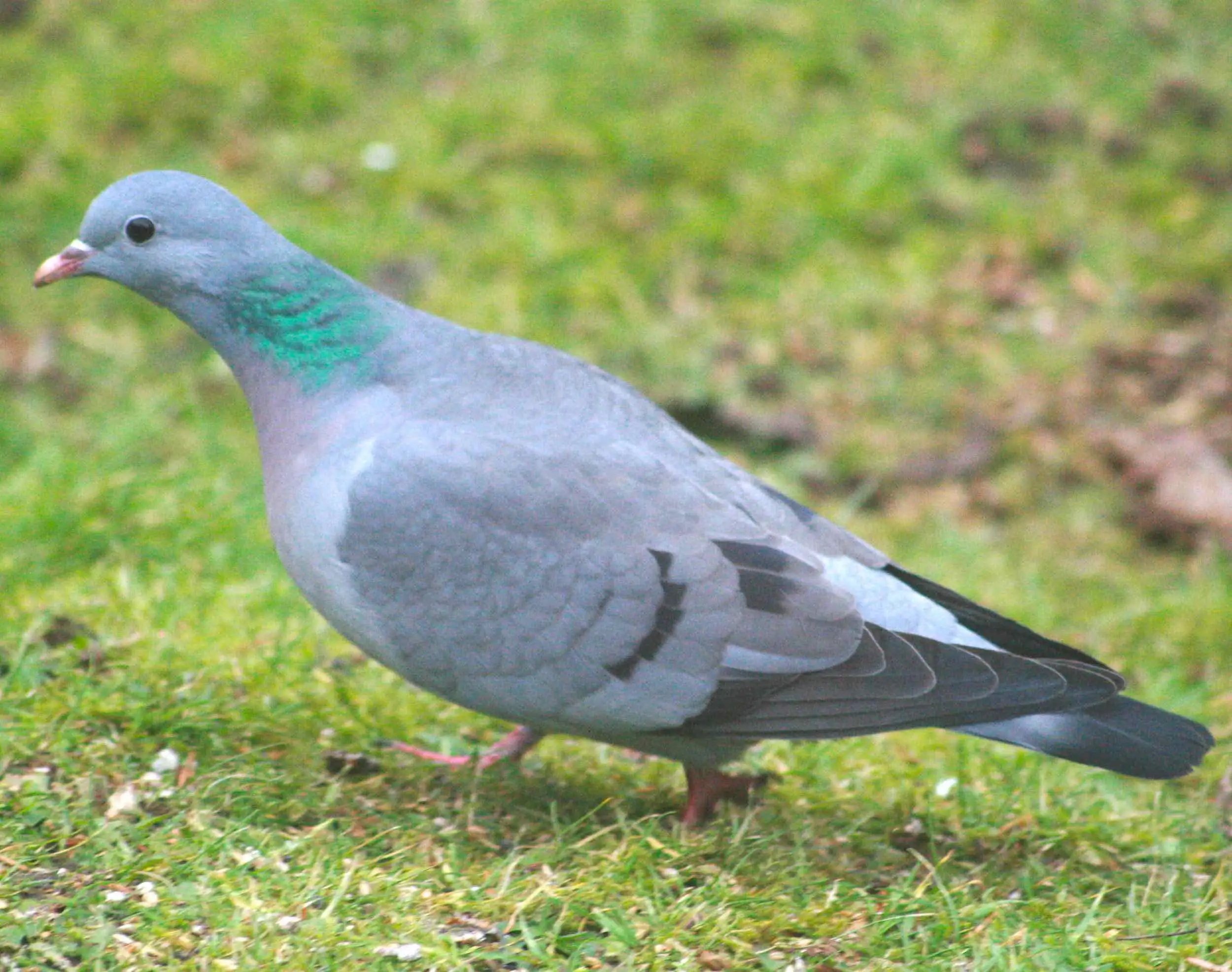
Stock Dove walking through the grass, in profile, with grey plumage and the green sheen of the neckPhoto: Chris Cant from Cumbria, UK, CC BY 2.0Photo 1 of 4
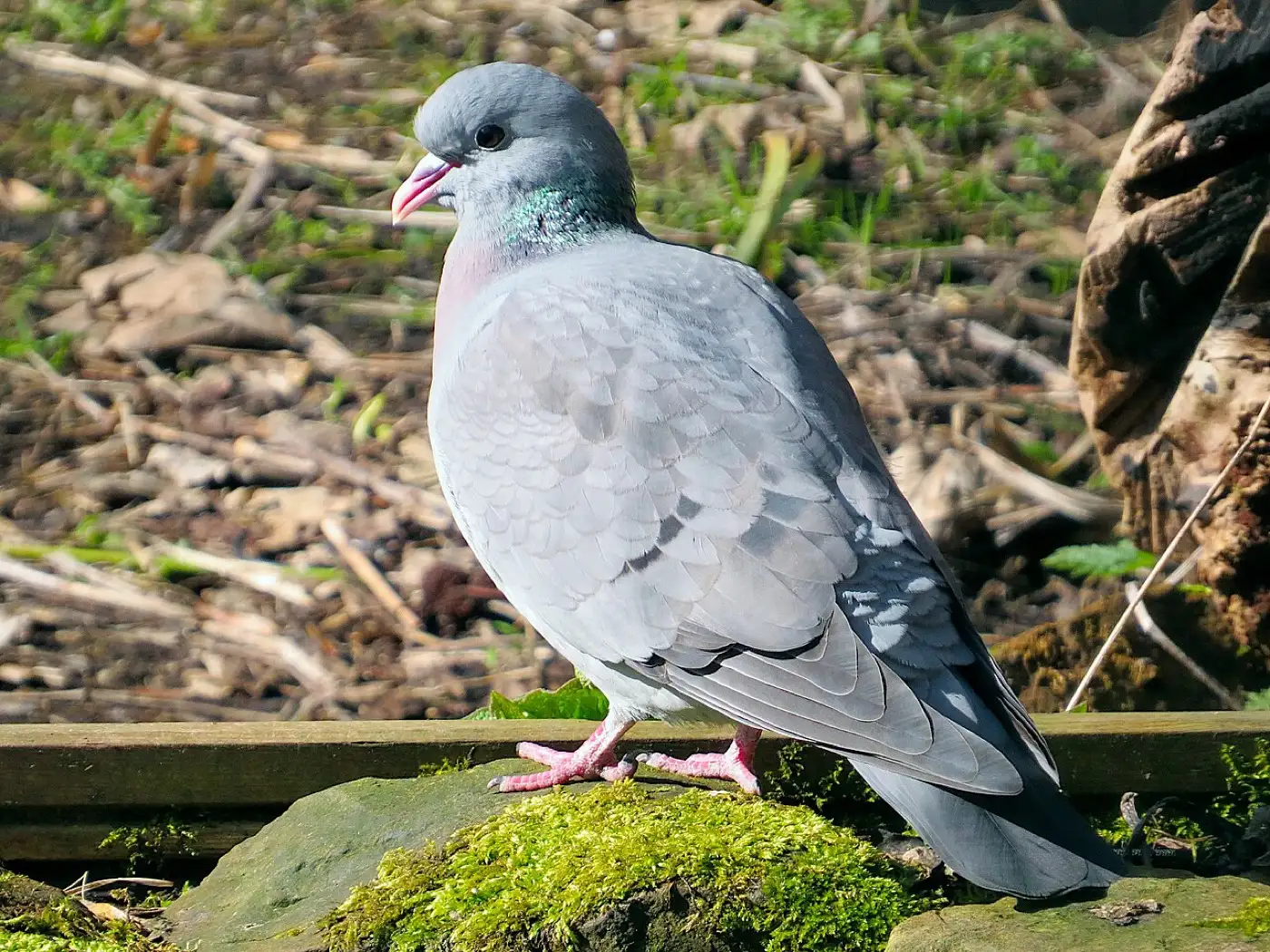
Stock Dove in profile on a moss-covered stone, with grey head and greenish and wine-coloured neckPhoto: MPF, CC BY-SA 4.0Photo 2 of 4
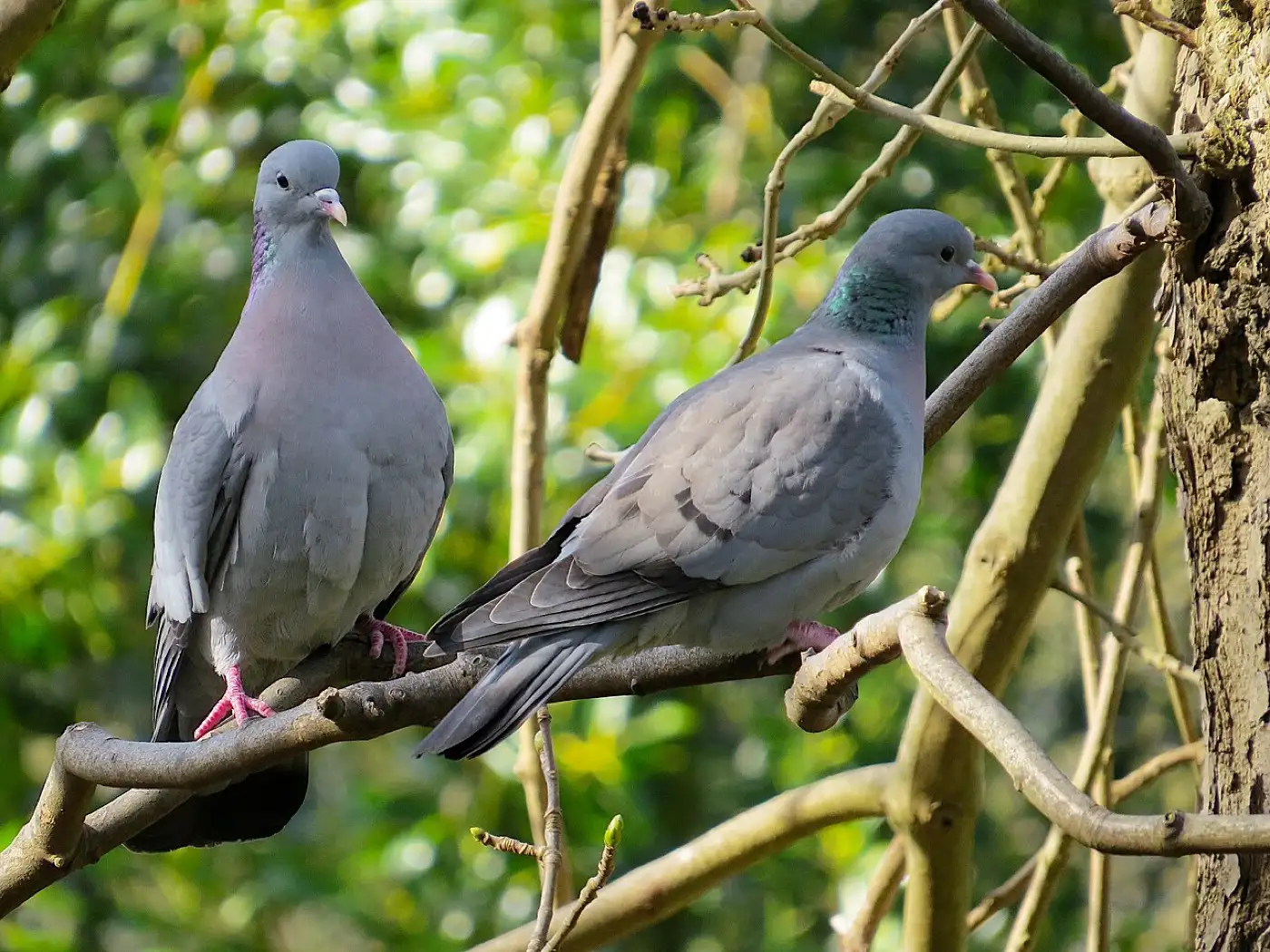
Two Stock Doves on a branch among leaves, one from the front and one in profile, with grey plumagePhoto: MPF, CC BY-SA 4.0Photo 3 of 4
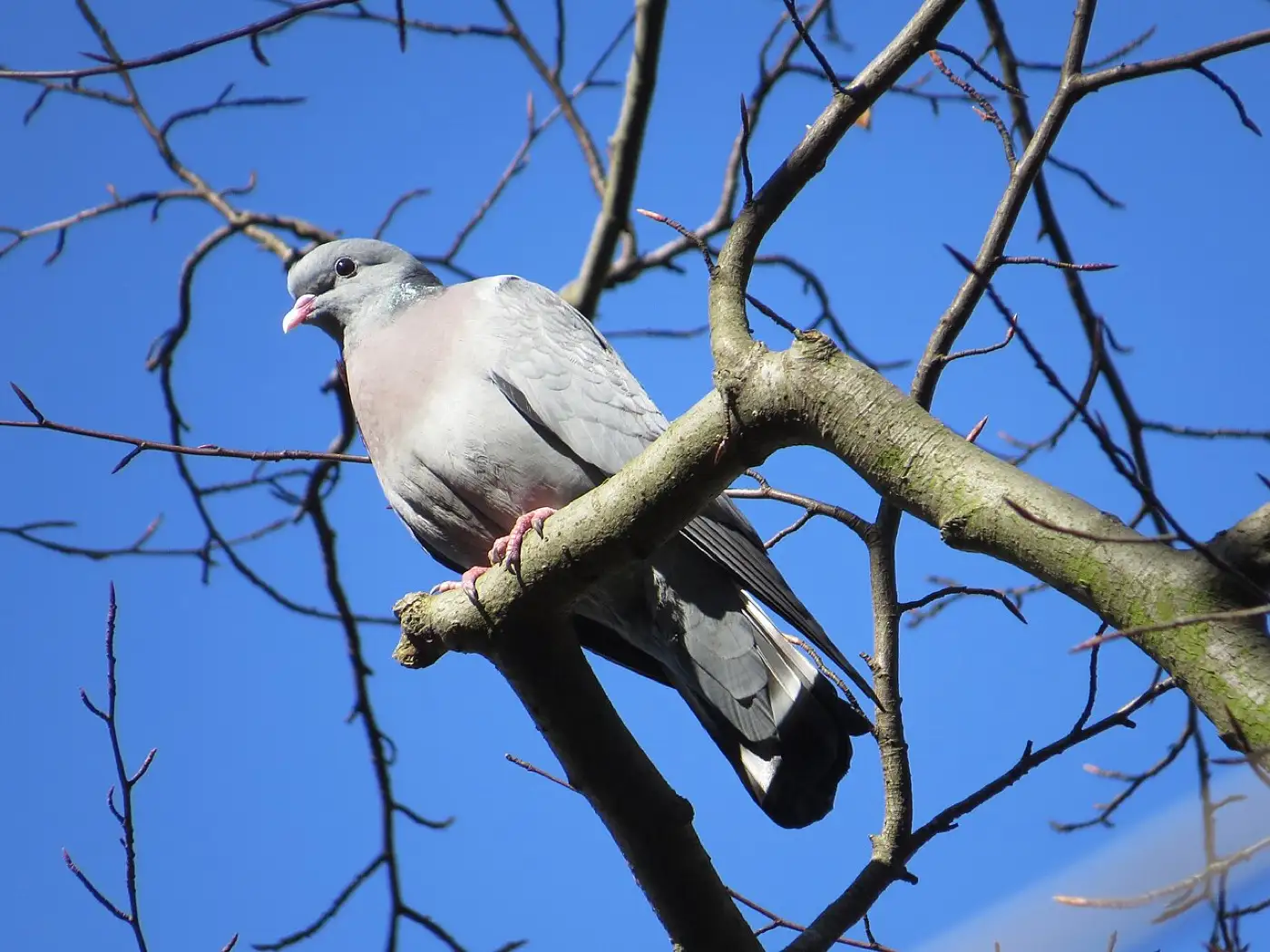
Stock Dove perched on a branch of a leafless tree against the blue sky, with wine-coloured breastPhoto: MPF, CC BY-SA 3.0Photo 4 of 4
1 / 4
Identification of the Stock Dove
The Stock Dove is similar to the Rock Dove, but somewhat smaller, and lighter than the Wood Pigeon. In its all-grey plumage, the wine tones of the neck, the pale grey colour of the rump and some lighter bands on the wings stand out. Both sexes are alike. It has a faster flight and a higher wingbeat frequency than the Wood Pigeon, and in flight the underside of its wings looks dark, whereas it is pale in the Rock Dove and the Wood Pigeon.
Adult
All-grey plumage, with wine tones on the neck.
Pale grey rump and lighter bands on the wings.
Habitat and distribution of the Stock Dove
It is well spread across the whole of Europe, from the Mediterranean to the southern portion of the Scandinavian countries, and from the Iberian Peninsula and north-west Africa to the Middle East and Siberia. Most of its population and range is confined to western Europe. Two subspecies are recognised, and in Spain the subspecies «oenas» occurs.
As a breeder it is distributed in Spain very irregularly and in scattered cores: its most important and continuous populations are in the Ebro valley, the northern plateau and the northern Mediterranean strip. It is absent from most of the Cantabrian fringe and from the south and west of the Peninsula, and is accidental in the Balearics; a progressive thinning is seen towards the south and east.
It is present in a wide variety of habitats, as long as there are cultivated areas, thinned woods and some cavity in which to nest, in trees, rock faces, ruined buildings. It occupies every kind of tree grove, as well as cereal plains.
Iberian nesting populations are sedentary or dispersive, but those of central and northern Europe are wholly or partly migratory, and their main wintering area is south-west France and the Iberian Peninsula, estimated very tentatively at between 40,000 and 100,000 birds. The autumn migration takes place from September to November, with a peak in October, and the spring one between February and April, with a peak in March.
Areas where it is regularly recorded since 2010Squares of about 25 km where it is recorded regularly (occasional passage records are left out). Data from GBIF.org (38,639 records, retrieved October 2026); outline from Natural Earth.
Etymology of the Stock Dove
«Columba» is the Latin word for «pigeon». «Oenas» comes from ancient Greek «oinás», «pigeon».
Population of the Stock Dove
In the 2021 European Red List of Birds the European breeding population is estimated at between 1,360,000 and 2,290,000 mature individuals, with an increasing trend. The Iberian nesting population is estimated at around 72,000 individuals, with the highest concentrations in Castilla-La Mancha (25 %), Aragon (24 %), Catalonia (14 %) and Andalusia (12 %); in winter it rises with the arrival of European winter visitors. In the last two decades it has had a slightly positive evolution. The main limiting factors are the high hunting pressure, the disappearance of old trees and agricultural intensification (removal of fallows, use of pesticides).
Nest of the Stock Dove
Nests are always in cavities (of old trees, cliffs, etc.), with a very simple structure of twigs.
Courtship and breeding of the Stock Dove
Pair formation takes place in early spring (February–April). It may make one or two clutches a year. The clutch consists of one or two pure white eggs, which both sexes incubate for 16–18 days. The chicks fly at 20–30 days.
Diet of the Stock Dove
Its diet is based on plant matter (seeds, leaves, flowers) and, occasionally, invertebrates.
Curious facts about the Stock Dove
This pigeon, of light appearance, is distributed as a breeder irregularly and in scattered cores, but the Iberian territory is an important wintering area for the populations of central and northern Europe.
The Stock Dove in Cabañeros
This website’s page on dehesas cites it, together with the Common Wood Pigeon and finches, among the seed-eating species of the dehesas of Cabañeros during winter.
Where to see the Stock Dove in Cabañeros
In the dehesas of Cabañeros, in winter.
When
In winter: birds arrive from central and northern Europe; the autumn migration peaks in October.
What time
Throughout the day, feeding on the ground or in the crowns.
Where
In dehesas, tree groves, thinned woods and cereal plains.
What to look for
A grey pigeon, lighter than the Wood Pigeon, with a wine-coloured neck, without white patches.
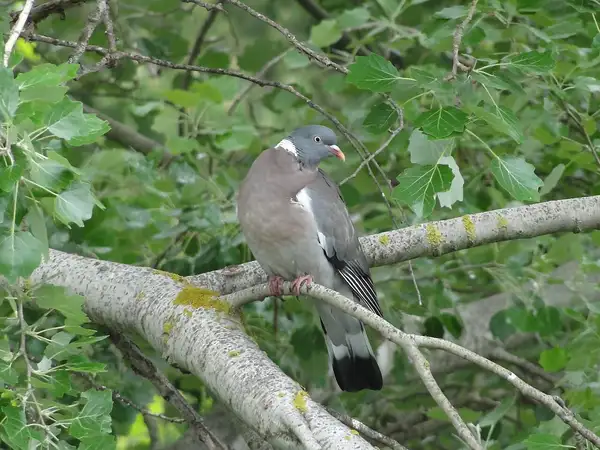
They are similar in voice and appearance1. The Wood Pigeon is heavier, and its flight is less fast and has a lower wingbeat frequency; underneath, the wings are pale.
Photo: Almaffi, public domain
Rock Dove
Columba livia
How to tell them apart
It is somewhat larger than the Stock Dove. It has a white rump and two black wing bars, and the wings are pale underneath.
Photo: rowan_m, CC BY 4.0
Other birds
Birds related to the Stock Dove or sharing its habitats in Cabañeros.



 Same family
 Same family
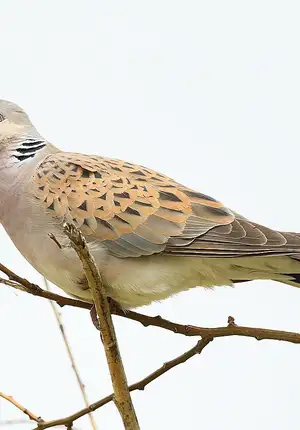 Same family
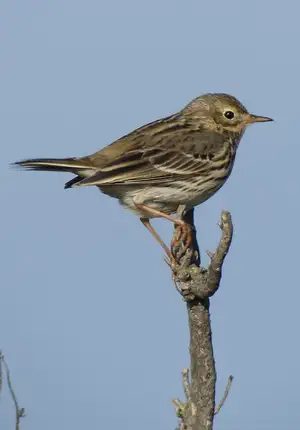 Also in dehesas (wood pasture)
 Also in dehesas (wood pasture)
 Also in dehesas (wood pasture)
 Also in dehesas (wood pasture)
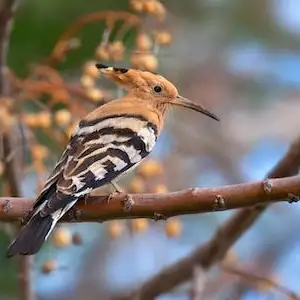 Also in dehesas (wood pasture)






