Wingspan compared with a person with arms outstretched.
Length
26–28 cm
Wingspan
47–53 cm
Weight
133.2–181 g
Social life
Forms strong pair bonds (Wikipedia)
Lifespan
Record of 13 years and 2 months in the wild (a bird ringed in the Netherlands and shot)
Conservation status
LC
NT
VU
EN
CR
EW
EX
Global (IUCN)
Vulnerable
Spain
Vulnerable (VU) in the 2021 Red Book of the Birds of Spain; it does not appear in the Spanish Catalogue of Threatened Species
When to see it
Summer visitor
Months of the year when it is present
J
F
M
A
M
J
J
A
S
O
N
D
In Iberia
no
no
yes
yes
yes
yes
yes
yes
yes
yes
yes
no
Breeding season
no
no
no
no
yes
yes
yes
yes
no
no
no
no
Song or voice of the European Turtle Dove
It gives a soft, monotonous, two-syllable purr, which it pronounces repeatedly: «tur-tuur-tuur». Both sexes can sing, although the male has a faster version in courtship.
CooingEuropean Turtle Dove
0:00 / 0:25
10 kHz5
The sonogram draws the sound: time runs from left to right, and the higher a trace sits, the higher the note.Recording by Benoît Van Hecke, Wikimedia Commons (xeno-canto XC582028) (CC BY-SA 4.0).
Flight of the European Turtle Dove
Its flight is fast, agile and erratic, with strong wingbeats and constant changes of direction. In flight the dark flight feathers, a greyish wing band and the orange back stand out.
Flight typeFast, agile and erratic, with changes of direction
It leaves a tree or the ground, where it feeds on cereal and herbaceous plant seeds, with strong wingbeats.
Fast, agile, erratic flight, with constant changes of direction. The dark flight feathers, a greyish wing band and the orange back stand out.
The tail shows a characteristic pattern, with a black base and a broad white terminal band.
Photo gallery of the European Turtle Dove
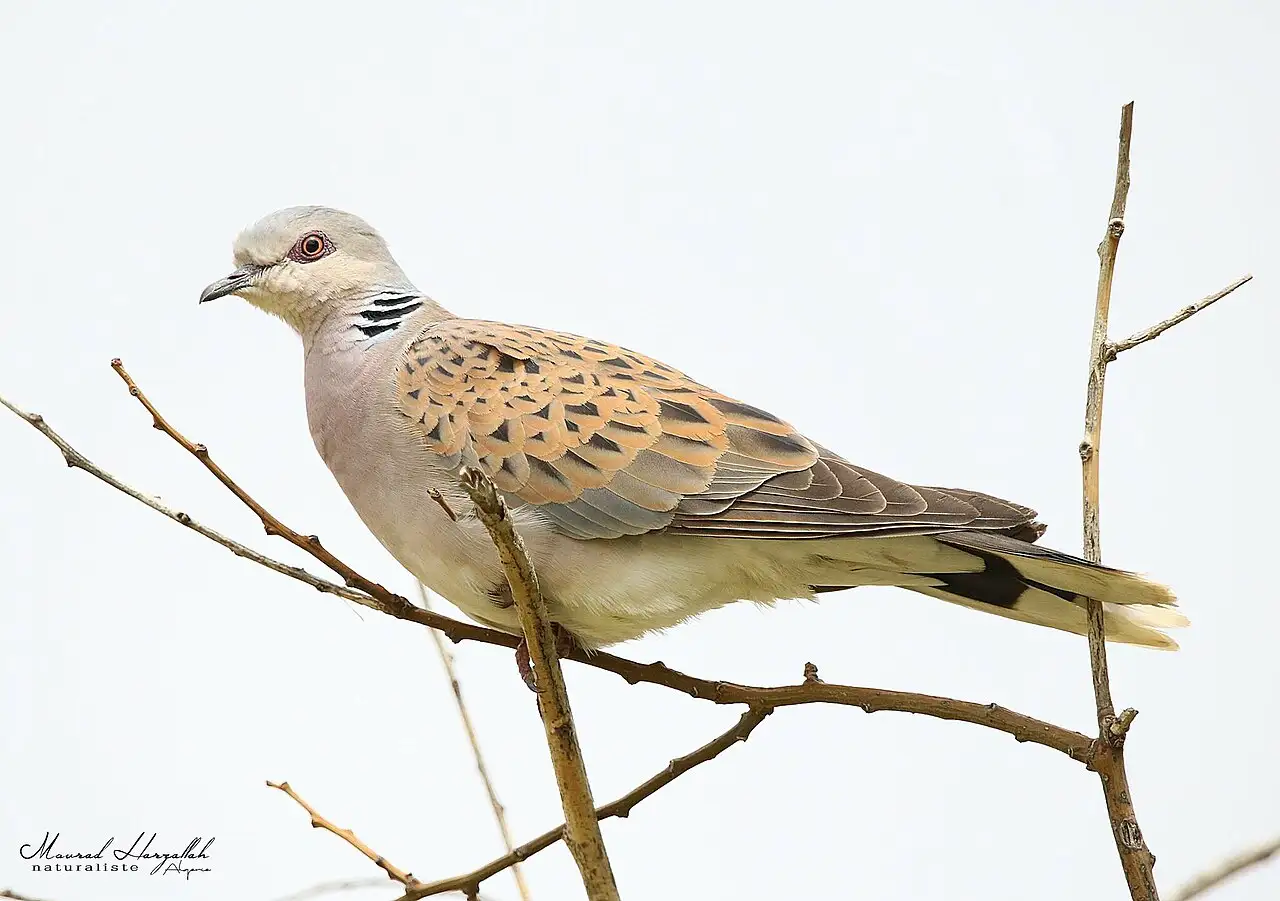
European Turtle Dove perched on a dry branch, with blue-grey head, collar of black and white stripes, orange back mottled with black and white-banded tailPhoto: mourad-harzallah, CC BY 4.0Photo 1 of 4
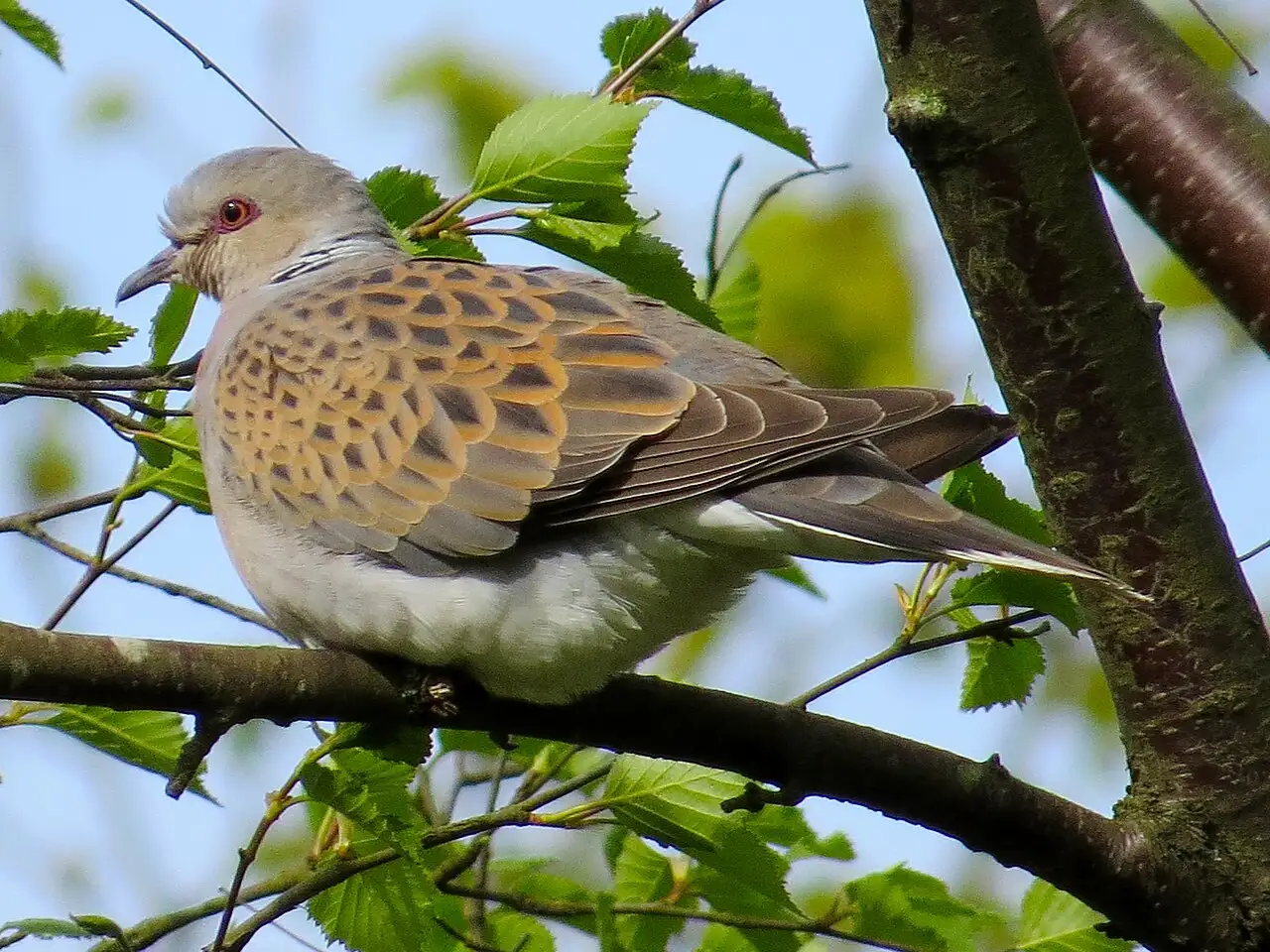
European Turtle Dove in profile on a tree branch with young leaves, with red eye, collar and mottled orange backPhoto: MPF, CC BY-SA 4.0Photo 2 of 4
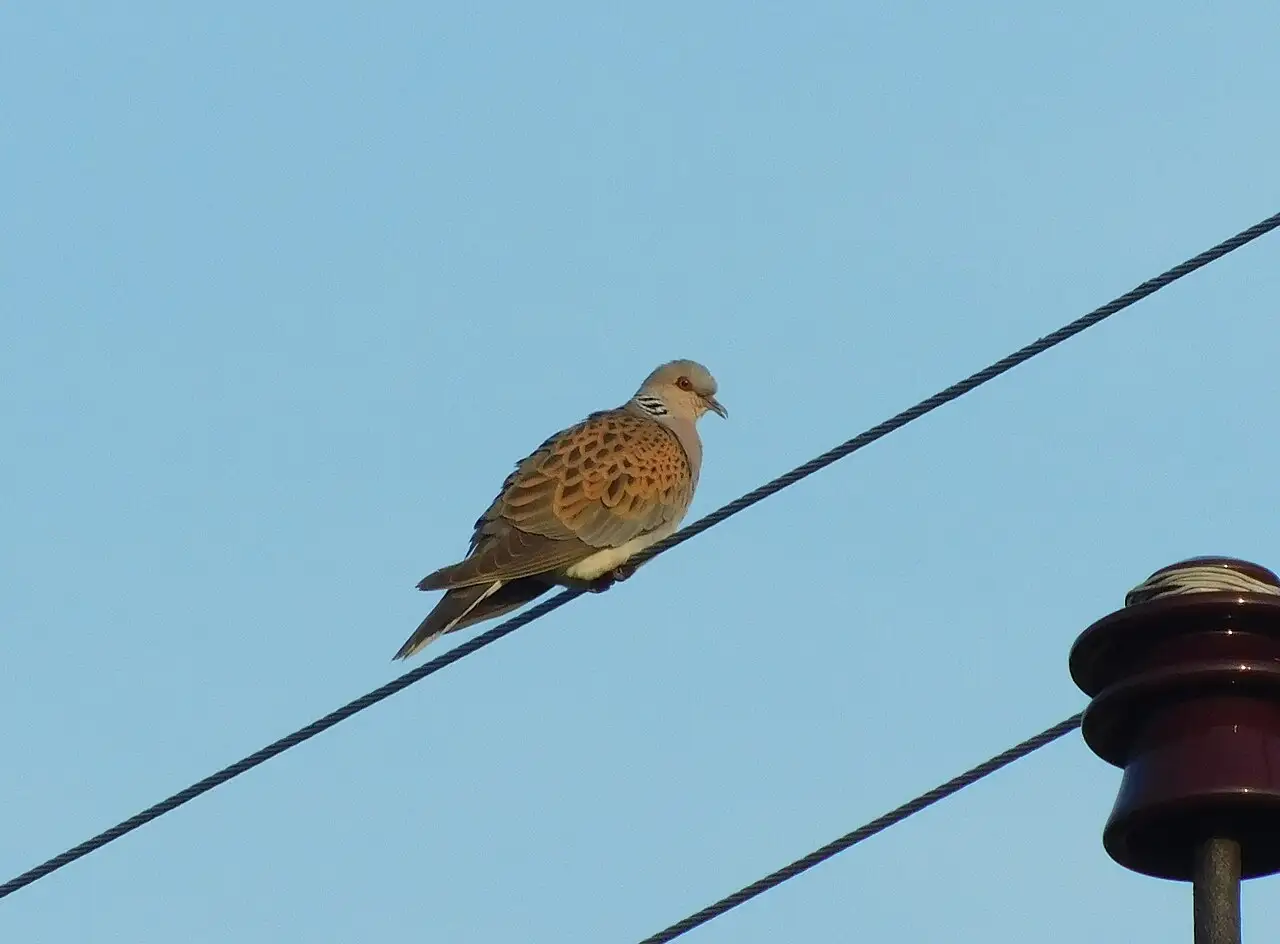
European Turtle Dove perched on a power line wire, seen in profilePhoto: Nikola Veljković, CC BY-SA 4.0Photo 3 of 4
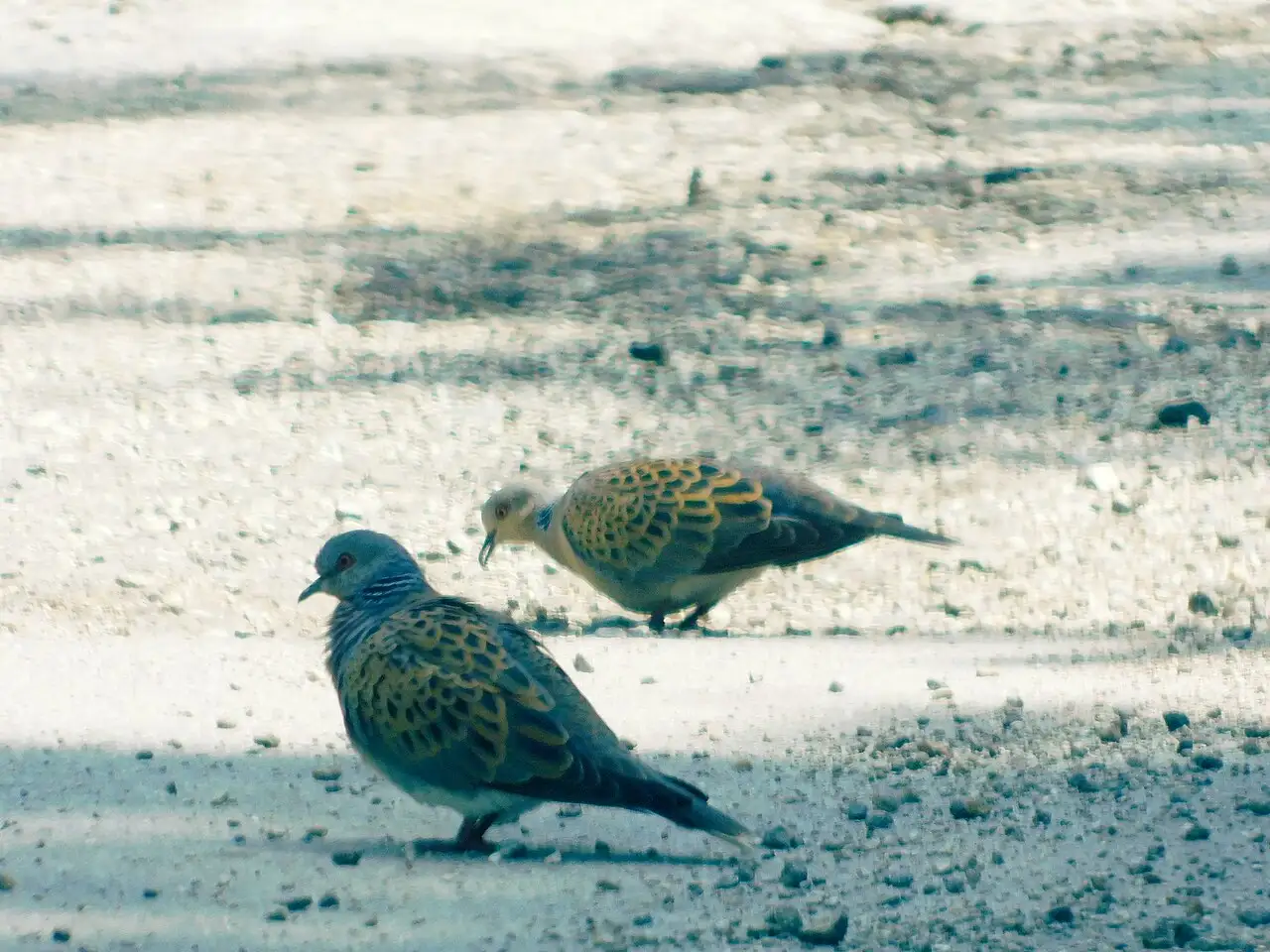
Pair of European Turtle Doves on a dirt track, with the back mottled with blackPhoto: Nikola Veljković, CC BY-SA 4.0Photo 4 of 4
1 / 4
Identification of the European Turtle Dove
The European Turtle Dove is a slender, light bird of delicate build. It has the back and shoulders orange and mottled with black, a collar of black and white stripes, the head and neck blue-grey, and the breast pink. In flight the dark flight feathers, a greyish wing band and the orange back stand out. The tail shows a characteristic pattern, with a black base and a broad white terminal band.
Adult
Back and shoulders orange, mottled with black.
Collar of black and white stripes; head and neck blue-grey; breast pink.
Tail with black base and a broad white terminal band.
Habitat and distribution of the European Turtle Dove
It is found throughout Europe, central Asia (as far as northern and central China), the Arabian Peninsula and tropical Africa. Four subspecies are recognised; in Spain there are two: «turtur», in the Canaries and the Peninsula, and «arenicola», in the Balearics.
It is well distributed throughout the Peninsula, the Balearics, the Canaries, Ceuta and Melilla, although it is scarce or absent at the highest altitudes of the main mountain massifs (Cantabrian Range, Pyrenees, Iberian System…).
It is a species of open, warm environments and prefers habitat mosaics where pastures and crops alternate with wooded hedges, small woodlots, riverside woods or dehesas, always with watercourses nearby. It avoids territories above 1,000 metres in altitude. The highest densities are reached in the dehesa formations of Pyrenean oak and holm oak in the centre and west of the Peninsula and in the Atlantic farmland.
It is a long-distance migrant, a summer visitor throughout its European range, with wintering areas in tropical Africa, south of the Sahara. In Spain, the summer breeding population is joined by migrating birds from central and eastern Europe. Pre-breeding passage takes place between April and May, with a peak in early May; post-breeding passage flows mostly through the western half and is concentrated between August and October, peaking in the first half of September.
Areas where it is regularly recorded since 2010Squares of about 25 km where it is recorded regularly (occasional passage records are left out). Data from GBIF.org (101,065 records, retrieved October 2026); outline from Natural Earth.
Etymology of the European Turtle Dove
According to Wikipedia, «Streptopelia» comes from the Ancient Greek «streptos» («collar») and «peleia» («dove»), and «turtur» is the Latin word for the turtle dove, an imitation of its song; the English «turtle» comes from there and has nothing to do with the reptile. It is also known as «tórtola europea»; in other languages it is «tórtora eurasiàtica» in Catalan, «rula común» in Galician, «usapal europarra» in Basque and «European turtle dove» in English1.
Population of the European Turtle Dove
The 2021 European Red List of Birds estimates some 5.02–9.51 million European Turtle Doves across the continent, with a decreasing trend. The Second Atlas of Breeding Birds in Spain estimates about 1.4 million breeding individuals, above all in Castilla y León, Andalusia, Castilla-La Mancha, Aragón, Extremadura and Galicia. The SACRE programme data suggest a decline of 37% between 1998 and 2018, sharper in the Eurosiberian region. The Spanish breeding population accounts for 73–77% of the birds that migrate along the western route, so the decline could have consequences on a continental scale.
The main threats are the destruction or alteration of the breeding habitat through agricultural intensification, that of the wintering habitat through droughts and overgrazing in Africa, and intense hunting pressure during autumn migration, in the «media veda» (the early-season hunt). It is proposed to protect the species legally in line with its threat category, to regulate hunting effectively, to promote field margins, waste ground and fallows and traditional forest management, to draw up recovery plans and to carry out censuses and studies1.
Nest of the European Turtle Dove
It nests in trees and shrubs. The nest is a simple, fragile structure of interwoven twigs.
Courtship and breeding of the European Turtle Dove
The breeding season runs from May to early August, and it can lay two or three clutches a year. The clutch consists of one or two white eggs incubated by both parents for 13–19 days. The chicks stay in the nest, cared for by both parents, and fledge at 20 days.
Diet of the European Turtle Dove
It is a seed-eating bird. It feeds mainly on cereal and herbaceous plant seeds, and also on fruits.
Curious facts about the European Turtle Dove
In 2015 SEO/BirdLife named it Bird of the Year to draw attention to its decline. According to EURING, the ringed bird that lived longest, in the Netherlands, reached 13 years and 2 months; AnAge gives 13.2 years.
The European Turtle Dove in Cabañeros
The habitat pages of this website do not mention it. GBIF.org records 159 observations of the European Turtle Dove in Cabañeros and its surroundings.
Where to see the European Turtle Dove in Cabañeros
In Cabañeros and its surroundings, from March to November.
When
From March to November: pre-breeding passage is between April and May and post-breeding passage between August and October.
What time
In good light, in dehesas and mosaics of pastures, crops and wooded hedges, always near water.
Where
On high branches, wires and the ground, where it looks for seeds.
What to look for
Look for the mottled orange back, the striped collar and the tail with the white band, and listen for its purr.



 Same family
 Same family
 Same family
 Same season in the park
 Same season in the park
 Same season in the park
 Same season in the park
 Same season in the park






