Wingspan compared with a person with arms outstretched.
Length
31–37 cm
Wingspan
68–78 cm
Weight
140–300 g
Social life
Solitary or in pairs
Lifespan
Record of almost 24 years in the wild
Conservation status
LC
NT
VU
EN
CR
EW
EX
Global (IUCN)
Least Concern
Spain
Endangered (Red Book of the birds of Spain)
When to see it
Resident in Cabañeros
Months of the year when it is present
J
F
M
A
M
J
J
A
S
O
N
D
In Iberia and Cabañeros
yes
yes
yes
yes
yes
yes
yes
yes
yes
yes
yes
yes
Breeding season
no
no
no
yes
yes
yes
yes
no
no
no
no
no
Song or voice of the Common Kestrel
It is a high, piercing cry that it repeats in series («qui-qui-qui»).
CallCommon Kestrel
0:00 / 0:09
10 kHz5
The sonogram draws the sound: time runs from left to right, and the higher a trace sits, the higher the note.
Flight of the Common Kestrel
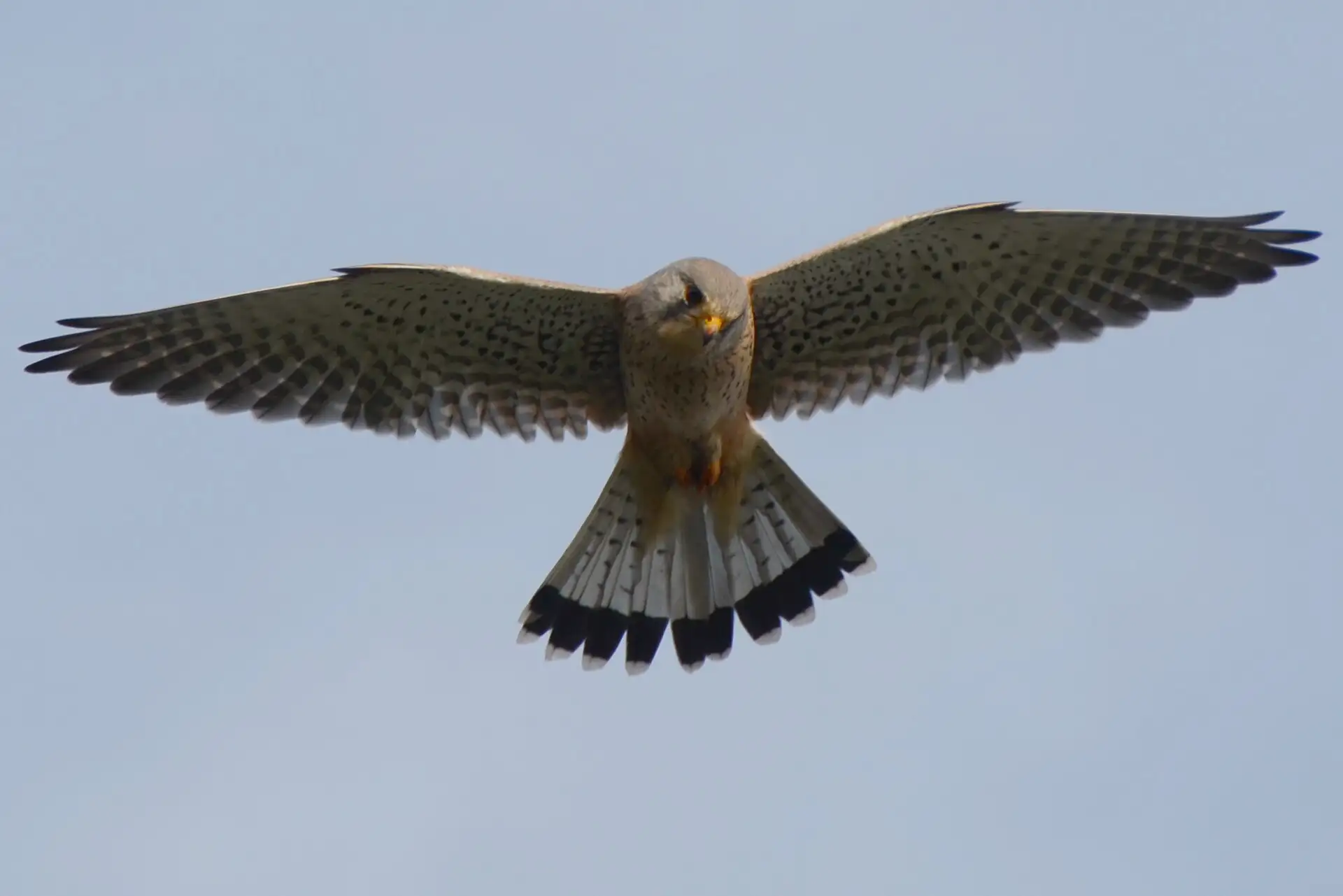
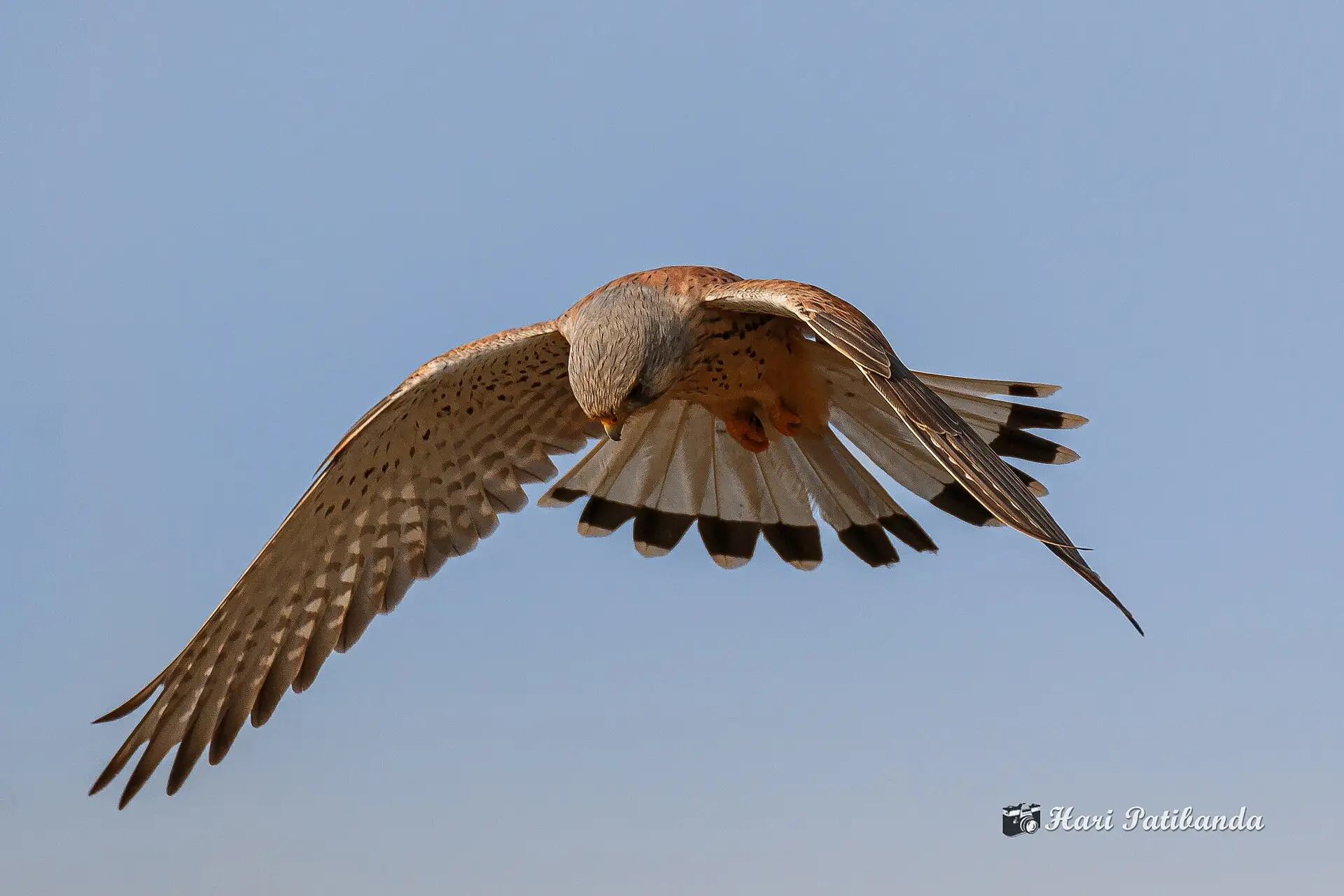
Its flight is direct with deep wingbeats, fluttering a lot. It hardly glides, and when it does it spreads its wings and tail in a fan. It performs acrobatics around cliffs. But what really gives it away is the hover: it stays still in the air, beating its wings, while it looks for its prey.
Flight typeHoverer
It ranges over the terrain at low height, with quick wingbeats and short glides, alert to any movement.
It stops facing the wind and hangs nailed in the air: the wings beat fast, the tail spread and the head perfectly still. If it does not like what it sees, it drops down a step.
It folds its wings and drops, thrusting its talons forward at the last moment onto the mouse or the grasshopper.
Photo gallery of the Common Kestrel
Hovering, from the front: wings beating and the tail fanned open, with its black bandPhoto: Henk Monster, CC BY 3.0Photo 1 of 4
Hovering, in profile, with the head still, looking at the groundPhoto: Hari K Patibanda, CC BY 2.0Photo 2 of 4
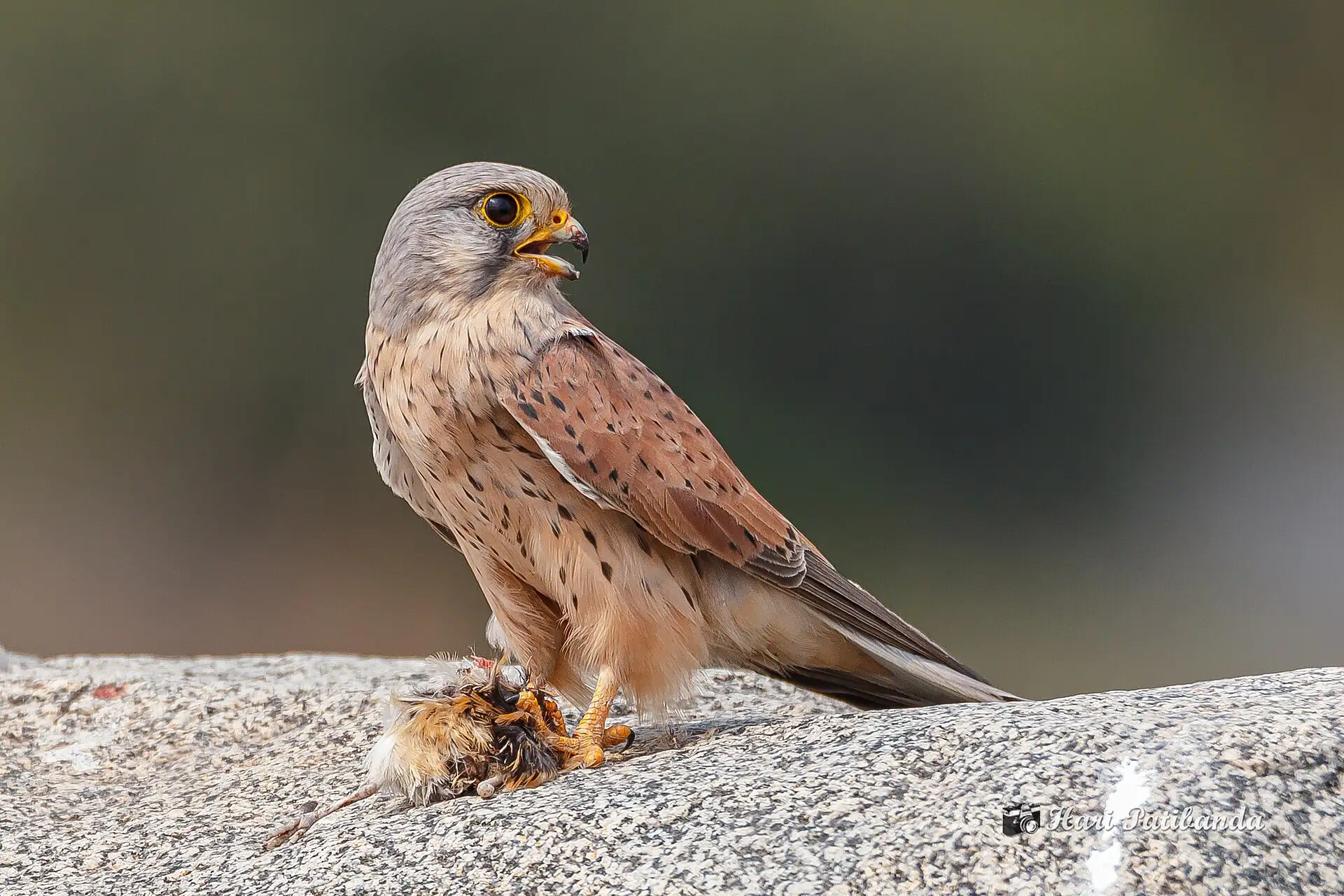
Male perched with prey: grey head and reddish back with spotsPhoto: Hari K Patibanda, CC BY 2.0Photo 3 of 4
Its size is similar to a pigeon’s, with long wings. It is a diurnal hunter that we can often see on electricity poles or fluttering near roads.
Without great differences in size between the sexes (the female is usually slightly larger), there is dimorphism in their pattern.
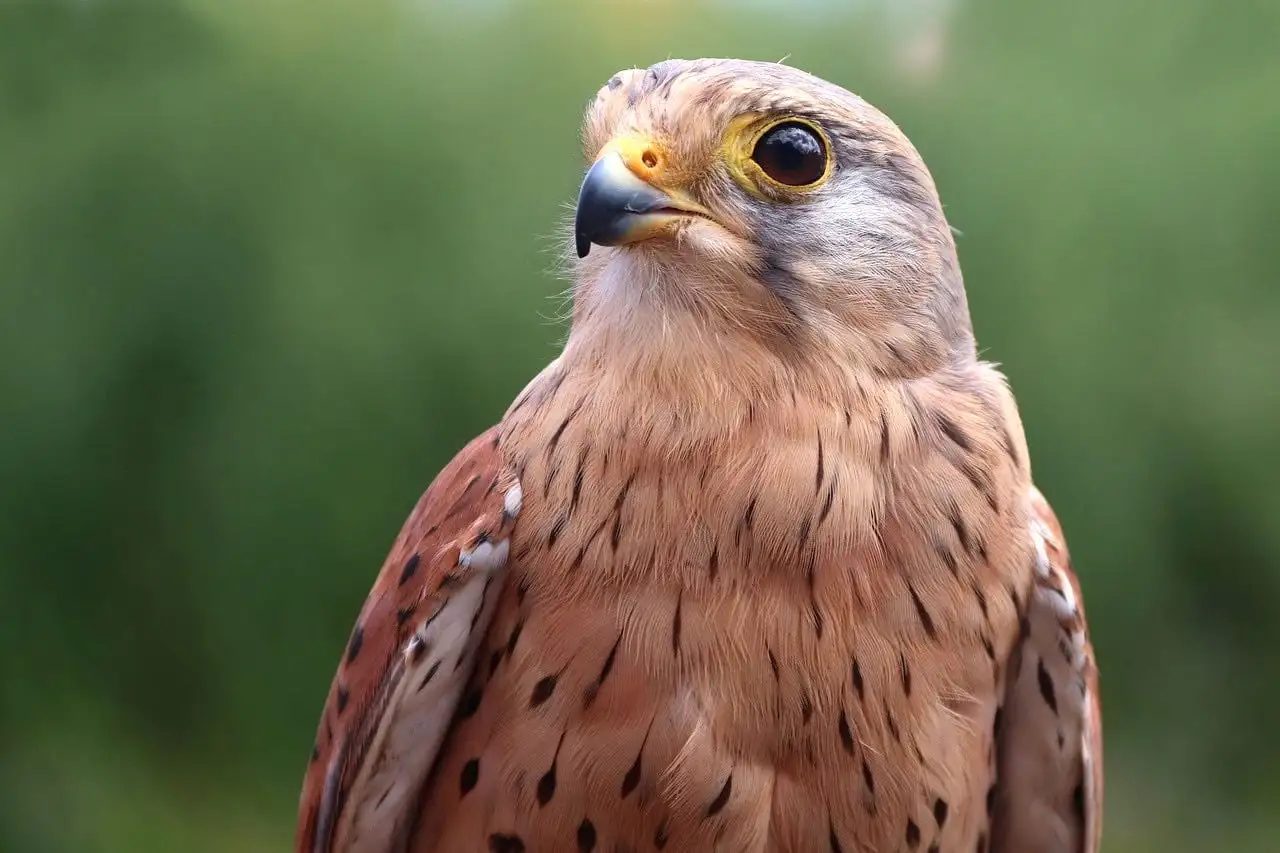
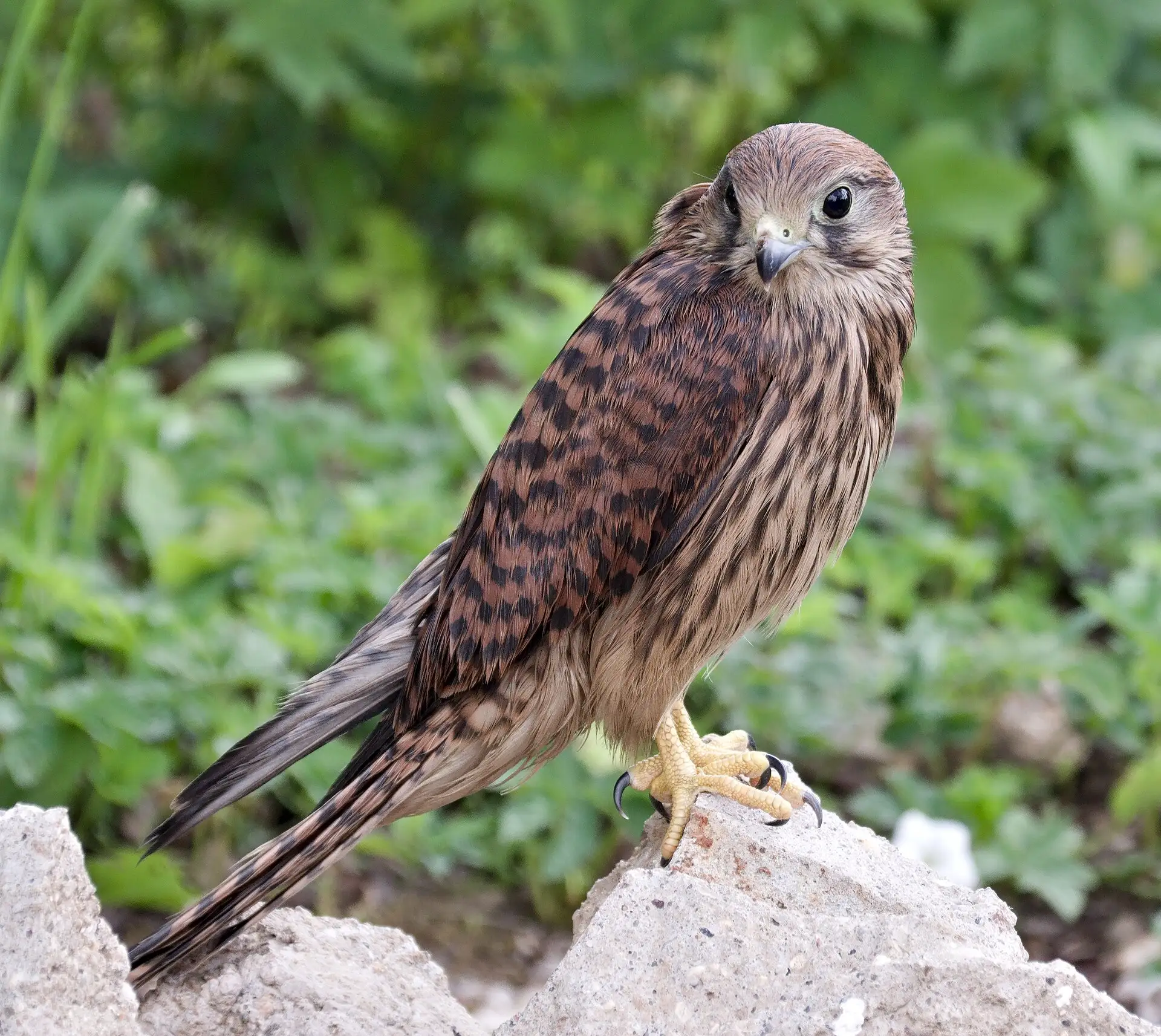
Both have a short, round head and black talons. Their wings are broad and somewhat pointed, the tail is long and they have a black band at the end of the tail.
Female
Her head is brown, of a warm colour.
The back and wings are streaked.
Her inner wings are light brown.
The outer wings are paler than the male’s.
The tail is brown, following the same pattern as the back and head.
The moustache is less evident.
Common Kestrel (Falco tinnunculus), female.
Male
The male has a bluish-grey head.
His back is light reddish brown with small black spots.
The outer wings are blackish brown, darker than the females’.
The tail is whitish.
Common Kestrel (Falco tinnunculus), male.
The key to telling them apart is to look at the head (bluish grey in the male) and the tail (brown in the female).
Habitat and distribution of the Common Kestrel
It is one of the most frequent birds of prey in Europe. It also appears in Africa and Asia, and can even reach tropical Africa and southern Asia in winter.
The kestrel can appear anywhere from cities to remote mountains. However, it is in woods and heathland that it is easiest to find. On crops its presence is dwindling because of the new farming systems.
In Spain it spreads as a breeder across the whole peninsula, including the archipelagos. Castilla y León, the border between Navarre and the Basque Country, the west and centre of Andalusia and the plains of Extremadura have the best populations of kestrels.
On the Peninsula and in the Balearics we find the subspecies tinnunculus, which occupies western Eurasia. The two endemic subspecies that occur in the Canaries are worth noting: dacotiae on Lanzarote, Fuerteventura and nearby islets; and canariensis, present on the other islands.
Areas where it is regularly recorded since 2010Squares of about 25 km where it is recorded regularly (occasional passage records are left out). Data from GBIF.org (531,737 records, retrieved October 2026); outline from Natural Earth.
Etymology
«Falco» comes from the Latin «falco» and means «falcon». Also from Latin, «Tinnunculus» means «kestrel», and is thought to come from «tinnio», to tinkle, from its high, repeated cry.
Population of the Common Kestrel
The kestrel population in Europe is estimated at between 330,000 and 500,000 breeding pairs. In Spain, the last census, in 2003, estimated about 17,500 pairs, but since then things have gone from bad to worse: the breeding population has fallen by around 50 % in the last 20 years, above all in farmland, because of changes in agriculture1. That is why the Red Book of the birds of Spain now classes it as «Endangered». In the Canaries a certain decline is also seen because of the alteration of its habitat.
Nest of the Common Kestrel
The kestrel sets its nest almost anywhere: on cliff ledges, quarries, window sills, ruined buildings, even electricity pylons. It also uses abandoned crow nests and tree hollows.
Courtship and breeding of the Common Kestrel
Clutches begin at the end of March, earlier in the Canaries. The earlier the laying, the larger it usually is. The norm is 1 brood of 3 to 6 eggs, of a warm, creamy, matt white with reddish-brown spots. Incubation, almost always by the female, lasts about 27–29 days. The chicks take their first flights when they reach a month old and become independent the following month, when they begin their dispersal, around August or early September.
Diet of the Common Kestrel
Well adapted to the territory it lives in, the kestrel catches small mammals, especially water voles. Although it also feeds on lizards and insects such as worms, beetles, crickets, grasshoppers, locusts and so on. It also eats other, smaller birds. In the Canaries, they even hunt the Barbary ground squirrel.
Its diet depends largely on the latitude and time of year it finds itself in.
Curious facts about the Common Kestrel
Kestrels have the ability to hover in the air, that is, to keep their position still and steady in the air, flapping their wings frantically, like a drone or a hummingbird, while watching their prey from on high. They are also able to catch caged birds, sticking their feet between the bars.
Quotations about the kestrel
We cannot forget its powerful talons in this quotation from Don Quixote, when Sancho receives this wise advice from the Knight of the Sorrowful Countenance.
—As to how you must govern your person and household, Sancho, the first thing I charge you is to be clean and to cut your nails, not letting them grow, as some do, whom their ignorance has led to believe that long nails beautify their hands, as if that excrescence and addition that they leave uncut were a nail, when it is rather the talon of a lizard-hunting kestrel, a filthy and extraordinary abuse.
CHAPTER XLIII: Of the second counsels Don Quixote gave Sancho Panza. Part Two of The Ingenious Gentleman Don Quixote of La Mancha. Miguel de Cervantes Saavedra.
Let us heed Don Quixote…
The Common Kestrel in Cabañeros
The kestrel is present all year, very common in summer and even more frequent in winter. It probably makes local movements to change habitat. On the raña it nests abundantly, using abandoned corvid nests. It also commonly does so in the scrub.
Laying takes place in mid-May and hatching coincides with the appearance of orthopterans, which serve as food. The chicks begin to fly in July.
From time to time it peeks into the nest boxes of the Lesser Kestrel colony house at Casa Palillos, where it can be mistaken for the Lesser Kestrel. The surest way to tell them apart up close is to look at the claws: black in the Common, white in the Lesser (park newsletter of January–February 2025) (in Spanish).
Where to see the Common Kestrel in Cabañeros
In any area, being easier to find on the cropped rañas.
When
All year, and even more in winter, when kestrels arrive from central and northern Europe.
What time
At any hour of the day. It hunts in daylight, and the hover is best seen on breezy days, when it takes less effort to stay still.
Where
On rañas with crops and grasslands, on track edges and on the poles and power lines from which it scans.
What to look for
A pigeon-sized bird pinned in the air over the raña, beating its wings without advancing, or perched on a pole with its long tail hanging.
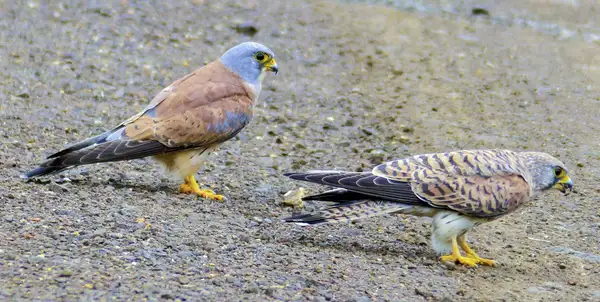
Smaller and more slender, with pale claws. The male has no spots on the back, which is plain reddish, and carries a bluish-grey band on the wing. It lives in colonies, in villages and buildings, and is a summer visitor.
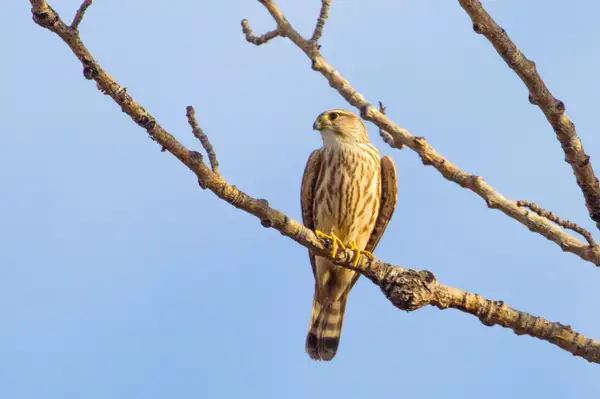
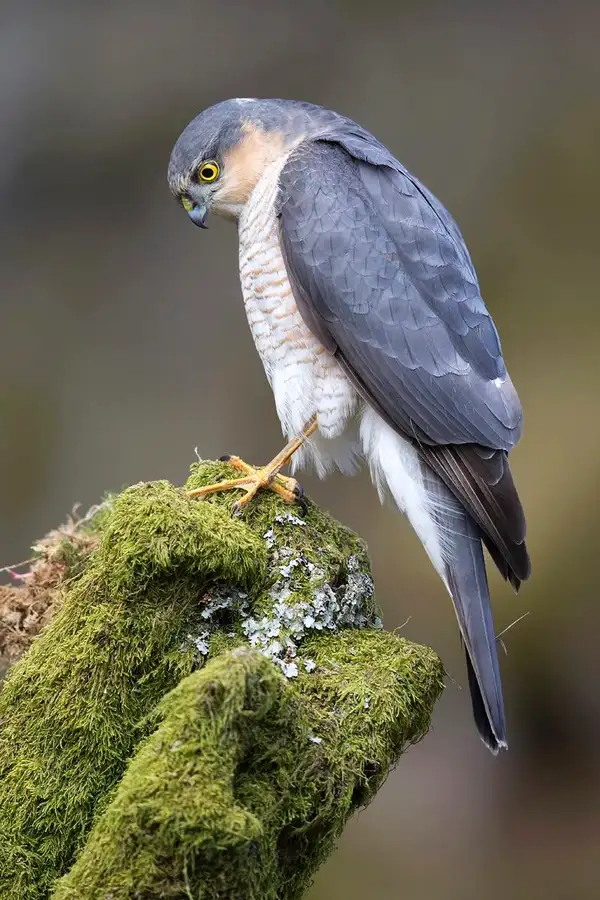
Smaller and more compact, with a shorter tail and wings broader at the base. It does not hover: it hunts by chasing small birds in low, fast flight. Only in winter.



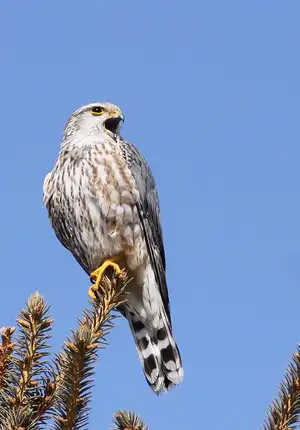 Same family
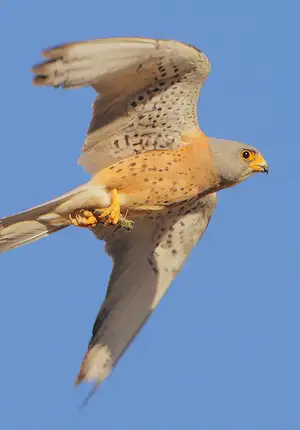 Same family
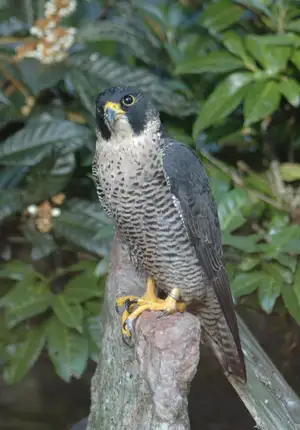 Same family
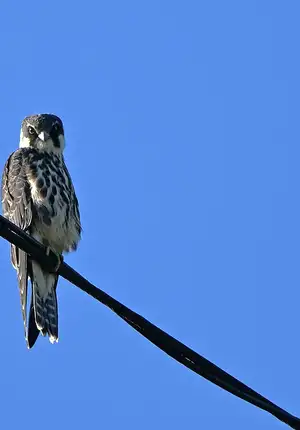 Same family
 Also in grasslands and rañas
 Also in grasslands and rañas
 Also in grasslands and rañas
 Also in grasslands and rañas






