Not especially territorial: several pairs may place their nests very close together; it wanders with other seed-eating birds through the fields
Lifespan
Record of 13 years and 2 months in the wild (a bird ringed in Great Britain and Ireland and found dead)
Conservation status
LC
NT
VU
EN
CR
EW
EX
Global (IUCN)
Least Concern
Spain
Least Concern (LC) in the Red Book of the Birds of Spain; not on the List of Wild Species under Special Protection or in the Spanish Catalogue of Threatened Species
When to see it
Resident
Months of the year when it is present
J
F
M
A
M
J
J
A
S
O
N
D
In Iberia
yes
yes
yes
yes
yes
yes
yes
yes
yes
yes
yes
yes
Breeding season
no
no
yes
yes
yes
yes
yes
yes
no
no
no
no
Song or voice of the European Greenfinch
Like other finches, it has various calls and a very characteristic breeding song. On taking off it usually gives a powerful trill, «chiri-ri-ri»; perched, alone or in a group, it makes a «chuiit» somewhat stronger than that of chaffinches. The male’s song, easy to recognise, has three quick verses («choro-ro…», «chi-ri-ri…», «chuing-ching…») finished off with a long, deep, metallic peep, «pruiiing».
SongEuropean Greenfinch
0:00 / 0:11
10 kHz5
The sonogram draws the sound: time runs from left to right, and the higher a trace sits, the higher the note.Recording by Jugrü, Wikimedia Commons (CC BY-SA 3.0).
Flight of the European Greenfinch
In flight, the broad yellow patches on the wings are useful for telling it from serins, linnets and goldfinches.
Flight typeUndulating, with yellow patches on the wings
On taking off it usually gives a powerful trill, «chiri-ri-ri».
It flies in waves, alone or with other seed-eaters. In flight, the broad yellow patches on the wings set it apart from serins, linnets and goldfinches.
It perches in a tree or comes down to pick up seeds from the ground or directly from the plants.
Photo gallery of the European Greenfinch
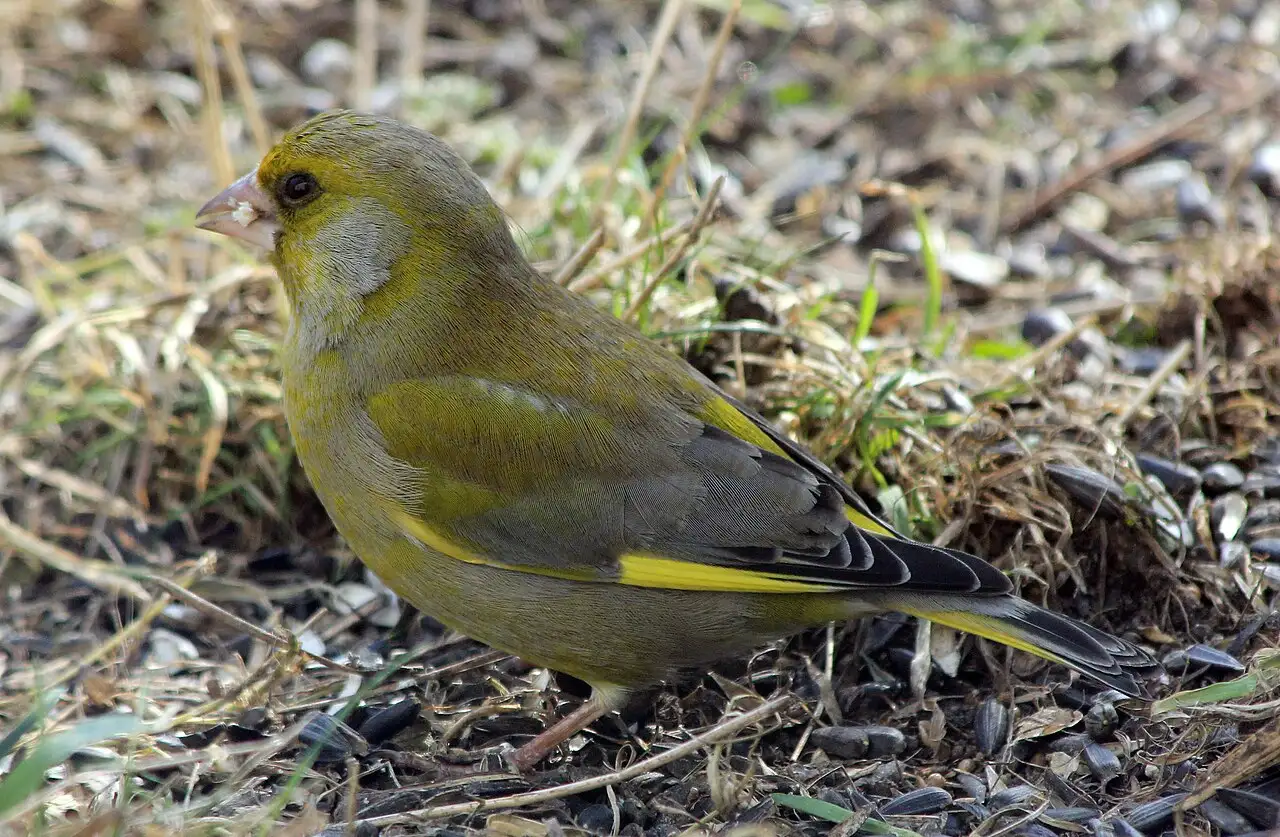
Male European Greenfinch in profile among sunflower seeds, olive-green, with a broad, strong bill and a yellow band on the wingPhoto: Karelj, CC BY-SA 3.0Photo 1 of 4
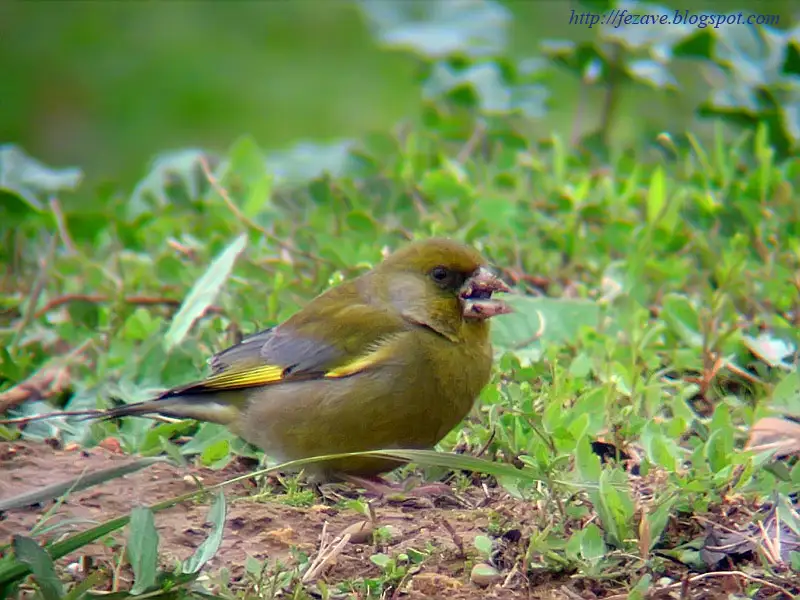
Male European Greenfinch on the grass, with a seed in its bill and the yellow patches of wing and tailPhoto: Fernando Zamora, Public domainPhoto 3 of 4
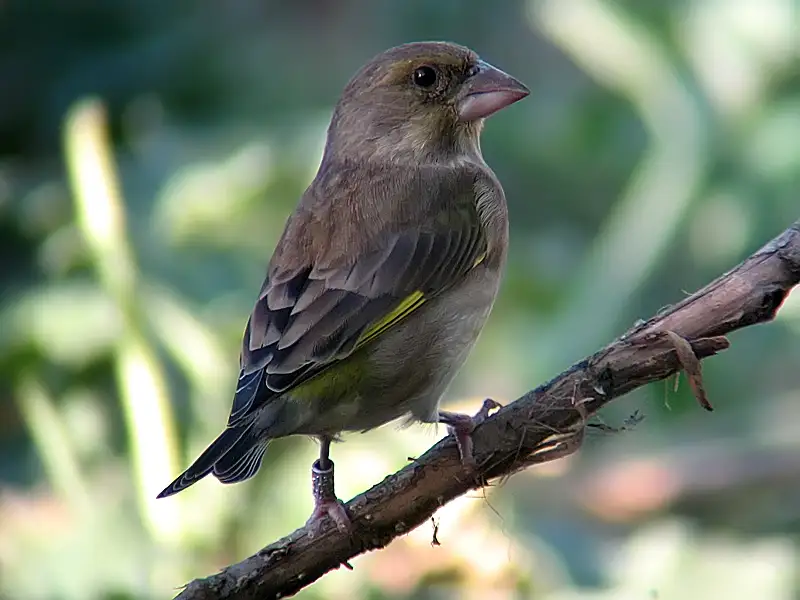
Female European Greenfinch on a branch, in more discreet colours, with a broad pink billPhoto: Fernando Zamora, Public domainPhoto 4 of 4
1 / 4
Identification of the European Greenfinch
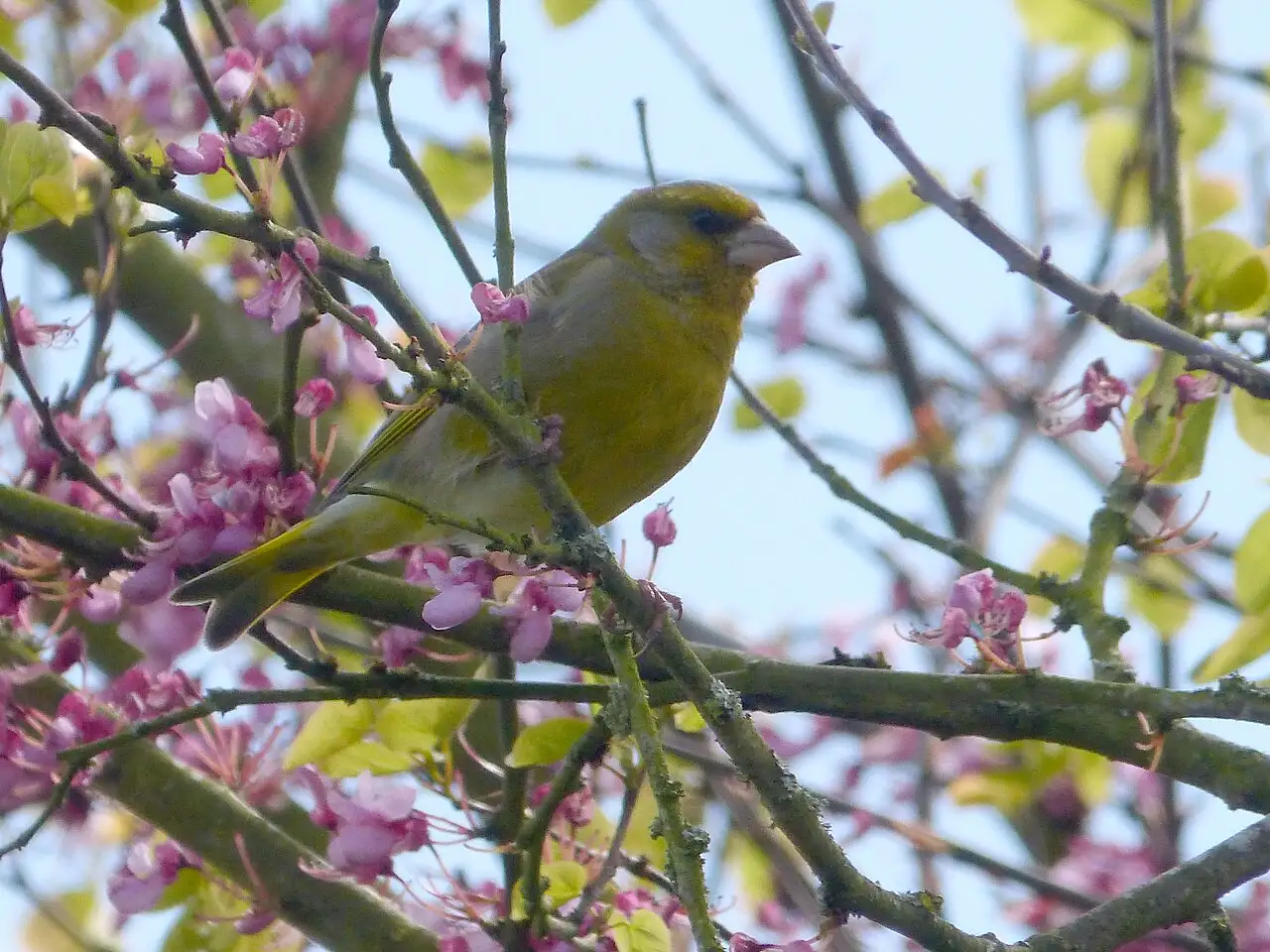
The European Greenfinch could be described as a «green sparrow». It has a robust head, with a broad, strong bill. Its emerald-green colouring stands out, with striking yellow patches on the shoulder, on the wing flight feathers and on the tail. Females have more discreet colours than males, but both are very alike. Only the juveniles look somewhat different: on leaving the nest they have mottled underparts and the green of the mantle and head much duller than the adults’.
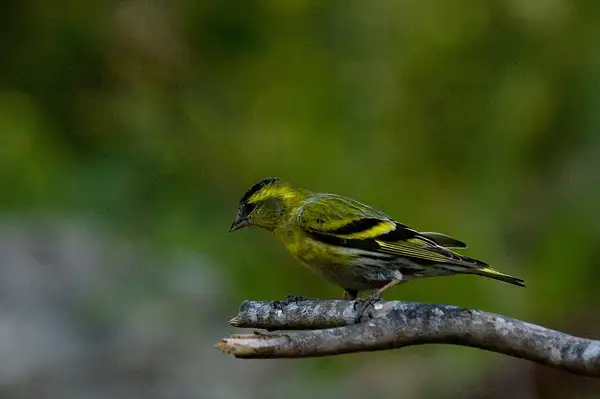
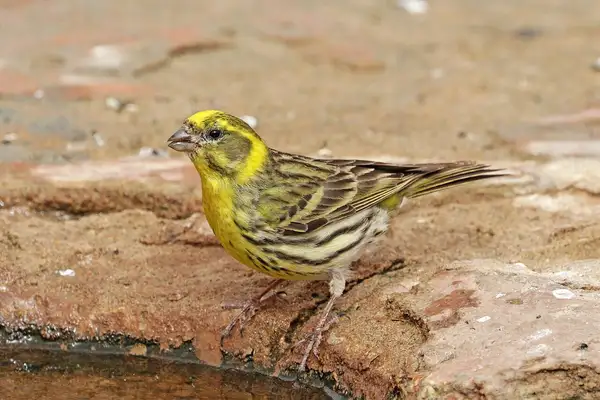
Its colouring resembles that of Citril Finches, Siskins and serins, but the Greenfinch is easily recognised by its larger size and the broad yellow patches on its wings. In flight, this detail is useful for telling it from serins, linnets and goldfinches.
Adult
Emerald green, with yellow patches on the shoulder, flight feathers and tail.
Robust head, with a broad, strong bill.
The female, in more discreet colours.
Young bird
Mottled underparts.
Green of mantle and head much duller.
Habitat and distribution of the European Greenfinch
It spreads across almost all of Europe, though it thins out in the interior and north of Scandinavia, and also occurs in North Africa. It seems to be expanding, not only northwards but also eastwards, reaching Israel and Egypt in recent decades. Several subspecies are recognised; in Spanish territory there are two: «vanmarli», in the north-west of the peninsula, and «aurantiiventris», in the rest of Spain and in Portugal.
It is found in practically all of Spain, including the Balearics, the Canaries (except Lanzarote), Ceuta and Melilla.
It occupies a diverse range of environments and a very wide altitudinal range, from sea level to 2,000 metres. It does very well in fruit-tree plantations, and also thrives in orchards, parks and gardens and, in general, in any environment with scattered trees: open broadleaf and conifer woods, hedgerows of trees or tall shrubs… In winter it concentrates mainly on the Galician Atlantic coast and in tree formations in warm climates, such as olive groves, orange groves, wild olive thickets, holm oak woods and stone pine woods, and wanders with other seed-eaters (serins, goldfinches, linnets) through herbaceous crop fields.
It is a partial migrant. The northernmost European populations, in Russia and Scandinavia, move south after breeding, and birds from Belgium, Germany, England, the Netherlands or Switzerland reach the Peninsula in winter. Within Iberian territory there are also sedentary and migratory populations: some Iberian birds, along with birds from the rest of Europe, cross to Africa in October and November, and return between February and April. With the arrival of the cold they concentrate at low altitudes and in warm territories (Mediterranean coast, Guadalquivir valley, Extremadura, Galicia), and in the Cantabrian Range, the Pyrenees and the Central and Iberian Systems they clearly decrease.
Areas where it is regularly recorded since 2010Squares of about 25 km where it is recorded regularly (occasional passage records are left out). Data from GBIF.org (64,440 records, retrieved October 2026); outline from Natural Earth.
Etymology of the European Greenfinch
According to Wikipedia, the scientific name «chloris» comes from «khloris», the Ancient Greek name of this bird, derived from «khloros», «green». In other languages it is called «verdum» in Catalan, «verderolo común» in Galician, «txorru arrunta» in Basque and «European greenfinch» in English1.
Population of the European Greenfinch
In the 2021 European Red List of Birds the European breeding population is estimated at between 41,500,000 and 64,400,000 mature individuals, with a decreasing trend. The Spanish census gave 6,293,125 greenfinches between 2014 and 2018, with the most important populations in Castilla y León, Andalusia and Castilla-La Mancha, which together make up about 51%. According to the SACRE programme for those dates, the trend is positive.
Given its abundance and its ability to fit into human-altered landscapes, both urban and farming, it does not seem a threatened species. However, it suffers considerably from the overuse of pesticides and herbicides in olive groves and other crops and, like other finches, from illegal or tolerated trapping: every year thousands of birds die or are caged.
Nest of the European Greenfinch
It is not especially territorial, and several pairs may place their nests very close together. To build them it uses very fine twigs, roots, hair, feathers, moss, lichens and grasses.
Courtship and breeding of the European Greenfinch
It breeds two or three times a year, from March to August. The female usually lays four to six eggs, but there are cases of clutches of between three and eight. Incubation lasts 11–15 days, and the chicks fly after two weeks of life; at that point the male usually feeds them, while the female starts the next clutch.
Diet of the European Greenfinch
It eats a very wide range of seeds, which it picks up from the ground or directly from the plants. It eats both the tiny seeds of wild mustards (crucifers) and the pine nuts of the stone pine. It also pecks at the pulp of fleshy fruits and, in spring, supplements its chicks’ diet with insects.
Curious facts about the European Greenfinch
According to Wikipedia, the male performs a «butterfly» display flight. According to EURING, the ringed bird that lived longest, in Great Britain, reached 13 years and 2 months; AnAge gives 13.6 years.
The European Greenfinch in Cabañeros
The habitat pages of this website do not mention it. GBIF.org records 198 observations of the European Greenfinch in Cabañeros and its surroundings.
Where to see the European Greenfinch in Cabañeros
In Cabañeros and its surroundings, all year.
When
All year: it is resident and partly migratory, and in winter birds arrive from other European countries.
What time
In good light, in open woods, hedgerows, orchards, olive groves and fields with scattered trees.
Where
On high branches, where it sings, or on the ground and plants, picking up seeds.
What to look for
Look for the emerald green, the broad bill and the yellow patches on the wings and tail.
Videos of the European Greenfinch
Similar species to the European Greenfinch
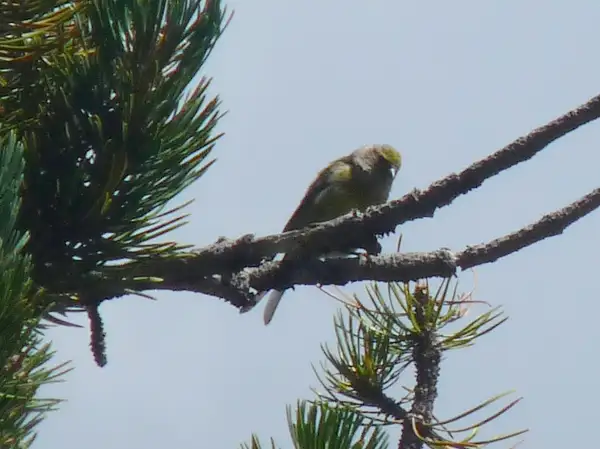
Citril Finch
Carduelis citrinella
How to tell them apart
It is similar in song and appearance1. The Greenfinch is recognised by its larger size and the broad yellow patches on its wings.



 Same family
 Same family
 Same family
 Same family
 Same order
 Same order
 Same order
 Same order






