In winter it gathers in flocks to sleep in reedbeds or bulrush beds; a second or third clutch is frequent
Lifespan
Record of 10 years and 7 months in the wild (a bird ringed in Germany)
Conservation status
LC
NT
VU
EN
CR
EW
EX
Global (IUCN)
Least Concern
Spain
Least Concern (LC) in the Red Book of the Birds of Spain; not on the List of Wild Species under Special Protection or in the Spanish Catalogue of Threatened Species
When to see it
Resident
Months of the year when it is present
J
F
M
A
M
J
J
A
S
O
N
D
In Iberia
yes
yes
yes
yes
yes
yes
yes
yes
yes
yes
yes
yes
Song or voice of the Corn Bunting
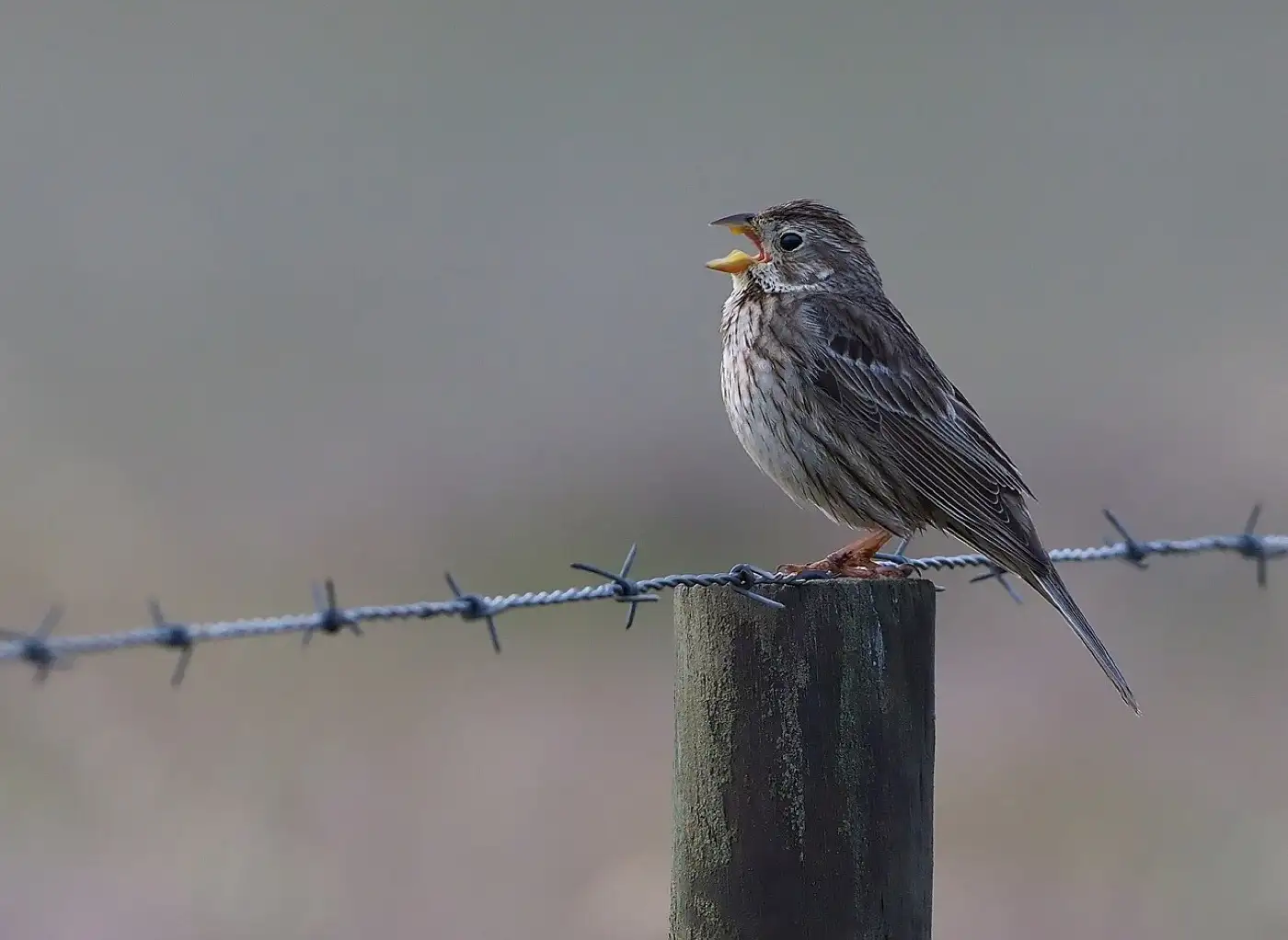
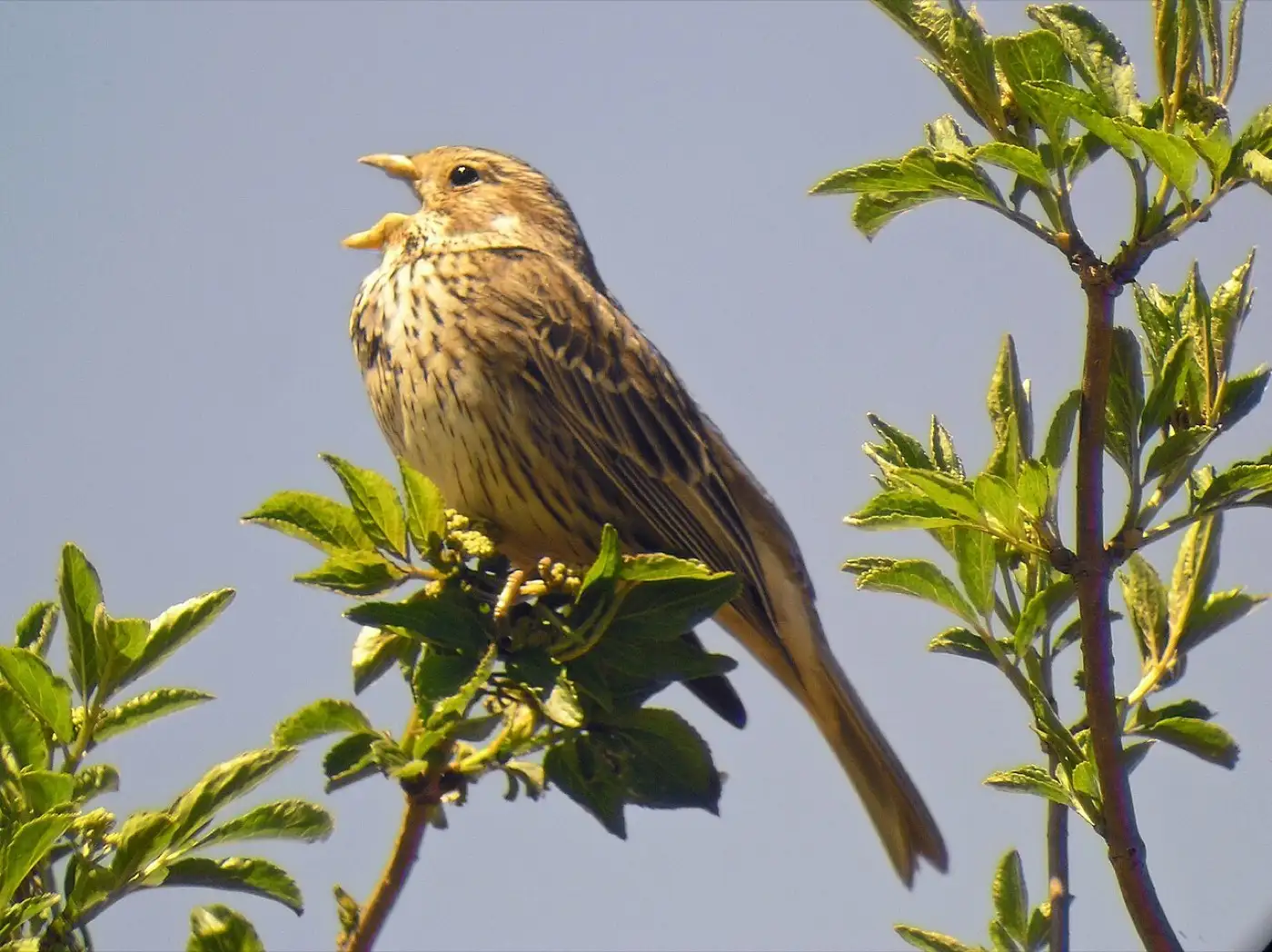
It is a very songful bird: it tirelessly repeats from a high perch a very characteristic trill, which starts hesitantly, speeds up and ends in a sort of screech, «zickzik-zikrisstrrr». As short contact calls it gives a «tsritt» or a brief, somewhat metallic «bit».
SongCorn Bunting
0:00 / 0:28
10 kHz5
The sonogram draws the sound: time runs from left to right, and the higher a trace sits, the higher the note.Recording by AviCanto, Wikimedia Commons (Vídeo de YouTube, con atribución).
Flight of the Corn Bunting
It sings from the top of a wire, a fence or a shrub. It prefers open, agricultural surroundings.
Flight typeShort flights between perches, over crops and grassland
It leaves the wire, the fence or the shrub where it sings, or the cereal field where it looks for seeds.
Short flight, from one perch to another, over crops and open grasslands or those with few trees.
It lands on a high perch and tirelessly repeats its trill: it begins hesitantly, speeds up and ends in a screech.
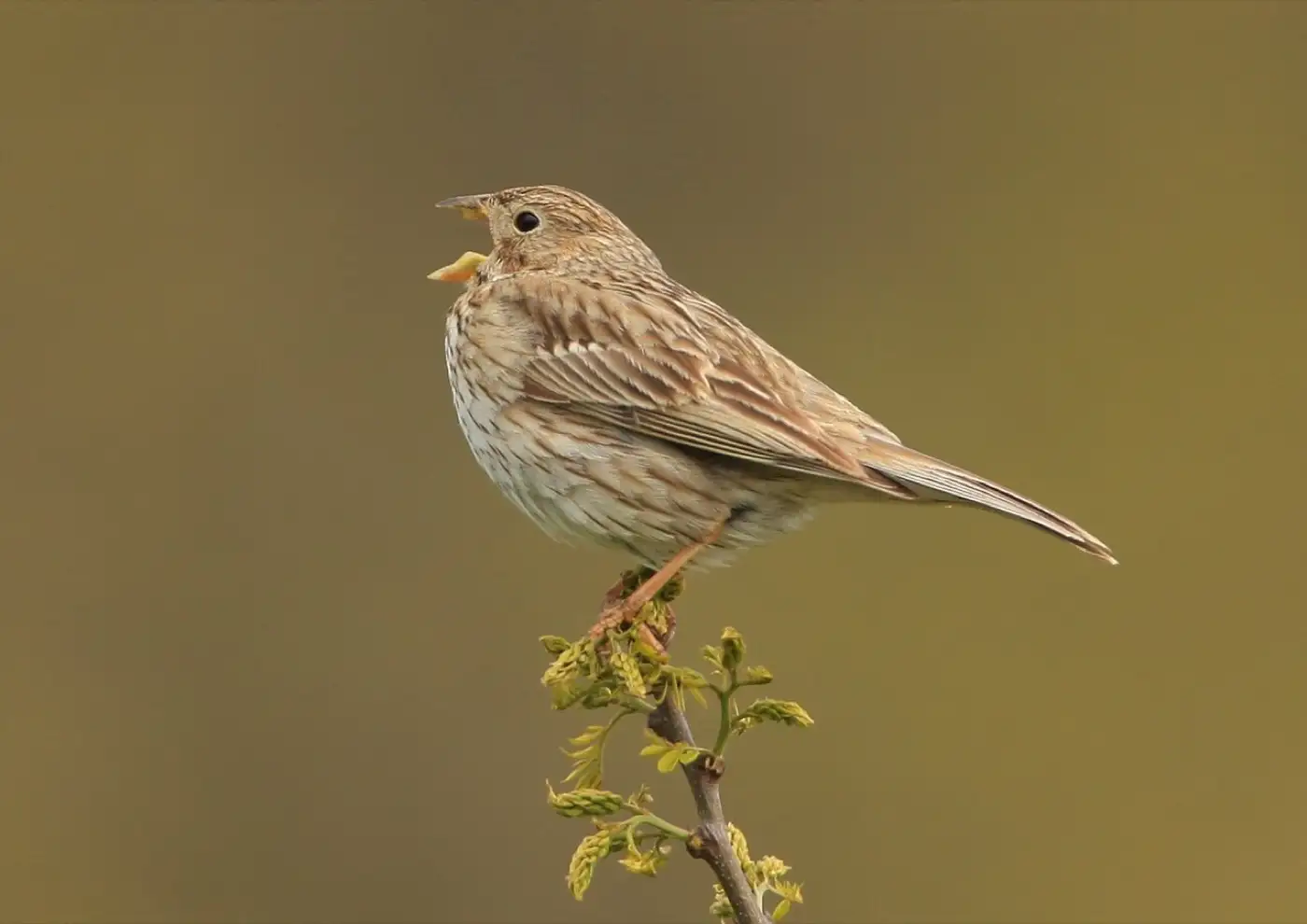
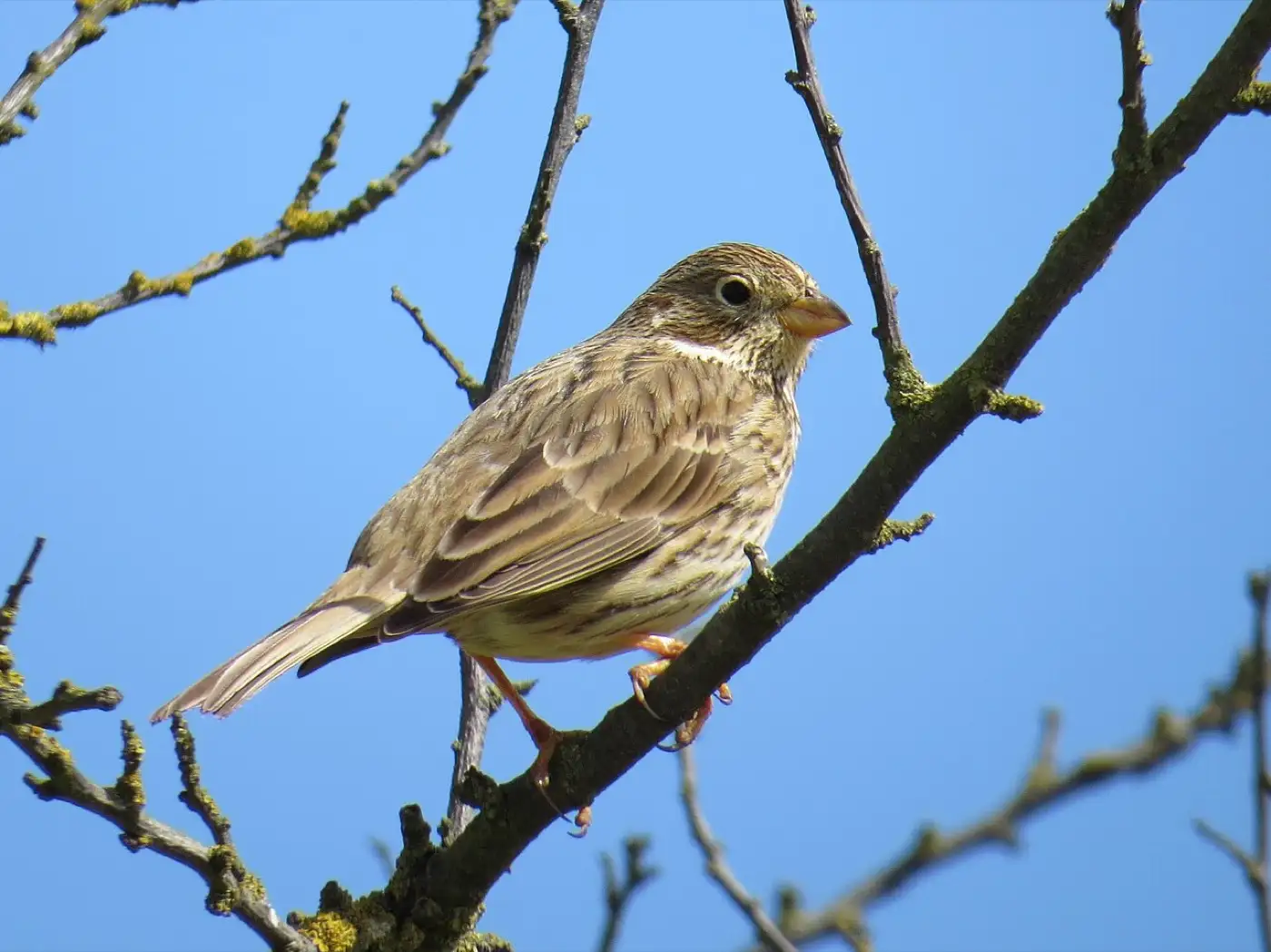
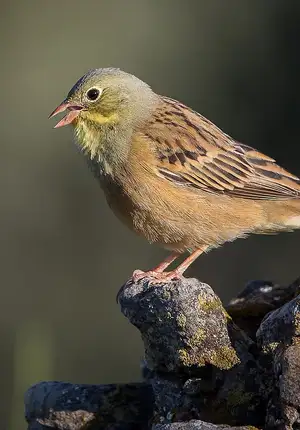
The Corn Bunting is a fairly bulky bird, considerably larger than other buntings, with plumage dominated by earthy and whitish tones with abundant streaks, which gives it a look like that of the larks. On the head, however, its membership of the bunting family is evident, above all from the white moustache framed by a dark stripe above and from a characteristic bill, though larger than that of other buntings, adapted to eating grain.
Adult
Bulky, in earthy and whitish tones with abundant streaks.
White moustache framed by a dark stripe, and large bill.
Habitat and distribution of the Corn Bunting
It ranges widely across the temperate regions of Europe and western Asia. South of the Mediterranean it appears only in the Maghreb and in the Canary Islands. It has several subspecies, and «calandra» is the one that lives in Europe.
In Spain it is an abundant species that is well distributed across the whole Peninsula and both archipelagos (except La Palma and Lanzarote), although it appears patchily in the Eurosiberian region, above all in certain areas of the Cantabrian fringe and in the most Atlantic districts of Galicia. It is also absent from Melilla.
It prefers open, agricultural surroundings, such as dry-farmed or irrigated herbaceous crops, and is also abundant in open dehesas, grasslands and other clear or sparsely wooded formations.
It behaves as a resident or as a partial migrant, depending on the area. The Spanish populations are resident throughout their range, although they may make medium- and long-range altitudinal and latitudinal movements to leave breeding areas that are harsher in winter, and for that reason it disappears in winter from the whole Cantabrian fringe and the main mountain ranges. The national contingent increases with the arrival of birds from Europe. In the coldest months it is common for birds to gather in flocks of some size to spend the night in reedbeds or bulrush beds.
Areas where it is regularly recorded since 2010Squares of about 25 km where it is recorded regularly (occasional passage records are left out). Data from GBIF.org (434,934 records, retrieved October 2026); outline from Natural Earth.
Etymology of the Corn Bunting
«Emberiza» comes from Old High German «Embritz», the name of a bunting. «Calandra» recalls the calandria, the large lark, which it resembles in appearance1. «Triguero» (from «trigo», wheat) comes to it from the fact that it feeds mainly on cereal seeds1.
Population of the Corn Bunting
In the 2021 European Red List of Birds the European breeding population is estimated at between 42,200,000 and 67,800,000 mature individuals, with a stable trend. For Spain an average of 10 million birds is estimated, with the largest populations in the centre and south of the Peninsula, and the population shows a moderate decline of more than 6 % in the last 20 years. It is a seed-eater still abundant despite agricultural intensification and pesticides1.
Nest of the Corn Bunting
The nest is set on the ground, under a dense, tangled shrub and, as with other buntings, consists of a simple cup of dry grasses, sometimes lined with hair.
Courtship and breeding of the Corn Bunting
The breeding season begins in late April or early May, although it starts somewhat earlier in the south and even earlier in the Canaries, where it begins in March. The clutch consists of four to six white or bluish eggs, marked with streaks and irregular speckles, which the female incubates alone. The male takes part in rearing the brood only in the final stage. The chicks leave the nest soon after hatching (some 7 or 10 days later), although they need food from their parents for at least another week. A second or even a third clutch is frequent.
Diet of the Corn Bunting
As its name indicates, it feeds mainly on seeds of various cereals, of cultivated or wild species, and on other plant matter. Often, above all in the breeding season, it adds all kinds of invertebrates to its diet.
Curious facts about the Corn Bunting
It is one of the sounds still frequent in spring in the open regions of almost all of Spain: a somewhat metallic, insistent, unmistakable song, from a wire, a fence or a shrub. Its look recalls a lark’s, but the white moustache gives it away as a bunting.
The Corn Bunting in Cabañeros
This website’s page on dehesas cites it, as «triguero», among the species of the nesting birdlife of the dehesas of Cabañeros, together with the Spanish Sparrow, the bee-eater, the roller, the hoopoe and the shrikes.
Where to see the Corn Bunting in Cabañeros
In the dehesas of Cabañeros and its raña.
When
All year round: it is resident, and sings mainly in spring.
What time
Throughout the day, singing from a high perch.
Where
In cereal crops, grasslands and open dehesas with few trees.
What to look for
A big, streaked, earthy bird, which repeats its trill from a wire.
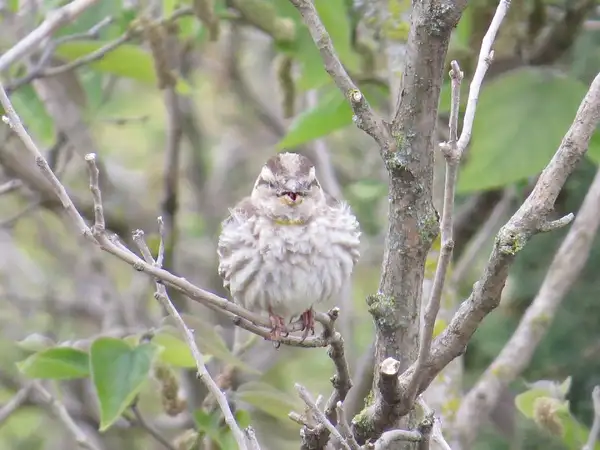
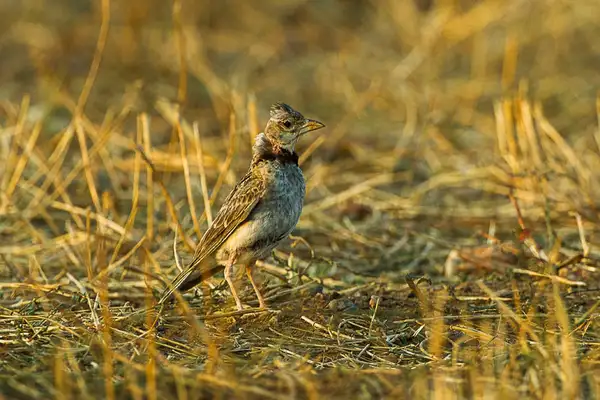
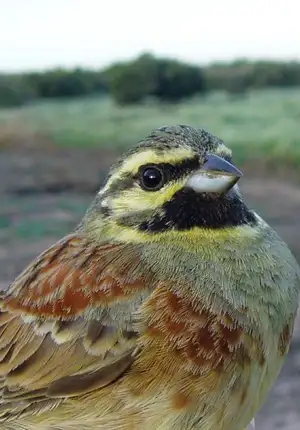
They are similar in appearance1. It is a large, stocky sparrow, with a robust head and a very strong bill, in greyish-brown tones with profuse dark streaking and three broad stripes on the head.



 Same family
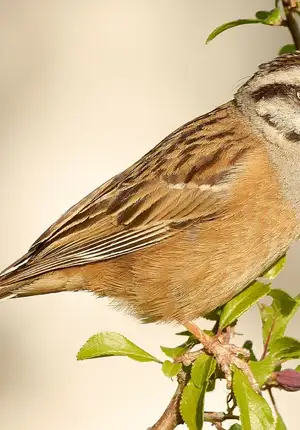 Same family
 Same family
 Same order
 Same order
 Same order
 Same order
 Same order






