Not listed: it does not appear in the catalogues of threatened species
When to see it
Resident in Cabañeros
Months of the year when it is present
J
F
M
A
M
J
J
A
S
O
N
D
In Iberia and Cabañeros
yes
yes
yes
yes
yes
yes
yes
yes
yes
yes
yes
yes
Breeding season
no
no
no
yes
yes
yes
yes
yes
no
no
no
no
Song or voice of the European Goldfinch
A musical, varied song, of penetrating trills mixed with short warbles, and in flight brief, cheerful tinkling notes.
SongEuropean Goldfinch
0:00 / 0:29
10 kHz5
The sonogram draws the sound: time runs from left to right, and the higher a trace sits, the higher the note.
Flight of the European Goldfinch
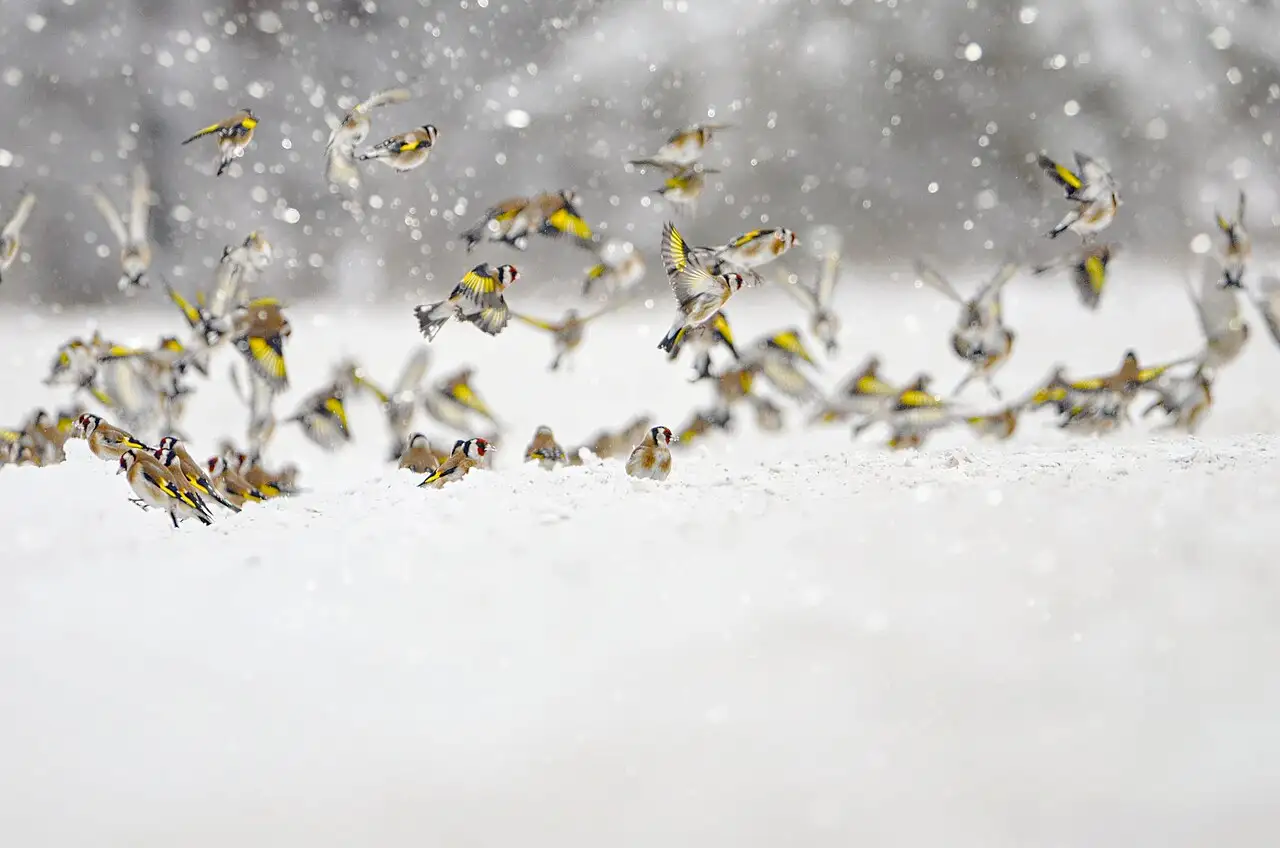
Its flight is light and bouncing, with a lively, vigorous movement that, together with its conspicuous colours, produces flashes in the landscape. The goldfinch is hopping and dancing, flies lightly and stretches its wings to flap. It alternates quick wingbeats with stretches in which it folds its wings and drops, and so it draws waves in the air.
Flight typeUndulating, in flocks
It takes off with a few nervous wingbeats and the whole flock follows, like a handful of yellow flashes.
Two or three quick wingbeats lift it; then it folds its wings completely and drops a stretch. That is how it draws waves in the air, and with each wingbeat the yellow bar can be seen.
It brakes with its tail spread, extends its wings and grips the plant to go on eating seeds.
Photo gallery of the European Goldfinch
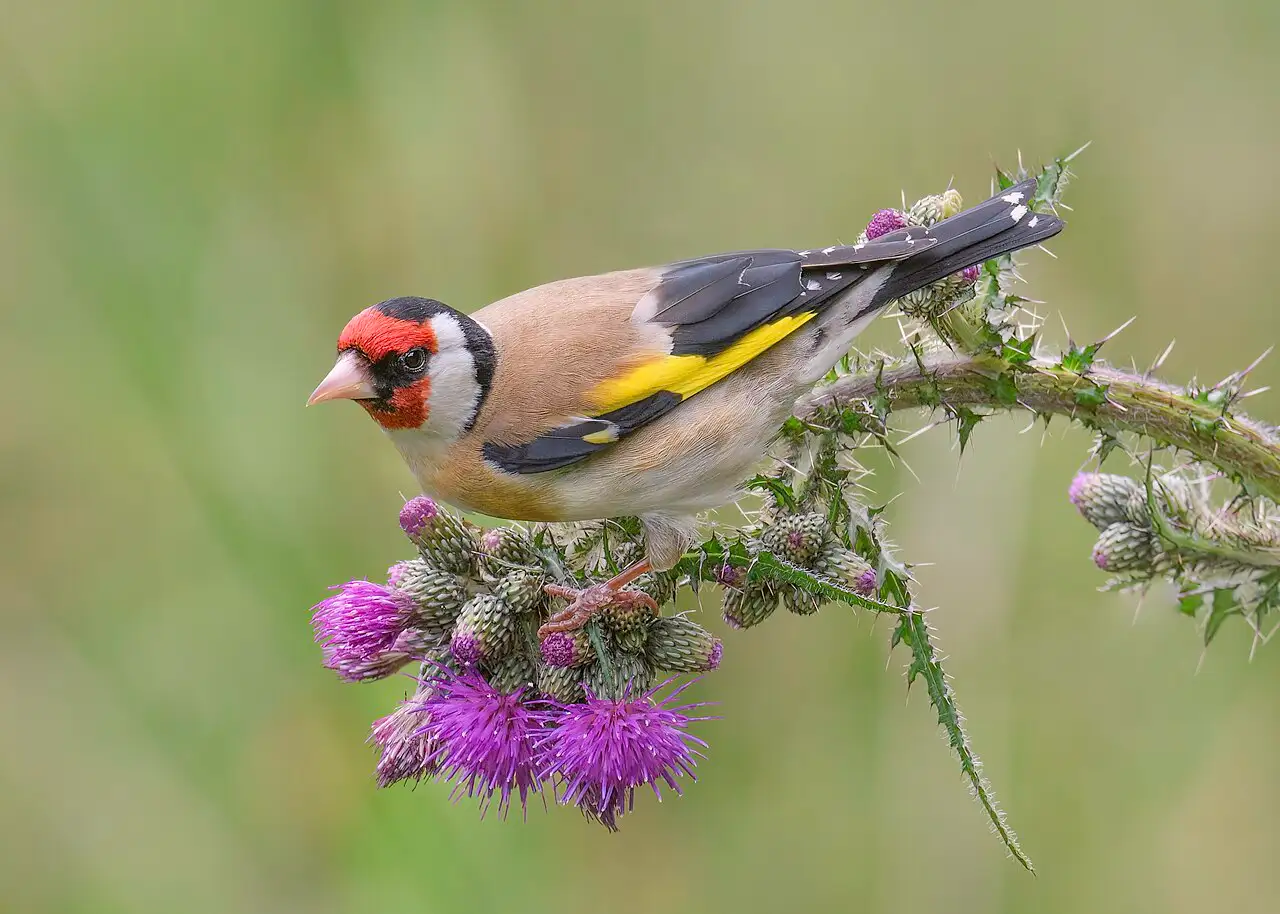
European Goldfinch on a flowering thistle, its favourite plant: red face, black mask and yellow wing barPhoto: caroline legg, CC BY 2.0Photo 1 of 4
Flock of European Goldfinches taking off over the snowPhoto: PetroKaterynych, CC BY 4.0Photo 2 of 4
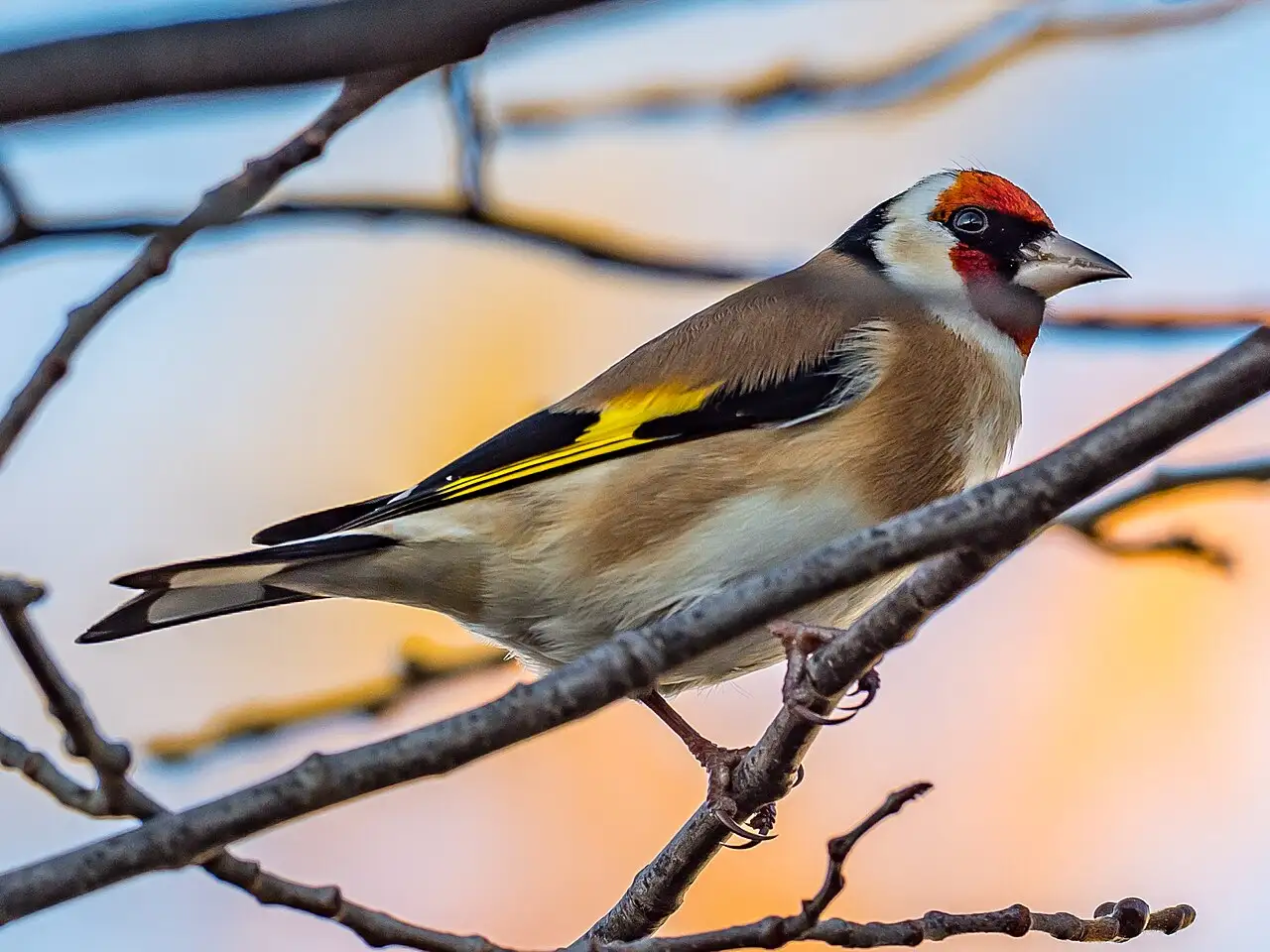
European Goldfinch in profile on a branch: the yellow wing bar and the black tail with white tips can be seenPhoto: Bengt Nyman from Vaxholm, Sweden, CC BY 2.0Photo 3 of 4
It is a bird that does not show great sexual dimorphism. The sexes can be told apart in that males have blacker shoulders and the red face is more extensive. When we see them in flocks, they are easily identified by a mass of yellow bars in vigorous, undulating flight.
Adult
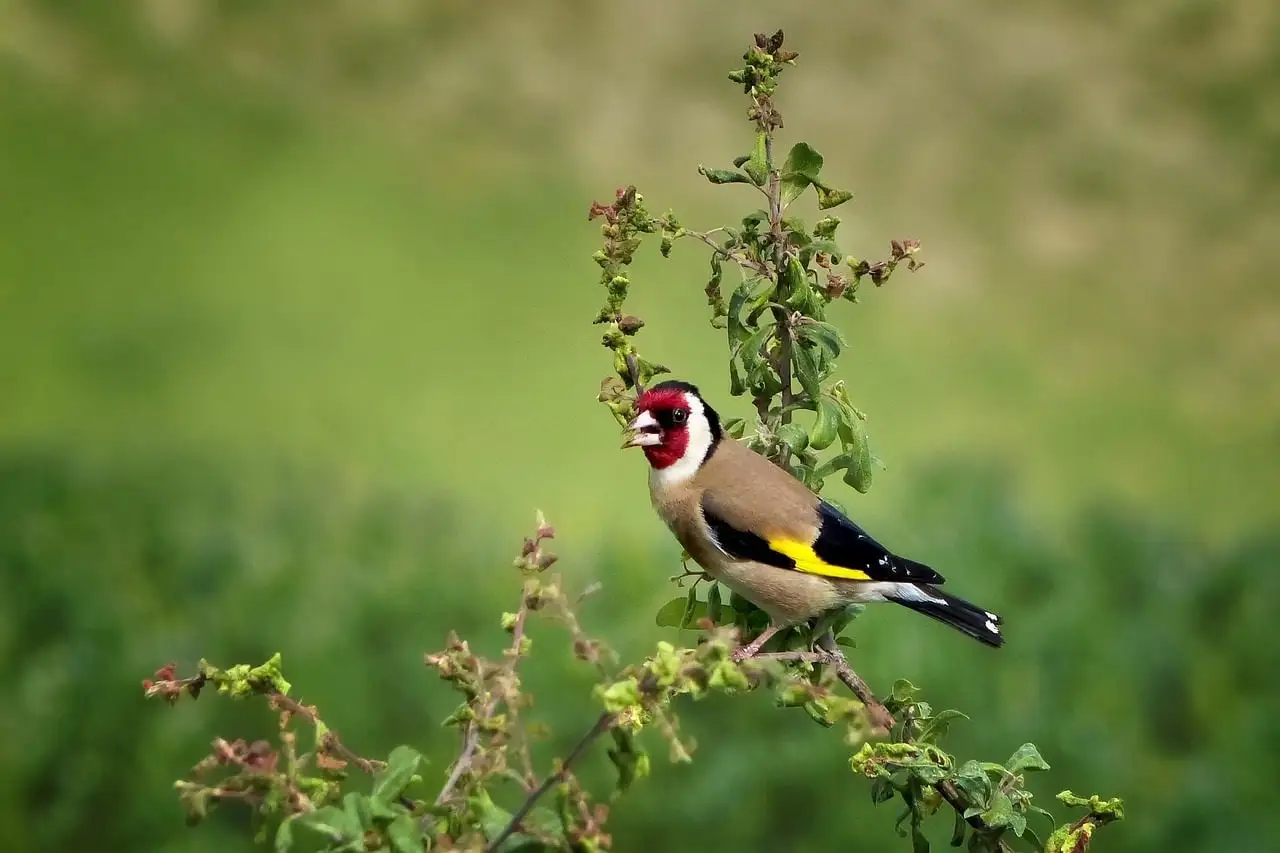
It is a showy bird, easy to tell thanks to its plumage. Its head is unmistakable, with a well-marked pattern in contrasting colours: the face is red, divided by a black band that covers its eyes, like a mask; from its neck comes a bright white that reaches the crown, which is black and continues, alongside the white, on the outside at the back of the head.
Its bill is pale and very sharp, with a broad base.
The goldfinch’s back is tan, with chestnut tones, which runs into the breast area marking two rectangular patches. Its underparts show paler, lighter tones, almost white.
Its wings are black with a yellow panel that crosses them through the middle and is visible when they are closed.
Its tail is black with white spots at the tip. The rump is also white.
Juvenile
Its body in general is darker, the head is grey and the wings are paler than in the adult.
Habitat and distribution of the European Goldfinch
The goldfinch ranges across the whole of Europe, even in damp, cold climates. However, it prefers the warm, dry summers of the Mediterranean. It breeds across almost all of Europe except Iceland and northern Scandinavia. In Asia we can find it in Mongolia and Saudi Arabia. It also appears in North Africa, entering the continent via the Nile basin. There are several subspecies and it was introduced to South America, Australia and New Zealand, as well as to Atlantic islands such as the Azores, Madeira and Cape Verde.
In Spain, the goldfinch spreads across the whole Iberian Peninsula and the archipelagos, also Ceuta and Melilla. The only resident subspecies that has been cited is carduelis. However, thanks to ringing we know that with the arrival of autumn the subspecies britannica visits us, coming from Great Britain.
It is a partial migrant. Those populations in the most northerly areas move south after their breeding period. In Spain we receive numerous goldfinches that come from or have passed through central or northern Europe. Many of them continue to Africa. Of those that reside on the Peninsula, we find sedentary and migratory ones. The latter cross the Mediterranean to winter in North Africa, and usually return from February.
Able to adapt to a great variety of habitats, the goldfinch opts for warm terrain where there are herbaceous environments with trees or large plants, especially where there are seeding flowers, for example, thistles. It does not usually live at altitudes above 1,800 metres. It often appears in tree crops of olives and in dehesas, open woodland and river floodplains with grasslands.
Areas where it is regularly recorded since 2010Squares of about 25 km where it is recorded regularly (occasional passage records are left out). Data from GBIF.org (946,711 records, retrieved October 2026); outline from Natural Earth.
Etymology of the European Goldfinch
Its name comes from «sily̆bum», a Latin word used to name thistles. That word, in turn, comes from another, Greek, of unknown origin: «σίλλυβον», which named the sea thistle. The origin of the goldfinch’s Spanish name («jilguero») has to do with its habit of eating thistle seeds, hence it was called «sil(l)ibarius», which would translate as something like «thistle-bird».
The same goes for its scientific name, which refers to another more common name for the thistle, «carduus».
Population of the European Goldfinch
It is calculated that in Europe there may be between 8.2 and 24 million pairs. In Spain between 14 and 15.5 million birds are estimated, with a stable trend though with fluctuations from year to year1. It is classified as Least Concern and does not appear in any catalogue of threatened species.
Nest of the European Goldfinch
The goldfinch builds a nest in the high branches of trees or shrubs. It is made of roots and grasses, with a whitish colour typical of the plant and animal fibres it uses, such as the white pappus of herbaceous plants and the sheep’s wool fibres that lie on thorn bushes.
Courtship and breeding of the European Goldfinch
Of all the finches, the goldfinch is the one that begins courtship latest. It makes 2 or 3 broods, from April–May to August, although in the south of the Peninsula it can pair up quite a bit earlier and breed in February.
The male builds the nest together with the female, and feeds her while she incubates, for some 12 to 14 days. The female normally lays 4 to 6 eggs, white with soft bluish tones and with spots of different sizes mostly located at the broad end. The chicks take flight at two weeks but are still fed for another week. When they become independent, the parents prepare for a new breeding cycle. At the end of summer, the family regroups and they form very large flocks.
Diet of the European Goldfinch
The goldfinch is a seed-eating bird that feeds mainly on soft, half-ripe seeds, which it finds on low and medium plants, even on the ground, though less often. It also eats tree seeds such as alders and birches. Its speciality, from which its etymological origin comes, is picking out the seeds of thistles and the rest of the plants of the family (Asteraceae), perching on top of the plants and selecting those that have not ripened. It also feeds on flower buds and seeds of wild mustards (Cruciferae).
Curious facts about the European Goldfinch
The goldfinch is the official bird of the states of New Jersey, Illinois and Washington. It is also a fairly repeated motif in Christian iconography painting, especially in Italian painting, where Raphael of Urbino’s Madonna del Cardellino, kept in the Uffizi gallery in Florence, stands out. Likewise, Vivaldi composed a flute concerto subtitled Il Gardellino, with a melodic motif clearly similar to the goldfinch’s song.
The European Goldfinch in Cabañeros
In the Montes de Toledo area it is also known as «colorín». The goldfinch is a fairly common species in the area. Two subspecies live here: parva, somewhat smaller and sedentary; and the nominate one, which joins the sedentary population in winter.
Laying occurs in late May and we can see the chicks flying in the first half of July.
Where to see the European Goldfinch in Cabañeros
During winter, the goldfinch appears on the rañas and near tracks and roads. When the heat comes, it moves to more wooded areas, preferably where there are vegetable plots nearby.
When
All year round. In winter there are more, because those from the north join in; the chicks fly in early July.
What time
First hours of the morning and last of the afternoon. In winter, in flocks that go over the fields at any hour.
Where
On the rañas and beside tracks and roads in winter; in the heat, in more wooded areas and near vegetable plots.
What to look for
A flock of little birds that move in hops among the thistles and shine with yellow flashes as they fly, with a continuous tinkling.



 Same family
 Same family
 Same family
 Same family
 Same order
 Same order
 Same order
 Same order






