Wingspan compared with a person with arms outstretched.
Length
49–56 cm
Wingspan
0.89–1.22 m
Weight
0.5–2.2 kg
Social life
Strong reversed sexual dimorphism: the female is quite a bit larger; the pair keeps several nest platforms in its territory
Lifespan
Record of 22 years in the wild according to EURING (a bird ringed in Sweden); AnAge also gives 22 years
Conservation status
LC
NT
VU
EN
CR
EW
EX
Global (IUCN)
Least Concern
Spain
Least Concern (LC) as a breeder in the Red List of Birds of Spain; on the List of Wild Species under Special Protection, but not in the Spanish Catalogue of Threatened Species
When to see it
Resident
Months of the year when it is present
J
F
M
A
M
J
J
A
S
O
N
D
In Iberia
yes
yes
yes
yes
yes
yes
yes
yes
yes
yes
yes
yes
Song or voice of the Eurasian Goshawk
It gives a characteristic cry, «pjiiia pjiiia», accompanied also by a «kha kha kha». The begging call, very loud and plaintive, is a violent «piiii ih piiii ih». The recording, from France, captures a series of «kha kha kha» and other calls during the passing of prey between the pair.
CallsEurasian Goshawk
0:00 / 0:20
10 kHz5
The sonogram draws the sound: time runs from left to right, and the higher a trace sits, the higher the note.Recording by Benoît Van Hecke, xeno-canto XC543711 (Quinçay, Vienne, Francia) (CC BY-SA 4.0).
Flight of the Eurasian Goshawk
It has a very characteristic silhouette, above all on the few occasions when it is seen rising above the treetops: relatively short, broad, rounded wings and a very long tail, adaptations that give it great mobility within thick woodland.
Flight typeAgile among trees, with short, broad, rounded wings and a very long tail
Closely tied to woodland, it occupies, from sea level to 2,000 metres, any wood with cover for nesting and prey.
Its relatively short, broad, rounded wings and very long tail give it great mobility in the thicket.
It hunts mainly medium-sized birds, such as corvids and pigeons, and mammals such as rabbits, hares and squirrels.
Photo gallery of the Eurasian Goshawk
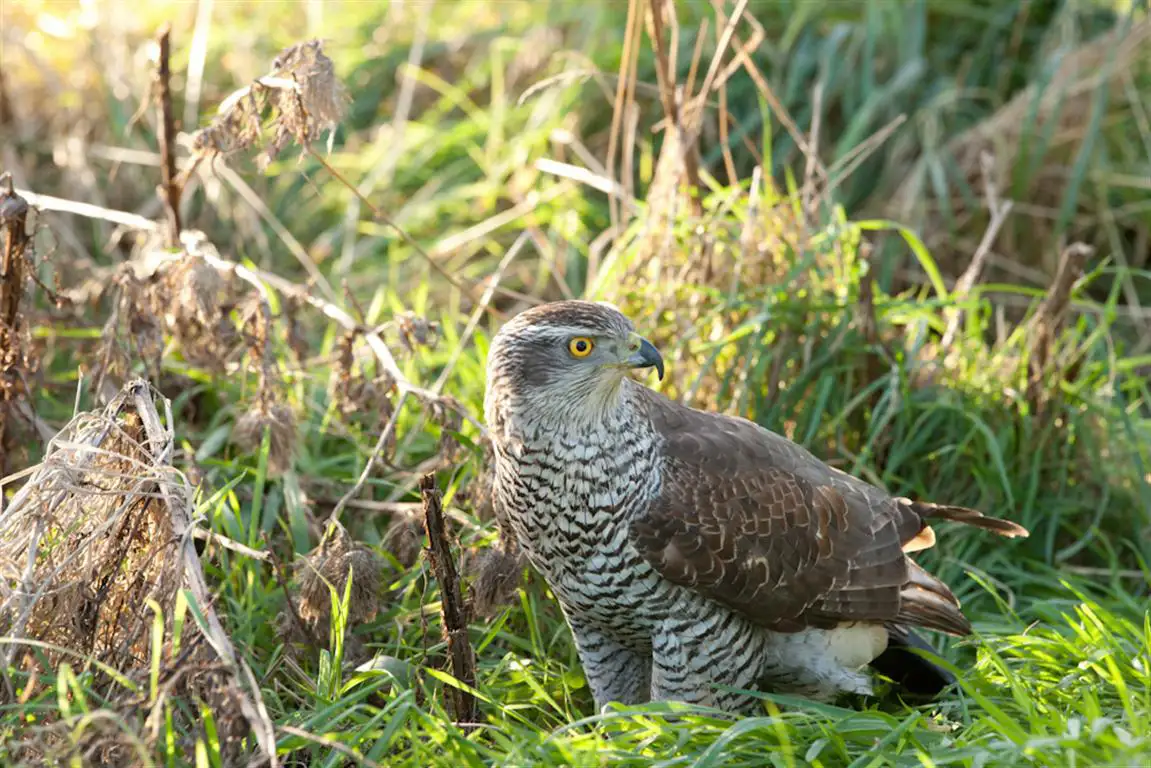
Adult Eurasian Goshawk in the grass, with yellow eye, pale eyebrow, greyish-brown back and finely barred breastPhoto: Nigel Wedge from Fife, Scotland, CC BY 2.0Photo 1 of 4
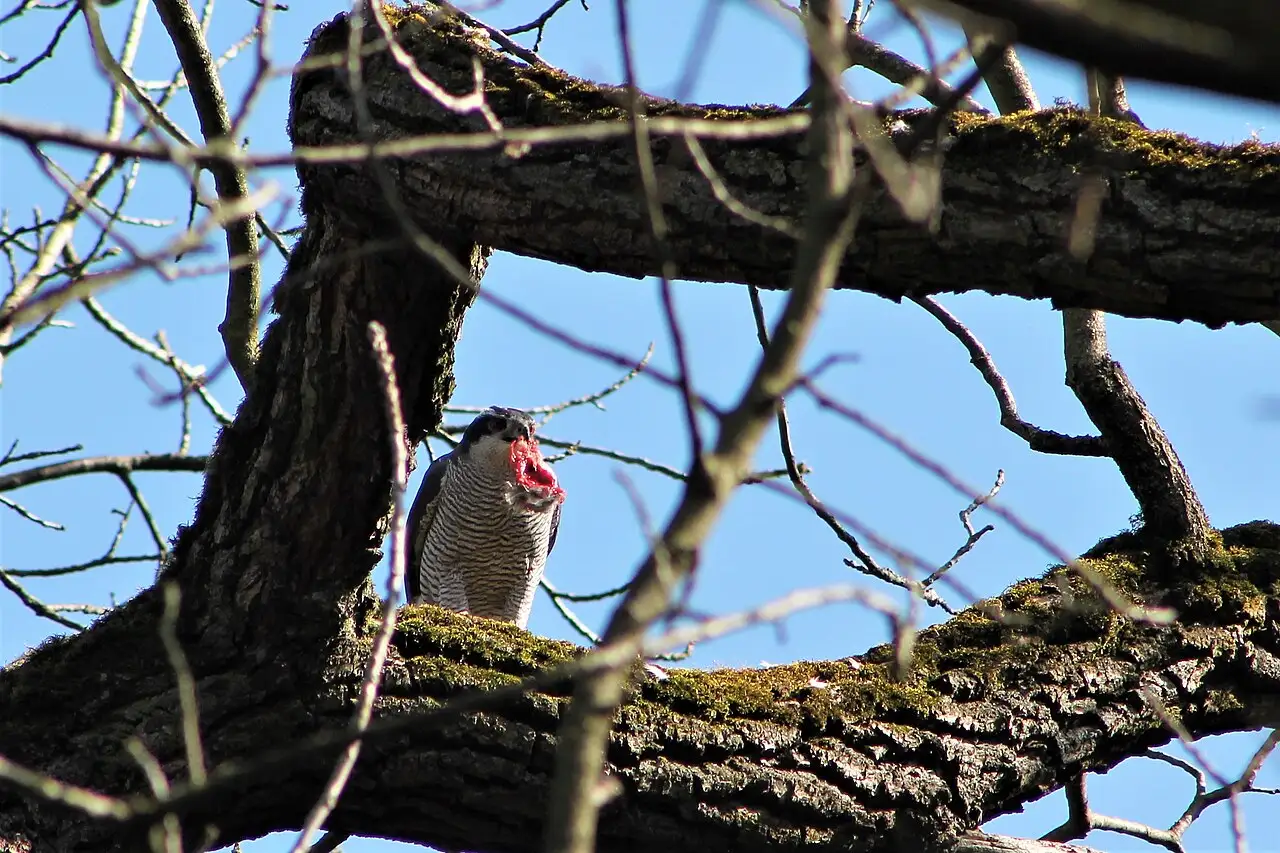
Eurasian Goshawk perched on a thick tree branch, plucking preyPhoto: Afr.1994, CC BY-SA 4.0Photo 2 of 4
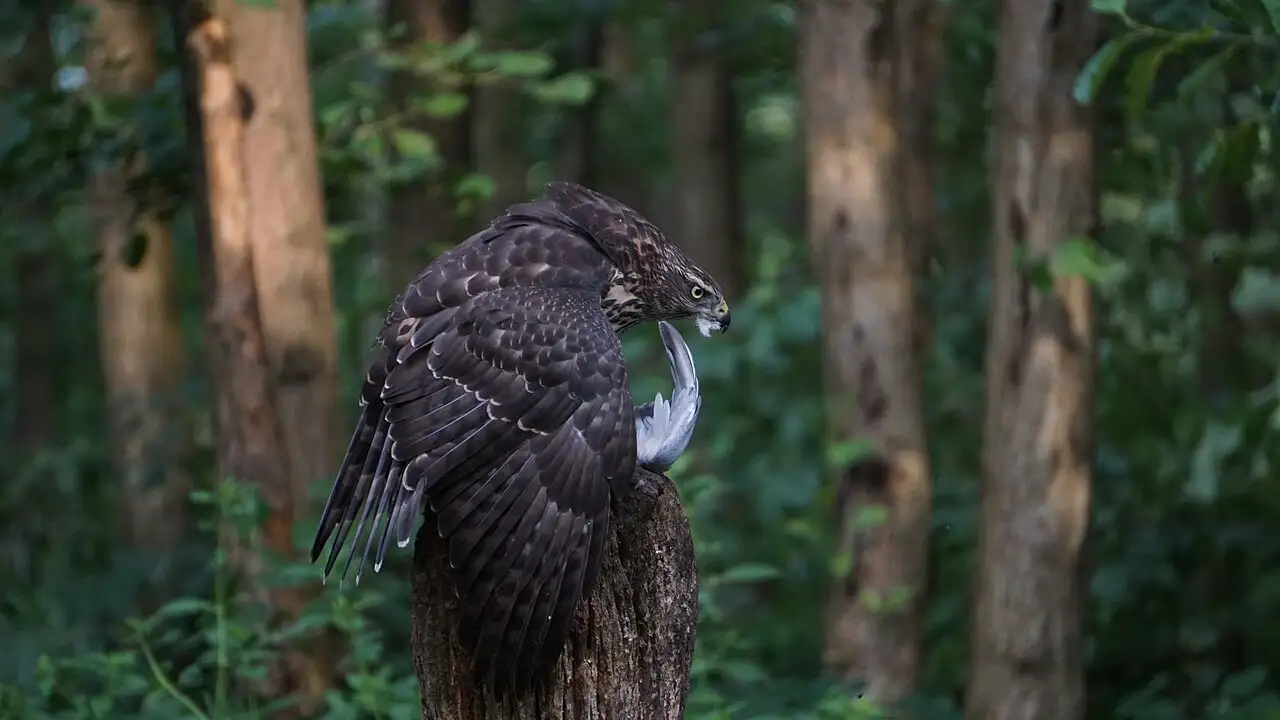
Eurasian Goshawk on a forest stump, with wings spread over the prey to hide itPhoto: Didij39, CC BY-SA 4.0Photo 4 of 4
1 / 4
Identification of the Eurasian Goshawk
It is a medium-sized raptor with markedly woodland habits, with marked reversed sexual dimorphism: females are quite a bit bulkier than males. In plumage the differences are more subtle: the male is dark grey above, with the breast and underside of the wings finely barred; the female is somewhat browner above, has a less contrasting head and coarser barring below. Both show a marked eyebrow. Young birds are brown above and pale brown or reddish below, with abundant lengthwise spots, and do not acquire adult plumage until three years.
Adult
Male: dark grey above, finely barred below.
Female: larger, browner, with coarser barring.
Marked eyebrow in both sexes.
Young bird
Brown above and pale brown or reddish below, with lengthwise spots.
Habitat and distribution of the Eurasian Goshawk
It is widely distributed across the northern hemisphere: it breeds in North America, in Europe and in a broad strip of central Asia, almost to its far east. Several subspecies are recognised, and in Spain «gentilis», that of continental Europe, lives.
It occupies much of the Peninsula, more continuously in the northern half, except the Ebro valley, and quite fragmented in the south, where there is less forest. In the north it uses any wooded area, even the isolated pine copses of the Meseta, and in the south it takes refuge above all in the sierras; the Atlas of Breeding Birds of Spain (MITECO, 2003) cites the Montes de Toledo among them. It is almost entirely absent from the Guadalquivir valley, the south-east, the more open areas of Extremadura and much of the southern Meseta, and is not on the archipelagos, Ceuta or Melilla.
It is closely tied to woodland, but without preferring one type or another, and settles from sea level up to 2,000 metres in any spot with trees to nest and shelter in and with prey: also in holm oak woods, fragmented or plantation pine woods, isolated copses and gallery woods of the plateaus. It is resident: adults are sedentary and young birds only make short movements until they find a territory.
Areas where it is regularly recorded since 2010Squares of about 25 km where it is recorded regularly (occasional passage records are left out). Data from GBIF.org (36,132 records, retrieved October 2026); outline from Natural Earth.
Etymology of the Eurasian Goshawk
According to Wikipedia, it is now placed in the genus «Astur», revived from Lacépède (1799). The scientific name is Latin: «astur» means «hawk», and «gentilis», «noble», because in the Middle Ages only the nobility could hunt with goshawks. In other languages it is called «astor comú» in Catalan, «azor común» in Galician, «aztore eurasiarra» in Basque and «northern goshawk» in English1.
Population of the Eurasian Goshawk
In the 2021 European Red List of Birds the European population is estimated at between 234,000 and 380,000 adult individuals, with a decreasing trend. In Spain there is no current estimate: the two earlier ones range from the 3,500–6,500 pairs of the 2003 census to the 11,350 sure territories of the 2009–2010 one, with the best contingents in Galicia and Castilla y León. No general trend can be established: it seems stable in the northern half, has dropped in the Sierra de Guadarrama and has colonised other areas, such as Doñana.
For a long time persecution by hunters was its main cause of death, and shooting still causes losses, above all where there is heavy hunting pressure or it is accused of hunting domestic pigeons. It is also one of the raptors most affected by electrocution, the main threat in some regions, and suffers from the robbing of chicks for falconry, pesticides, diseases of domestic pigeons, competition with the Eagle-Owl, fires and poor management of mature woodland.
Nest of the Eurasian Goshawk
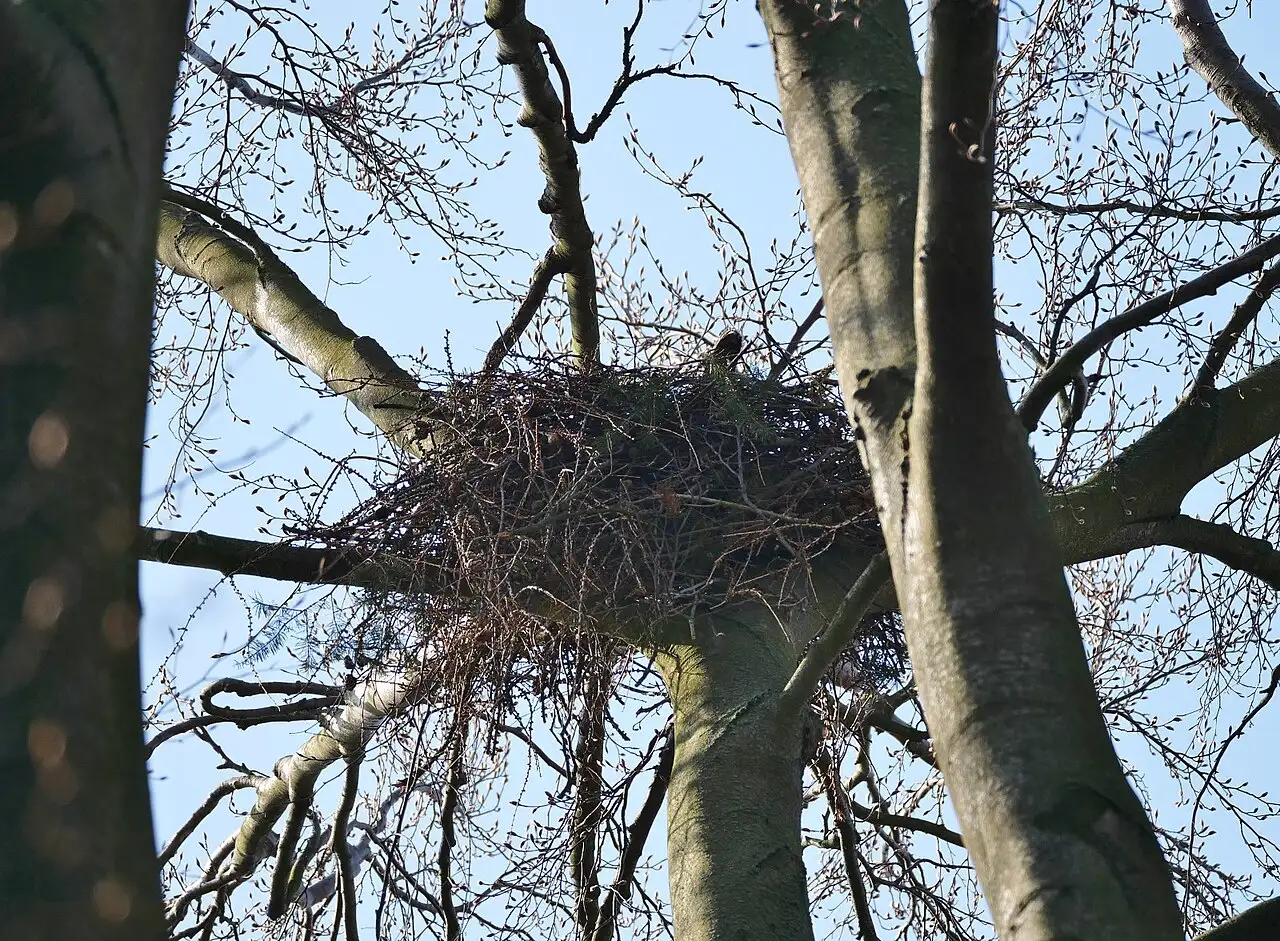
The pair builds a nest or repairs one of the several platforms it keeps in its territory, normally refurbished corvid nests: an untidy structure of twigs and sticks that grows over the years and which they line with green branches.
Courtship and breeding of the Eurasian Goshawk
The breeding season begins at the end of winter, when the male soars above the wood, spreading the undertail coverts and making constant dives. The female lays three or four eggs, sometimes up to six, dirty white or bluish, and incubates them alone for 35–38 days. At first she looks after the chicks while the male brings prey; later she also goes out to hunt and the chicks spend a lot of time alone. At about 35 days they already walk on the branches near the nest, although they take somewhat longer to finish developing, males before the heavier females. A little over two months after hatching they begin to disperse.
Diet of the Eurasian Goshawk
It is a fairly generalist predator that adapts to the prey in its territory, but it strikes above all two groups: medium-sized birds, up to the size of a capercaillie, above all corvids and pigeons, and mammals such as rabbits, hares and squirrels. It is not unusual for it to hunt reptiles, small diurnal and nocturnal raptors and small carnivores such as weasels and stoats.
Curious facts about the Eurasian Goshawk
It is one of our most reputed winged hunters, able to catch prey the size of a hare, and recalls that it was used in falconry1. According to Wikipedia, Iberian goshawks are the lightest of their race: a median of 690 grams for males and 1,050 for females. EURING lists a goshawk ringed in Sweden that lived 22 years.
The Eurasian Goshawk in Cabañeros
The habitat pages of this website do not mention it, and we have not found any other published source on it in the Park, although the Atlas of Breeding Birds of Spain (MITECO, 2003) names the Montes de Toledo among the southern sierras where it takes refuge. GBIF.org records 25 observations of the Eurasian Goshawk in Cabañeros and its surroundings.
Where to see the Eurasian Goshawk in Cabañeros
In Cabañeros and its surroundings, all year, in the wooded parts of the sierras.
When
All year: it is resident; at the end of winter the male performs his display flights over the wood.
What time
By day, though it is hard to see: it rarely rises above the treetops.
Where
In woods, holm oak woods, pine woods and gallery woods with big trees.
What to look for
Look for the very long tail, the short, rounded wings and the marked eyebrow; listen for its «kha kha kha».



 Same family
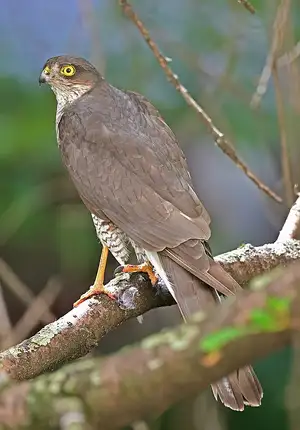 Same family
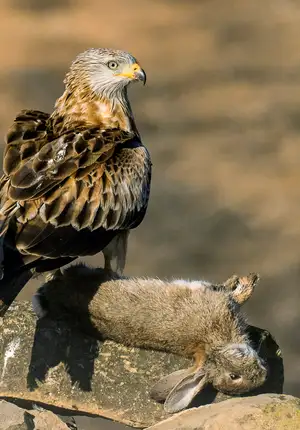 Same family
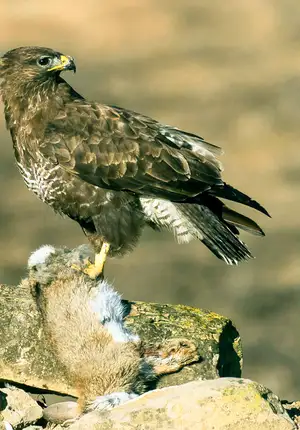 Same family
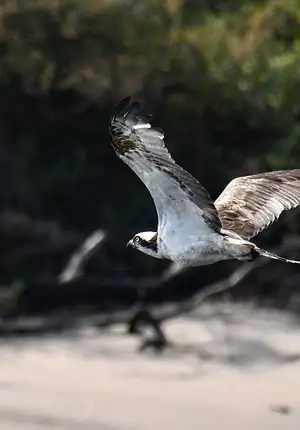 Same order
 Same season in the park
 Same season in the park
 Same season in the park






