Wingspan compared with a person with arms outstretched.
Length
46–58 cm
Wingspan
1.1–1.32 m
Weight
662–800 g
Social life
Solitary or in pairs; territorial in the breeding season
Lifespan
Record of over 30 years in the wild (a bird ringed in the United Kingdom)
Conservation status
LC
NT
VU
EN
CR
EW
EX
Global (IUCN)
Least Concern
Spain
Included in the List of Wild Species under Special Protection; not in the Spanish Catalogue of Threatened Species
When to see it
Resident
Months of the year when it is present
J
F
M
A
M
J
J
A
S
O
N
D
In Iberia
yes
yes
yes
yes
yes
yes
yes
yes
yes
yes
yes
yes
Breeding season
no
no
no
yes
yes
yes
yes
no
no
no
no
no
Song or voice of the Common Buzzard
In flight it often lets out a characteristic cry reminiscent of a cat’s mew, «piiiii-aaaa». It is one of the sounds that most gives away its presence, because we often hear it before seeing it circle on high.
CallCommon Buzzard
0:00 / 0:16
10 kHz5
The sonogram draws the sound: time runs from left to right, and the higher a trace sits, the higher the note.Recording by Benoît Van Hecke, Wikimedia Commons (CC BY-SA 4.0).
Flight of the Common Buzzard
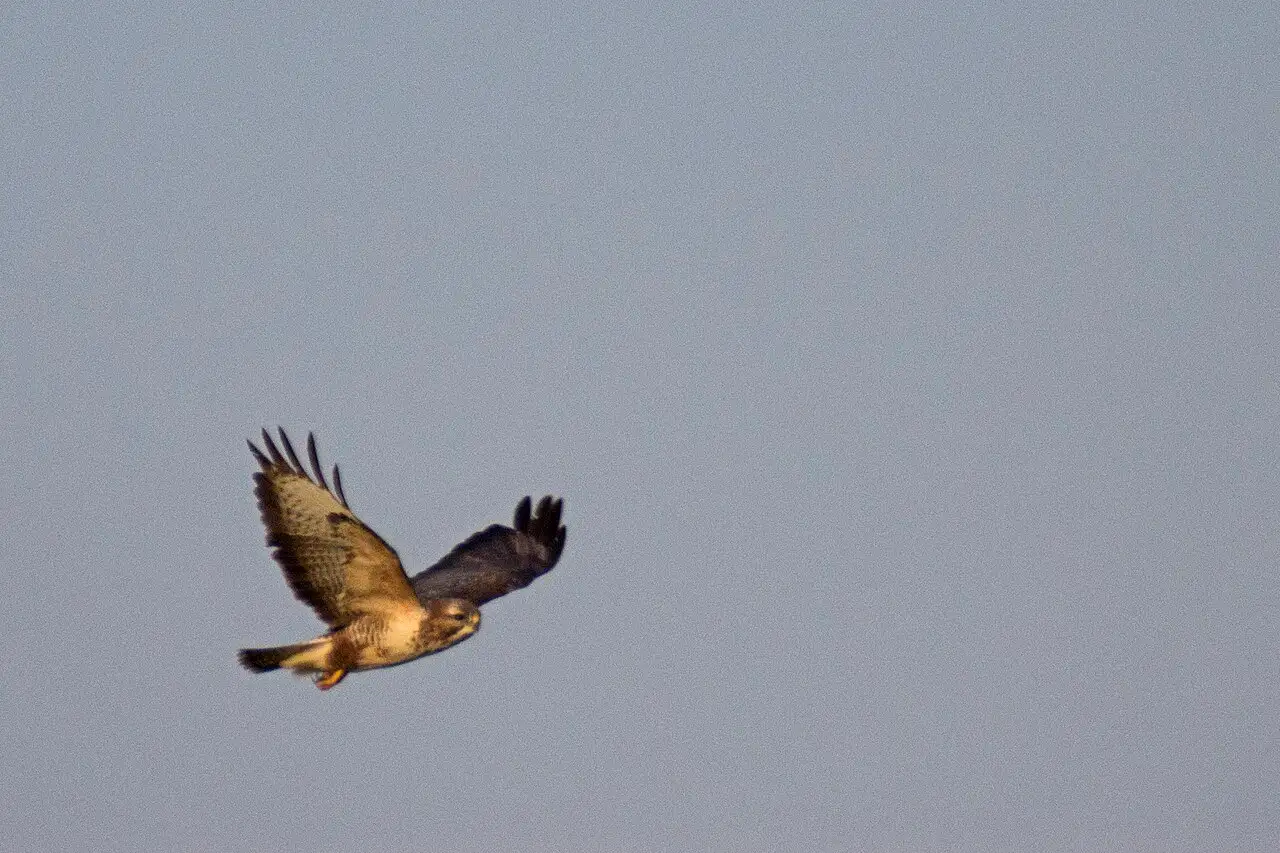
It has relatively short, very broad wings and a not too long tail, which it often spreads like a fan. So it can keep up a sustained flight for a long time, climbing in circles on thermals, and alternates that gliding with occasional hovering, facing the wind, with the tail spread.
Flight typeBroad-winged glider, with occasional hovering
It circles widely on the warm air, with broad wings open and tail fanned, and climbs without flapping.
When the wind allows, it hangs still in the air with quick wingbeats and the tail spread, watching the ground. It does not do it as well as the kestrel and soon drops to a perch.
It closes its wings and drops, thrusting its talons forward onto the vole, the young rabbit or the lizard.
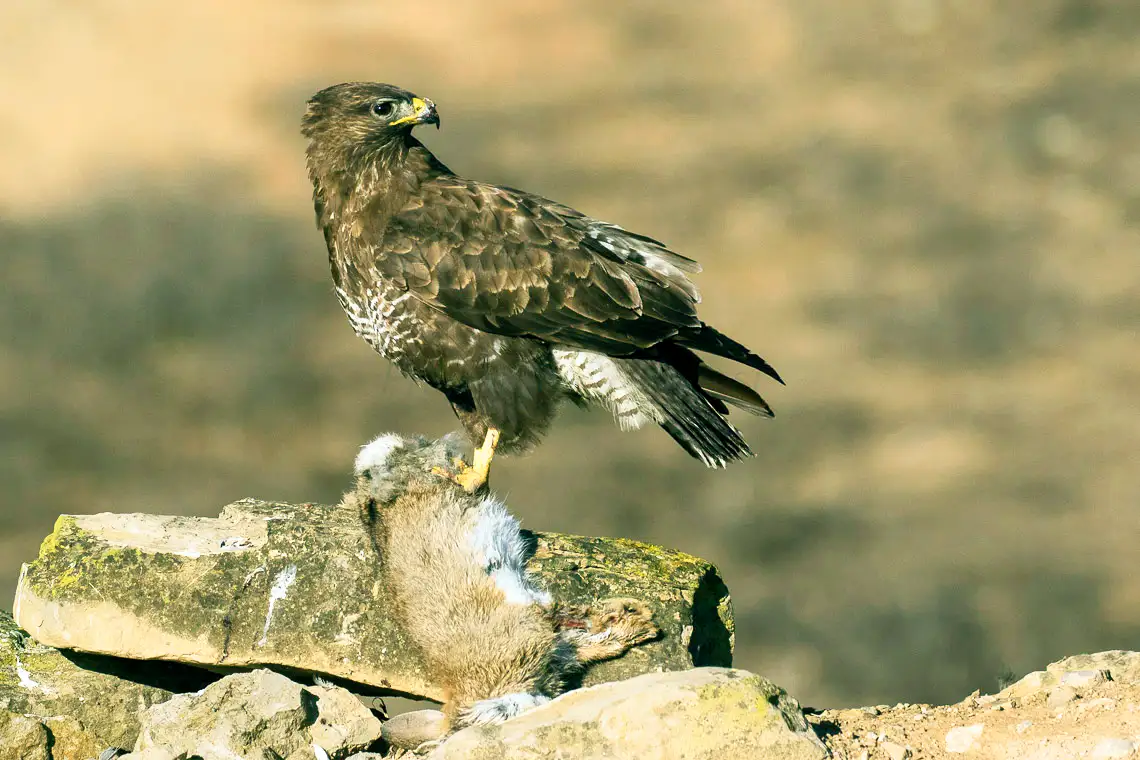
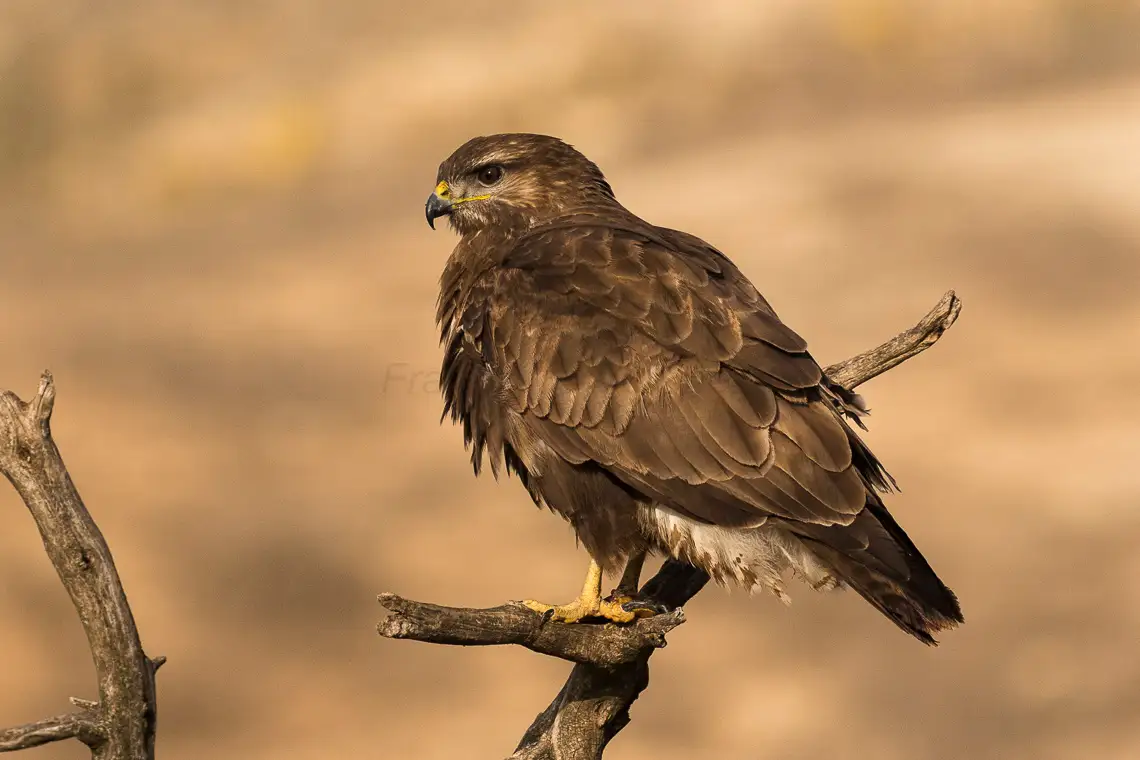
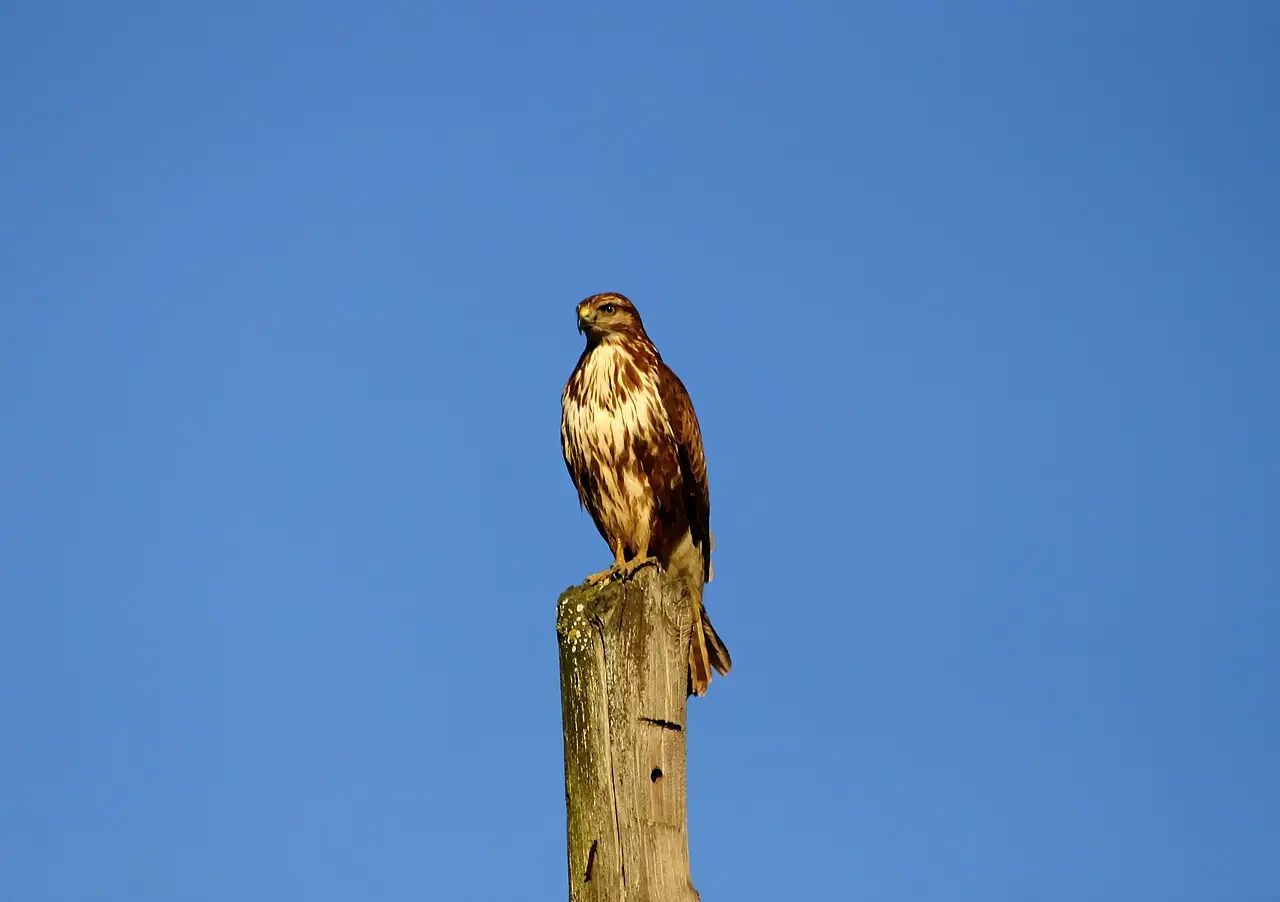
It is a medium-sized raptor, sturdily built and very variable in colour, stocky in appearance when perched. The plumage has so many individual variations that birds from very pale to quite dark can be seen, although the most typical adult is a fairly uniform brownish tone above and somewhat paler below, with a whitish breast band of uneven extent. In flight broad, pale, heavily barred patches are seen on the underside of the wings, and a dark band on the trailing edge, as on the tail.
Adult
Brown above, paler below, with a whitish breast band.
Dark band on the wing and tail edge, which may be barred.
Dark iris.
Young bird
Underparts of uneven browns, more streaked than barred.
Tail finely barred, without the adult’s broad terminal band, and pale iris.
Habitat and distribution of the Common Buzzard
It breeds across much of Europe, in Macaronesia and in a strip of Asia as far as Japan, as well as in two isolated areas, one between the Black Sea and the Caspian and another north of India. Several subspecies have been described; on the Peninsula «buteo» lives, and in the Canaries the endemic «insularum».
In Spain it is a common raptor, spread across almost the whole Peninsula, with more presence in the north-western quadrant, the Basque Country, Navarre, Catalonia, Extremadura and western Andalusia; it is scarce towards the Mediterranean and the south-east. To breed it needs a minimum of plant cover and occupies anything from dense mountain forest to dehesas, although it prefers open mosaic landscapes, where clear areas alternate with groves, copses and meadows, from sea level to 1,600 metres. In winter it is even less demanding and appears even in ploughed fields with almost no natural vegetation. It is resident, although young birds may make long movements and in winter we receive a good number of European birds.
Areas where it is regularly recorded since 2010Squares of about 25 km where it is recorded regularly (occasional passage records are left out). Data from GBIF.org (506,087 records, retrieved October 2026); outline from Natural Earth.
Etymology of the Common Buzzard
«Buteo» is the Latin name of a bird of prey, probably the buzzard, and is repeated in the species: «buteo buteo». «Busardo» comes from the Old French «busard», and «ratonero» (mouser) from its habit of hunting mice and other rodents.
Population of the Common Buzzard
In Spain between 30,450 and 31,400 pairs are estimated, with a stable trend, although some northern populations show a moderate decline. In Europe between 1.76 and 2.46 million mature individuals are estimated, stable. It is classed as Least Concern. Years ago hunters persecuted it as harmful; today many are still shot illegally, on top of power lines, road kills and poisons, to which it is sensitive because of its partly scavenging habits.
Nest of the Common Buzzard
It is a medium-sized structure that the pair make together with branches and sticks and line inside with fresh leaves. They place it at variable height, sometimes more than 25 metres up, in the fork of a tree, or repair one of the platforms they already have.
Courtship and breeding of the Common Buzzard
The breeding season begins with continued flights by the pair over their territory. Laying takes place in April or early May and consists of two to four eggs, sometimes five, white with reddish or brown spots, which both incubate for 33 to 35 days. Both tend the chicks, although the female spends more time in the nest while he brings prey. At 50 or 55 days the young take flight and stay on the territory for a while until they disperse, normally in summer.
Diet of the Common Buzzard
Its diet is varied: it ranges from worms and insects to carrion, as well as small mammals, birds, reptiles, amphibians and rabbits. Variation by season and place is very marked, because, being eclectic and opportunistic, it makes use of any available resource, and that is undoubtedly the key to its success.
Curious facts about the Common Buzzard
The key to the success of one of the most abundant raptors in Europe is not having specialised in anything: it breeds in countless habitats and climates, hunts almost anything and tolerates people and the changes they impose on the countryside well.
The Common Buzzard in Cabañeros
This website’s habitat pages list it, under the name «ratonero común», among the birds of the grasslands and rañas, where it is present all year, together with the Red Kite.
Where to see the Common Buzzard in Cabañeros
On the rañas and grasslands, and in dehesas with scattered trees, perched on trees or posts.
When
All year. In winter it increases with the arrivals from the north.
What time
The middle hours of the day, when thermals form and it climbs in circles.
Where
Perched on a post or in the crown of a tree, scanning the ground, or circling high over the rañas and clearings.
What to look for
A broad-winged, short-tailed raptor, with brown plumage and the dark band on the wing edge, and its mewing call.
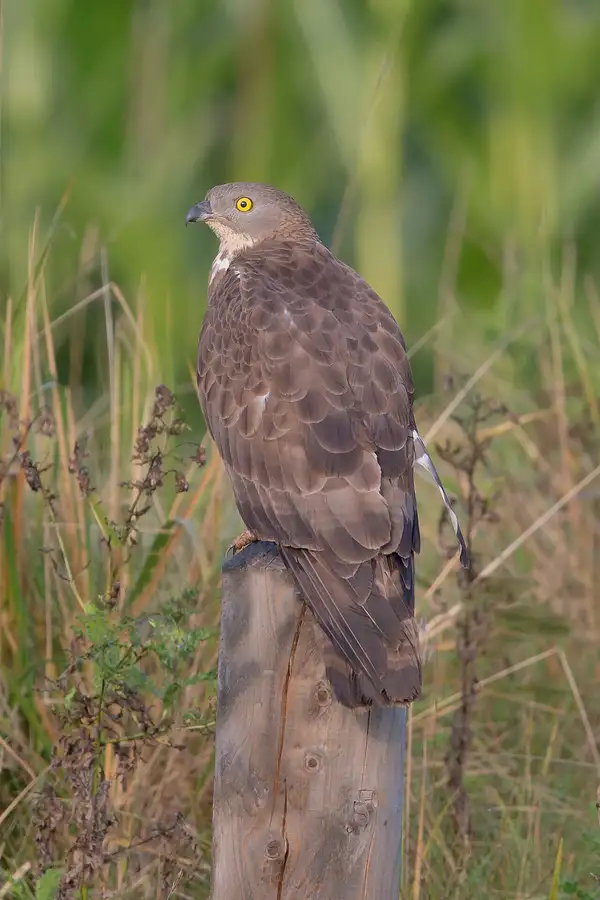
It has a small, narrow, cuckoo-like head and a long tail with broad bands. It arrives in Cabañeros in summer and looks for wasp nests; the Common Buzzard is stockier and is here all year.



 Same family
 Same family
 Same family
 Same family
 Also in grasslands and rañas
 Also in grasslands and rañas
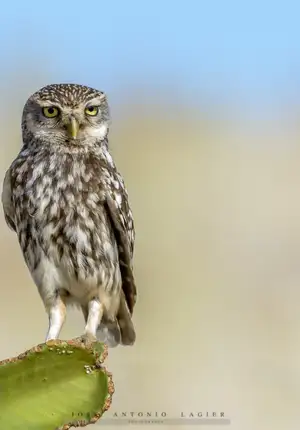 Also in grasslands and rañas
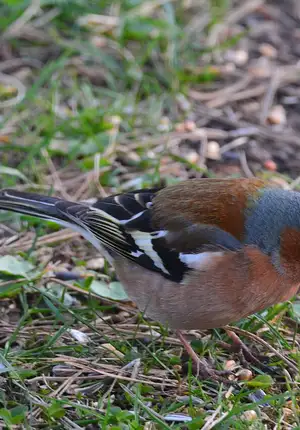 Also in grasslands and rañas





