Wingspan compared with a person with arms outstretched.
Length
60–66 cm
Wingspan
1.54–1.7 m
Weight
0.8–1.3 kg
Social life
In winter it forms communal roosts of dozens or hundreds of birds; in the breeding season, in pairs
Lifespan
Record of almost 26 years in the wild (a ringed bird)
Conservation status
LC
NT
VU
EN
CR
EW
EX
Global (IUCN)
Least Concern
Spain
Spanish Catalogue of Threatened Species: Endangered (2021 Red Book of the Birds of Spain: Endangered)
When to see it
Resident
Months of the year when it is present
J
F
M
A
M
J
J
A
S
O
N
D
In Iberia
yes
yes
yes
yes
yes
yes
yes
yes
yes
yes
yes
yes
Breeding season
no
no
yes
no
no
no
no
no
no
no
no
no
Song or voice of the Red Kite
Sometimes it gives a sound like a mew, somewhat fluty, followed by rising and falling notes. It is thinner than the buzzard’s and it gives it mainly in courtship, with the pair’s chases and dives.
SongRed Kite
0:00 / 0:30
10 kHz5
The sonogram draws the sound: time runs from left to right, and the higher a trace sits, the higher the note.Recording by Pascal Christe, Wikimedia Commons (CC BY-SA 4.0).
Flight of the Red Kite
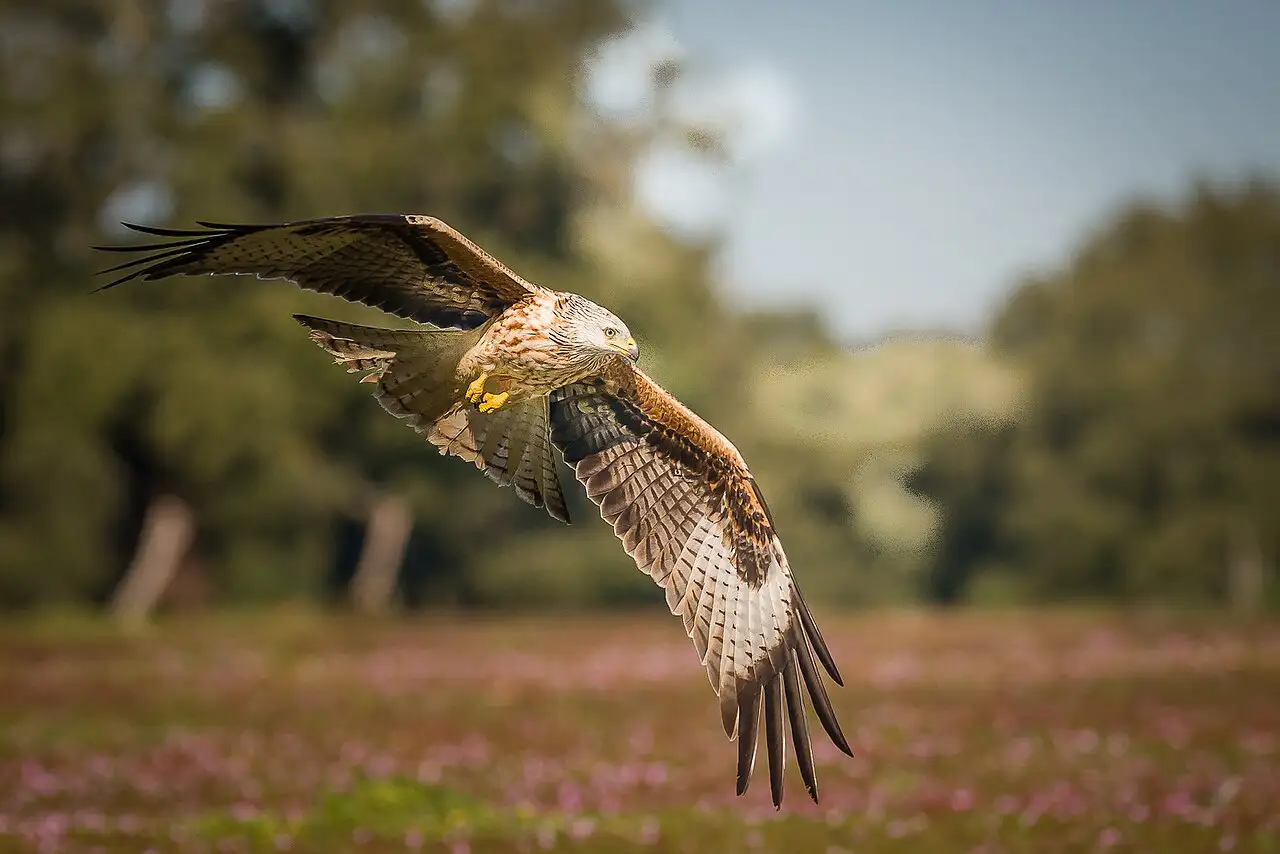
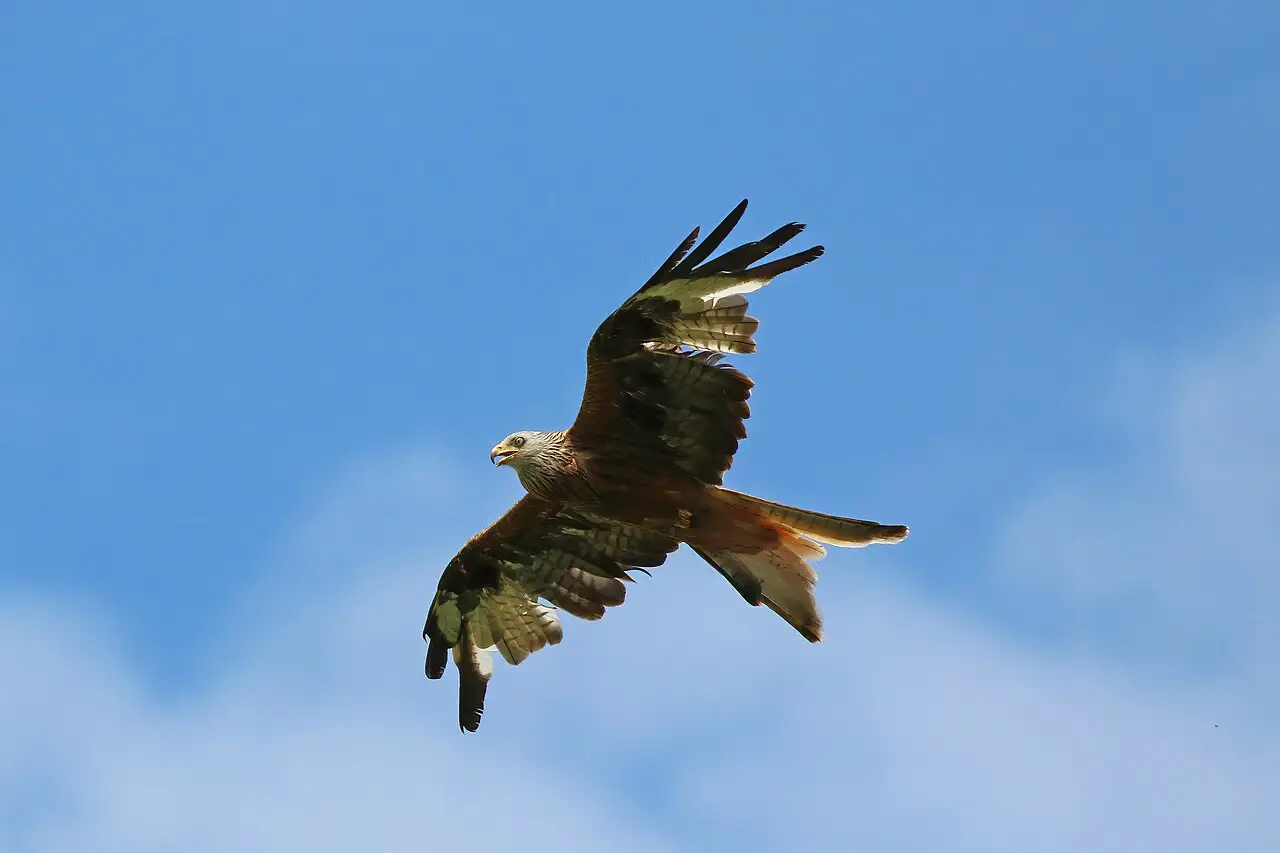
It is unmistakable in flight, for its extraordinary skill in every kind of manoeuvre and swerve and for its silhouette: long, angled wings, with a very visible white patch, and a deeply forked tail, orange-rufous in colour, which it turns constantly from side to side like a rudder. It glides at mid and low height, sweeping the terrain.
Flight typeAgile glider, with the forked tail as a rudder
It climbs in circles with long, somewhat bent wings, constantly twisting the forked tail, which serves it as a rudder.
It sweeps the terrain at low height, with the wings arched and the tail spread turning from side to side, alert for any carcass or prey.
When it sees the carrion it descends in a spiral, brakes with its tail spread and lands or takes it in its talons without landing.
Red Kite in low flight over a flowering meadow, with wings open and the flight feathers markedPhoto: José Antonio Lagier Martin, CC BY 3.0Photo 2 of 4
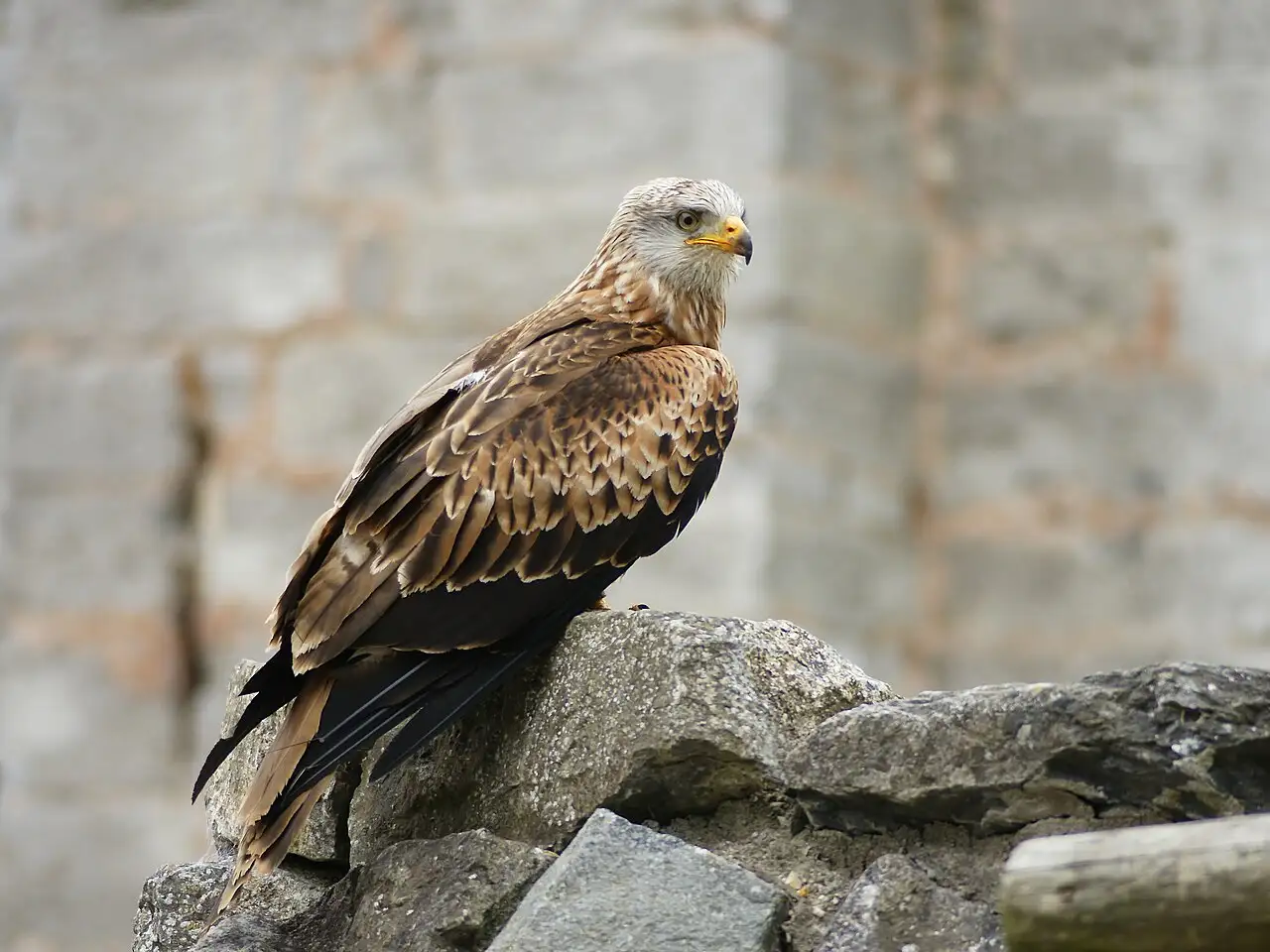
Red Kite perched on a stone wall, in profile: pale head, edged back and rufous tailPhoto: Hans Hillewaert, CC BY-SA 3.0Photo 3 of 4
Red Kite in flight seen from below, with the forked tail spread and the angled wingsPhoto: Charles J. Sharp, CC BY-SA 4.0Photo 4 of 4
1 / 4
Identification of the Red Kite
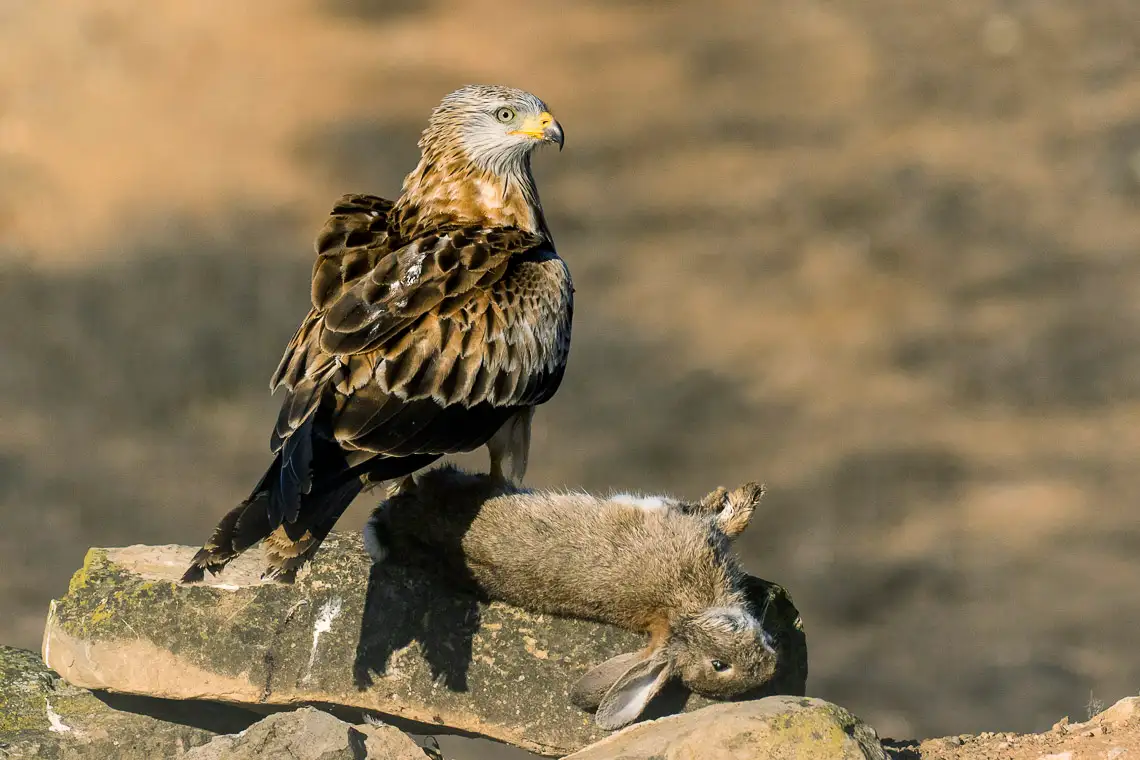
It is a medium-sized raptor, with plumage of rufous tones, heavily streaked with dark below and with an edged look above, from the pale edges of the wing coverts. The head and neck are a pale grey marked with fine dark streaks. In flight it is unmistakable for the deeply forked, orange-rufous tail and the long, angled wings with a white patch. Perched it is also easy to tell from other raptors by the shape of the tail and its slender figure.
Adult
Rufous, with dark streaks on the breast and belly.
Pale grey head with dark streaks.
Deeply forked rufous tail.
Young bird
Paler and more uniform, without the grey head.
Shorter, less forked tail.
Habitat and distribution of the Red Kite
It has a fairly restricted range: Germany, France and Spain hold 90 % of the world’s birds. It was quite common in the past, but over the 20th century its population fell greatly, through the intense persecution it suffered, until it disappeared from wide regions.
In Spain there are two large breeding areas, the centre-west of the Peninsula (Cáceres, Salamanca, Zamora, Ávila, Segovia and Madrid) and the south face of the Pyrenees as far as the Ebro valley; in the rest it is more scattered, and it is absent from very rainy areas and areas of markedly Mediterranean climate. It breeds in Mallorca and Menorca and is absent from the Canaries, where it became extinct in the seventies. To breed it chooses forested foothill or mid-mountain zones, with wide open areas nearby. In winter, Spain is the species’ main destination: to the birds that remain with us is added an enormous contingent from Germany and France, which arrives from September, with a peak between October and November, and with the population peak in January. Wintering birds occupy open areas with farmland and crops, and in the evening gather in massive roosts in pine woods, eucalyptus woods or small riverside groves.
Areas where it is regularly recorded since 2010Squares of about 25 km where it is recorded regularly (occasional passage records are left out). Data from GBIF.org (312,029 records, retrieved October 2026); outline from Natural Earth.
Etymology of the Red Kite
«Milvus» is the Latin name for the kite, and it is repeated in the species: «milvus milvus». «Milano» comes from that «milvanus», derived from «milvus», and «real» («royal») serves to tell it from the Black Kite.
Population of the Red Kite
In Spain between 2,312 and 2,440 breeding pairs were estimated in 2014, after sharp falls between 1994 and 2004 and between 2004 and 2014, although afterwards the trend was more stable and even a 15 % increase was observed. Half the population is concentrated in Castilla y León, followed by Navarre, Extremadura and Aragon, and it is close to extinction in the southern third of the Peninsula, with very scarce presence in Extremadura and Castilla-La Mancha. In winter there are some 50,297 individuals (2013–2014 wintering). It is classified in Spain as Endangered. The causes are poisoning, by baits and rodenticides, power lines, road deaths, loss of breeding sites, illegal hunting and the scarcity of rabbits.
Nest of the Red Kite
It is a crude construction of branches in a large tree, in a fork or on a side branch, at a great height, with the inside lined with grass, wool, rags or plastics. If it is enlarged season after season, it can reach a metre across.
Courtship and breeding of the Red Kite
Pairs consolidate in early spring with an acrobatic aerial display, of chases and dives with cries. In the Mediterranean laying begins in early March (Cramp, 1980). The female lays one to five matt-white eggs speckled with reddish brown, which she incubates, with short relief shifts by the male, for 31 or 32 days from the first egg, so the chicks hatch staggered. During the first 14 days the female feeds them with what the male brings, and then both go hunting. At 45 days the chicks begin to climb along the branches, and rarely take flight before 48 or 50 days, sometimes up to 60 or 70, and for another 15 to 20 days stay near the nest receiving food (Cramp, 1980).
Diet of the Red Kite
It does not specialise in anything, and that lets it make use of many resources. As it is not a great hunter, it opts for easy prey: small, sick or inexperienced animals, such as rabbits with myxomatosis, fledglings of medium-sized birds, small mammals, amphibians, reptiles and insects. In winter it frequents rubbish tips, slaughterhouses, vulture restaurants and farms, and all year it looks for carrion, above all on roads, over which it glides at mid and low height looking for road-killed animals.
Curious facts about the Red Kite
Spain is the species’ main wintering destination, and in the evening the kites travel long distances to gather at massive roosts. And its forked, orange-rufous tail is the simplest way to recognise it from afar.
The Red Kite in Cabañeros
The habitat pages of this website cite it in the grasslands and rañas, where it is present all year and has more presence during the winter, with a roost of some 80 birds very close to Cabañeros.
Where to see the Red Kite in Cabañeros
On the rañas and grasslands of the park, above all from autumn to winter; the roost is very close to Cabañeros.
When
All year round; it is much easier in winter, from October to February.
What time
Late in the afternoon, when they return to the roost, and in the morning, when they go out to look for food.
Where
Over the rañas and the clearings of the dehesa, gliding low, and at the edges of roads, where it looks for carrion.
What to look for
A rufous raptor with a deeply forked tail and a white patch under the wings.
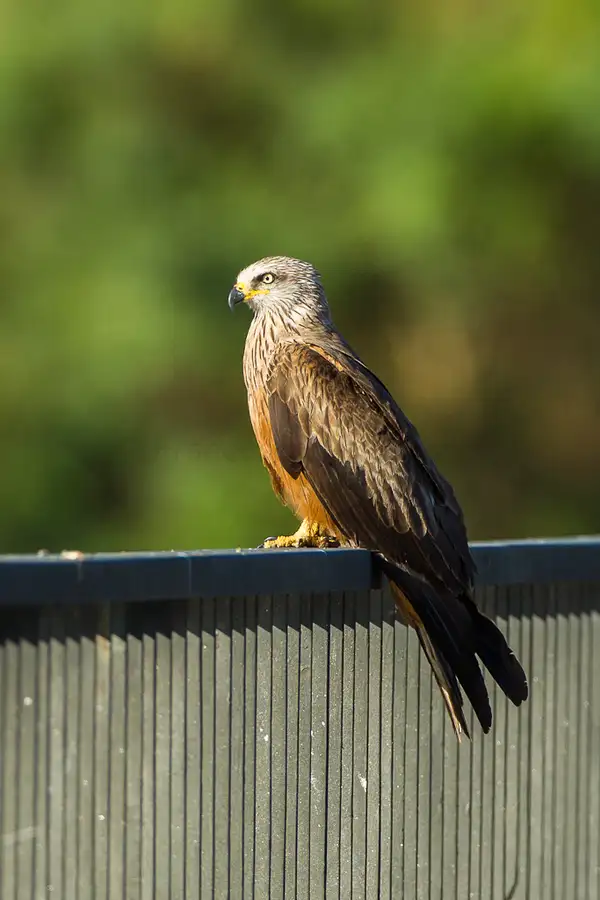
Darker and browner, with the tail only slightly forked and without the white wing patch. It is a summer visitor, while the Red Kite is present all year and abounds above all in winter.
Photo: Francesco Veronesi from Italy, CC BY-SA 2.0



 Same family
 Same family
 Same family
 Same family
 Also in grasslands and rañas
 Also in grasslands and rañas
 Also in grasslands and rañas
 Also in grasslands and rañas




