Wingspan compared with a person with arms outstretched.
Length
43–55 cm
Wingspan
1.15–1.4 m
Weight
400–800 g
Social life
Territorial when breeding and, in winter, gregarious in communal roosts among the marsh vegetation of certain wetlands
Lifespan
Record of 20 years and 8 months in the wild (a bird ringed in the Netherlands and shot)
Conservation status
LC
NT
VU
EN
CR
EW
EX
Global (IUCN)
Least Concern
Spain
Least Concern (LC) in the Red Book of the Birds of Spain; on the List of Wild Species under Special Protection, but not in the Spanish Catalogue of Threatened Species
When to see it
Resident
Months of the year when it is present
J
F
M
A
M
J
J
A
S
O
N
D
In Iberia
yes
yes
yes
yes
yes
yes
yes
yes
yes
yes
yes
yes
Song or voice of the Western Marsh Harrier
The male gives a «ki-i-aj» in flight; the female’s alarm is an explosive «qui-ic-ic-¡c».
CallWestern Marsh Harrier
0:00 / 0:12
10 kHz5
The sonogram draws the sound: time runs from left to right, and the higher a trace sits, the higher the note.Recording by Sternanita2, Wikimedia Commons (CC BY-SA 4.0).
Flight of the Western Marsh Harrier
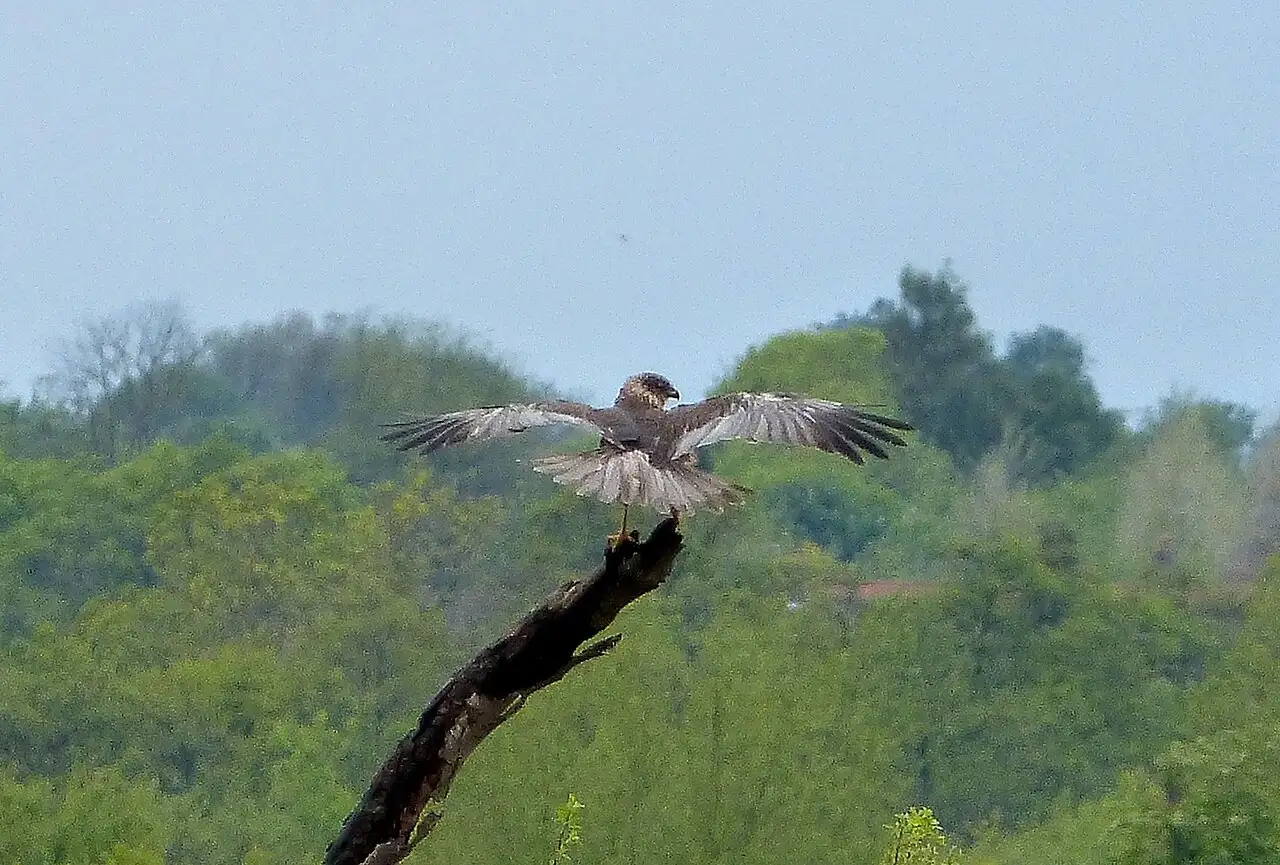
The weightless figure of the Marsh Harrier patrolling tirelessly over reedbeds and marshes was an increasingly rare sight until its population began to recover. When the male flies, the contrast of the black primary flight feathers can be seen under the pale wings, and above, a broad grey wing band.
Flight typeLow, patrolling glide over reedbeds
It leaves its roost or nest among the marsh vegetation; in winter, harriers come every evening to communal roosts.
It patrols tirelessly over reedbeds and marshes, and also over crop fields, sparse-scrub slopes, grasslands and wasteland, in search of rodents, rabbits and birds.
It spots its prey, small and medium-sized vertebrates, both on the ground and in the water.
Photo gallery of the Western Marsh Harrier
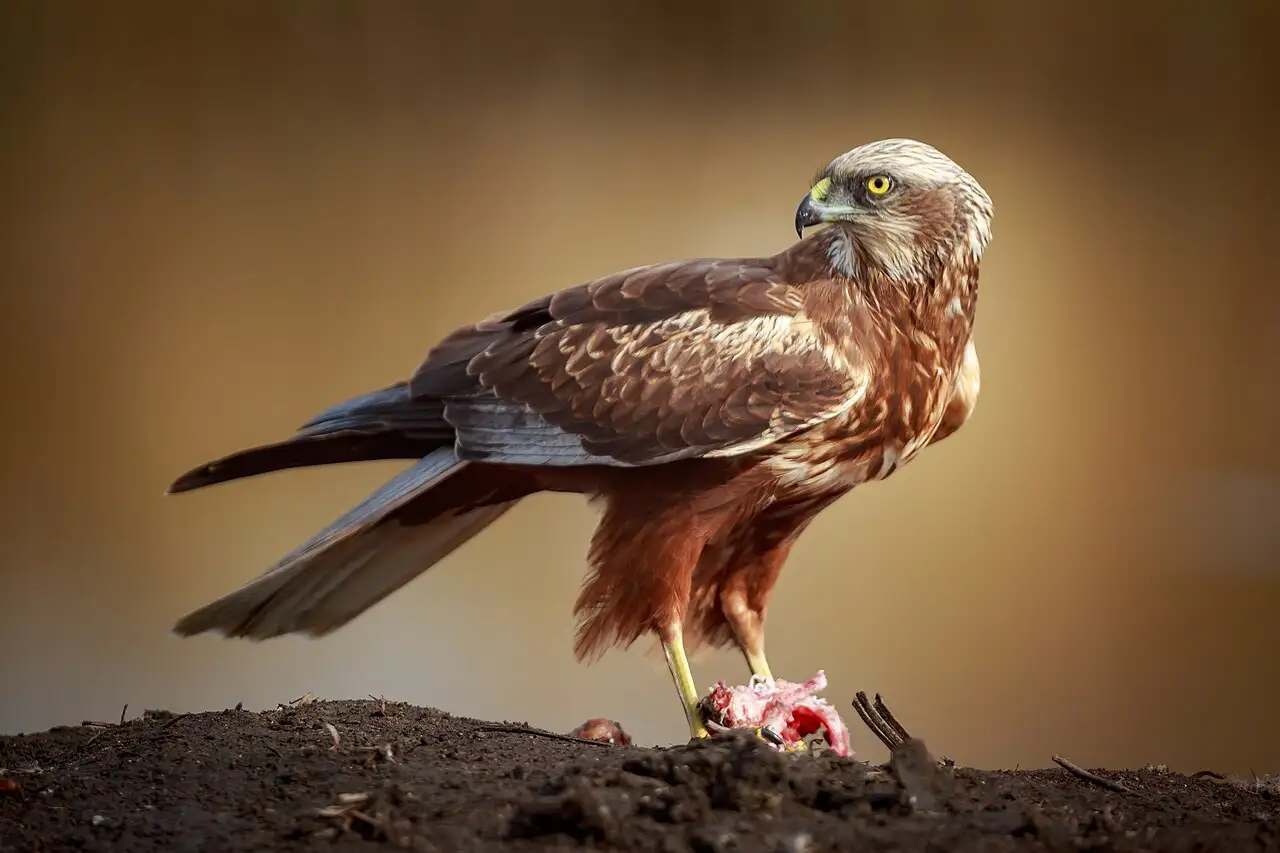
Male Western Marsh Harrier perched on a mound of earth with prey, with brown back, yellowish head, reddish belly and grey tailPhoto: Paco Gómez from Castellón, Spain, CC BY-SA 2.0Photo 1 of 4
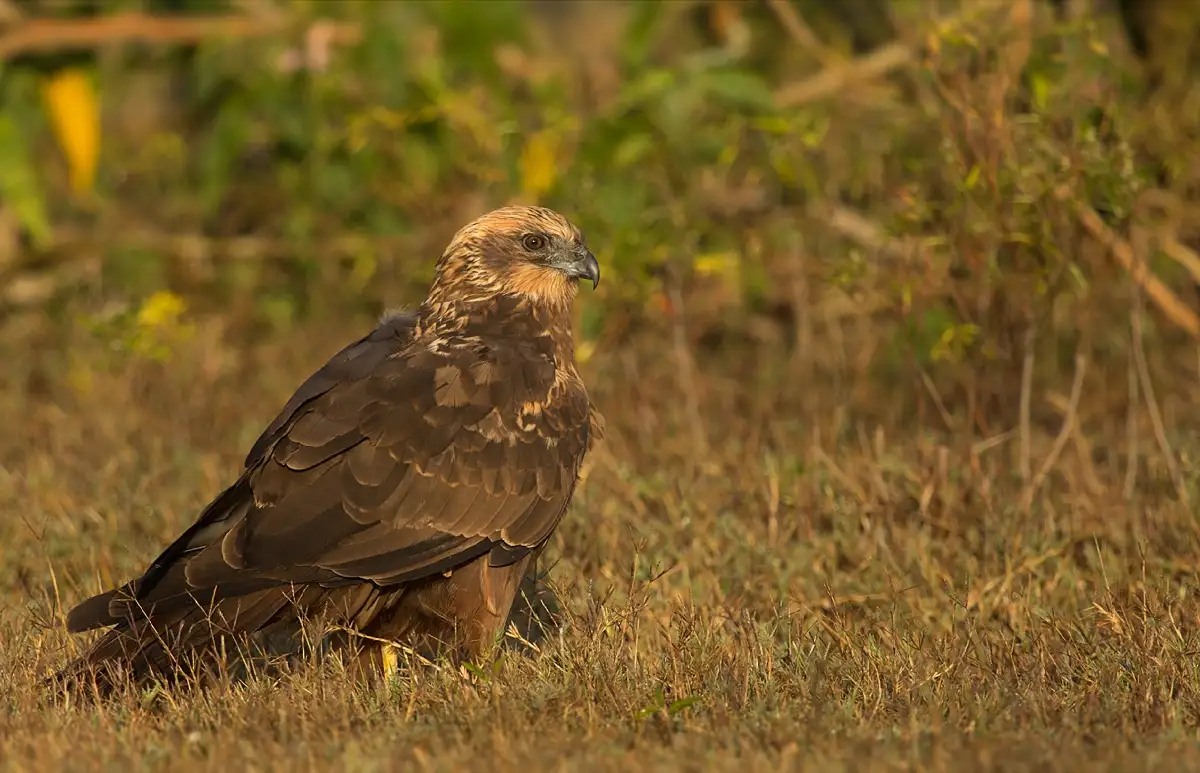
Female Western Marsh Harrier on dry grass, with chocolate-brown plumage and a paler head and shouldersPhoto: Sumeet Moghe, CC BY-SA 3.0Photo 4 of 4
1 / 4
Identification of the Western Marsh Harrier
The Marsh Harrier is a medium-sized bird of prey of fairly slender appearance, though certainly sturdier than the other harriers of our fauna, which it also exceeds in wingspan. It shows marked sexual dimorphism: the female is quite a bit larger and heavier than the male, and the plumages of the two sexes are very different.
In the adult male brown tones predominate on the back, although the head and nape are yellowish or slightly greyish, with fine dark streaks. The underparts, especially at the level of the legs and lower belly, are usually reddish, shading to cream or dirty white towards the breast and throat, which are softly streaked. The tail feathers and secondaries are grey, and the latter form a broad wing band very visible in flight. Below, the male’s wings are rather pale, whitish or pale grey, and the black primaries stand out on them. Adult females are quite a bit darker and less contrasted, with chocolate-brown plumage that turns yellowish or whitish on the head, throat and shoulders.
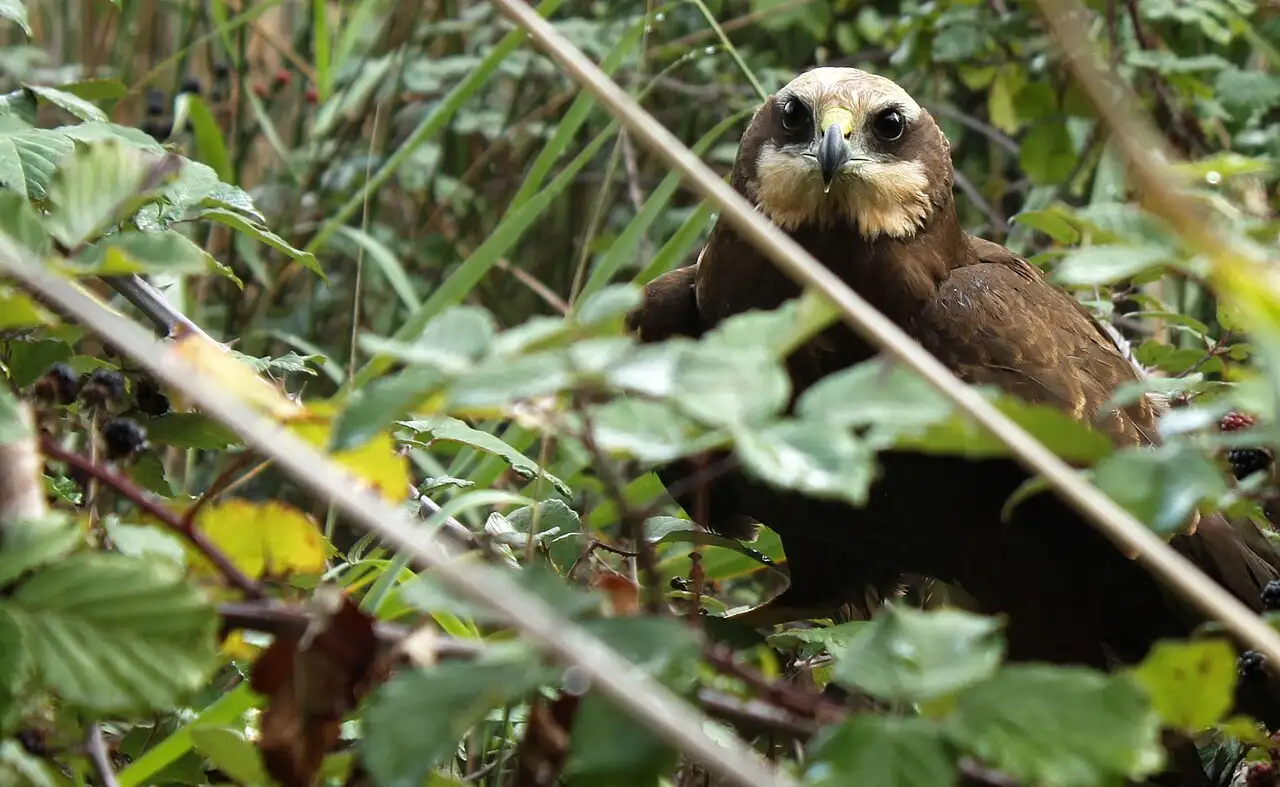
Birds just out of the nest look quite like the females, although they are more uniform and slightly darker, and only have paler patches on the head, nape and throat. Between juvenile and adult dress there are several transitional plumages. Cases of melanism and atypical patterns are not uncommon, which can make identification harder and lead to confusion with species of similar size.
Adult male
Brown back, head and nape yellowish or greyish, streaked.
Underparts reddish on the lower belly, cream or dirty white towards the breast.
Tail and secondaries grey, with black primaries.
Adult female
Larger and heavier, in chocolate-brown tones.
Head, throat and shoulders yellowish or whitish.
Young bird
Similar to the female, more uniform and a little darker, with pale patches on the head, nape and throat.
Habitat and distribution of the Western Marsh Harrier
It breeds in different temperate and tropical regions of both hemispheres, from North Africa and the Iberian Peninsula to the Far East, including Madagascar and all of Australia, although there is considerable controversy about the unity as a species of the different populations and subspecies. In Europe it is widely distributed and the most numerous breeding populations are in the east: Russia and Ukraine are the countries with the most pairs. There are two subspecies, «aeruginosus» and «harterti»; the one that visits Spain is «aeruginosus», from central and western Eurasia.
The Spanish population is concentrated in the Duero, Ebro and Tagus basins, in wet La Mancha and in the Guadalquivir marshes, with smaller cores in the middle Guadiana basin, the inland wetlands of Catalonia, Andalusia and Mallorca. In the Canaries it is rare, although it appears regularly during migration passage and in winter.
It is closely tied to wetlands, particularly those with extensive stands of reeds, bulrushes, cattails, rushes or saw-sedge, where it places nests and roosts. It also frequents other sites, above all to hunt: crop fields, slopes with sparse scrub, pastures or wasteland, and it is not unusual for a pair to settle in large expanses of cereal. The size of the wetland does not seem to limit its distribution: what conditions it is the availability of food in its surroundings.
It is resident on the Peninsula, where an important flow of migrants from central Europe and the Nordic countries also arrives: some spend the whole winter here, settled above all in the large wetlands of the south and east, and others cross the Strait of Gibraltar between September and the first half of October. The pre-breeding passage leaves the African wintering areas around February or March, passes Gibraltar in March and crosses the Peninsula in April, and males settle at their breeding sites before females. In winter it forms communal roosts, some very busy, among the marsh vegetation of certain wetlands, which it reaches punctually every evening.
Areas where it is regularly recorded since 2010Squares of about 25 km where it is recorded regularly (occasional passage records are left out). Data from GBIF.org (362,402 records, retrieved October 2026); outline from Natural Earth.
Etymology of the Western Marsh Harrier
According to Wikipedia, «Circus» comes from the Greek «kirkos», the name of a bird of prey, meaning «circle» from its circular flight, and «aeruginosus» is «rusty» in Latin, from its colour. In other languages it is called «arpella vulgar» in Catalan, «tartaraña das xunqueiras» in Galician, «zingira-mirotza» in Basque and «western marsh harrier» in English1.
Population of the Western Marsh Harrier
In the 2021 European Red List of Birds the European breeding population is estimated at between 303,000 and 485,000 mature individuals, a figure considered stable. The last Spanish census set a population of 1,149–1,494 breeding pairs for 2006, with the largest contingents in Castilla-La Mancha, Castilla y León, Navarre and Andalusia, and with the Ebro basin as the most important.
It suffered a sharp decline in the middle of the last century, with the disappearance of numerous wetlands and the start of relentless persecution, which by the late 1980s left barely 200 pairs in the whole country. Since then it has recovered, notably in Andalusia, Navarre, La Rioja, Madrid, Catalonia or Extremadura, with increases of more than 50 % in the number of pairs, although it is far from the populations of other European countries.
Destruction or alteration of habitat (drainage, ploughing, pollution…) is the main threat. It is also affected by agricultural changes and pesticides, which reduce the availability of prey. The great concentration of pairs in a few optimal sites is a risk, and other dangers are lead contamination, illegal hunting and nest robbing.
Nest of the Western Marsh Harrier
In early spring the female builds an untidy nest, from stems of marsh vegetation and small branches, which is the bulkier the more directly over water it lies.
Courtship and breeding of the Western Marsh Harrier
Courtship usually begins at the end of winter and consists of an elaborate aerial dance in which both members of the pair take part, which serves to affirm their bond and mark possession of the territory. Between April and May laying takes place, three to eight greenish-white or bluish eggs, sometimes speckled with red, which are incubated mainly by the female for 31–38 days, while the male gets food and defends the territory. The female tends the chicks and stays a long time on the platform tearing up the prey the male brings; when the chicks grow, she joins her mate in hunting. The young finish developing in 35–40 days and stay with their parents a couple more weeks before dispersing.
Diet of the Western Marsh Harrier
The diet is frankly varied and includes all kinds of small and medium-sized vertebrates, which it locates both on the ground and in the water. In Spain it is based above all on small mammals (rodents and rabbits) and birds, both adults and chicks of marsh and land species, as well as reptiles and, to a lesser extent, amphibians, fish, large insects and eggs. It frequently eats some carrion, especially if the usual prey is scarce.
Curious facts about the Western Marsh Harrier
It is a raptor whose Spanish populations were reduced to little over 200 pairs. According to EURING, the ringed bird that lived longest, in the Netherlands, reached 20 years and 8 months; AnAge gives 20.1 years. According to Wikipedia, males weigh 400 to 650 g and females 550 to 800 g.
The Western Marsh Harrier in Cabañeros
The habitat pages of this website do not mention it. GBIF.org records 115 observations of the Western Marsh Harrier in Cabañeros and its surroundings.
Where to see the Western Marsh Harrier in Cabañeros
In Cabañeros and its surroundings, all year.
When
All year: it is resident, and in winter migrants arrive from central Europe and the Nordic countries.
What time
In good light, over reedbeds and wetlands, and over nearby crop fields and pastures.
Where
In low flight, patrolling, or perched on a mound; at dusk, at the communal roosts.
What to look for
Look for the male with the pale head, grey tail and black-tipped wings, and the chocolate-brown female.



 Same family
 Same family
 Same family
 Same family
 Same order
 Same season in the park
 Same season in the park
 Same season in the park






