Wingspan compared with a person with arms outstretched.
Length
53–66 cm
Wingspan
1.47–1.74 m
Weight
1.5 kg
Social life
The pair builds the nest together; a strict hierarchy can set in among the chicks when food is scarce
Lifespan
Record of 32 years in the wild according to AnAge; EURING lists a bird ringed in Finland that lived 26 years and 11 months
Conservation status
LC
NT
VU
EN
CR
EW
EX
Global (IUCN)
Least Concern
Spain
Endangered (EN) in the 2021 Red Book of the Birds of Spain and Vulnerable (VU) in the Spanish Catalogue of Threatened Species
When to see it
Resident
Months of the year when it is present
J
F
M
A
M
J
J
A
S
O
N
D
In Iberia
yes
yes
yes
yes
yes
yes
yes
yes
yes
yes
yes
yes
Song or voice of the Western Osprey
It gives plaintive whistles during courtship display1. The alarm is a «kiu, kiu, kiu» that it sounds in flight1. The recording (alarm call) is by Aku Kalliomäki and was made in Etelä-Konnevesi National Park (xeno-canto XC1162704, quality A). It lasts 9 seconds and is a trimmed section of the original, without repeating or lengthening, from which we have removed the bass below 200 Hz, reduced the background noise and adjusted the volume; neither pitch nor speed has been changed. It is from Finland, not Spain.
In flight it shows a fairly characteristic silhouette, with a short tail and relatively narrow, «angled» wings. When flying in search of food it can hover with deep wingbeats before plunging into the water to catch fish with its talons. Young birds of the Mediterranean region are dispersive and in some cases travel up to 3,000 kilometres.
Flight typeShort tail and angled wings; it hovers and dives into the water
It is tied to the aquatic environment: it breeds on sea cliffs and fishes in nearby areas, above all bays, estuaries and even inland lagoons close by.
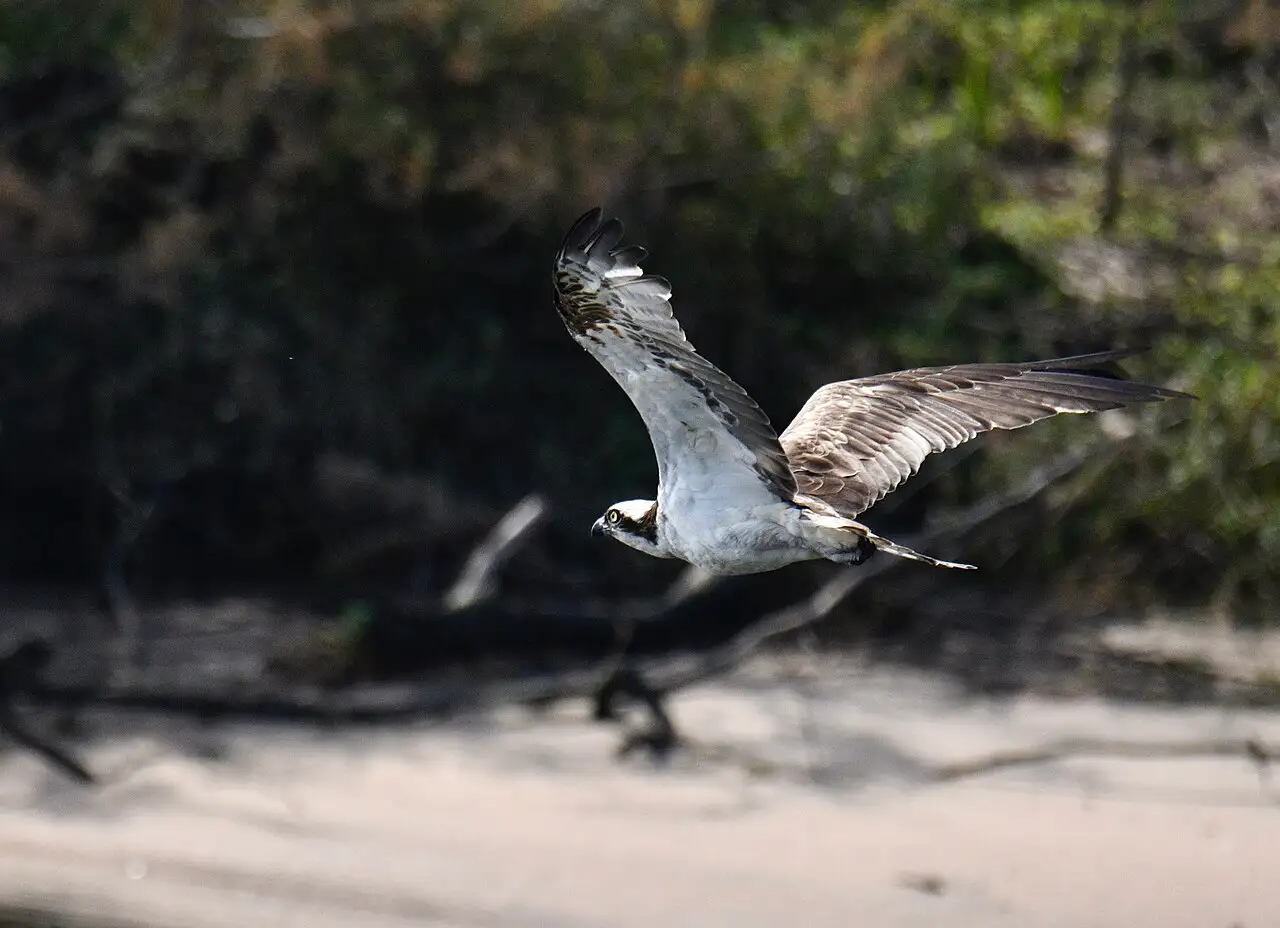
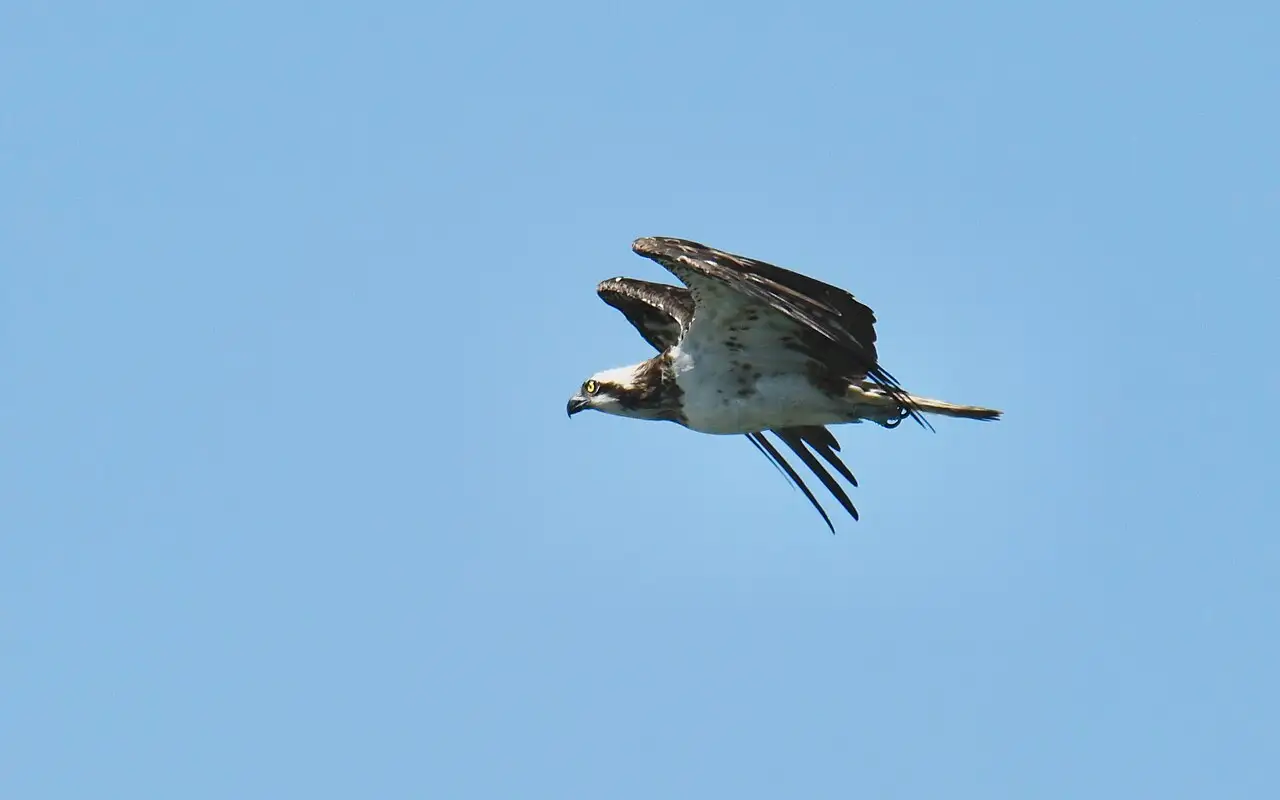
In flight it shows a characteristic silhouette, with a short tail and relatively narrow, «angled» wings; from below, the white body contrasts with the dark bars of the flight feathers.
When it flies in search of food it can hover with deep wingbeats before plunging into the water and catching fish with its talons.
Photo gallery of the Western Osprey
Western Osprey in low flight over a sandy beach, wings open, body white below and dark flight feathersPhoto: Luiz Lapa from Oeiras, Portugal, CC BY 2.0Photo 1 of 4
Western Osprey in flight against a blue sky, in profile, wings up and legs dangling below the short tailPhoto: Luiz Lapa from Oeiras, Portugal, CC BY 2.0Photo 2 of 4
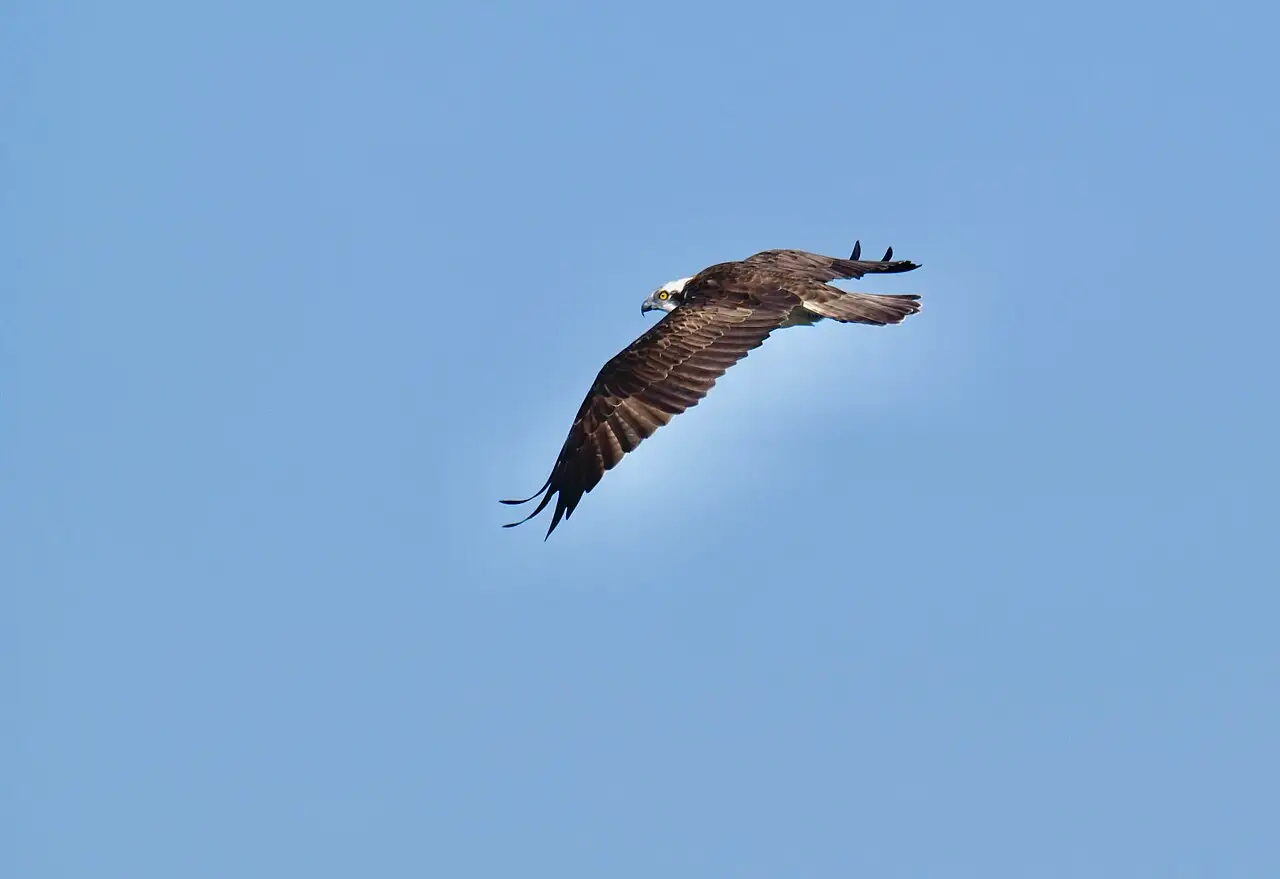
Western Osprey in flight seen from above against a blue sky, with dark brown upperparts and angled wingsPhoto: Luiz Lapa from Oeiras, Portugal, CC BY 2.0Photo 3 of 4
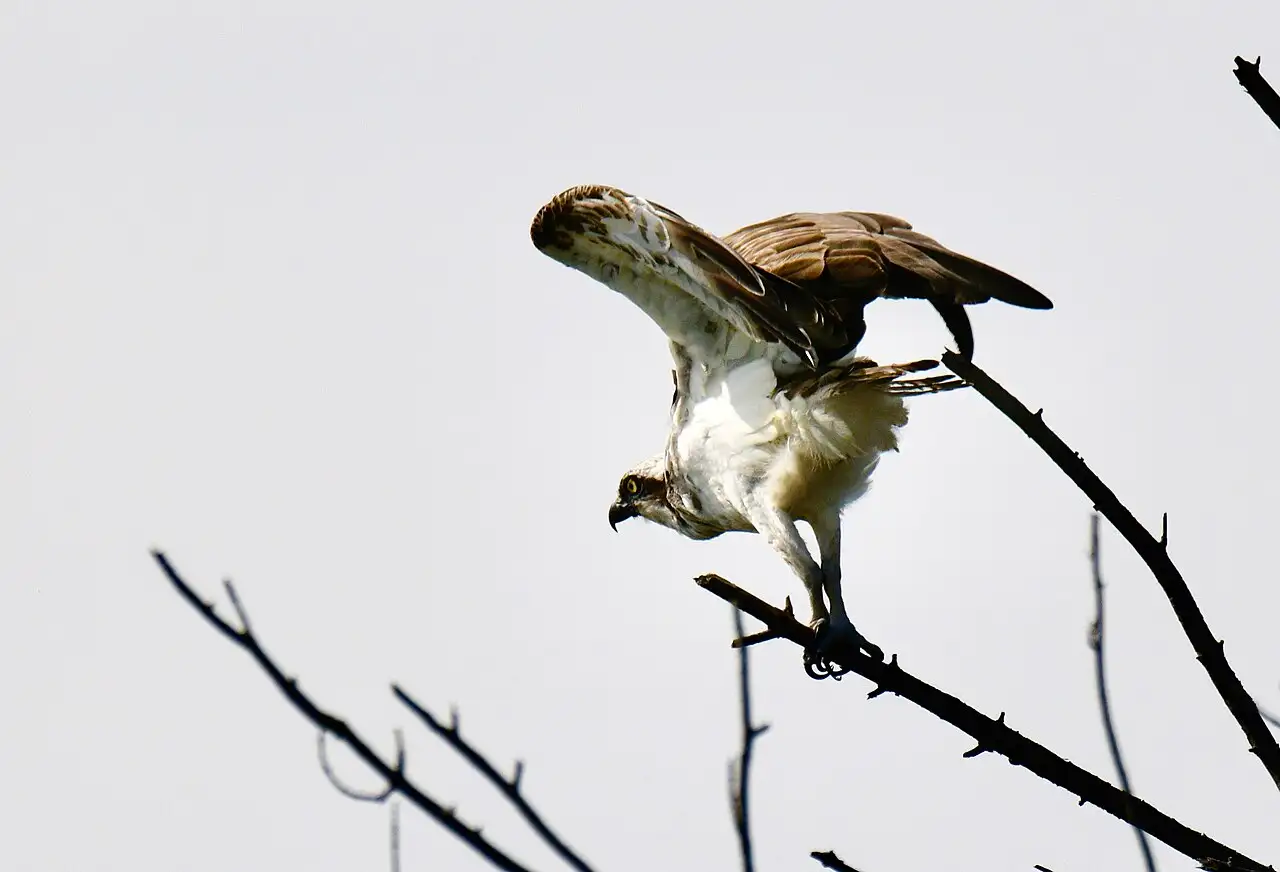
Western Osprey perched on a dry branch with wings open, about to take off, white breast and brown wings abovePhoto: Luiz Lapa from Oeiras, Portugal, CC BY 2.0Photo 4 of 4
1 / 4
Identification of the Western Osprey
The Western Osprey is a medium-sized bird of prey. Adults have white underparts, with variable mottling on the breast, and birds with a more marked collar of streaks on the breast are usually females. In contrast, the upperparts are very dark. The crown is white, and behind the eye there is an eye stripe, like a mask, running down part of the neck. In flight they show a fairly characteristic silhouette, with a short tail and relatively narrow, «angled» wings. Seen from below, the body and the white front of the wing contrast with the dark bands running across the flight feathers, and the tail shows a series of dark bars. The young bird is very similar, but its upperparts look scaly from the pale edges of the feathers and, in flight, the secondaries are somewhat paler than in adults, with more evident barring.
Adult
White underparts, with mottled breast; very dark upperparts.
White crown and dark eye-mask behind the eye.
Young bird
Very similar, with upperparts scaly from the pale feather edges.
Secondaries somewhat paler and more barred.
Habitat and distribution of the Western Osprey
It is widely distributed across the northern hemisphere and Australasia. In the Palaearctic it occupies mainly northern Europe and Russia. It has several subspecies, and in Spain the typical Palaearctic one, «haliaetus», occurs.
As a breeder it is present on the Peninsula in Andalusia, Cantabria and Extremadura (a single pair that breeds alternately in Spanish and Portuguese territory)1. The island population breeds in the Balearics and the Canaries1. A small but significant share of the birds are introduced or come from earlier introductions. As a winter visitor it is more frequent on the Atlantic arc of Andalusia, with a less important presence in the Valencian Community and Extremadura.
In the case of the Spanish breeding populations, it is closely tied to the marine environment: it breeds on cliffs and fishes in nearby areas, above all bays, estuaries and even nearby inland lagoons. Migratory or wintering birds appear in various water complexes: bays, inland lagoons, reservoirs and estuaries.
The Spanish breeding population is essentially resident, although with some movements by adults. Nordic populations are migratory, and their flow across the Peninsula can be observed on their routes to tropical Africa, with some birds staying to winter.
Areas where it is regularly recorded since 2010Squares of about 25 km where it is recorded regularly (occasional passage records are left out). Data from GBIF.org (77,330 records, retrieved October 2026); outline from Natural Earth.
Etymology of the Western Osprey
In other languages it is called «àguila pescadora» in Catalan, «aguia pescadora» in Galician, «arrano arrantzalea» in Basque and «osprey» in English1. According to Wikipedia, Linnaeus described it in 1758 as «Falco haliaetus». We have not found a source explaining the origin of the genus name, so we do not venture one.
Population of the Western Osprey
In Europe a little over 20,000 individuals are estimated (European Red List of Birds 2021), with an increasing trend. The Spanish breeding population fell drastically in the second half of the 20th century: in the 1950s almost a hundred pairs were estimated and in the 2002 census the figure dropped to about thirty1. Since then censuses generally show a slight increase, above all in Andalusia and the Balearics, to the 48 pairs in the whole country in the 2018 census, although the Canary population is still clearly declining.
The main threat is the destruction of aquatic and marine habitats by tourist and recreational facilities on the coast, which caused a great retreat of breeders in the second half of the 20th century. To all this are added electrocution on power lines, fatal accidents at wind turbines, heavy metals in prey from polluted areas and pressure from the Yellow-legged Gull in the breeding season1. It is proposed to list it as «Endangered with extinction», mark power lines, ban wind farms and housing developments in sensitive areas, regulate access to breeding sites and install artificial platforms1.
Nest of the Western Osprey
The Spanish breeding population, marginal, places its nests on rocky sea cliffs; Nordic birds do so in trees and even on electricity pylons near inland waters. The nest platform, which both sexes build, is a set of branches lined with twigs, moss, grasses and bark, and after successive reuse can reach up to 2 metres high.
Courtship and breeding of the Western Osprey
The breeding cycle of Mediterranean birds begins in mid-March. The clutch is usually two or three eggs, white or glossy cream and with spots, which the pair, with more effort from the female, incubate for 37 days. The female looks after the young, while the male hunts and brings food. When there is shortage a strict hierarchy can set in among the chicks, with aggression above all during feeding, and the small ones may die, not so much from siblicide as from starvation or dehydration because they cannot reach the food. In about 49–57 days the chicks develop fully and become independent two months later. The start of the cycle is not enough to fix its end or to attribute breeding in Cabañeros to it.
Diet of the Western Osprey
It is exclusively fish-eating.
Curious facts about the Western Osprey
Although the species is widespread in the world, in Spain it is one of the scarcest birds of prey1. Its longevity record in the wild according to AnAge, 32 years, exceeds the 26 years and 11 months from EURING, of a bird found dead in Finland.
The Western Osprey in Cabañeros
The habitat pages of this website do not mention it, but it does appear in the bird list of the «Visitor guide to Cabañeros National Park» (OAPN, page 103). That list vouches for its presence in the Park, not for breeding there. GBIF.org records 5 observations of the Western Osprey in Cabañeros and its surroundings. Extremadura is among the regions with breeding, with a single pair; as a winter visitor it is less frequent, and migrants appear at reservoirs and inland lagoons1. None of those observations falls within the Park boundary (according to OpenStreetMap): all are from the surroundings.
Where to see the Western Osprey in Cabañeros
In Cabañeros and its surroundings, only passing through or in winter, over reservoirs, ponds and rivers with fish.
When
Present all year in Spain; on passage, Nordic birds cross the Peninsula.
What time
By day, over the water, hovering before diving for a fish.
Where
In bays, estuaries, inland lagoons and reservoirs.
What to look for
Look for the white body, the white crown with eye-mask and the angled wings; listen for the alarm «kiu, kiu, kiu».



 Same order
 Same order
 Same order
 Same order
 Same order
 Same order
 Same order
 Same order






