Monogamous and very territorial in the breeding season; not very gregarious, with winter roosts of a few dozen birds
Lifespan
Record of 13 years and 1 month in the wild (a bird ringed in Spain)
Conservation status
LC
NT
VU
EN
CR
EW
EX
Global (IUCN)
Least Concern
Spain
Included in the List of Wild Species under Special Protection; not in the Spanish Catalogue of Threatened Species
When to see it
Resident
Months of the year when it is present
J
F
M
A
M
J
J
A
S
O
N
D
In Iberia
yes
yes
yes
yes
yes
yes
yes
yes
yes
yes
yes
yes
Breeding season
no
no
yes
yes
yes
yes
yes
yes
no
no
no
no
Song or voice of the Grey Wagtail
The call, often given in flight, is made up of two high, loud, metallic notes, «tsiv-tsiv». The song is a succession of those same calls repeated, «tsiviss-tsiviss-tisviis…». The recording is from Sant Cugat del Vallès.
SongGrey Wagtail
0:00 / 0:12
10 kHz5
The sonogram draws the sound: time runs from left to right, and the higher a trace sits, the higher the note.Recording by Oriol Sastre, Wikimedia Commons (CC BY-SA 4.0).
Flight of the Grey Wagtail
It is an elegant bird of undulating flight, which flicks its tail continuously when it lands on the ground. It spends almost all its time near water, among the stones that stick out of the current.
Flight typeUndulating and elegant, over the stream
It leaves the river stone with its two-note, high, metallic call, «tsiv-tsiv», almost always given in flight.
Undulating, elegant flight, over the stream, with the very long tail behind: it flaps and drops with its wings folded. The yellow of the belly and rump can be seen.
It lands on another stone or on the shore and flicks its tail continuously while pecking insects on the ground and in shallow water.
Photo gallery of the Grey Wagtail
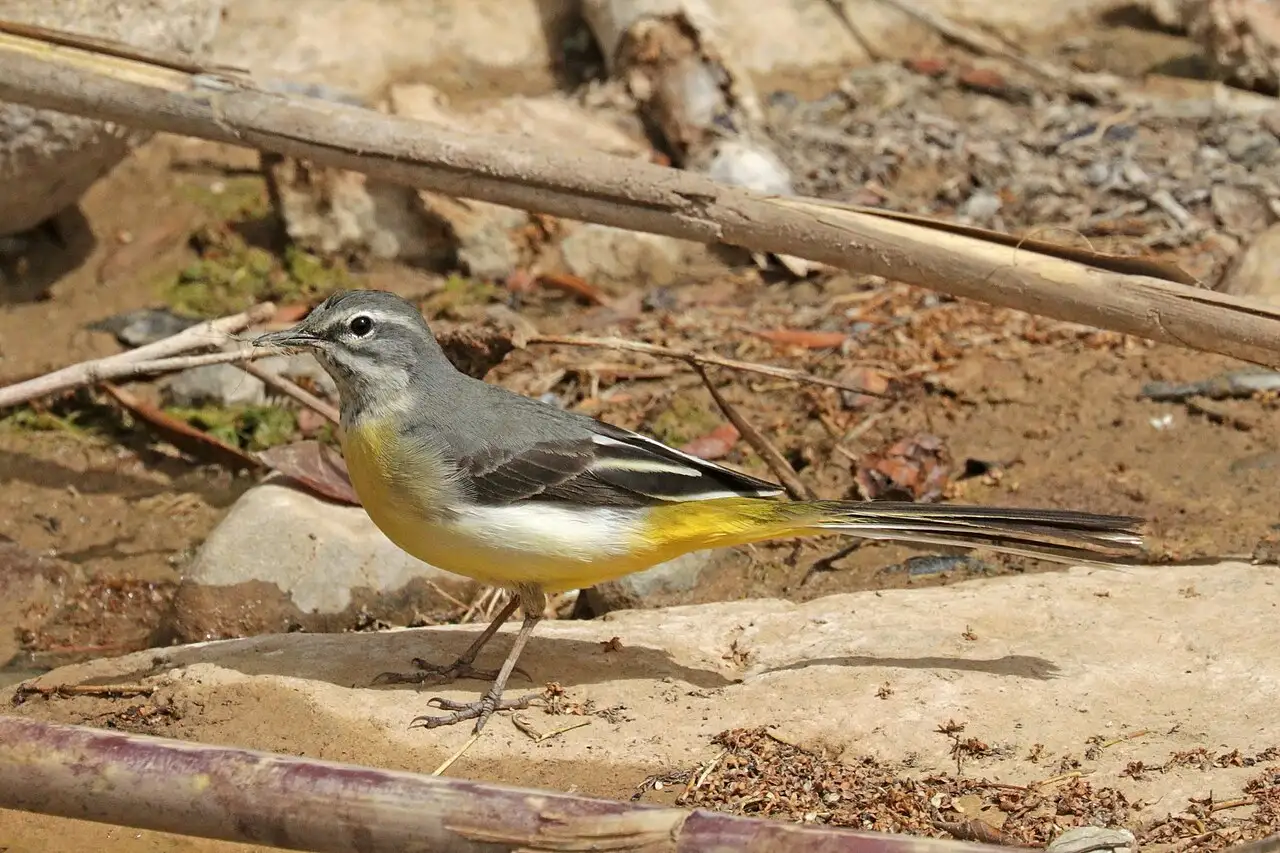
Grey Wagtail on a riverbank, with grey back, yellow belly and long, dark tailPhoto: Charles J. Sharp, CC BY-SA 4.0Photo 1 of 4
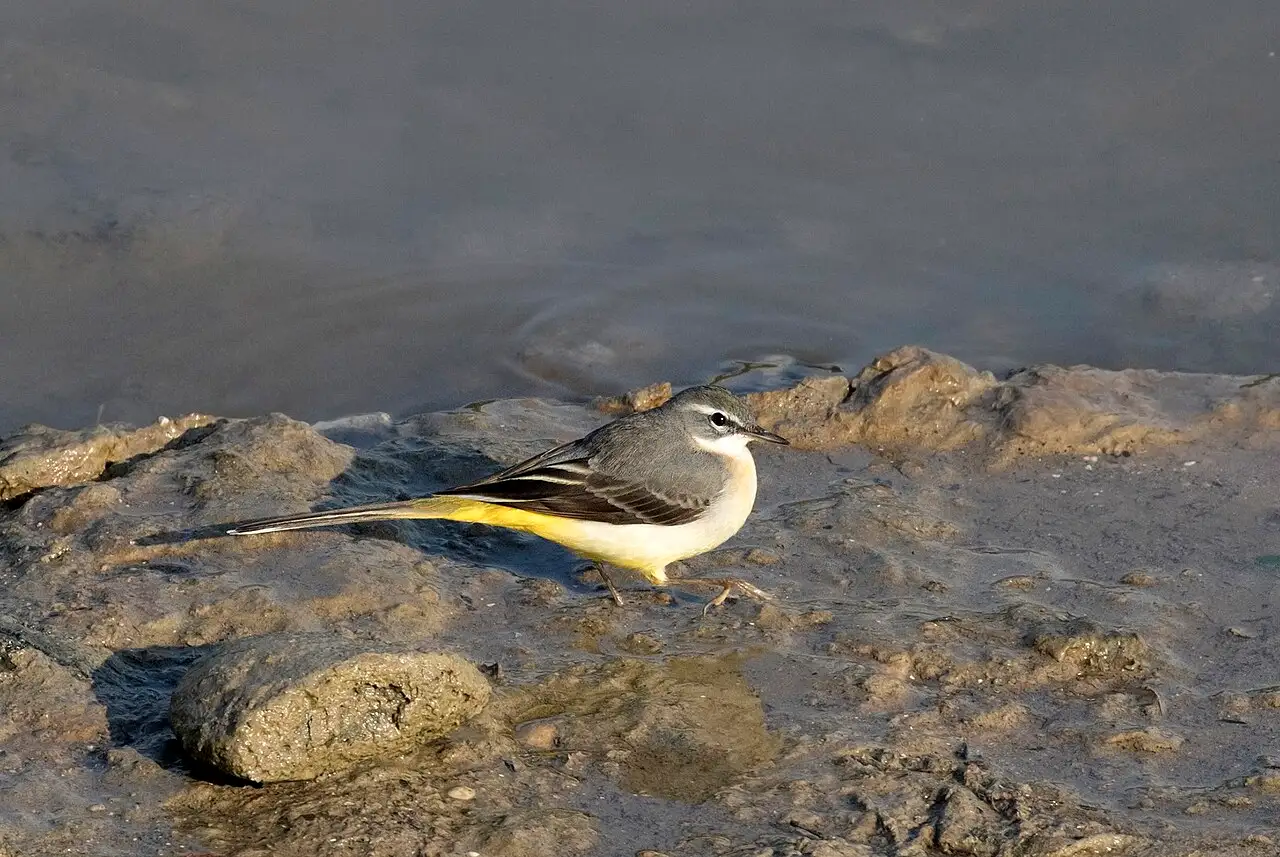
Grey Wagtail on a muddy shore, with the long, dark tail spread and yellow breastPhoto: Zeynel Cebeci, CC BY-SA 4.0Photo 2 of 4
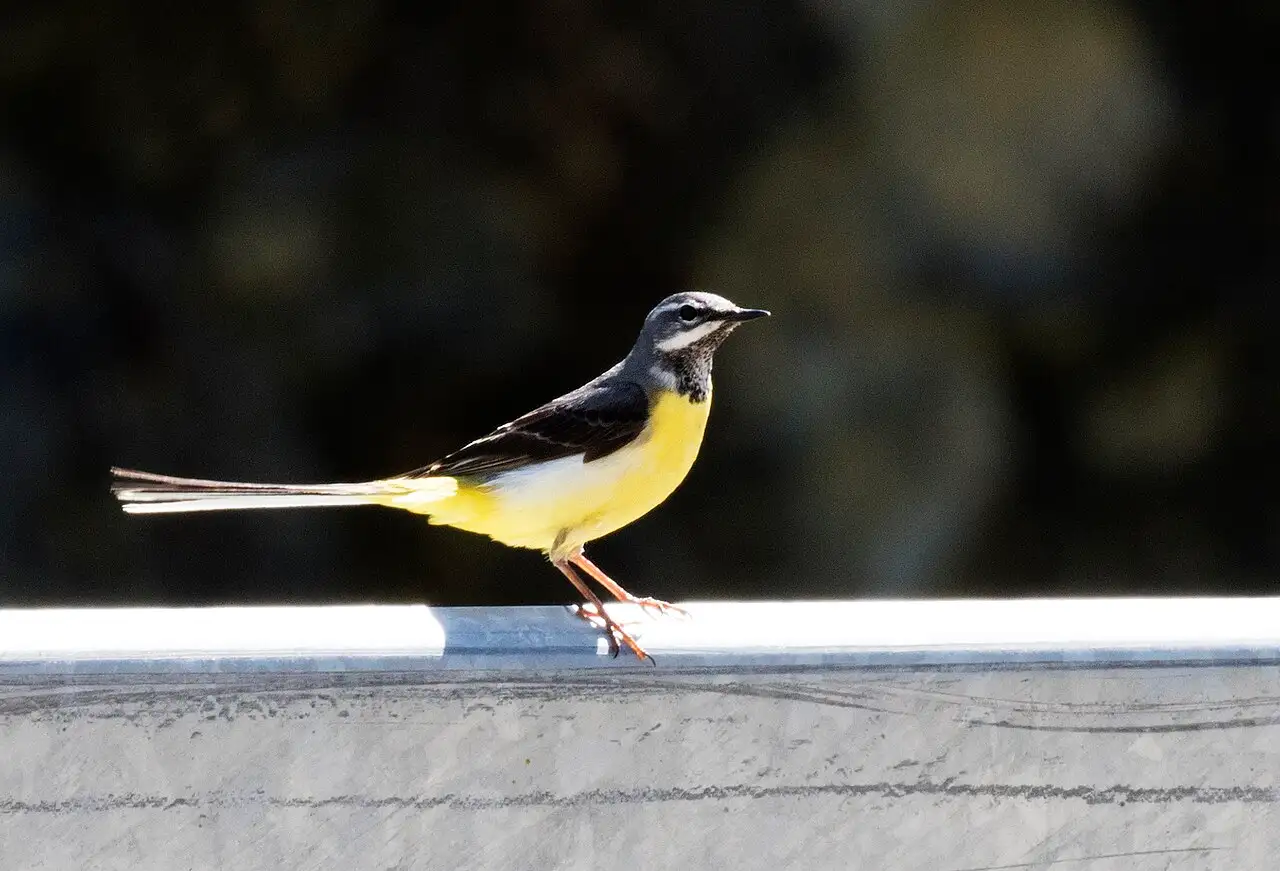
Male Grey Wagtail perched on a parapet, in profile, with black throat and bib and white eyebrowsPhoto: Zeynel Cebeci, CC BY-SA 4.0Photo 3 of 4
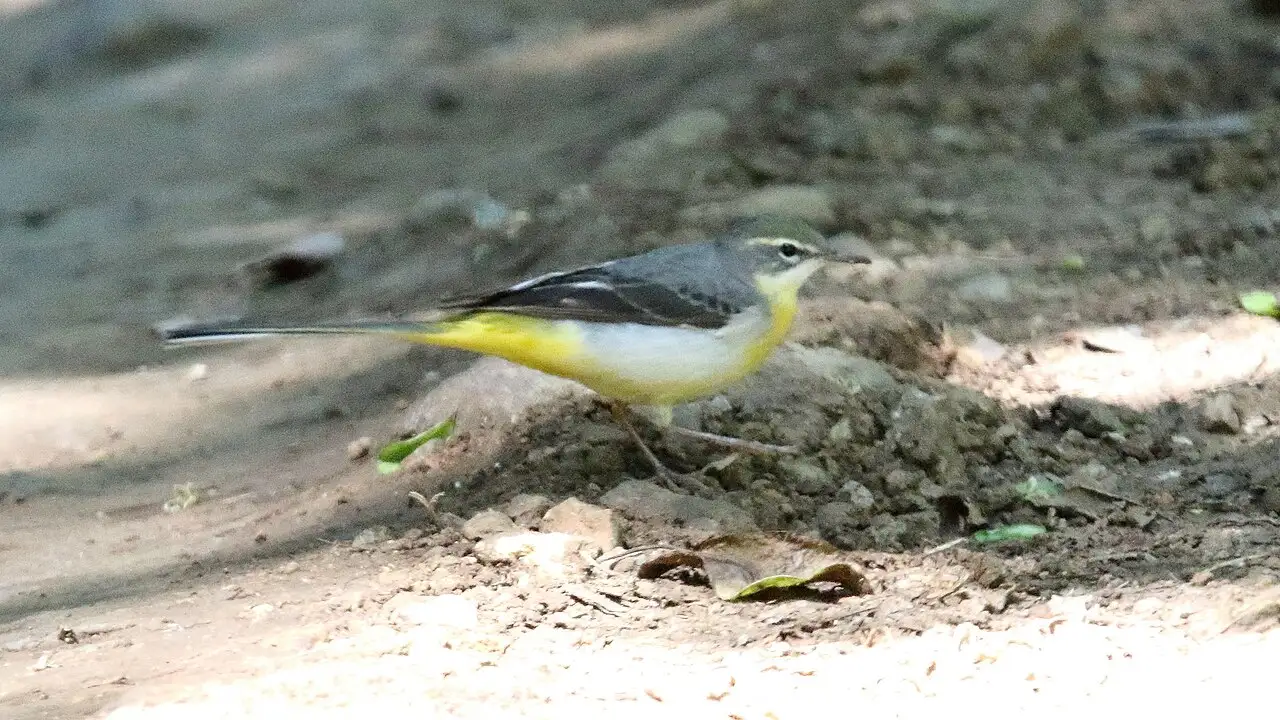
Grey Wagtail pecking on the shore ground, with yellow belly and grey backPhoto: Dominic Sherony, CC BY-SA 2.0Photo 4 of 4
1 / 4
Identification of the Grey Wagtail
It is a very slender, distinctive bird, with a long tail and grey and yellow tones. It has an ash-grey back, black folded wings without white bands, and yellow underparts and rump. The tail is very long and black, with white outer feathers, and the bill and legs are black. The head is grey, with black throat and bib and two marked white lines at the eyebrow and moustache. In winter it wears similar plumage, but with a white throat and part of the underparts also white. Two outstanding habits are the continual rocking of the tail and its presence almost always near watercourses.
Male
Throat and bib black, which turn white in winter.
Back grey, belly and rump yellow.
Female and young bird
The female never has a black throat and is less yellow below.
Young birds recall a female in winter plumage, with softer tones.
Habitat and distribution of the Grey Wagtail
As a breeder it occupies the temperate latitudes of Eurasia in a fragmented way, and is absent from much of Russia and from Tibet. Although in Asia it is migratory, in Europe it is basically resident, with a small wintering population in North Africa. It has little geographical variation, with six recognised subspecies.
In Spain, the subspecies «cinerea» is on the Peninsula and in the Balearics, and in the Canaries the subspecies «canariensis» lives, resident on La Palma, La Gomera, Gran Canaria and Tenerife. On the Peninsula it breeds in all damp or mountainous regions with permanent watercourses: the northern third, the Iberian and Central systems, the ranges of the Mediterranean coast, Sierra Morena and the Subbetic and Penibetic ranges. It is closely tied, all year though not exclusively, to freshwater torrents with a rocky bed and fast current, with a marked preference for mountain areas, more and more so towards the south, with little sunshine and good tree cover; it is not rare in urban centres. It nests from sea level to over 2,000 metres. In winter it is less strict, and also occupies lower stretches of rivers and streams, ponds and canals, and gathers in small roosts of a few dozen birds. Spanish birds are sedentary, with altitudinal movements of little importance, and in winter a few birds arrive, mainly from France and Belgium.
Areas where it is regularly recorded since 2010Squares of about 25 km where it is recorded regularly (occasional passage records are left out). Data from GBIF.org (213,201 records, retrieved October 2026); outline from Natural Earth.
Etymology of the Grey Wagtail
«Motacilla» is the Latin name for wagtails. «Cinerea» is «ash-coloured», for the grey back.
Population of the Grey Wagtail
In the 2021 European Red List of Birds the European breeding population is estimated at between 2.24 and 4.75 million mature individuals, with a stable trend. In Spain the breeding population exceeds half a million birds, according to the latest estimates, which double those of earlier censuses, although other estimates made in Asturias, Alicante or Valencia suggest the figure is well above reality. The SACRE programme shows a stable trend between 1998 and 2018. It is classified as Least Concern and is not a threatened species.
Nest of the Grey Wagtail
Both sexes build it: a large cup of branches, grass and moss, in a hole low down and near water, for example in river banks, rocks, roots, bridges, buildings and walls.
Courtship and breeding of the Grey Wagtail
The breeding period runs from March to August, with two clutches, sometimes three. It is monogamous and very territorial, and defends stretches of 200 to 1,000 metres of watercourse. It lays four to six cream-white eggs with grey spots, which both sexes incubate for some 12 days. After 10 to 15 days of care by both parents the chicks leave the nest, and they will be fed for at least another week.
Diet of the Grey Wagtail
Its diet consists of a great variety of terrestrial and aquatic insects, above all larvae and adults of mosquitoes, flies, mayflies and beetles. It looks for and pecks at them on the ground and in shallow water, with occasional chases, on foot and in flight, alone or in small groups.
Curious facts about the Grey Wagtail
It is the most riverine and slender of the Spanish wagtails. In the Canaries it has a subspecies of its own, with more intense yellows, sometimes almost orange.
The Grey Wagtail in Cabañeros
The habitat pages of this website cite it, together with the White-throated Dipper, among the usual prowlers of the rivers of Cabañeros, which go among the stones that stick out of the water.
Where to see the Grey Wagtail in Cabañeros
On the rivers of Cabañeros, among the stones that stick out of the water.
When
All year round; it is sedentary, and in winter the odd bird comes from central Europe.
What time
During the day, while it hunts insects.
Where
On the stones and banks of rivers and streams, bobbing its tail.
What to look for
A grey and yellow bird, with a very long tail, which never stops moving it.
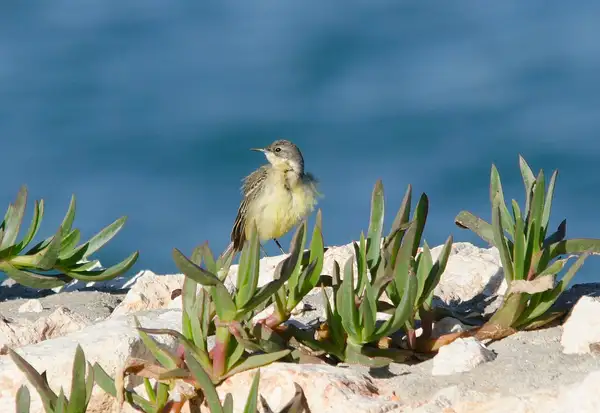
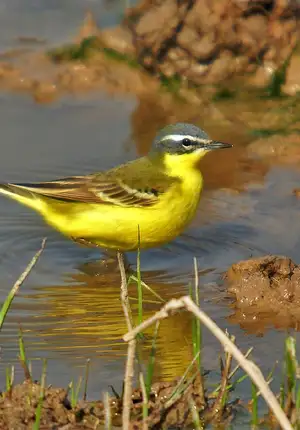
The most compact, greenish and shortest-tailed of the Spanish wagtails: back and rump olive green and underparts very yellow, with blue-grey head and white eyebrow.



 Same family
 Same family
 Same family
 Same family
 Also in rivers and riverbanks
 Also in rivers and riverbanks
 Also in rivers and riverbanks
 Also in rivers and riverbanks






