Wingspan compared with a person with arms outstretched.
Length
40–51 cm
Wingspan
52–60 cm
Weight
171–254 g
Social life
The pair builds the nest; the female incubates and both parents tend the chicks
Lifespan
Record of 21 years and 8 months in the wild (a bird ringed in Great Britain and Ireland, shot)
Conservation status
LC
NT
VU
EN
CR
EW
EX
Global (IUCN)
Least Concern
Spain
Least Concern (LC) in the Red Book of the Birds of Spain; not on the List of Wild Species under Special Protection or in the Spanish Catalogue of Threatened Species
When to see it
Resident
Months of the year when it is present
J
F
M
A
M
J
J
A
S
O
N
D
In Iberia
yes
yes
yes
yes
yes
yes
yes
yes
yes
yes
yes
yes
Song or voice of the Eurasian Magpie
Like all corvids, it has a remarkable ability to produce a great variety of vocalisations. It is normally a noisy, chattering bird, which gives various hoarse, harsh sounds, although the most frequent is a penetrating «chac-chac-chac», very common when it is alarmed or disputing some food. The song proper is harsh and not very sonorous, with the odd higher note suddenly slipped in.
CallEurasian Magpie
0:00 / 0:32
10 kHz5
The sonogram draws the sound: time runs from left to right, and the higher a trace sits, the higher the note.Recording by AviCanto, Wikimedia Commons (Vídeo de YouTube, con atribución).
Flight of the Eurasian Magpie
It is recognised by its characteristic silhouette and by an undulating flight, during which it beats its wings jerkily.
Flight typeUndulating, with jerky wingbeats
It is a noisy, chattering bird that gives hoarse, harsh sounds; the most frequent is a penetrating «chac-chac-chac», very common when it is alarmed or disputing some food.
It is also identified by its characteristic silhouette and undulating flight, during which it beats its wings jerkily.
It has no specialised diet: depending on place and season it eats grain, invertebrates, scraps, carrion and fruit, and if it gets the chance, the eggs and broods of other birds.
Photo gallery of the Eurasian Magpie
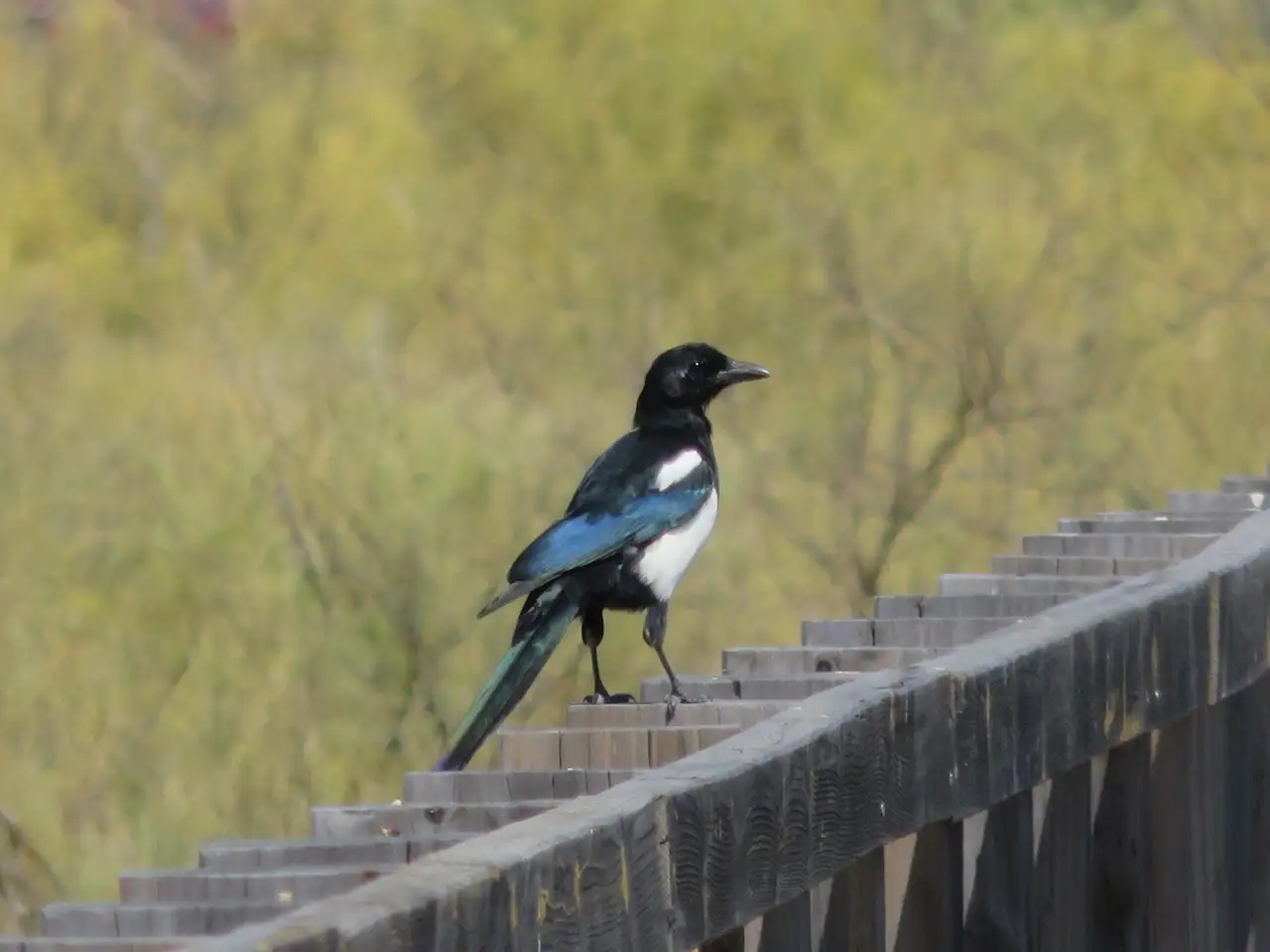
Eurasian Magpie perched on a wooden railing, with black-and-white plumage, wings with blue iridescence and a long tailPhoto: Mpicado, CC BY-SA 4.0Photo 1 of 4
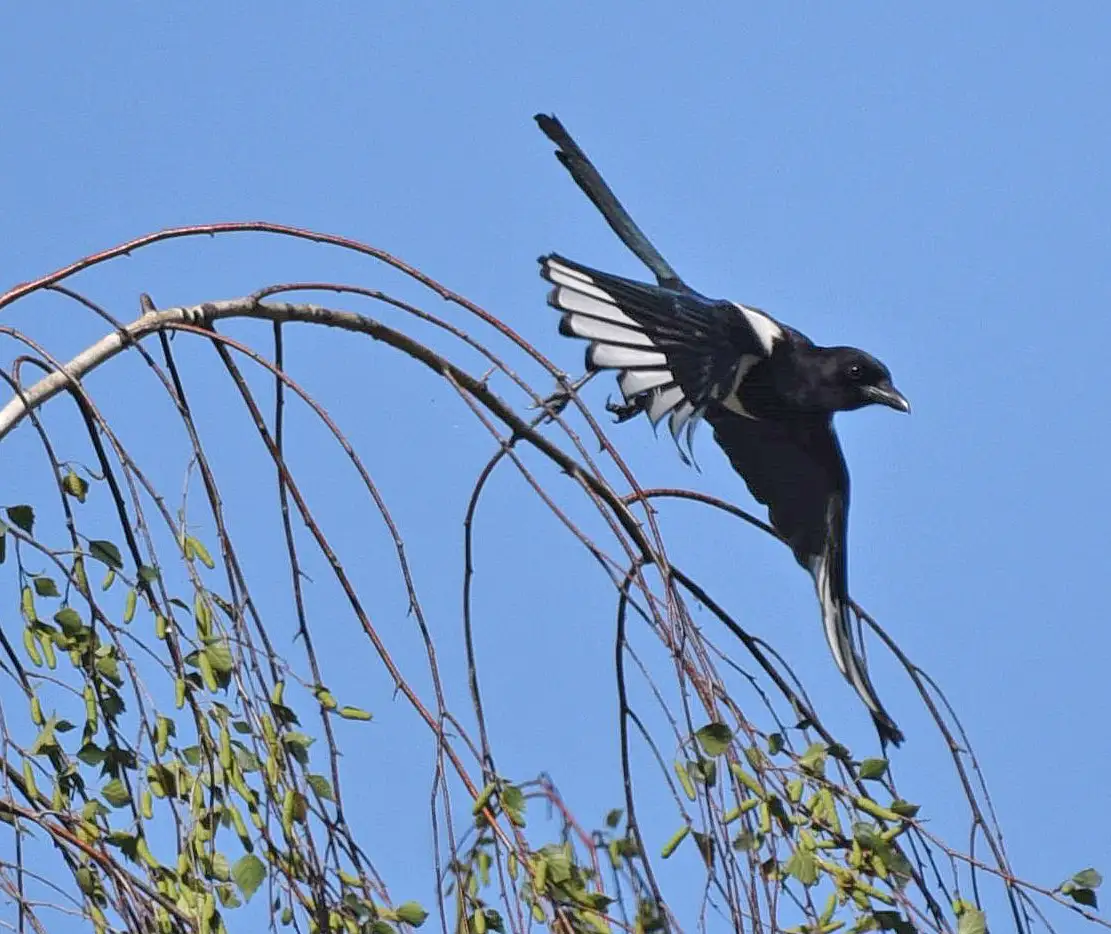
Eurasian Magpie taking off from a thin branch, with open wings and long tail spreadPhoto: Pierre-Marie Epiney, CC BY-SA 2.0Photo 2 of 4
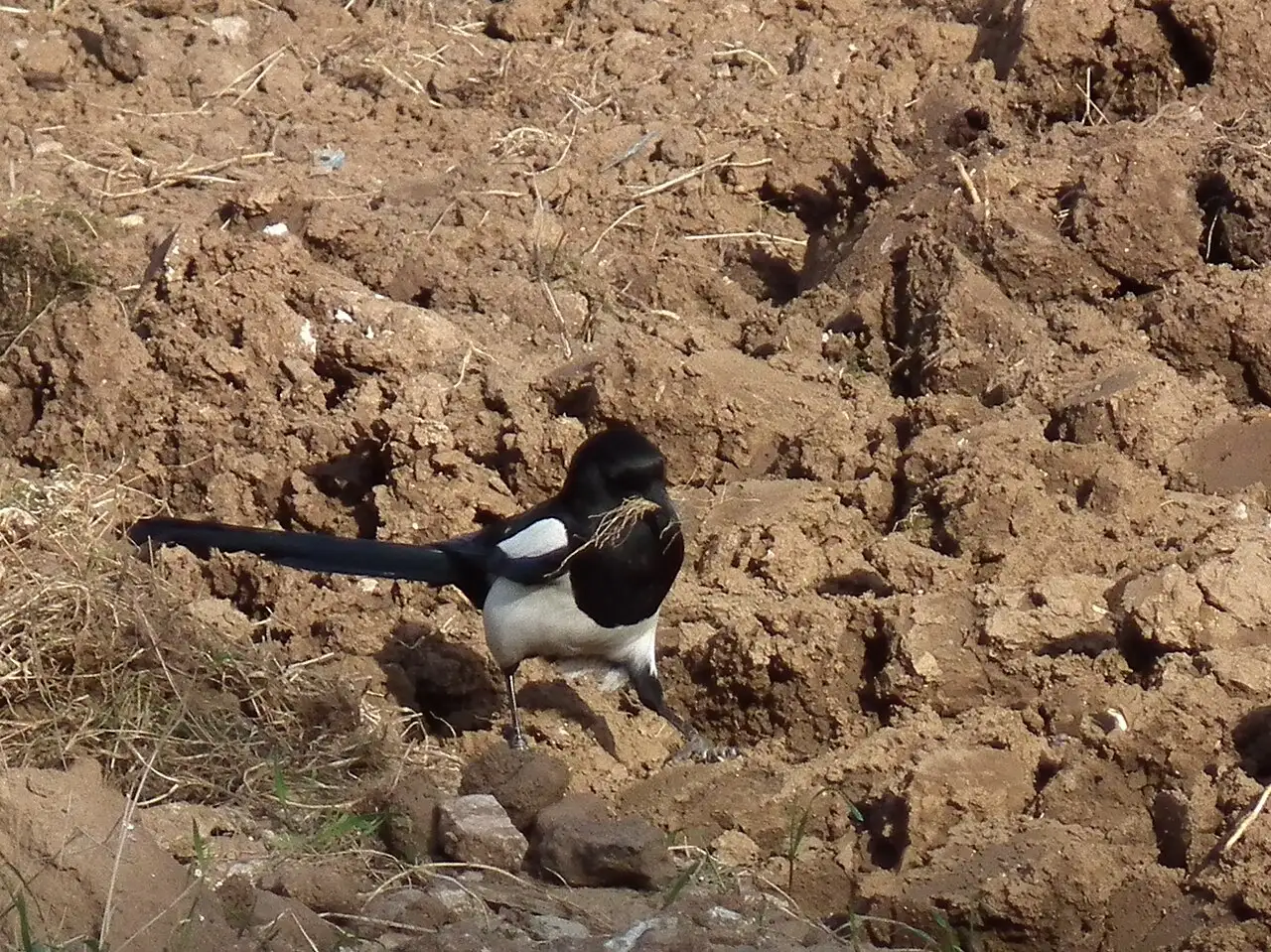
Eurasian Magpie in a ploughed field, with white breast, black back and long tail, with a twig in its billPhoto: 4028mdk09, CC BY-SA 3.0Photo 3 of 4
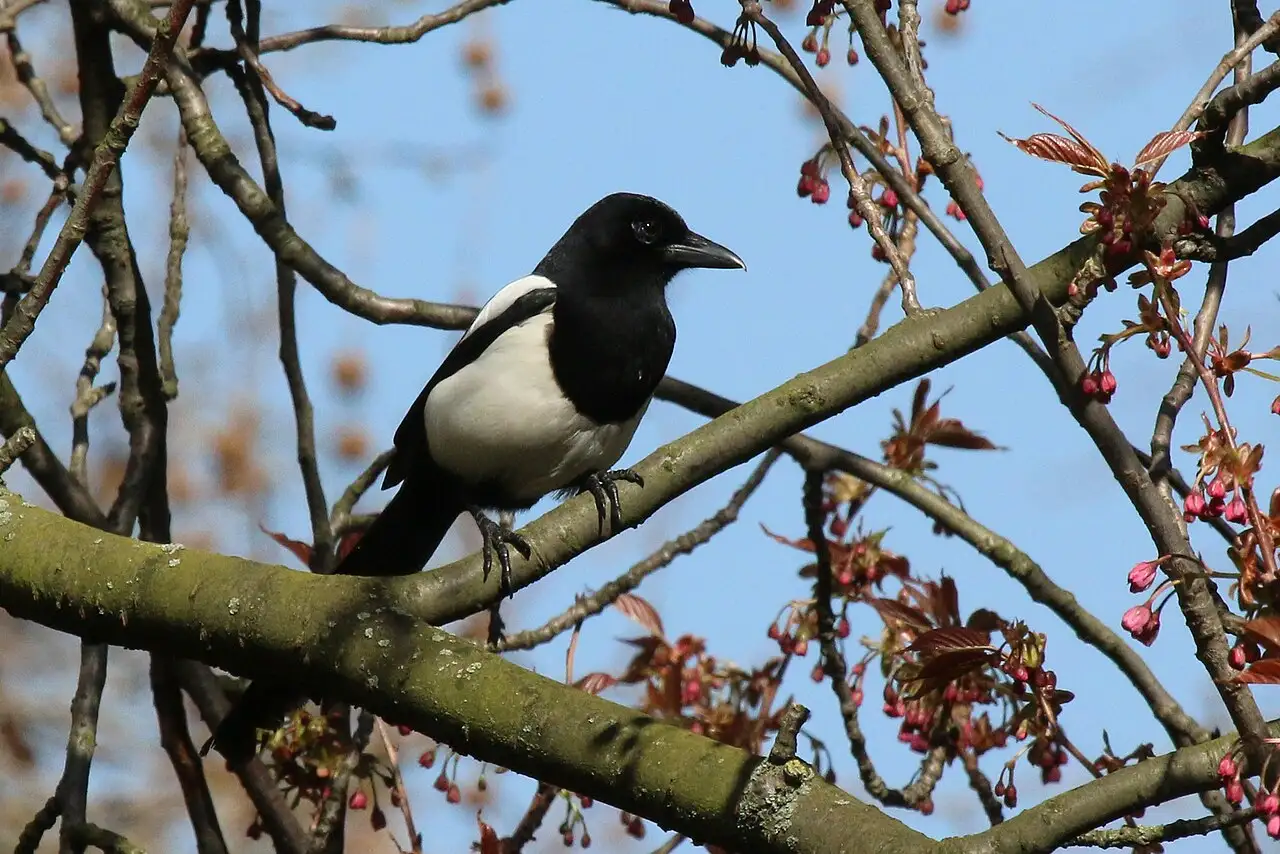
Eurasian Magpie perched on a branch, in profile, with black head, white belly and bluish gleams on the wingsPhoto: Charles J. Sharp, CC BY-SA 3.0Photo 4 of 4
1 / 4
Identification of the Eurasian Magpie
It is one of the best-known species of Spanish fauna, not only for its unmistakable appearance, but also for its far from discreet habits and its ability to settle in highly transformed habitats, including the interior of large cities. Medium-sized among the corvids, it wears a striking and characteristic black-and-white plumage, which takes on lovely iridescence in different areas, above all in the tail feathers.
When it moves it is easily identified, besides its colour pattern, by its characteristic silhouette and by an undulating flight, during which it beats its wings jerkily. It is extremely intelligent: to date it is the only bird that has proved able to recognise its own image in a mirror.
Adult
Black-and-white plumage, with iridescence above all in the tail.
Characteristic silhouette and undulating flight.
Habitat and distribution of the Eurasian Magpie
Extraordinarily adaptable and successful, it is a species spread across the whole northern hemisphere, from which it is absent only in the most extreme regions; its tolerance lets it settle from the Maghreb to central Asia or northern Scandinavia. Numerous subspecies are recognised.
In Spain it is distributed over practically the whole Peninsula, where it is one of the commonest and most widespread species. It is absent from both archipelagos and the North African towns. It is particularly abundant in the northern half, while the lowest densities are recorded in the Levante Mediterranean strip, Cádiz, Málaga and the Guadalquivir valley, areas in which it may be wholly absent. The subspecies «melanotos» is present in Spain.
It bases its strength on an adaptable, eclectic character: it settles in a great variety of habitats, except dense forests and high mountains. It reaches its best densities in farming regions, with woodlots, riverside groves and isolated trees, on the outskirts of inhabited areas and in some urban parks.
At all times and throughout its range it is strictly sedentary. Once the young become independent, its dispersal capacity is low: it rarely makes movements beyond a 50-kilometre radius.
Areas where it is regularly recorded since 2010Squares of about 25 km where it is recorded regularly (occasional passage records are left out). Data from GBIF.org (777,474 records, retrieved October 2026); outline from Natural Earth.
Etymology of the Eurasian Magpie
In other languages it is called «garsa comuna» in Catalan, «pega rabilonga» in Galician, «mika arrunta» in Basque and «Eurasian magpie» in English1. The subspecies «melanotos» is present in Spain.
Population of the Eurasian Magpie
In the 2021 European Red List of Birds, the European breeding population is estimated at between 19,300,000 and 31,300,000 mature individuals, with a stable trend. In Spain, the breeding population in 2014–2018 was estimated at around 3,000,000 individuals, with the highest abundances in Castilla y León, Castilla-La Mancha, Andalusia and Aragón. The Magpie seems to have expanded and increased in abundance at the end of the last century, and then entered a phase of moderate decline in recent decades.
Given its abundance and great adaptability, it has no particular conservation problems. In the past it was relentlessly persecuted, accused of harming game species (a point never conclusively proved) and of plundering crops and sown fields. Today the pressure is much lower, but countless cases of nest destruction and shooting still occur, and poison is used illegally to control its numbers.
Nest of the Eurasian Magpie
The pair makes the nest at the end of March or beginning of April, in a great variety of sites: from large trees to thorny bushes and electricity pylons. It is a careful, solid construction, made of sticks, roots and other materials, reinforced with mud. The inside of the cup is lined with moss, wool, plant fibres, feathers and, at times, brightly coloured or shiny objects. Some of these platforms are also given a framework of twigs like a parasol.
Courtship and breeding of the Eurasian Magpie
In our territory, the breeding cycle begins at the end of March or the beginning of April. Laying usually starts in mid-April and consists of between five and eight greenish-blue eggs, heavily speckled. Incubation is carried out by the female alone and lasts 21 or 22 days; then the chicks hatch and are tended by both parents. The fledglings leave the nest after 24–32 days, but remain dependent on parental care for some weeks more. It lays a single clutch a year, although it may lay replacement clutches if the first fails.
Diet of the Eurasian Magpie
Opportunism and great adaptability also show in the complete lack of specialisation in its diet: almost anything edible can form part of its food. Depending on place and season, it eats everything from grain to invertebrates, as well as all kinds of scraps, carrion and fruit. If it gets the chance, it devours the eggs and broods of other birds and hunts small vertebrates, such as reptiles and rodents.
Curious facts about the Eurasian Magpie
It is the most abundant and widespread corvid of the Peninsula. In the past it was heavily persecuted for its supposed harm to game and crops, but it has achieved notable success through its ability to adapt to the most human-altered environments. It is, to date, the only bird that has shown it can recognise its own image in a mirror. The ringed bird that lived longest, shot in Great Britain and Ireland, reached 21 years and 8 months.
The Eurasian Magpie in Cabañeros
The grassland page of this website cites it, together with the Meadow Pipit and the Black Redstart, among the birds of the raña in winter, and describes it as one of the «omnivorous species» of that environment, which join the flocks of seed-eating and insect-eating species.
Where to see the Eurasian Magpie in Cabañeros
On the grasslands and open areas of the raña, above all in winter.
When
All year: it is resident and strictly sedentary.
What time
In good light, scanning the raña and open areas with binoculars.
Where
In fields, woodlots, riverside groves and isolated trees.
What to look for
It is heard before it is seen: a penetrating «chac-chac-chac» and an undulating flight with jerky wingbeats.



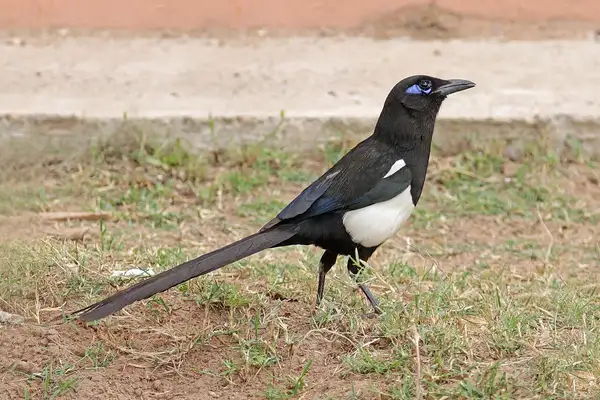
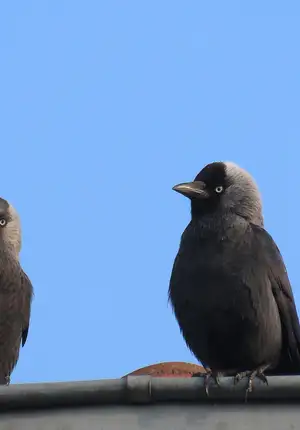 Same family
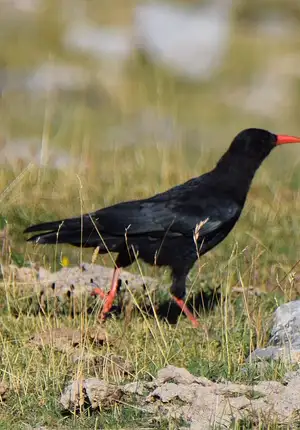 Same family
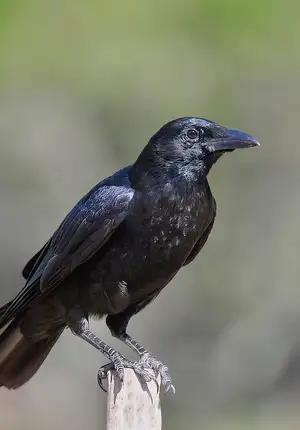 Same family
 Same family
 Also in dehesas (wood pasture)
 Also in dehesas (wood pasture)
 Also in dehesas (wood pasture)
 Also in dehesas (wood pasture)






