Wingspan compared with a person with arms outstretched.
Length
30–34 cm
Wingspan
64–73 cm
Weight
196–265 g
Social life
Very social: it breeds in colonies and moves and looks for food in noisy flocks
Lifespan
Record of 24 years and 3 months in the wild (a bird ringed in Germany)
Conservation status
LC
NT
VU
EN
CR
EW
EX
Global (IUCN)
Least Concern
Spain
Endangered (EN) in the 2021 Red Book of the Birds of Spain; not on the List of Wild Species under Special Protection or in the Spanish Catalogue of Threatened Species
When to see it
Resident
Months of the year when it is present
J
F
M
A
M
J
J
A
S
O
N
D
In Iberia
yes
yes
yes
yes
yes
yes
yes
yes
yes
yes
yes
yes
Song or voice of the Western Jackdaw
It is a very noisy species, which usually gives several very characteristic calls, such as a «chaac, chaac» or a «kiá, kiá», which recalls the Red-billed Chough’s. The recording, a «chyak», was made in Tartu (Estonia).
CallWestern Jackdaw
0:00 / 0:13
10 kHz5
The sonogram draws the sound: time runs from left to right, and the higher a trace sits, the higher the note.Recording by Veljo Runnel, Wikimedia Commons (CC BY-SA 4.0).
Flight of the Western Jackdaw
It is usual for jackdaws to organise into noisy flocks that fly over rocks and old buildings, or that bustle about fields and pastures in search of food.
Flight typeIn noisy flocks over rock faces, buildings and fields
It rises with the flock from a cliff, an old building or a stork's nest, letting out its calls: «chaac, chaac» and «kiá, kiá».
It flies in noisy flocks that fly over rocks and old buildings, or that come down to fields and pastures.
It lands on the pasture or ploughed field, where it bustles about in search of cereals, fruit, invertebrates and seeds.
Photo gallery of the Western Jackdaw
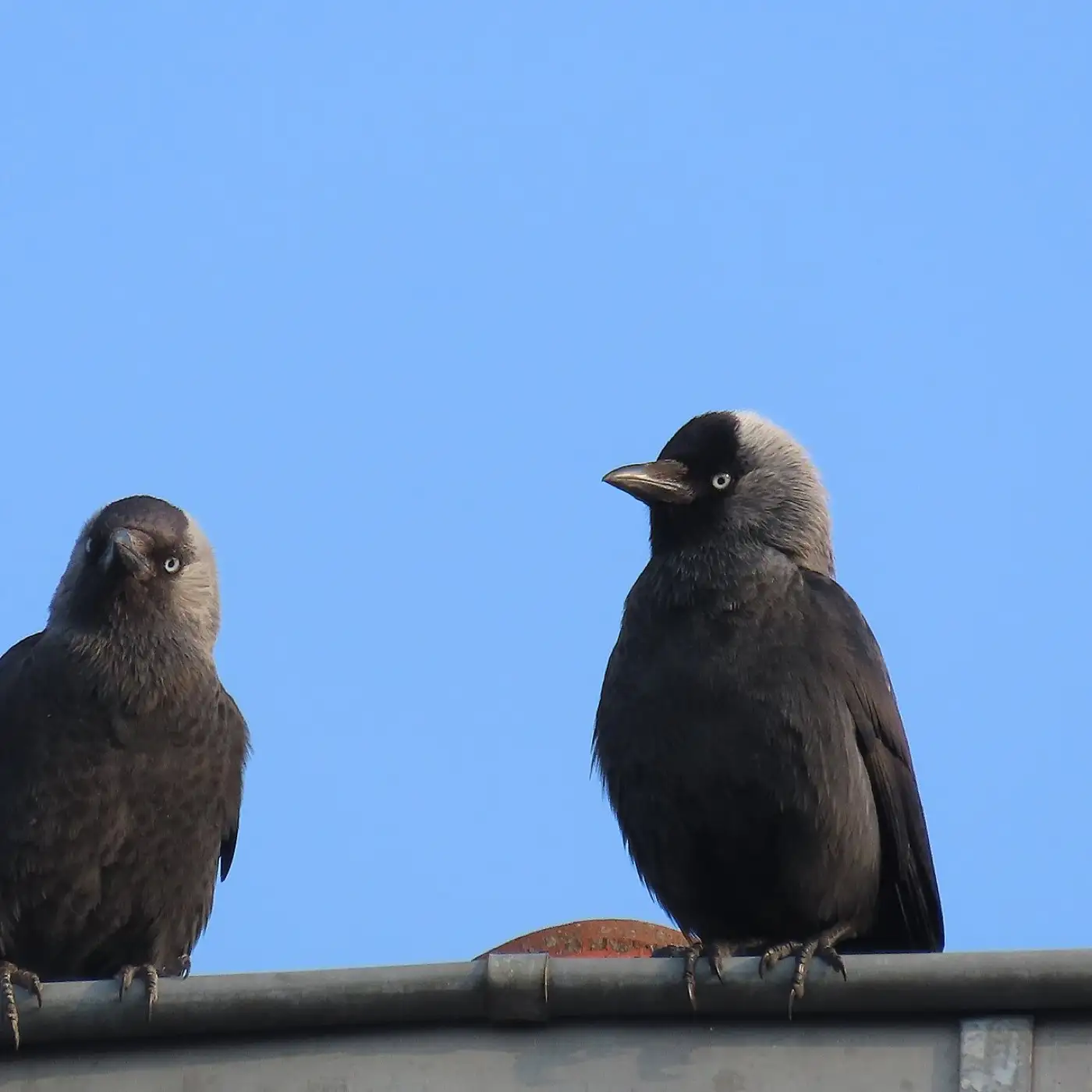
Two Western Jackdaws on a roof in Vitoria-Gasteiz, with dark plumage, grey nape and pale eyePhoto: Xardin, CC BY-SA 4.0Photo 1 of 4
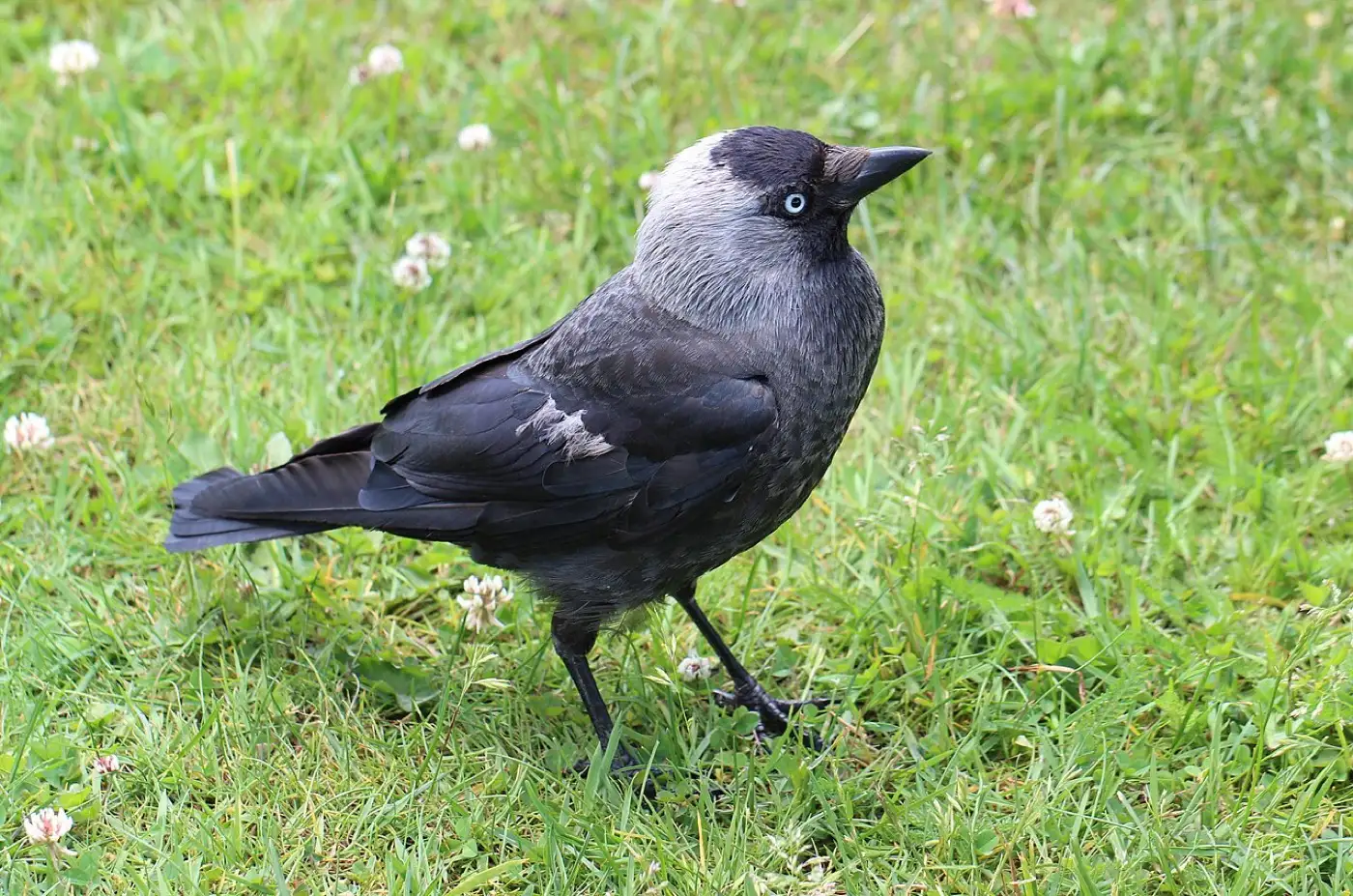
Western Jackdaw in profile on the grass, with head and nape ash grey and an almost white irisPhoto: AfroBrazilian, CC BY-SA 4.0Photo 2 of 4
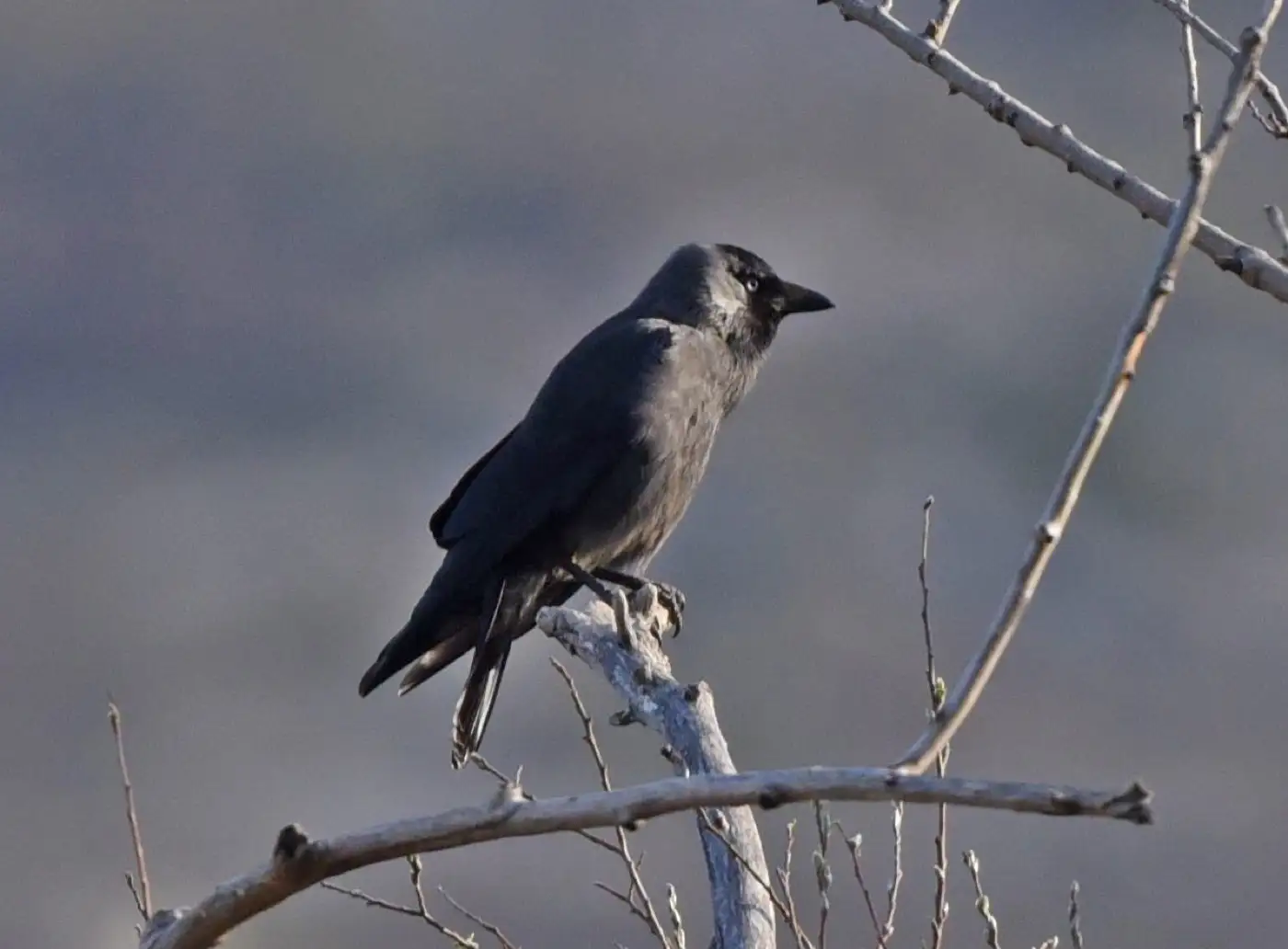
Western Jackdaw perched on a bare branch, in dark tones and with a paler napePhoto: Pierre-Marie Epiney, CC BY-SA 2.0Photo 3 of 4
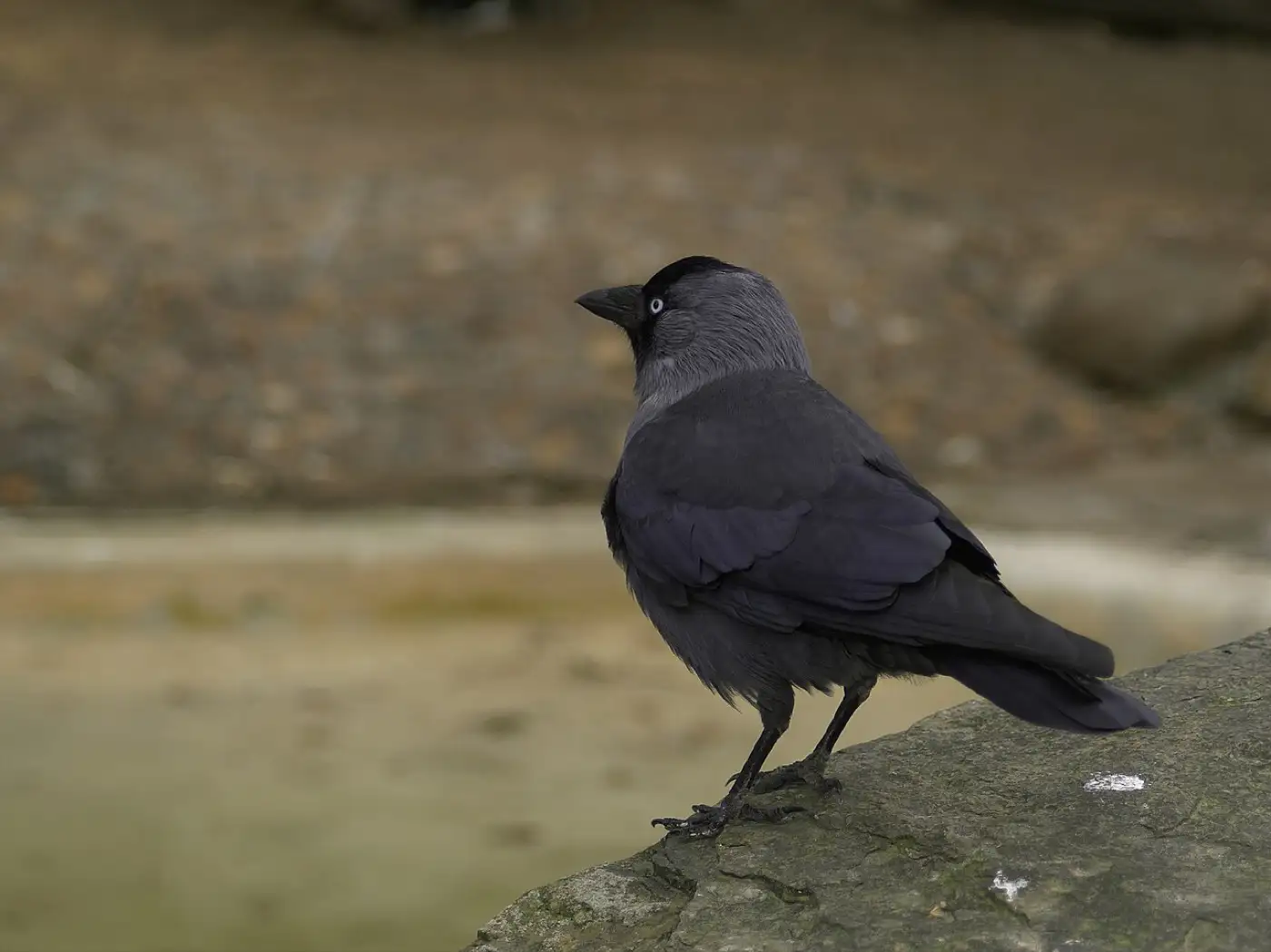
Western Jackdaw on a stone, from behind, with black plumage and short tailPhoto: Hans Hillewaert, CC BY-SA 3.0Photo 4 of 4
1 / 4
Identification of the Western Jackdaw
The Western Jackdaw is a bird of more modest size than rooks and crows, with very dark plumage that, at some distance, looks black. Seen close up, however, a certain greyish tone can be seen on some regions of the body, especially the breast and the nape, which is a lovely ash-grey colour. The iris is very pale, a pale blue, almost white.
They usually organise into noisy flocks that fly over rocks and old buildings or that bustle about fields and pastures in search of food.
Adult
Very dark plumage, with greyish tones on the breast and ash-grey nape.
Iris pale blue, almost white.
Habitat and distribution of the Western Jackdaw
It is a species of wide distribution across the whole western Palearctic, where it extends to the bounds of Mongolia and Lake Baikal. In Europe it is a frequent bird, spread over almost the whole continent, except Iceland and northern Scandinavia, and there are some isolated populations in the Maghreb. It has three subspecies in Europe, of which «spermologus» is the one present in the west of the continent, including the Iberian Peninsula.
In Spain it can be considered abundant and is distributed quite evenly across the whole Peninsula, from which it is absent only over a good part of the Cantabrian coast and the Pyrenees. It has disappeared as a breeder from wide areas of the northern plateau, the Ebro valley, the southern plateau, the Central System, Sierra Morena and the Betic System. It is scarce in Galicia, at some points of the Guadalquivir valley and in certain districts of Catalonia and the southern plateau. It is absent from the Balearics, the Canaries and Melilla, although it lives in Ceuta.
It is closely tied to the existence of rock faces, walls and overhangs, and its presence is conditioned by the existence of suitable sites in which to set up its breeding colonies. That is why it frequents river gorges, rock faces, old tree groves (in particular ash groves), bridges, ruined buildings and monumental cities. To look for food it prefers open areas, with ploughed fields, grasslands, dehesas and livestock farms. It avoids heavily wooded areas and mountainous zones, where it does not usually climb beyond 1,400–1,500 metres. In Central Europe urban colonies are very common, and in Spain there are excellent examples in Salamanca, León, Cáceres or Trujillo.
It is a corvid that is more sedentary the further south its populations are found: Nordic birds are the most prone to migrate, and young birds the most inclined to move.
Areas where it is regularly recorded since 2010Squares of about 25 km where it is recorded regularly (occasional passage records are left out). Data from GBIF.org (175,793 records, retrieved October 2026); outline from Natural Earth.
Etymology of the Western Jackdaw
«Coloeus» comes from ancient Greek «koloiós», «jackdaw». «Monedula» comes from «moneda», the Latin word from which «moneda» («coin») comes: Linnaeus chose it for its supposed fondness for picking up coins.
Population of the Western Jackdaw
The 2021 European Red List of Birds estimates that there are between 17.8 and 36.2 million jackdaws in Europe, with an increasing trend. In Spain, the III Atlas of Breeding Birds estimates between 440,000 and 530,000 birds, figures that contrast with those of 2004–2006, of between 3.0 and 5.3 million. The data of the SACRE programme corroborate the decline, which would reach 55 % in 20 years: more than half since 1998, over two million fewer birds between 1998 and 2018. The main threats are hunting pressure and the loss of habitat and food resources. For years it was legally hunted because its habits were considered harmful to agriculture and to other game species, although published studies show there is no relationship between its populations and those of game species. Agricultural intensification, with the use of pesticides, makes it harder for it to find food, and it also dies on power lines and wind turbines.
Nest of the Western Jackdaw
Nests are placed almost always in cavities of every kind and consist of irregular, somewhat untidy heaps of branches, sticks and roots, which they line with feathers, wool and plant fibres and which, occasionally, they reinforce with mud or dung.
Courtship and breeding of the Western Jackdaw
With the arrival of April, great uproar reigns in jackdaw colonies, due to the feverish activity that synchronises the group’s breeding calendar. The clutch, of two to eight pale blue eggs, takes place around mid-April. Incubation lasts 17 or 18 days and is the sole responsibility of the female. The chicks are fed by both adults and, when they reach 30–35 days, can already leave the nest, although they stay tied to their parents for at least another five weeks.
Diet of the Western Jackdaw
As is usual in corvids, it has very unspecialised feeding habits, and its diet includes matter of animal and plant origin, although with more vegetarian tendencies than other corvids. Depending on the region, it eats all kinds of cereals (wheat, maize, barley), legumes, olives and fruit, which it supplements with invertebrates such as grasshoppers, beetles, earthworms and molluscs. It seldom frequents carrion and rubbish tips, although these carry more weight in its diet every day. Occasionally it catches small vertebrates, such as lizards or mice, and devours eggs and chicks.
Curious facts about the Western Jackdaw
Because of its supposed fondness for picking up coins, Linnaeus named it «monedula». Years ago it was abundant, and today it is an endangered species in Spain. In Salamanca, León, Cáceres and Trujillo there are urban colonies.
The Western Jackdaw in Cabañeros
This website’s page on dehesas explains that in the south of the park there is a White Stork colony and that, in its large, bulky nests, some species breed, such as the Western Jackdaw and the House Sparrow.
Where to see the Western Jackdaw in Cabañeros
In the White Stork colony of the south of Cabañeros, where it breeds in their nests.
When
All year round: it is resident, and from April the colonies are very noisy.
What time
Throughout the day, in a flock, over rock faces, buildings and fields.
Where
On cliffs, river gorges, bridges and buildings, and in ploughed fields, grasslands and dehesas.
What to look for
A small corvid with grey nape and almost white eye, in noisy groups.
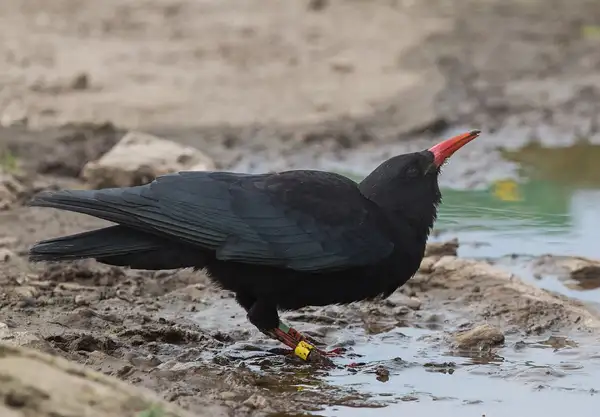
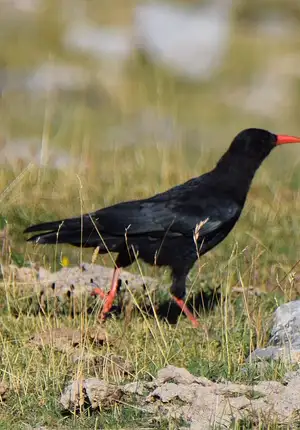
They are similar in voice1. The chough is somewhat larger, with intensely black plumage, and a long, curved, intensely red bill.
Photo: Alun Williams333, CC BY-SA 4.0
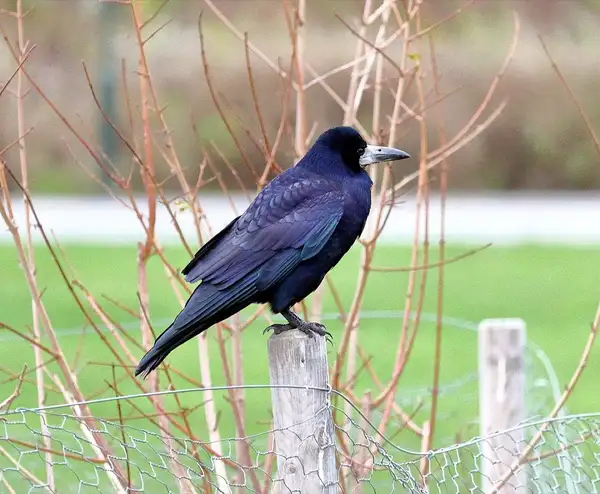
Rook
Corvus frugilegus
How to tell them apart
The Rook wears completely black plumage, with metallic sheen and iridescence, and a bare area at the base of the bill, of greyish skin. They are similar in appearance1.
Photo: Lars A, CC BY-SA 4.0
Other birds
Birds related to the Western Jackdaw or sharing its habitats in Cabañeros.



 Same family
 Same family
 Same family
 Same family
 Also in dehesas (wood pasture)
 Also in dehesas (wood pasture)
 Also in dehesas (wood pasture)
 Also in dehesas (wood pasture)






