Wingspan compared with a person with arms outstretched.
Length
54–67 cm
Wingspan
1.15–1.4 m
Weight
0.7–2.3 kg
Social life
Adults usually go in pairs and, once paired, usually nest together for life, normally in the same place; young birds form flocks (Wikipedia)
Lifespan
Record of 21 years and 10 months in the wild (a bird ringed in Norway and read in the field)
Conservation status
LC
NT
VU
EN
CR
EW
EX
Global (IUCN)
Least Concern
Spain
Least Concern (LC) on the Peninsula and the Balearics and Vulnerable (VU) in the Canaries, according to the Red Book of the Birds of Spain; not on the List of Wild Species under Special Protection nor in the Spanish Catalogue of Threatened Species
When to see it
Resident
Months of the year when it is present
J
F
M
A
M
J
J
A
S
O
N
D
In Iberia
yes
yes
yes
yes
yes
yes
yes
yes
yes
yes
yes
yes
Song or voice of the Northern Raven
With a deep, hoarse, metallic voice, its most frequent call in flight is a very low croak; as an alarm it gives a faster, harder «crack-crack-crack». As is usual in corvids, it can produce numerous sounds like short, hoarse chatter, with which it communicates with other birds.
CallNorthern Raven
0:00 / 0:25
10 kHz5
The sonogram draws the sound: time runs from left to right, and the higher a trace sits, the higher the note.Recording by Jonathon Jongsma, Wikimedia Commons (xeno-canto XC110257) (CC BY-SA 3.0).
Flight of the Northern Raven
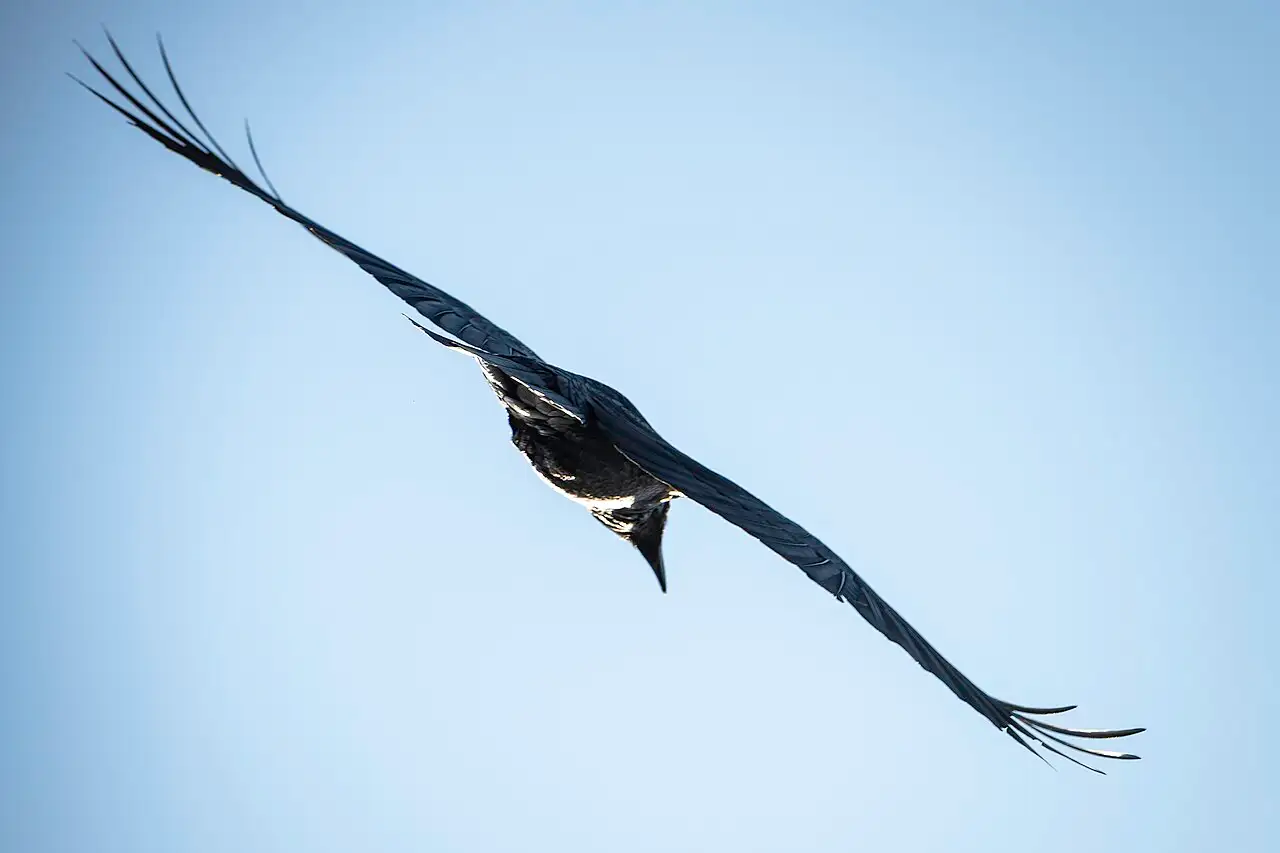
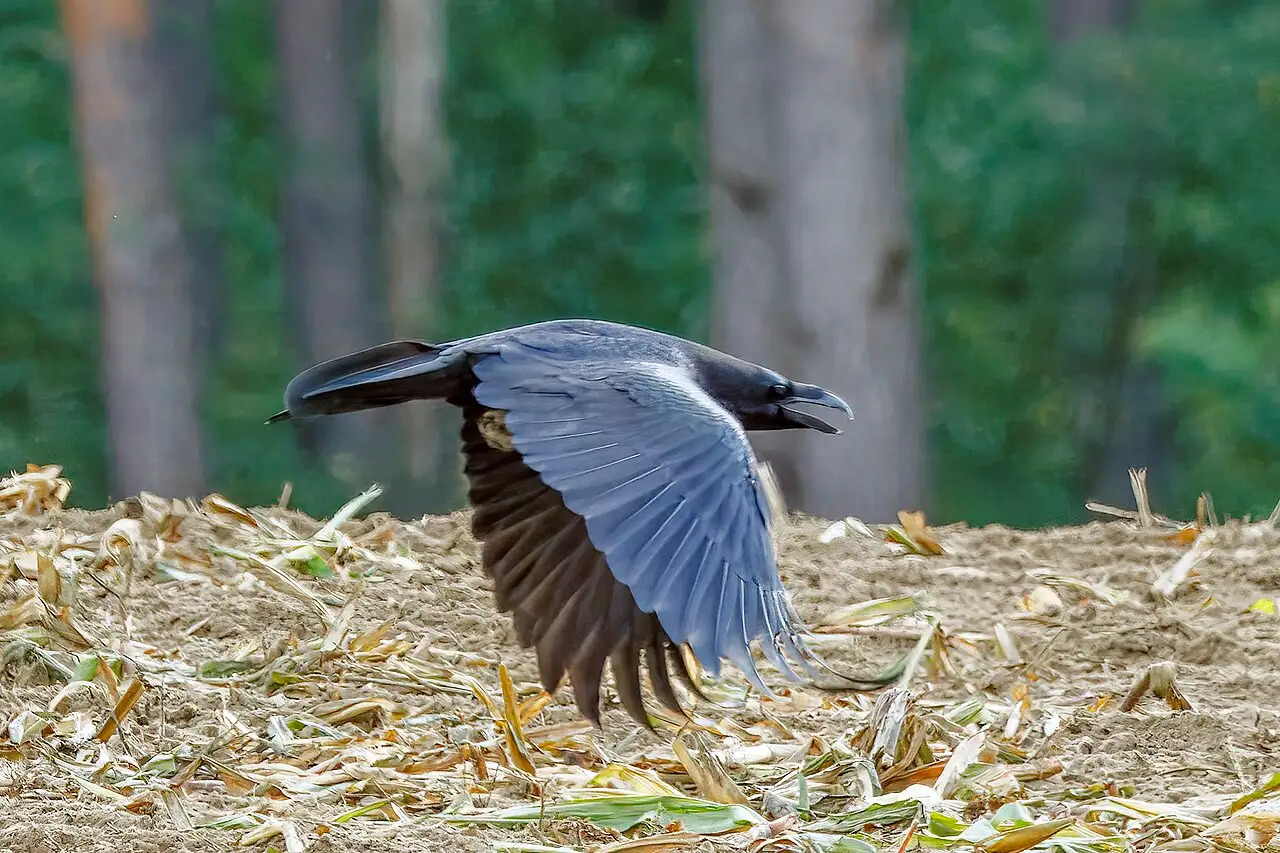
The flight of this enormous bird is slow and it usually alternates flaps with long glides, which it performs thanks to its long pointed wings and its wedge-shaped tail.
Flight typeSlow, with flaps and long glides
It leaves the ledge or branch with a deep croak, the call it gives most often in flight.
Its flight is slow: it mixes flaps with long glides, thanks to its long pointed wings and its wedge-shaped tail.
It looks for a rock face to perch and nest on and, if there are none, a large tree, an electricity pylon or an abandoned building.
Photo gallery of the Northern Raven
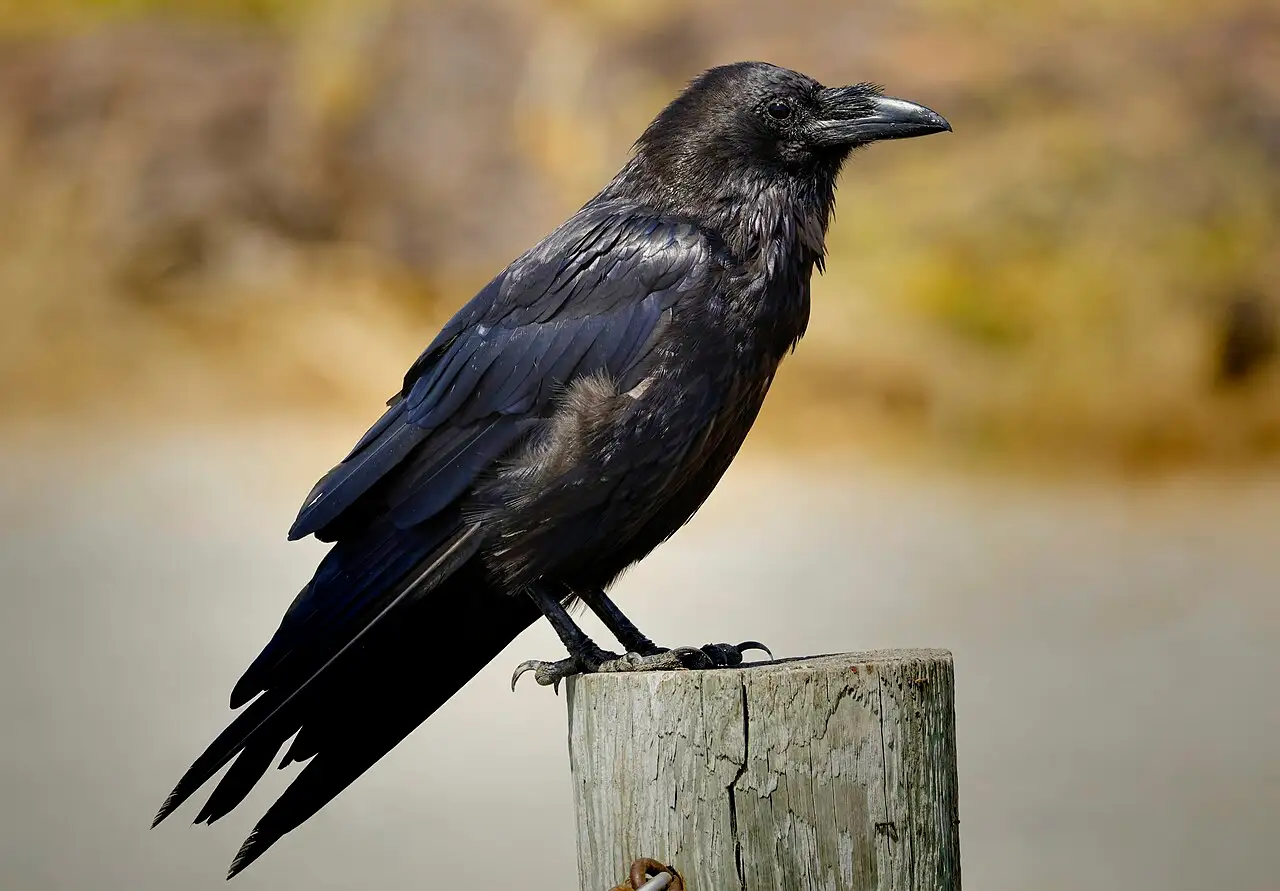
Northern Raven perched in profile on a wooden post, with black plumage with metallic sheen and a long, thick, robust billPhoto: Saiquaticlifeform, CC0Photo 1 of 4
Northern Raven taking off over a stubble field, with its wing openPhoto: Charles J. Sharp, CC BY-SA 4.0Photo 3 of 4
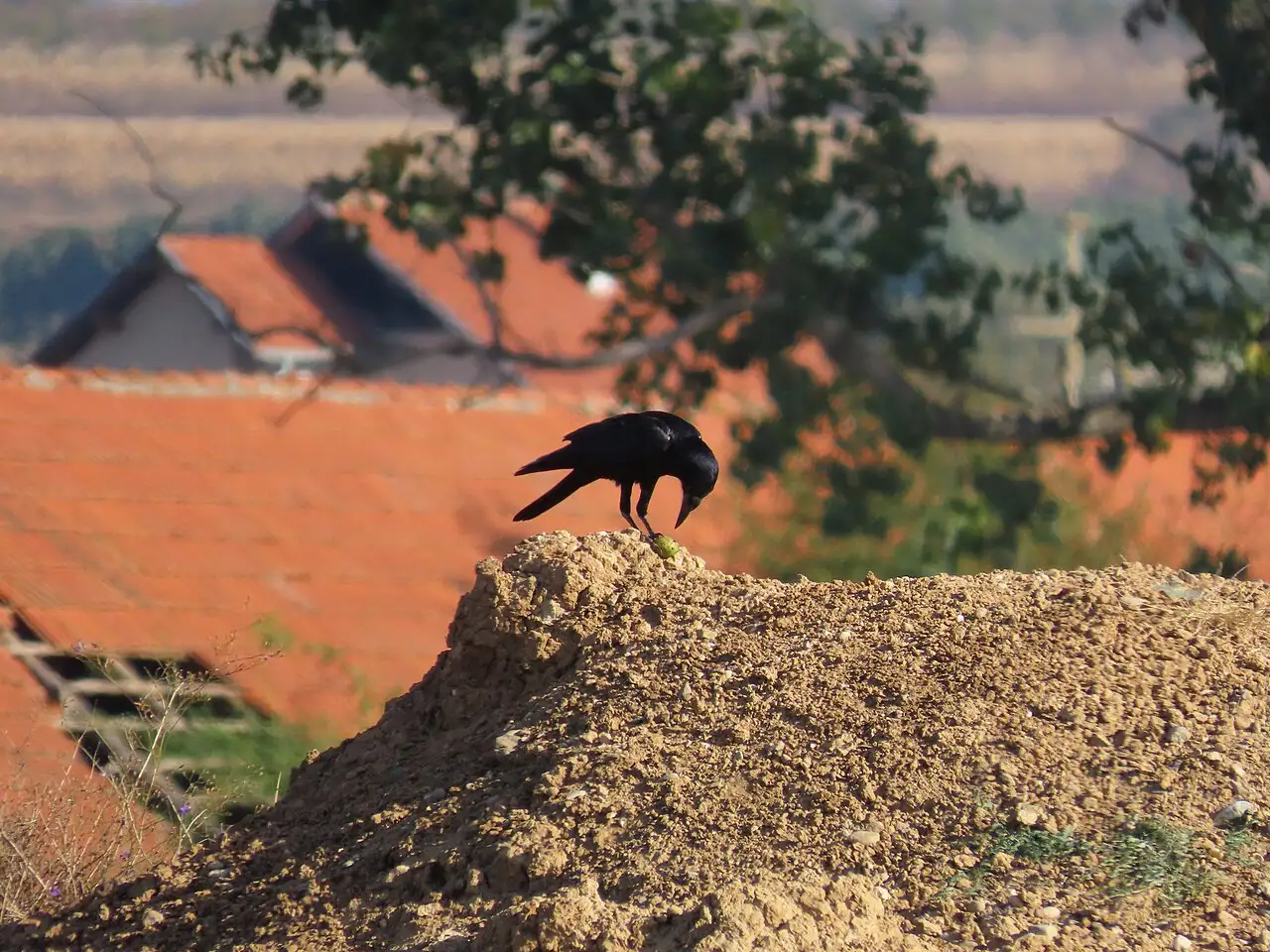
Northern Raven on a mound of earth, with a tiled roof in the backgroundPhoto: MilanIlic553, CC0Photo 4 of 4
1 / 4
Identification of the Northern Raven
The raven’s most striking feature is its colossal size, which makes it the largest member of the order of passerines. In its anatomy the bill stands out above all, notably long, robust and thick. Otherwise it wears uniformly black plumage, with some metallic sheen.
In flight, which is slow and usually alternates flaps with long glides, its long pointed wings and wedge-shaped tail can be seen.
Adult
Uniformly black plumage, with metallic sheen.
Long, robust, thick bill.
Long, pointed wings and wedge-shaped tail.
Habitat and distribution of the Northern Raven
Widely distributed throughout the northern hemisphere, it is found over much of North America, Eurasia and North Africa, and the Canarian populations are the most southerly. Several subspecies are recognised. In Spanish territory there are three: «hispanus» occupies the Peninsula and the Balearics, the endemic «canariensis» is found in the Canaries and «tingitanus», established in North Africa, lives in Ceuta.
It extends across almost the whole peninsular territory, with less presence on the southern plateau and in the Guadalquivir valley, as well as in the less rugged pockets of Almería and Murcia. In Galicia it is more common on the coasts and appears irregularly inland. The highest densities are reached in rugged, mountainous areas, as well as at certain cliff sites on the coasts. It is also present in both archipelagos and in Ceuta, and has not been found in Melilla.
Although it can be found in a great variety of habitats, its distribution is conditioned by the availability of rock faces to nest on, so it is much more common in rugged regions with cuts, cliffs and crags, whatever their altitude. Where rocky sites are scarce it can build its nest in large trees, electricity pylons and even abandoned buildings, which lets it occupy less rugged places. It seems to prefer more or less open spaces to those covered by dense woodland.
In general it is sedentary, although immatures tend to make quite considerable dispersal movements. Recent observations indicate that in winter certain areas used in the breeding season are abandoned at least partially, and the population concentrates in less territory.
Areas where it is regularly recorded since 2010Squares of about 25 km where it is recorded regularly (occasional passage records are left out). Data from GBIF.org (254,386 records, retrieved October 2026); outline from Natural Earth.
Etymology of the Northern Raven
According to Wikipedia, «Corvus» is the Latin word for «raven», and «corax» the Latinised form of the Greek «κόραξ», which also means «raven» or «crow». It is also known as «cuervo grande»; in other languages it is «corb» in Catalan, «corvo carnazal» in Galician, «erroia» in Basque and «northern raven» in English1.
Population of the Northern Raven
In the 2021 European Red List of Birds the European breeding population is estimated at between 1,170,000 and 3,570,000 mature individuals, with an increasing trend. In Spain a census of 160,000 individuals is calculated, with a distribution that tends to be homogeneous1. The trend is one of moderate decline, according to data from the SACRE programme since 1998.
The raven has always had an unjust reputation as a species harmful to game and even to domestic livestock, and it has often been accused of all kinds of mischief. For this reason, without any real basis, it has been viciously persecuted by all kinds of methods, from plundering nests to poison. Today that pressure has fallen considerably, but many birds still die from illegal poisoning, shooting or accidents on power lines, although its populations seem to hold. The situation of the Canarian subspecies is much more delicate: barely 400 pairs survive in the archipelago.
Nest of the Northern Raven
The nest, which the pair normally sets on an inaccessible ledge or crack in the rock, is a untidy platform of sticks, branches and roots, lined inside with a compact layer of soft, warm materials, such as wool, feathers and moss.
Courtship and breeding of the Northern Raven
The breeding period starts early, in February, with acrobatic flights by the pair over the territory, after which it sets up the nest. It makes a single clutch a year, of between four and six pale blue eggs, which usually takes place in March. Incubation lasts between 18 and 21 days and is carried out mainly by the female; it begins before the clutch is complete, so the chicks hatch asynchronously and a strict hierarchy is established among the siblings. Both parents feed and care for the brood, and go on feeding the chicks for several months after they leave the nest, which happens at 38–50 days.
Diet of the Northern Raven
Opportunistic, very versatile and with a certain predatory ability, given its size, it can feed on almost anything within reach of its stout bill. Depending on the place and the season, its diet includes everything from invertebrates of all kinds to placentas, by way of grain, various carrion, small mammals, chicks and eggs of other birds or fruit.
Curious facts about the Northern Raven
In every region where it appears, the raven is present in mythology, in traditions and even in religious rites. In Europe its image has been associated with bad omens and witchcraft, which, together with its reputation as a predator of species useful to people, has led to its persecution. According to Wikipedia, young ravens play: they have been seen sliding down snow and making their own toys. EURING lists a bird ringed in Norway that lived 21 years and 10 months; Wikipedia gives 23 years and 3 months as the record for a ringed wild raven and AnAge, 69 years in captivity.
The Northern Raven in Cabañeros
The habitat pages of this website name it among the birds that follow tractors over land turned by farm ploughing, together with storks and White Wagtails. GBIF.org records 282 observations of the Raven in Cabañeros and its surroundings.
Where to see the Northern Raven in Cabañeros
In Cabañeros and its surroundings, all year.
When
All year round: in Spain it is sedentary.
What time
In good light, in open, rugged terrain with rock faces, and behind tractors in ploughed fields.
Where
On crags and cliffs, in large trees, on electricity pylons and in abandoned buildings.
What to look for
Look for its great size, thick bill, black plumage, wedge-shaped tail and deep croak.
It is similar in voice and physical appearance1. The raven is the largest of the passerines and stands out for its notably long, robust and thick bill.



 Same family
 Same family
 Same family
 Same family
 Same order
 Same order
 Same order
 Same order






