Wingspan compared with a person with arms outstretched.
Length
32–35 cm
Wingspan
50–55 cm
Weight
243–460 g
Social life
Gregarious in winter and more solitary when nesting, when both members of the pair defend the territory
Lifespan
Record of 20 years and 6 months in the wild (a bird ringed in the Netherlands)
Conservation status
LC
NT
VU
EN
CR
EW
EX
Global (IUCN)
Least Concern
Spain
Least Concern (LC) as a breeder and Near Threatened (NT) as a winter or passage visitor in the Red Book of the Birds of Spain; not on the List of Wild Species under Special Protection nor in the Spanish Catalogue of Threatened Species
When to see it
Resident
Months of the year when it is present
J
F
M
A
M
J
J
A
S
O
N
D
In Iberia
yes
yes
yes
yes
yes
yes
yes
yes
yes
yes
yes
yes
Song or voice of the Common Moorhen
It is a fairly noisy species. It usually gives a penetrating, ringing «curric».
CallCommon Moorhen
0:00 / 0:24
10 kHz5
The sonogram draws the sound: time runs from left to right, and the higher a trace sits, the higher the note.Recording by AviCanto, Wikimedia Commons (Vídeo de YouTube, con atribución).
Flight of the Common Moorhen
Despite its few virtues as a flier, it has a great capacity for colonisation, which lets it settle in practically any site available. It is fundamentally sedentary in Spain.
Flight typeShort and low, with laboured flapping
It takes off from the water or from the shore among the marsh vegetation, with a penetrating, ringing «curric». It is one of the birds that flies least.
Short, low flight, with laboured flapping: it has few virtues as a flier, but a great capacity for colonisation.
It drops down among the rushes or on the shore, and shows the white patch under the tail, which it uses as an indicator of its mood.
Photo gallery of the Common Moorhen
Common Moorhen in the water, with red frontal shield and bill, and an aquatic plant in its billPhoto: Bernard DUPONT from FRANCE, CC BY-SA 2.0Photo 1 of 4
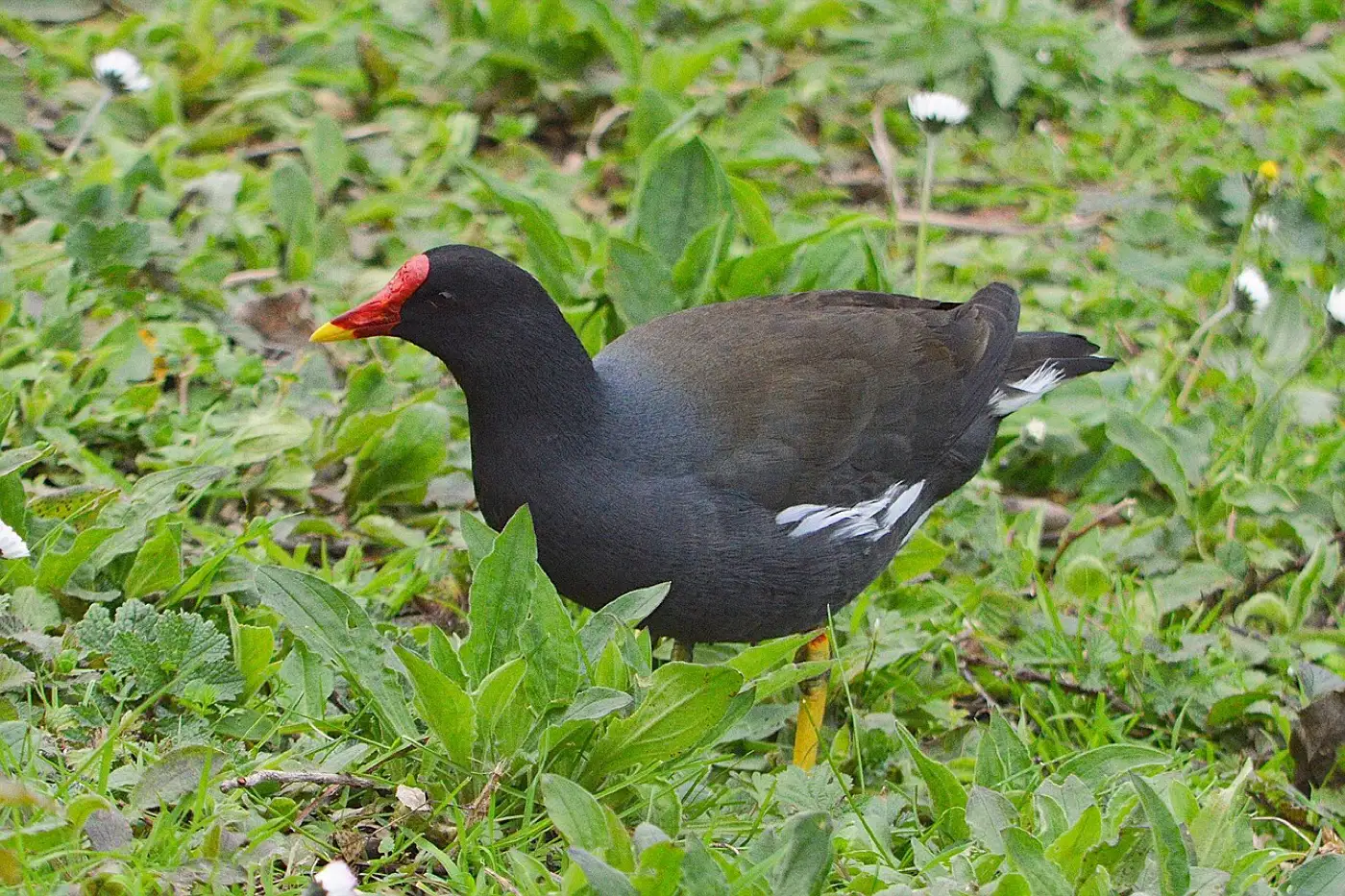
Common Moorhen walking among the grass, with red shield, yellow-tipped bill and yellow legsPhoto: Ryan Hodnett, CC BY-SA 4.0Photo 2 of 4
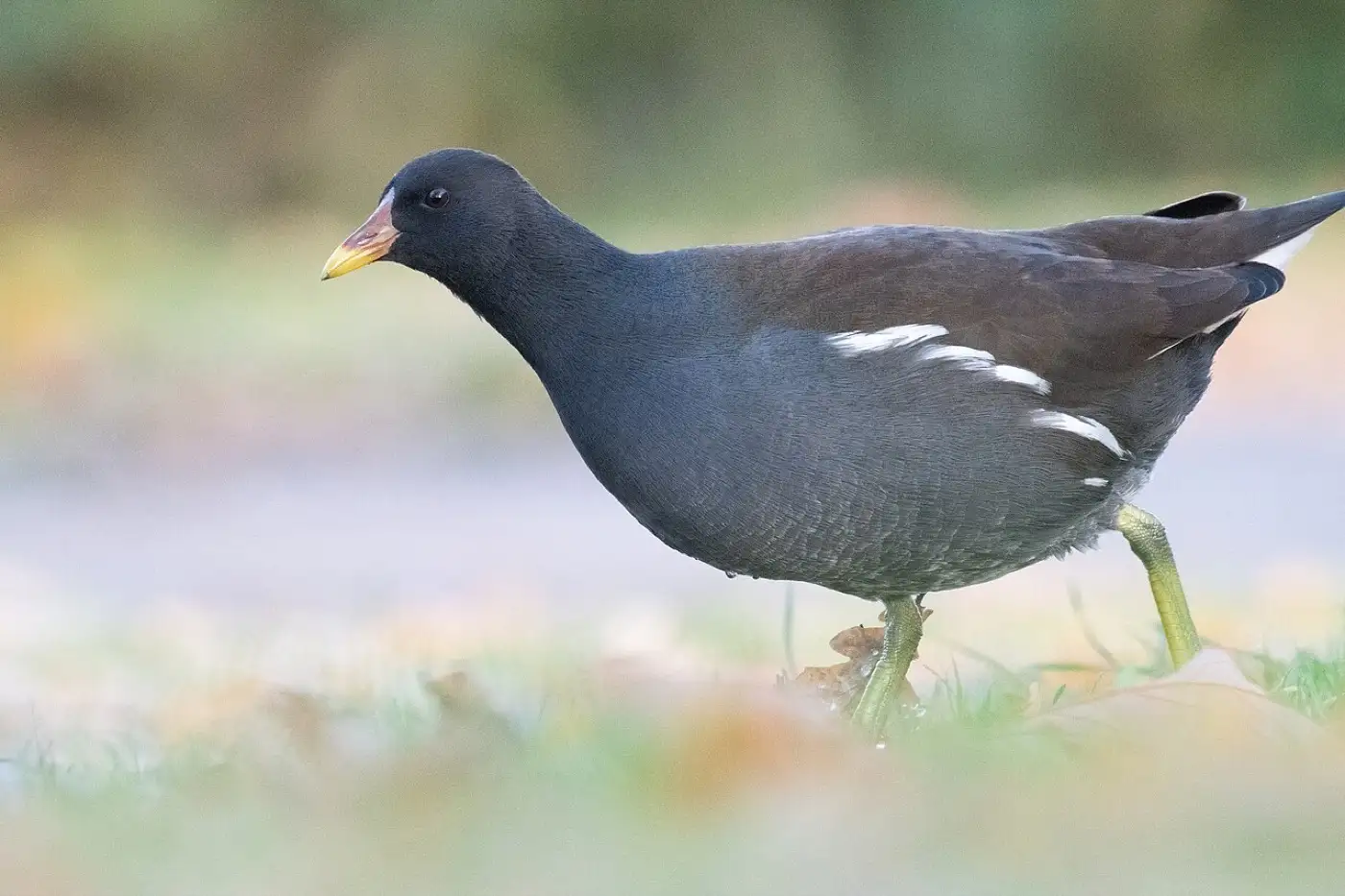
Young moorhen in profile, in dark and brown tones, with yellowish bill and greenish legsPhoto: TRinaud, CC BY 4.0Photo 4 of 4
1 / 4
Identification of the Common Moorhen
The colouring of this medium-sized rail looks, at some distance, uniformly dark, almost black. Close up, the back takes on a tone between greenish and olive, with abundant metallic sheen, and the head is an intense slate colour, which turns bluish towards the nape. The underparts are dark grey, but the flanks are practically black and are edged with long white feathers, which define a striking broken line.
The undertail coverts are also white, drawing a conspicuous patch, the «anal shield», which it uses as an indicator of its moods and as a means of communication between members of its species. The bare parts are striking and change in breeding: the iris, normally brownish, takes on an intense crimson colour; the legs take on a yellowish colouring, which turns red on the upper half of the tibia; and the frontal shield, like the bill, takes on an intense red tone, in strong contrast with the bill’s yellow tip.
Young moorhens wear a rather modest dress, in which brownish tones with greenish tints dominate; they lack the frontal shield and the other colour ornaments of mature birds.
Adult
Almost black at a distance; back greenish olive with metallic sheen and slate head.
Red shield and bill with yellow tip; yellowish legs; white patch under the tail.
Young bird
Brownish tones with greenish tints; no frontal shield.
Habitat and distribution of the Common Moorhen
It is a practically cosmopolitan species, present in all climatic regions, from temperate and warm to boreal, although it is absent from desert areas and the tundra, as well as from Australia. In the Palearctic it appears from North Africa to the Japanese archipelago, which includes the whole of Europe, where it reaches the British Isles and southern Scandinavia. Several subspecies have been described, and «chloropus» is the one that lives in the western Palearctic.
In Spain it is a very common bird across a good part of the peninsular territory and both archipelagos, although it is absent from Ceuta and Melilla and scarce in arid and mountainous regions, where it does not rise above 1,200 metres.
It is a very tolerant, accommodating species, which settles without difficulty in any wetland, regardless of its state of conservation or its extent: large marshes, lagoons, estuaries or deltas, banks of the main rivers, reservoirs, irrigation ditches and canals, urban ponds or waterlogged roadside ditches, and even polluted watercourses or dumping areas. If it has to choose, it prefers areas of calm water, with sandy or silty bottoms, surrounded by thick belts of marsh vegetation or riverside woodland.
It is fundamentally sedentary in Spain, although we regularly receive birds from northern Europe that use our wetlands as a stopover or wintering ground.
Areas where it is regularly recorded since 2010Squares of about 25 km where it is recorded regularly (occasional passage records are left out). Data from GBIF.org (365,904 records, retrieved October 2026); outline from Natural Earth.
Etymology of the Common Moorhen
«Gallinula» is a Latin word meaning «little hen». «Chloropus» combines ancient Greek «khlōrós», «green», and «poús», «foot»: the green-footed one.
Population of the Common Moorhen
In the 2021 European Red List of Birds the European breeding population is estimated at between 1,790,000 and 2,670,000 mature individuals, with a decreasing trend. The last census in Spain, from 2007, recorded 116,800 birds, although the fluctuations of the population, the difficulties of making reliable estimates and the time elapsed mean the figure must be taken at a distance. The species seems to be declining in recent decades, both in Spain and in the rest of Europe, with consistent declines in Mediterranean areas and the Eurosiberian north. Owing to its great adaptability and its extensive range, it faces few threats, although on a local scale it can have problems through the loss of wetlands or predation by introduced species.
Nest of the Common Moorhen
It is a bulky structure of aquatic plants, sticks and stems, which both members of the pair make and which is normally set among marsh vegetation, although it may also be placed in riverside shrubs or in trees, sometimes on the nests of other birds.
Courtship and breeding of the Common Moorhen
Despite their gregarious nature in winter, moorhens are rather solitary when nesting. Once the pair is formed and the breeding territory chosen, which both birds defend fiercely against their rivals, nest building begins. The females lay between 2 and 13 greyish or greenish eggs, with some spots, which both adults incubate for 21 or 22 days. The chicks hatch covered in long, filamentous down, are very precocious and soon leave the platform to wander around the surroundings, always under parental guardianship. They make short flights at around 40 days old, although they stay with their parents for some time more. It is usual for the young of the first brood to help their parents in defending the territory and rearing the chicks of later clutches.
Diet of the Common Moorhen
Its diet is omnivorous, and is made up in varying proportions of animal or plant matter depending on the place and time of year. It searches both open water, where it even dives, and muddy shores, marsh vegetation and the meadows and crops near the wetland. It takes in a large amount of plant matter (rushes, reeds, cattails, submerged plants, shoots, blackberries, rose hips and cereals); the animal matter comes mainly from the invertebrates of the water, vegetation and shores, and sometimes it catches a small vertebrate or eats rubbish and even carrion.
Curious facts about the Common Moorhen
It is the most abundant and widespread rail in Europe and, perhaps, in the whole world. It is practically impossible to find a wetland, however small or degraded it looks, where it is not present. It uses its white patch under the tail as an indicator of its mood.
The Common Moorhen in Cabañeros
This website’s page on the rivers of Cabañeros cites it, as «polla de agua», among the birds that can be found breeding on the Bullaque river, slow-flowing across the plain of the raña, together with the Black Stork, the Common Kingfisher and the Mallard.
Where to see the Common Moorhen in Cabañeros
On the slow-flowing Bullaque river, on the plain of the raña of Cabañeros.
When
All year round: it is sedentary, and in winter birds from northern Europe also arrive.
What time
Throughout the day, among the vegetation of the banks.
Where
In any wetland, above all calm waters surrounded by marsh vegetation or riverside woodland.
What to look for
A dark bird with a red shield, which swims with its head forward and shows the white patch on the tail.
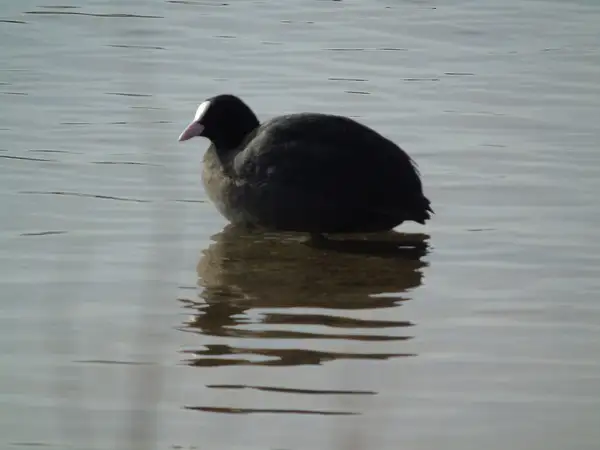
They are similar in appearance1. The coot is a robust, good-sized rail, with almost black plumage, white tips to the secondary flight feathers and a white frontal shield that narrows towards the base of the bill, also white.
Photo: Fernando Losada Rodríguez, CC BY-SA 4.0
Other birds
Birds related to the Common Moorhen or sharing its habitats in Cabañeros.





 Same family
 Same family
 Also in rivers and riverbanks
 Also in rivers and riverbanks
 Also in rivers and riverbanks
 Also in rivers and riverbanks
 Also in rivers and riverbanks
 Also in rivers and riverbanks






